Leave Your Minpaku Management to Us
100% Free Online ConsultationWhen running a minpaku (vacation rental) business, building a solid revenue and expense simulation and understanding how much profit you can expect and how long it will take to recoup your investment makes it much easier to keep risk under control and get your business on track. In this article, we’ll walk through the thinking behind such a simulation using the following conditions: a property acquisition cost of 50 million yen, startup costs of 10 million yen before opening, monthly revenue of 1 million yen, monthly profit of 600,000 yen, a 5-year operating period, and an exit via selling the property together with the minpaku business.
Rather than simply listing numbers, the goal of this article is to incorporate miscellaneous expenses and variable factors in as much detail as possible, offering a perspective on “how far should you actually estimate things.” Whether you’re taking on minpaku for the first time or you already own a property and want to rebuild your financial plan, we hope this serves as a useful reference.
1. Why a Revenue and Expense Simulation Matters
1-1. Guesswork Calculations Are Too Risky
Unlike hotels, minpaku is a business model that individuals can relatively easily run using their own property. However, if your advance planning for handling unexpected expenses and vacancy risk is inadequate, you can quickly fall into the red. Operating costs cover a wide range of areas—rent, loan repayments, cleaning fees, utilities, restocking consumables, and more—so simply assuming “I’ll be fine because I have 1 million yen in revenue” doesn’t give you an accurate picture of reality.
By carefully building out a revenue and expense simulation, you can get a concrete grasp of what occupancy rate you need to stay profitable and under which risk scenarios your cash flow might run dry. Presenting solid numbers is also essential for gaining the understanding of investors and financial institutions.
1-2. It Also Affects Investment Decisions and Exit Strategy
This is especially true when you purchase the property yourself and run the minpaku business, since it requires a substantial upfront investment. In our example here, 50 million yen goes toward acquiring the property, plus an additional 10 million yen for renovations, furniture and appliances, and other expenses—bringing the total investment to a sizable 60 million yen. If you plan to operate for 5 years and eventually sell (the property plus the minpaku business), you need to use a simulation to project the “value 5 years from now” and determine whether it will truly result in a profit.
2. Case Setup: A 50 Million Yen Property with 10 Million Yen in Startup Costs
2-1. Basic Conditions
Here is the case with the following conditions:
- Property acquisition cost: 50 million yen
- Startup costs before opening: 10 million yen (renovations, furniture/appliances, licensing and application fees, etc.)
- Monthly revenue: 1 million yen (estimated based on combined occupancy rate and nightly rate)
- Monthly profit: 600,000 yen (revenue above minus operating costs)
- Operating period: 5 years
- Exit: Sell the property and minpaku business together after 5 years
These figures are merely a model case, but they provide a sufficient benchmark for learning how to think through a revenue and expense simulation. In actual operations, the numbers will vary depending on the property’s location, size, competitive landscape, seasonal fluctuations, and other factors.
2-2. Total Investment and Projected Cash Flow
The initial investment required is 50 million yen for the property plus 10 million yen in startup costs, totaling 60 million yen. Whether this is covered by a loan or personal funds will change your monthly repayment amount and interest burden. For simplicity here, we’ll fold the repayment amount into the operating costs discussed later.
3. Steps to Building the Simulation
3-1. Revenue Plan
We initially set monthly revenue at 1 million yen, but let’s break this down in a bit more detail. If we assume a nightly rate of 20,000 yen (per room) and an occupancy rate of roughly 50%, then:
- Daily room revenue: 20,000 yen × 0.5 (occupancy rate) = 10,000 yen
- Over one month (30 days): 10,000 yen × 30 = 300,000 yen
In some cases, that falls well short of what’s needed. In practice, many operators run multiple rooms within one property or aim for higher rates with larger properties, pushing daily revenue up to 30,000–40,000 yen. For properties suited to larger groups, they might charge 50,000 yen per day, or 80,000 yen on weekends, applying dynamic pricing that varies by season and day of the week.
For our purposes here, we’ll roughly estimate a monthly average revenue of 1 million yen and proceed with the simulation on that basis.
3-2. Identifying Cost Components
Minpaku operating costs can broadly be divided into fixed costs and variable costs.
- Fixed costs: loan repayments, property upkeep (taxes, insurance), internet fees, basic utility charges, etc.
- Variable costs: cleaning fees, consumables (amenities, toilet paper, etc.), utility usage charges, linen laundering fees, etc.
In addition, OTA listing commissions (fees from platforms like Airbnb and Booking.com) are charged as a **percentage of revenue**, so they’re treated much like a variable cost.
Leave Your Minpaku Management to Us
100% Free Online Consultation4. Breaking Down the 600,000 Yen Monthly Profit
4-1. Deductions from 1 Million Yen in Revenue
Here we’re assuming a monthly revenue of 1 million yen, resulting in a final profit of 600,000 yen. That leaves a difference of 400,000 yen, representing monthly operating costs. A concrete example might break down as follows (these are hypothetical figures):
- Cleaning fees: 150,000 yen
- Linen and amenities: 50,000 yen
- Utilities: 80,000 yen
- Communications (Wi-Fi, etc.): 10,000 yen
- OTA commissions: 100,000 yen (calculated as 10% of revenue)
- Miscellaneous expenses/repair reserve: 10,000 yen
This adds up to roughly 400,000 yen in total. Of course, the actual figures will vary considerably depending on the property’s size, location, and number of booked nights, but this gives you a reasonable balance to work with when aiming for a monthly net profit of 600,000 yen.
4-2. Actual Take-Home After Loan Repayments and Taxes
If you’re financing the 50-million-yen property purchase through a loan, the monthly repayment amount needs to be added here. For example, with a 35-year loan at roughly 1.5% interest, monthly repayments might come to around 150,000–200,000 yen. In that case, your actual take-home would be roughly 400,000–450,000 yen.
Additionally, minpaku income is subject to income tax and residence tax, and depending on your business structure, you may also owe corporate tax or consumption tax. To accurately understand your true take-home amount, it’s best to work through the details with a tax accountant or other specialist.
5. Exit Strategy After 5 Years: Selling the Property and Minpaku Business
5-1. Cash Flow After 5 Years of Operation
Roughly speaking, monthly profit of 600,000 yen × 12 months = 7.2 million yen per year in net profit, meaning over 5 years you can expect a total profit of 7.2 million yen × 5 = 36 million yen (setting taxes and other factors aside for simplicity). Meanwhile, the initial investment was 60 million yen (50 million yen for the property plus 10 million yen for renovations, etc.), so fully recouping that within 5 years might feel like a tall order.
However, this is where the **exit (selling the property and business)** plays a major role. If you sell the property itself after 5 years while also bundling in the minpaku business—selling your operating track record and brand along with it—you may be able to accelerate your investment recovery.
5-2. How Much Can You Get by Selling the Property Plus the Business?
The sale price is often determined by combining the property’s market value with an assessment of the minpaku operating track record (booking rate, review scores, annual revenue, etc.). For example, even if there’s still around 40 million yen remaining on the loan, if the property is generating stable annual profits in the millions of yen, an investor or operating company might well decide “I want that business.”
Suppose the property’s own valuation drops to 45 million yen. If it can still be sold as a minpaku property generating 7.2 million yen in annual revenue, you might be able to add an additional premium of 5–10 million yen (business value) on top. This could mean selling for around 50 million yen after 5 years of operation—which, combined with the 36 million yen in operating profit over those 5 years plus the sale proceeds, could leave you with a solid net gain relative to your initial 60-million-yen investment.
6. How to Simulate Down to the Finer Expenses and Variables
6-1. Managing by Line Item with Excel or a Spreadsheet
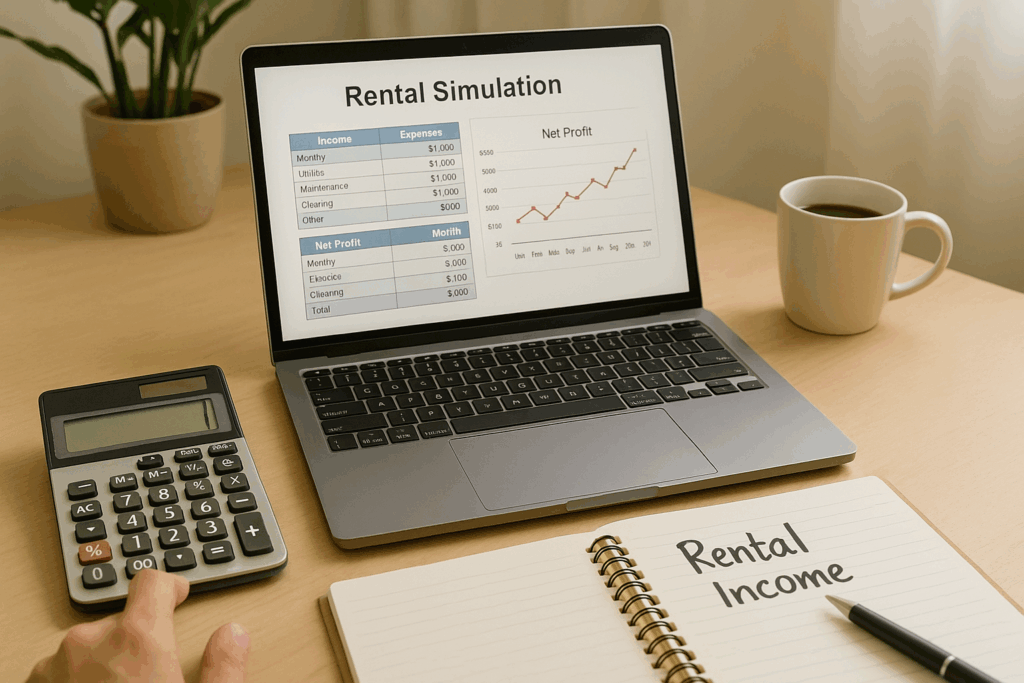
If you’re actually building a simulation, it’s a good idea to use Excel or Google Sheets to lay out an annual plan month by month. For instance, put “Month (Jan–Dec)” in the rows, and line up columns for items such as “revenue, occupancy rate, average rate per guest, OTA commissions, cleaning fees, linen costs, utilities, loan repayment, repair costs, and profit.”
- Revenue column: average monthly bookings × average rate per guest
- Variable cost column: set up formulas such as the OTA commission rate to calculate automatically
- Fixed cost column: enter rent or loan repayments
- Final profit column: (revenue) − (variable costs) − (fixed costs)
Using a table like this lets you instantly check the results while adjusting scenarios, such as what happens if occupancy drops 10% or if the average rate rises by 1,000 yen.
6-2. Seasonality and Competitor Pricing Trends
Minpaku often sees a large gap between peak and off-peak seasons, so rather than relying only on an average figure, it’s more accurate to simulate projected revenue by season. For example, you might set higher nightly rates during summer break and the New Year holidays, while factoring in discount campaigns and a somewhat lower occupancy rate during slow periods—incorporating realistic fluctuations into your model.
It’s also worth referencing the rates and occupancy of nearby competing properties, and thinking through how to leverage your own points of differentiation, which will help you produce estimates that more closely reflect reality.
7. Conclusion: Boost Your Minpaku Success Rate with a Detailed Revenue and Expense Simulation
While minpaku may seem easy to start on the surface, it’s a business that requires a substantial investment in property acquisition and renovation, with profits that can shift easily due to unexpected expenses or fluctuations in occupancy. That’s exactly why it’s essential to build out your revenue and expense simulation down to the finest details, clearly mapping out how you’ll secure profit and when you can expect to recoup your investment.
As introduced in this article, the scenario of investing 60 million yen total (50 million yen for property acquisition plus 10 million yen in startup costs), sustaining monthly revenue of 1 million yen and profit of 600,000 yen over 5 years, and finally selling the property together with the minpaku business, is just one example. Using this as a reference, by mapping out detailed expense line items and variables on a spreadsheet tailored to your own property and area, and comparing multiple scenarios, you can aim for a high success rate while minimizing risk.
At the same time, operational aspects of minpaku management—such as “how do you attract guests” and “how do you improve your review scores”—are extremely important as well. Even with a great property and facilities, getting your pricing or communication wrong can lead to sluggish occupancy. Thinking through both the numbers and operational know-how together, and then realizing the profits you projected in your simulation, is the path to becoming a successful minpaku owner.
For Minpaku Revenue and Expense Simulations, Trust Stay Buddy!
If you’d like to build a more detailed revenue and expense simulation for your minpaku business, or if you’re looking to revisit the numbers on an existing property, please feel free to reach out to Stay Buddy Co., Ltd.
Drawing on extensive experience, we provide total support—from assessing property requirements and researching local demand, to planning renovations and equipment, pricing strategy, and boosting visibility on booking platforms. If you’d like to learn how to build a revenue and expense simulation while aiming to run a minpaku business with minimal risk, please don’t hesitate to contact Stay Buddy Co., Ltd. We’ll be happy to offer data-backed planning and effective operational know-how, without holding anything back.