Leave Your Vacation Rental Management to Us
100% Free Online Consultation
Focusing on a single platform has its perks—stronger algorithmic visibility and easier repeat bookings, to name a couple. But there’s a real risk lurking here: if you get hit with a bad review or your account suddenly gets suspended due to some platform issue, your revenue could drop to zero overnight.
That’s why this article focuses on the theme “For vacation rental OTAs, running both Airbnb and Booking.com is the better approach.” We’ll break down the pros and cons of each platform, along with the stability benefits and potential pitfalls of running a dual-platform strategy. If you’re on the fence about your OTA strategy, this one’s for you.
1. What Sets Airbnb and Booking.com Apart
1-1. Airbnb: Closer Connection Between Hosts and Guests
Airbnb is globally recognized as the platform that puts host-guest communication front and center—it’s essentially the brand that put vacation rentals on the map. Since the “individual renting out their space” model was foundational to Airbnb’s growth, guest interactions tend to be more personal, creating a distinct sense of community.
Airbnb also attracts guests who prioritize **”experience,”** so properties with unique interiors or a strong sense of local culture tend to do well. That said, check-in procedures and review culture can get a bit detailed, meaning how responsive both guests and hosts are plays a big role in shaping overall ratings.
1-2. Booking.com: Hotel-Style Systems and a Western User Base
Booking.com built its reputation as a hotel booking platform primarily across Europe, so it comes with a hotel-grade reservation system as its hallmark feature. Since expanding into vacation rentals, it’s added functionality to make things easier for property owners, but at its core, most guests still approach it with a hotel mindset when searching for a place to stay.
Compared to Airbnb, Booking.com also tends to attract more business travelers and casual tourists, and since payment processing and cancellation policies are more standardized, owners often find it easier to manage. On the flip side, the fee structure and support system are optimized more for hotels, so some owners might find it lacks the flexibility that’s unique to vacation rentals.
2. The Upside and Downside of Sticking with Just One Platform
2-1. The Upside: Concentrated Ratings and Repeat Guests
If you list your property exclusively on either Airbnb or Booking.com, guest reviews naturally consolidate on one platform, letting you build up your rating and ranking more efficiently. In some cases, this can work in your favor with the platform’s ranking algorithm, boosting your visibility in search results.
Repeat guests and favorites also tend to concentrate in one place, which simplifies your day-to-day management. Running everything—cleaning schedules, pricing—through a single system can significantly cut down on operational hassle.
2-2. The Downside: A Bad Review or Suspension Hits Hard
The flip side is that a single bad review or unexpected trouble can hit disproportionately hard. One poor review can drag down your average rating, tank your search ranking, and cause bookings to plummet almost overnight. Worse yet, a string of cancellations or complaints could even lead to an account suspension.
If something like this happens, you could lose your only revenue channel entirely, sending your income to zero in an instant. No matter how carefully you manage your property, unexpected issues—guest mismatches, unforeseen incidents—can strike any owner, which is exactly why spreading out your risk matters.
3. The Stability You Gain from Running Airbnb and Booking.com Together
3-1. Diversifying Booking Channels as a Risk-Hedge
The single biggest factor in stabilizing your vacation rental business is diversifying your revenue channels. If you’re heavily reliant on Airbnb alone, the kind of suspension or algorithm shift mentioned earlier could tank your income instantly. But if you’re also listed on Booking.com at the same time, a temporary slump on one platform can often be offset by activity on the other.
This dual-platform approach proves especially valuable during disasters or demand fluctuations, since it lets you reach different customer segments. Even if inbound tourists on Airbnb dry up, you might still capture domestic business travelers through Booking.com—creating a nice synergy effect.
3-2. Boosting Bookings and Occupancy Rates
Simply put, listing on more platforms means more exposure, which naturally translates into more bookings. Even though there’s some overlap between the two platforms’ audiences, each has a somewhat distinct user base, opening the door to guest segments you might not otherwise reach.
Additionally, if a date sits vacant on one platform but gets booked through the other, your overall occupancy rate rises and revenue becomes more stable. Managed well, this approach can even minimize the risk of vacancies during peak season.
Leave Your Vacation Rental Management to Us
100% Free Online Consultation4. Things to Watch Out for When Running Both Platforms: Calendar Sync, Pricing, and More
4-1. Inventory Management and Calendar Integration
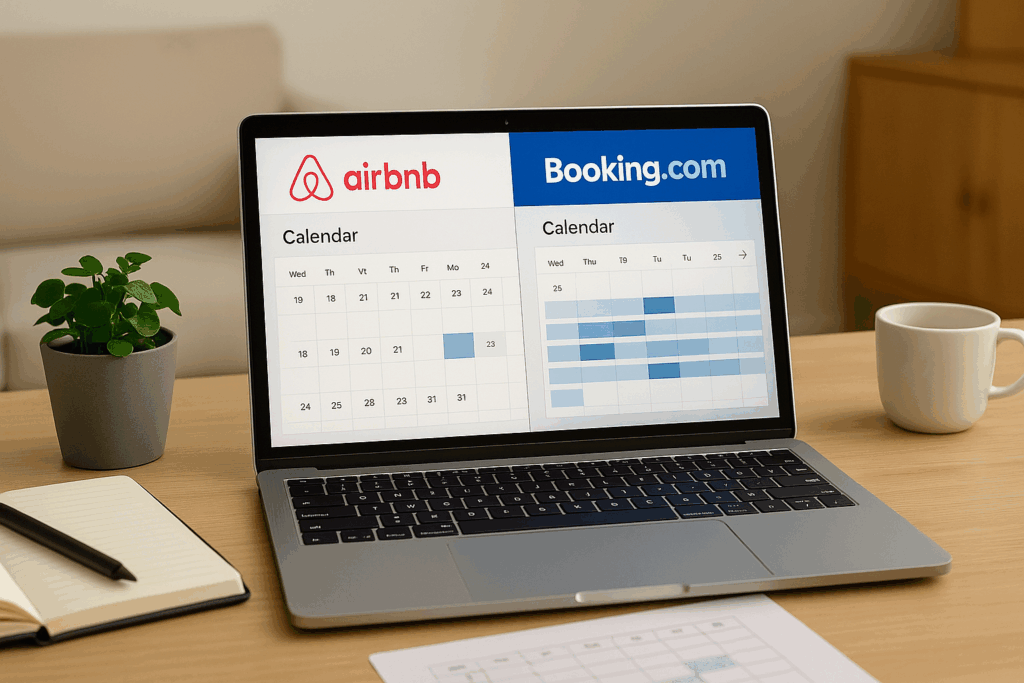
If you’re running both Airbnb and Booking.com, you’ll need to stay on top of double-booking risks. Having both sites book the same date—resulting in two sets of guests showing up for one room—is a scenario you absolutely want to avoid.
Fortunately, calendar sync features exist to help with this. By using iCal integration or a Channel Manager, you can set up a system where your inventory automatically updates across platforms. It may take some effort to configure initially, but once it’s running, double bookings are largely a non-issue, making dual-platform management much smoother.
4-2. Platform Fees and Price Adjustments
Airbnb and Booking.com differ somewhat in their fee structures and payment timing. Booking.com, for instance, offers multiple options—hosts can either process guests’ credit card payments directly themselves, or let Booking.com handle payment collection on their behalf.
Since fee rates vary slightly between the two, it’s worth deciding whether to keep your pricing consistent across platforms or introduce a slight difference. Guests often compare the same property across multiple sites, so while you’ll want a degree of pricing consistency, you also need to factor in each platform’s fees to strike the right balance that protects your margins.
5. Success Stories and Cautionary Tales
Success Story: Achieving Stable Occupancy Through a Dual-Platform Approach
One urban vacation rental owner ran their property exclusively on Airbnb for about six months, but a string of negative reviews eventually dragged down their search ranking, causing inquiries to plummet. After adding a Booking.com listing, the property started picking up bookings from Western business travelers and domestic tourists through the new channel—and overall revenue actually went up as a result.
Once the owner addressed the issues that had hurt their Airbnb ratings and started earning positive reviews again, bookings began flowing steadily from both platforms, ultimately achieving stable business operations.
Cautionary Tale: Neglecting Inventory Sync Leads to Repeated Double Bookings
On the other hand, one owner listed on both platforms but failed to properly manage calendar synchronization, resulting in repeated double bookings. Complaints and negative reviews poured in from guests, and the owner eventually had their Booking.com listing suspended altogether.
This serves as a clear lesson: proper inventory management and calendar syncing are absolutely essential to reap the benefits of a dual-platform strategy. Cut corners here, and you’re setting yourself up for serious trouble.
6. Conclusion: Why Running Both Airbnb and Booking.com Is the “Better” Approach
When it comes to vacation rental management, focusing on a single platform does have its advantages—namely, consolidated ratings and repeat guests. But the truth is, a pandemic, natural disaster, unexpected trouble, or even a policy change on the platform’s end could wipe out your revenue in an instant.
Given that Airbnb fosters a sense of community built around host-guest communication, while Booking.com tends to attract users looking for a hotel-like booking experience, running both simultaneously makes a lot of sense. By reaching different customer segments and spreading your booking channels across platforms, you gain both risk diversification and higher occupancy rates.
Of course, this approach does add some operational complexity—preventing double bookings, keeping pricing consistent, and so on. But once you clear those hurdles with a modest investment in systems and clear operating procedures, the payoff can be substantial. If you’re aiming for stable, resilient management that isn’t overly exposed to industry shifts or external factors, running both Airbnb and Booking.com is genuinely the “better” choice. With more consistent revenue and a broader reach, the same property can perform dramatically differently depending on your approach.
Have Questions About OTA Strategy for Your Vacation Rental? Talk to Stay Buddy
If you’re thinking, “I’d like to try running both Airbnb and Booking.com, but I’m worried about inventory management, pricing adjustments, and double bookings…”—reach out to Stay Buddy Inc. today.
Drawing on our track record of helping numerous properties succeed as vacation rental management experts, we provide comprehensive support—from the optimal way to set up both platforms, to calendar syncing, pricing strategy, and review management. If you’re looking to move beyond single-platform dependency and diversify your risk while expanding bookings, take on the dual-platform approach with Stay Buddy Inc. and build the stable business you’re aiming for.