Leave Your Minpaku Management to Us
Free Online Consultation1. Safety Considerations Are Essential
Fall Risk from the Top Bunk and How to Prevent It
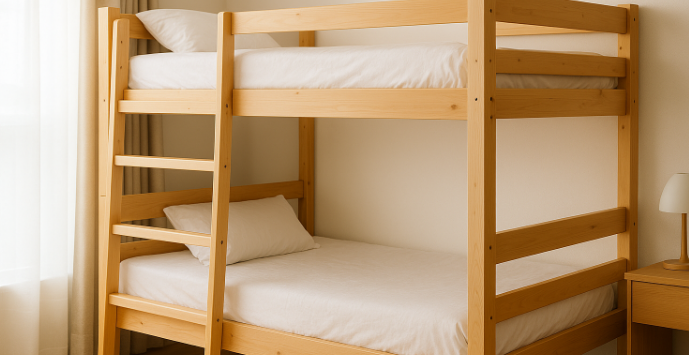
The biggest advantage of installing bunk beds is that they let you increase the number of beds while saving floor space—but the flip side is that the risk of “falling” is the number one thing you need to watch out for.
If a guest sleeping on the top bunk rolls over in the middle of the night and falls, or slips while climbing up or down the ladder, it can lead to serious injuries such as bruises or fractures. Bunk beds aren’t unusual in accommodations overseas either, but extra caution is needed when larger guests use them, or when children unfamiliar with bunk beds climb up and down excitedly.
For these reasons, the following measures are recommended.
- Install a Sturdy Guardrail
Add guardrails of sufficient height on both sides of the top bunk so that simply rolling over won’t cause a fall. If the guardrail is too low, even adults can easily climb over it, so a height of around 30 cm as a benchmark is reassuring. - Ladder Stability
Check that the ladder is firmly secured so it doesn’t wobble. If you’re using a removable ladder, it’s a good idea to add a notice so guests don’t accidentally remove it, or design it so the ladder hooks onto the guardrail to minimize movement. - Check Weight Capacity and Design
Choose a bed frame with a clearly stated weight capacity for the top bunk, and select a model sturdy enough to accommodate guests of various body sizes. International guests, in particular, are often larger than the average Japanese person, so a frame lacking stability may cause the top bunk to sag.
Setting Usage Rules for Children
For minpaku properties that host many guests with children, it’s worth considering rules around age restrictions and parental supervision. For example, establishing guidelines such as “children under 6 should not use the top bunk” or “children should not climb up without a parent’s permission,” and posting them in the in-house guide or on the booking page, can significantly reduce risk.
Additionally, including a message in the room manual encouraging children not to jump on the bed can also help lower the risk of damage to the floor or the bed itself.
2. Layout Ideas for Guest Comfort
Saving Floor Space While Ensuring Flow
The advantage of introducing bunk beds is that they let you make use of vertical space rather than placing two beds side by side. This makes it possible to accommodate 4 or 6 guests even in a small room, while also creating more room in the living area or kitchen—giving you the benefit of both increased capacity and a sense of spaciousness.
That said, cramming two or three bunk beds into a single room can narrow the walkways too much, leading to complaints about lack of space for luggage or privacy concerns. Be sure to secure a minimum amount of walking space, factoring in the ladder’s position and distance from the wall, so guests can move around comfortably without stress.
Headroom and Sense of Confinement on the Top Bunk
Guests sleeping on the top bunk may feel a sense of confinement if the ceiling is too close. Bumping their head, or touching the ceiling when rolling over, can hurt the guest experience and lead to poor reviews.
- Ideally, there should be enough clearance between the top bunk and the ceiling for a person to sit up comfortably
- If the room lighting shines directly onto the top bunk, it can be too bright—so it’s best to add a cover, or provide a reading light within the bunk so guests can turn off the main light
To ensure guest comfort, it’s not just about saving space—paying attention to making the top bunk feel appropriately spacious tends to leave a good impression.
3. Operational Costs and Cleaning Considerations
Factoring in the Extra Cleaning Workload
Installing bunk beds makes changing sheets on the top bunk and cleaning the mattress physically more difficult. Because cleaning staff must climb the ladder to work, it takes more time and effort than a regular bed, and there’s also a safety risk involved.
For this reason, it’s a good idea to create a cleaning manual outlining a smooth procedure for changing sheets and safe ladder use, and to share it with staff. Since this adds time and effort, you’ll want to calculate in advance whether the increased cleaning costs still make sense financially.
Choosing Functional Linens and Waterproof Sheets
The top bunk mattress is in a position where night sweats or spilled drinks can easily soak in. To prevent any mess from dripping down and staining the lower bunk as well, it’s wise to use a waterproof sheet, along with easy-to-wash linens and a mattress cover.
This will speed up cleaning and linen changes after guests check out, and should reduce the risk of stubborn stains or odors being left behind.
4. Advance Guidance and Manuals for Guests
Guidance to Help Guests Choose Their Bed
At a minpaku property equipped with bunk beds, international or elderly guests might feel hesitant about climbing up to sleep on the top bunk. Providing guidance with photos at the time of booking or check-in—showing which bed is the top bunk and which is the bottom—makes things much clearer. For families, you could also suggest that “the bottom bunk is recommended for children.”
Safety Guides and Warning Notices
Just as with other issues like tripped breakers, providing a simple guide covering how to safely climb up and down the ladder and how to avoid falling from the top bunk will help guests feel more at ease. For instance, posting signs in both English and Japanese that say “Watch your head,” “Watch your step,” or “Do not lean against the guardrail” can help prevent serious accidents before they happen.
5. Comparing to Standard Rental: Revenue Potential of Bunk Beds
Bunk Beds May Be Less Effective in a Standard Rental
If you were simply renting out a room as a standard residential rental, installing bunk beds wouldn’t significantly raise the rent—and might even be seen as “unconventional” or “for kids,” making tenants shy away. From a rental property management perspective, this may not offer much of an advantage.
With minpaku, on the other hand, you can **”increase capacity within the same floor space,”** which opens up the potential to charge more per stay. If you’re targeting younger travelers or families, a clever use of bunk beds can also be a strong selling point.
A Real-World Revenue Model
For example, by replacing what would normally be space for two single beds with two bunk beds to create a capacity of four, you can often raise the per-night rate. However, keep in mind that as guest numbers increase, so do utility and cleaning costs—so be sure to compare the “additional revenue from increased capacity” against the “increase in operating costs” to confirm the numbers work in your favor.
6. Conclusion: Bunk Beds Can Boost Guest Satisfaction and Capacity—But Safety Management Is Key
For minpaku properties looking to actively welcome young travelers, groups, and families, introducing bunk beds can make a major contribution to increasing capacity and creating an appealing space.
Since bunk beds save floor space compared to standard beds while allowing you to host more guests, they open up opportunities to boost occupancy rates and revenue. What’s more, for children and young guests, bunk beds are often received well as an adventurous experience, and may even end up being shared on social media as “a fun, one-of-a-kind stay.”
That said, careful attention must be paid to the risk of falls from the top bunk and to ladder safety. Without measures such as installing sturdy guardrails, securing the ladder, and setting rules for children’s use, the risk of accidents or complaints increases significantly. There are also drawbacks on the cleaning side—such as the extra effort involved in changing sheets on the top bunk or moving luggage up and down—so keep in mind that operating costs may rise as a result.
Even accounting for these challenges, the benefits of introducing bunk beds remain significant. They enhance the appeal of a room and serve as a draw for younger travelers and families, and once repeat bookings and word-of-mouth take effect, they can directly translate into higher occupancy rates. Why not take this opportunity to review the key considerations for installing bunk beds in your minpaku property, and aim for an operation that boosts both guest satisfaction and capacity at the same time?
For Minpaku Operations Using Bunk Beds, Contact Stay Buddy Inc.!
If you’re considering improving your minpaku operation—including the introduction of bunk beds—or need advice on selecting a property, please feel free to reach out to Stay Buddy Inc.
We offer wide-ranging support, from advice on compliance with building and fire codes, to room layout proposals, to optimizing cleaning operations and guest communication. Whether or not bunk beds are truly the right choice, and if so, which model would work best—we’ll work with you to find the ideal balance of capacity and comfort, and help you build a truly appealing minpaku property.