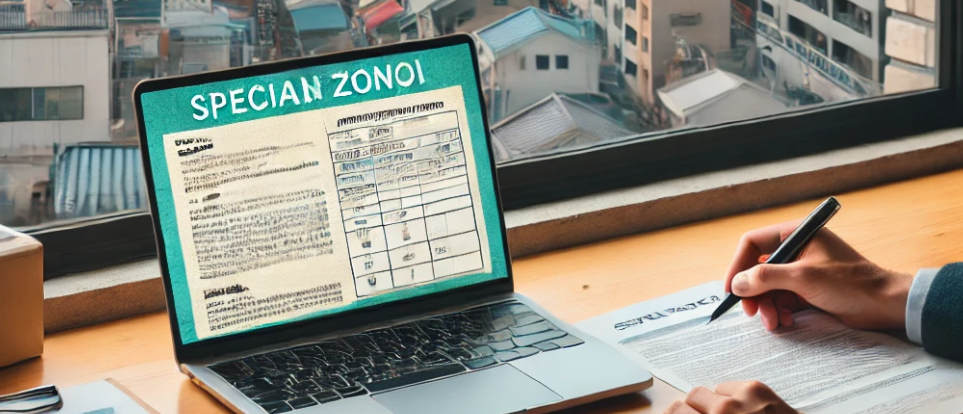
Osaka Prefecture and Osaka City fall under an area where the “Special Zone Minpaku” system can be used, allowing residential properties to be legally operated as lodging facilities once certain conditions are met. Special Zone Minpaku is a system approved as part of Japan’s National Strategic Special Zones initiative, offering benefits distinct from the standard Hotel Business Act or the Minpaku New Law (Private Lodging Business Act).
That said, obtaining approval (formally known as a “specific certification”) comes with several hurdles to clear. This article explains, based on the latest legal information, the requirements and application process for starting a Special Zone Minpaku business in Osaka in an easy-to-understand way. By reading through this article, you’ll gain a full understanding—from the basics of Special Zone Minpaku to the concrete application steps, required documents, and important points to keep in mind.
What Is Special Zone Minpaku? How It Differs from the Hotel Business Act and the Minpaku New Law
Let’s start with the basics of Special Zone Minpaku. Its formal name is the “National Strategic Special Zone Business for Accommodating Foreign Visitors,” and it refers to a minpaku (private lodging) business that can be operated with certain relaxed regulations under the Hotel Business Act, within areas designated as National Strategic Special Zones. This system is only permitted in a limited number of areas, including Osaka Prefecture (including Osaka City) and Ota Ward in Tokyo.
The most distinctive feature of Special Zone Minpaku is its “minimum stay requirement.” Here’s how it compares to other types of minpaku:
- Hotel Business Act (Simple Lodging)
No limit on the number of operating days, and no minimum stay requirement. However, obtaining a license may require a change of building use under the Building Standards Act and compliance with strict facility standards.
- Housing Accommodation Business Act (Minpaku New Law)
Operation is limited to a maximum of 180 days per year, but stays can be as short as one night. Facility requirements are more relaxed than under the Hotel Business Act, and since it operates on a notification system, procedures are simpler. However, if there is no resident host on-site, delegating management to a licensed management company is mandatory.
- National Strategic Special Zone Minpaku (Special Zone Minpaku)
Properties can only be rented out for stays of two nights, three days or longer (single-night stays are not permitted). However, there is no limit on annual operating days—the property can be operated all 365 days of the year. Since this isn’t a license under the Hotel Business Act, a change of building use isn’t required, making it a relatively accessible system to enter. The minimum stay requirement used to be as strict as six nights, seven days, but has since been relaxed to two nights, three days.
In short, the strength of Special Zone Minpaku is that “it can’t accommodate short-term (one-night) stay needs, but it can operate year-round.” In Osaka, where inbound tourism is thriving, this system allows owners to efficiently operate vacant houses or apartment units as minpaku properties.
Areas in Osaka Where Special Zone Minpaku Is Permitted
Special Zone Minpaku isn’t available everywhere. The designated areas cover all of Osaka City and parts of Osaka Prefecture. Specifically, certification applications can be made in Osaka City, as well as in Yao City and Neyagawa City (each of these three cities serves as its own point of contact), and in areas under the jurisdiction of Osaka Prefecture (all other municipalities, with some exceptions noted below).
Note that there are certain cities within Osaka Prefecture where Special Zone Minpaku is not permitted. For example, Sakai City, Higashiosaka City, Takatsuki City, Toyonaka City, Hirakata City, Suita City, and Katano City are excluded by local ordinance, meaning Special Zone Minpaku certification cannot be obtained in these areas. If you wish to operate minpaku in one of these locations, you’ll need to consider a license under the Hotel Business Act (such as simple lodging) or a notification under the Minpaku New Law.
There are also conditions related to the zoning of the land where the property is located. In Osaka City, the property generally must be situated in a zoning district where the construction of hotels or ryokan is permitted (such as commercial districts, quasi-industrial districts, or quasi-residential districts). In areas zoned purely as Type 1 or Type 2 low-rise exclusive residential districts, certification is unlikely to be granted, so be sure to check the zoning classification in advance.
Summary of the Key Requirements for Special Zone Minpaku
Next, let’s go over the requirements (hurdles) you’ll need to clear in order to obtain Special Zone Minpaku certification. The key points are organized below.
- Minimum length of stay
Stays must be at least two nights, three days. Single-night stays are not permitted. - Room size
The floor area of the room provided to guests must be at least 25㎡. This excludes balconies and verandas, so the roughly 20㎡ common in studio apartments may not meet this requirement. - Basic facilities
The room must be equipped with a kitchen, bathroom (a shower is acceptable), toilet, and washbasin facilities. Bedding, cooking utensils, and cleaning supplies must also be provided. - Fire safety equipment
You must install residential fire alarms, fire extinguishers, and flame-retardant items, and undergo an inspection by the fire department to obtain a “Certificate of Compliance with Fire Service Laws and Regulations.” Depending on the structure and scale of the property, additional equipment such as evacuation devices or guide lights may also be required. - Foreign language support
Since Special Zone Minpaku is designed to accommodate foreign tourists, signage and information provided in two or more languages, including Japanese and English, is recommended. It’s advisable to prepare house rules, check-in instructions, and emergency contact information in multiple languages so guests won’t run into trouble. - Complaint response system
You must maintain a 24-hour contact point and be prepared to respond immediately to complaints from nearby residents. Designate a complaint response manager in advance and make sure this contact point is known to the surrounding community. - Proper waste disposal
Waste generated by minpaku operations is treated as commercial waste and cannot be disposed of using the same methods as household waste. You’ll need to contract with a licensed waste collection company and have the waste collected through the proper procedures.
These are the main requirements. It may seem like a lot to handle, but if you work through them step by step, you can make steady progress. Next, let’s look at the actual application process, step by step.
The Special Zone Minpaku Application Process
Here, we’ll explain the concrete steps for obtaining certification. The general flow is: “1. Preliminary consultation → 2. Resident briefing session → 3. Document preparation and submission → 4. On-site inspection → 5. Issuance of certification.”
1. Check Your Plan Through a Preliminary Consultation
Before starting a Special Zone Minpaku business, it’s important to consult with the relevant government department before acquiring or renovating a property. For properties within Osaka City, the point of contact is the Osaka City Health Center (Environmental Sanitation Inspection Division); for other areas within the prefecture, it’s the Osaka Prefecture Public Health Division or the relevant city’s health center. It’s also a good idea to consult with the fire department in parallel to confirm the required fire safety equipment standards.
Bring the property’s drawings and materials (floor plans, site plans, property overview, etc.) to the preliminary consultation, so the health center can check whether the requirements can be met and what facility work may be needed. At the fire department, get guidance on the required alarms and firefighting equipment, and confirm the inspection process to be conducted after the work is completed. Since the Certificate of Compliance with Fire Service Laws and Regulations is a required document for the certification application, it’s smart to prepare for this early on.
2. Hold a Briefing Session for Nearby Residents
Once you’ve confirmed that there are no issues with the property or your plan, it’s time to inform your neighbors. Since April 2020, Osaka City has required that a “resident briefing session” be held with nearby residents before submitting the application. This requirement applies not only to Special Zone Minpaku but also to the Minpaku New Law, meaning you must hold at least one explanatory session for surrounding residents before starting operations.
Generally, the residents who need to be informed are those living in buildings within 20 meters of the facility’s exterior walls. The explanation should, in principle, be given either through a group briefing session or individual household visits. Distributing flyers is permitted as a supplementary method, but you must ensure at least some form of in-person explanation is provided.
Be sure to explain specific details to nearby residents—your name and address as the operator, the location and name of the facility, an overview of the lodging services provided, the complaint contact information, and your waste disposal and noise management measures—and keep a record of these explanations. If questions arise, answer them, and take a proactive approach to considering possible countermeasures where needed. The minutes and materials from these briefing sessions will need to be submitted along with your application.
3. Prepare Required Documents and Submit Your Application
Once the neighborhood briefing is complete, gather the documents needed for your certification application. For properties within Osaka City, submit to the Osaka City Health Center; for other areas, submit to the Osaka Prefecture Public Health Division (or the relevant health center in Yao City or Neyagawa City). The main documents required are as follows:
- Specific Certification Application Form (Form No. 1)
- Complete set of property drawings (floor plans, site plans, etc.)
- Location map of the surrounding area
- Records of explanations given to nearby residents (date, attendees, distributed materials, etc.)
- Documentation of your complaint response system (contact person information, etc.)
- Copy of the Certificate of Compliance with Fire Service Laws and Regulations
- Documents establishing property rights (owner’s consent form or lease agreement; for condominiums, confirmation of the management regulations)
- Multilingual facility usage guide
- Identification documents for the applicant (residence certificate for individuals; articles of incorporation, corporate registry, etc. for companies)
Prepare two copies of the application documents (original and duplicate), bring them to the application window, and pay the application fee (¥21,200) to have your application accepted. Applications to the Osaka City Health Center require an appointment, so be sure to call ahead to secure a date and time. After submission, your application will be reviewed, and if there are no issues, the process will move on to the next step.
4. Undergo an On-Site Inspection
If the document review passes without issue, the health center will conduct an on-site inspection. A staff member will visit the property in person to confirm that the equipment and systems match what was described in the application. The main points checked include:
- Whether necessary room facilities, such as the kitchen and bathroom, are properly installed
- The installation status of fire safety equipment (fire alarms, fire extinguishers, flame-retardant items, etc.)
- Signage and complaint contact information displayed (whether operator information and contact details are posted inside and outside the facility)
- Sanitation management and the condition of waste storage areas
If any issues are found during the inspection, you’ll need to correct them, and in some cases, a follow-up inspection may be required.
5. Issuance of the Certification
Once the on-site inspection is successfully cleared, the “Specific Certification for Special Zone Minpaku Business” will be issued. Once you receive this, you’re all set to legally begin operating as a Special Zone Minpaku. The process from application to certification typically takes about one to two months. However, it can take longer due to document deficiencies or construction schedules, so be sure to apply with plenty of lead time.
After Certification: Preparing to Start Operations
Once you’ve received your Special Zone Minpaku certification, you’re finally ready to begin operating your property as a minpaku facility. When it comes to listing the property to attract guests, many owners use major booking platforms such as Airbnb, Booking.com, Rakuten Travel, and Jalan. For Special Zone Minpaku properties, you simply register your certification number on each platform, and once published, you can begin accepting reservations.
There are also rules you must continue to follow once operations begin. In particular, you’re required to create and maintain a guest registry (recording name, address, nationality, passport number, length of stay, and contact information), and this must be retained for a minimum of three years. Ongoing management is also important, including regular cleaning and sanitation, proper waste disposal, and maintaining a 24-hour response system for any complaints from neighbors.
If handling all of this on your own proves difficult, contracting with a minpaku management company is another option. In particular, if you’re concerned about communicating with overseas guests or handling potential issues, entrusting these tasks to professionals can help you maintain a higher property rating.
Summary: Special Zone Minpaku
We’ve walked through the process and requirements for starting a Special Zone Minpaku business in Osaka. While the application process takes time and effort, Special Zone Minpaku offers significant benefits, including no annual operating limit and relatively little hassle around changing the building’s designated use. With inbound demand on the rise in Osaka, taking advantage of the Special Zone Minpaku system represents a promising business opportunity.
That said, illegal minpaku operations are strictly enforced against, so be sure to follow the steps outlined here to begin operating legally. If you have any concerns, we recommend consulting with government authorities or a specialized administrative scrivener, and staying alert to the latest ordinance changes and legal updates as you prepare. We hope the information in this article proves helpful as you work toward a successful minpaku venture in Osaka.
For Questions About Special Zone Minpaku, Contact Stay Buddy Co., Ltd.!
For any questions or support related to minpaku operations, please feel free to reach out to Stay Buddy Co., Ltd.
From selecting the right property to make the most of your vacant space, to creating listings, handling guest communications, and supporting the procedures needed for legal compliance, we draw on extensive experience and know-how to provide full support every step of the way. We’ll walk you through the finer details of legal procedures—whether related to Special Zone Minpaku or the Hotel Business Act—in a clear, easy-to-understand way, so you can put your mind at ease. We offer flexible solutions tailored to your needs, including management services and consulting. Please don’t hesitate to get in touch using the form below or by phone.