Leave Your Minpaku Management to the Experts
100% Free Online ConsultationConsumption Tax and the Invoice System for Minpaku: What Every Host Should Know Before Becoming a Taxable Business
Consumption tax and the invoice system are topics that many minpaku hosts only think about once their revenue has already crossed a certain threshold — usually with an “oh, wait a minute” realization. In reality, though, the timing of when you become a taxable business, and whether you need to register for the invoice system, depends heavily on when you started your business and how your properties are structured. In our work supporting the tax compliance of hosts who manage multiple properties, Stay Buddy has seen real cases where an owner missed a taxable-status determination simply because they hadn’t checked their revenue from two years prior. This article walks through those practical pitfalls, laying out exactly when hosts become taxable businesses and how the invoice system affects day-to-day minpaku operations.
How to Think About the “Timing” of Becoming a Taxable Business for Consumption Tax
Under Japan’s Consumption Tax Act, if your taxable sales in the base period (two years prior) exceed 10 million yen, you become a taxable business starting two years later. For minpaku operators, revenue earned through platforms like Airbnb and Jalan counts as taxable sales.
There’s also a separate rule to watch for: if your taxable sales — or your total salary payments — during the first six months of the preceding year (the “specified period”) exceed 10 million yen, you become a taxable business starting the following year (Article 9-2 of the Consumption Tax Act). For hosts managing multiple properties rather than just one, this specified-period threshold can arrive sooner than expected, which is why checking your revenue every six months should be standard practice.
If you’re running your minpaku business through a corporation, the base period doesn’t exist in the company’s first fiscal year, so the company is generally tax-exempt from the start. However, corporations with capital of 10 million yen or more are treated as taxable businesses from their very first fiscal year (Article 12-2 of the Consumption Tax Act). If you’re planning to set up a corporate structure, this means the capital amount you choose at incorporation deserves careful thought.
Does the “Nature” of Taxable Sales Differ Between the Minpaku Act and the Hotel Business Act?
There are broadly two types of permits for operating minpaku in Japan: registration under the Private Lodging Business Act (the “minpaku law”), and licensing under the Hotel Business Act (such as simple lodging licenses). Under either framework, accommodation revenue counts as taxable sales for consumption tax purposes — there’s no distinction made when determining your sales threshold.
That said, properties registered under the Private Lodging Business Act are capped at 180 operating days per year, and this cap effectively puts a ceiling on revenue as well. Depending on location and nightly rates, a single registered unit is unlikely to push you past the 10-million-yen taxable threshold. On the other hand, if you hold a license under the Hotel Business Act and operate multiple rooms year-round, the taxable-status question becomes a much more real and pressing issue as your room count and property count grow.
How the Invoice System Affects Minpaku Operations
The Qualified Invoice System, introduced in October 2023, changed the requirements for claiming input tax credits on consumption tax. For minpaku hosts, this mainly plays out in two ways.
Platform Fees and Input Tax Credits
The platform fees (service fees) charged by Airbnb and other OTAs can potentially qualify as taxable purchases eligible for input tax credit. To actually claim that credit, however, you need to retain a qualified invoice. For domestic OTAs, you’ll need to check whether they’re registered as qualified invoice issuers; for documents issued by overseas operators (such as Airbnb, Inc.), you’ll need to check the National Tax Agency’s specific guidance on the treatment of “electronic telecommunications services” on a case-by-case basis.
Outsourcing Costs for Cleaning and Management Vendors — and the Chain Effect on Credits
One issue that comes up often on the ground is outsourcing costs paid to cleaning staff and key-management vendors. In our own work at Stay Buddy, we’ve encountered cases where a host who had been individually arranging multiple cleaning staff became a taxable business, only to discover that “since my subcontractors aren’t registered for the invoice system, I can’t claim input tax credit on what I pay them.” There is a transitional measure in place for payments to tax-exempt businesses that haven’t registered for the invoice system: you can still deduct 80% of the tax amount from October 2023 through September 2026, and 50% from October 2026 through September 2029, before the deduction phases out entirely. The earlier you check your subcontractors’ registration status and start reviewing your contracts, the more options you’ll have.
The Trade-Offs of Remaining a Tax-Exempt Business
Even if your revenue hasn’t reached the taxable threshold, you can voluntarily register for the invoice system by filing a “Notification of Selection of Taxable Business Status” (Article 9, Paragraph 4 of the Consumption Tax Act). Keep in mind that once you elect taxable status, you’re generally required to maintain it for two years. This decision should be weighed carefully — registering for invoices offers the benefit of enabling input tax credits for your business partners, but it also comes with the downside of taking on tax payment obligations. The right answer varies depending on your revenue scale, the proportion of costs you outsource, and the makeup of your business partners.
How Your Day-to-Day Workflow Changes Once You Become a Taxable Business
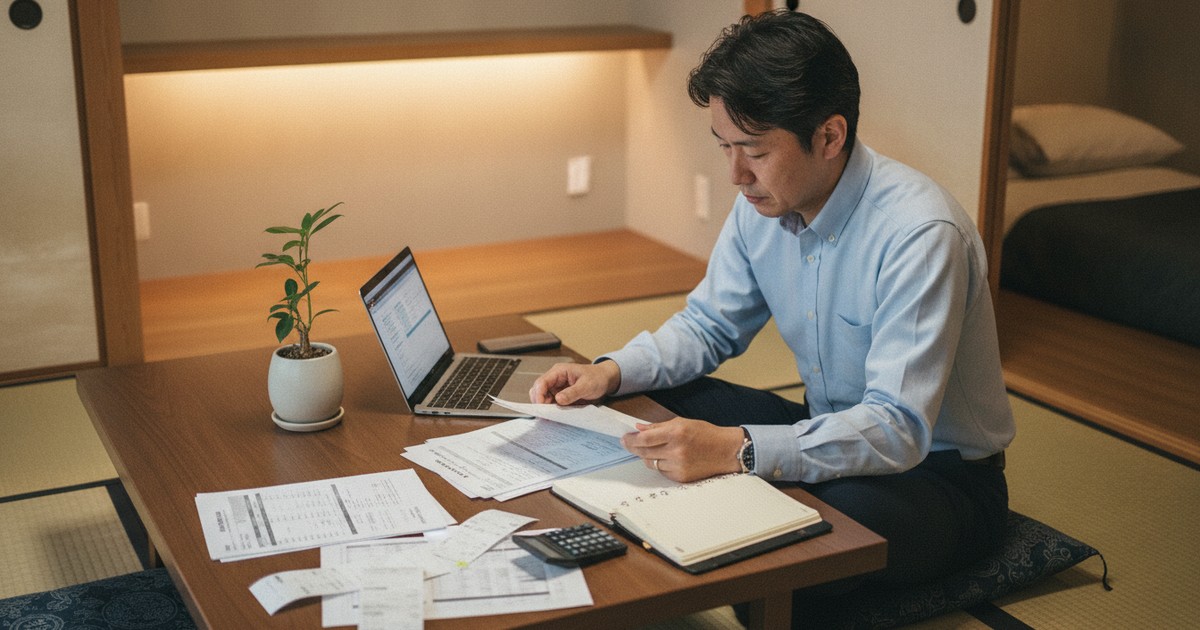
Once you become a taxable business, you’ll need to file consumption tax returns every period. Minpaku revenue is tallied as taxable sales, while cleaning costs, OTA fees, and utility costs (apportioned for business use) are organized as taxable purchases. If you opt for the simplified taxation system (Article 37 of the Consumption Tax Act), you can calculate your tax liability using a deemed purchase ratio — for the accommodation business, this falls under Category 5, with a deemed purchase ratio of 50%. That said, choosing simplified taxation requires comparing it against the actual input tax credit method to see which is more advantageous, and the answer again depends on your business scale and cost structure.
Accounting rules also shift around the time you become a taxable business, so from a practical standpoint, it’s important to make sure your booking management system’s reporting output is properly integrated with your accounting software well in advance. If you haven’t been in the habit of keeping sales records separated by platform, you’ll end up having to reconstruct everything from scratch when it’s time to file.
Talk to Stay Buddy About Your Minpaku Consumption Tax and Invoice System Questions
Stay Buddy Co., Ltd. provides full-service minpaku property management under both the Private Lodging Business Act and the Hotel Business Act. We handle everything from permit applications to day-to-day booking management, cleaning coordination, and guest support — and from a tax compliance standpoint, we also advise on managing outsourcing costs and organizing the records you’ll need.
Questions like “I’m not sure if my revenue is approaching the taxable threshold,” “I can’t decide whether I should register for the invoice system,” or “How do I even check whether my subcontractors are registered?” are hard to answer without real, on-the-ground operational knowledge. Alongside consulting with a tax accountant, bringing in the operational perspective of a management company can help you catch things you might otherwise miss.
In our free initial consultation, we’ll ask about your current property operations and revenue scale, then walk you through rough guidelines for taxable-status determination and the practical priorities you should tackle first. Whether you’re already up and running or still considering getting started, feel free to reach out to us anytime.