Leave Your Vacation Rental Management to the Experts
Free Online ConsultationWhen we guide a property owner through the ryokan business licence process in Japan, the fire department inspection is reliably the stage that causes the most anxiety — and the most delays. Understanding what that inspection actually involves, what the fire service examines, and how to prepare a property you may never have visited in person is not a small thing. This article draws on what we see operationally, not what the regulations say in theory.
Why the Fire Department Inspection Matters for a Ryokan Licence in Japan
A ryokan licence is issued under the Hotel Business Act (旅館業法), administered at the prefectural level via the local public health centre (hokenjo). But before the hokenjo will issue that licence, it requires a fire-safety confirmation from the municipal fire department under the Fire Service Act (消防法). The two processes run in parallel, and neither can conclude without the other. If you are planning to skip the minpaku route — either because the 180-day cap under the Housing Accommodation Business Act makes the numbers unworkable, or because your property does not meet local authority conditions — the ryokan licence is the more demanding path, and fire compliance is where that demand is felt most acutely.
The specific fire-protection equipment required depends on building type, floor area, number of guest rooms, and whether the property is a dedicated structure or a unit within a mixed-use building. Under the Fire Service Act and its associated ministerial ordinances, a ryokan is classified as a Category 5 (イ) facility (特定用途), which carries more stringent requirements than a private dwelling. Broadly, inspectors will examine: automatic fire alarm systems, emergency lighting, fire extinguisher placement, evacuation route signage, sprinkler systems (required at thresholds that vary by floor area and building age), and in some cases smoke-control equipment. These are not tick-boxes — inspectors assess whether the installation is functional and correctly configured, not merely present.
What Actually Happens During the Inspection
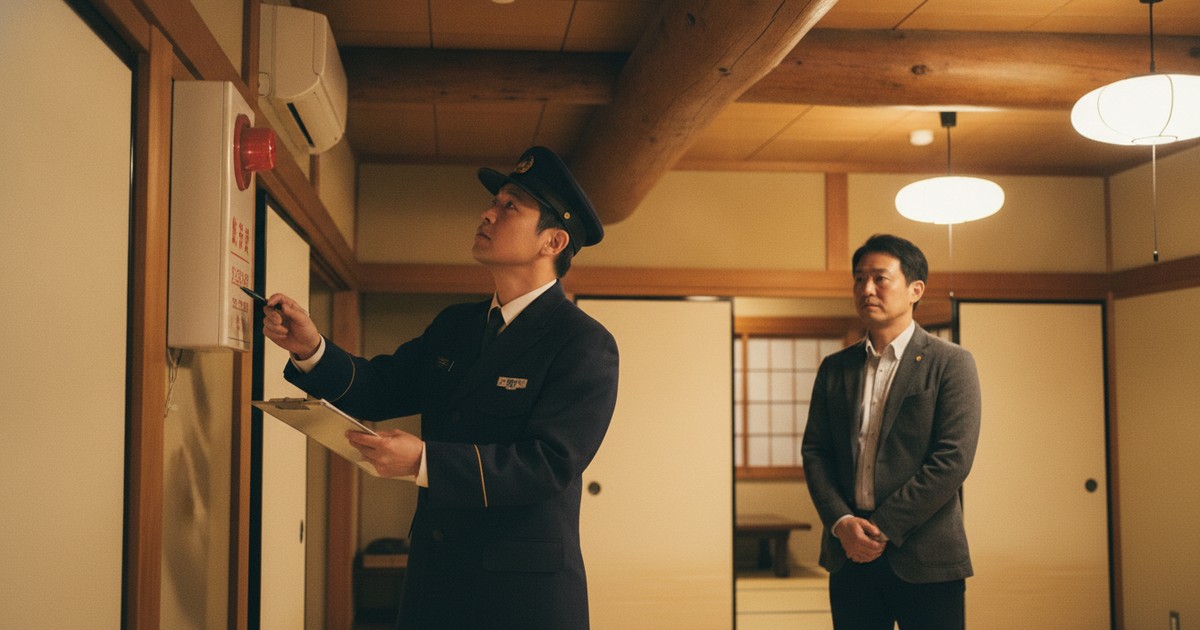
We managed a traditional machiya conversion in Kyoto’s Higashiyama ward — a two-storey wooden property the owner had inherited and wanted to licence as a small ryokan. The local fire station conducted a pre-inspection visit about three weeks before the formal inspection date. The inspector identified that the interconnected smoke detectors in the upper corridor were a domestic grade, not the commercial-grade units required for a Category 5 facility. That single item held up the entire timeline by six weeks, because the replacement units had to be sourced, fitted by a licensed contractor, and re-examined.
The owner was in London. We were on-site coordinating between the fire station, the electrical contractor, and the hokenjo case officer, because missing the re-inspection slot would have pushed us to the following month’s schedule. The judgement call we made was to authorise the contractor cost ourselves and settle it against the management float rather than wait three days for owner sign-off — a decision we documented clearly. For overseas owners, this kind of compressed operational cycle is the norm, not the exception. A management company that asks for every approval to route through you in a different time zone is going to lose weeks you cannot recover.
The Pre-Application Stage: What to Submit Before the Inspector Arrives
Fire departments in most municipalities expect applicants to submit pre-consultation documents before scheduling the formal inspection. These typically include floor plans showing room dimensions and use, a fire-equipment layout diagram (消防用設備等設置計画書), and confirmation of the proposed construction or conversion scope. Some fire stations — particularly in tourist-dense cities — have dedicated ryokan/hotel consultation desks and will flag problems at this stage. Others are more hands-off and let the inspection surface issues. You cannot know which approach your local station takes until you have dealt with them. This is one reason we always submit plans to the fire station before the hokenjo pre-consultation, even though neither formally requires you to do it in that order.
For older buildings, the interaction between the Fire Service Act requirements and the Building Standards Act (建築基準法) becomes relevant. A property built before current standards may be grandfathered under the Act’s existing-structure provisions — but conversion to ryokan use can trigger a use-change assessment that removes that grandfathering. We have seen this catch owners who assumed that because a building had been operating as a guesthouse informally, it would sail through inspection. It often does not.
Non-Resident Owner Considerations During the Inspection Process
You will need a local representative (管理者) named in your ryokan licence application — a person physically reachable who can respond to fire, guest, or authority incidents. For non-resident owners, this is almost always the management company. The fire department does not conduct the inspection in the presence of the owner; they inspect the property with the representative or contractor. However, you will need to provide power of attorney or equivalent authorisation to allow your operator to act on your behalf in formal submissions. Japanese authorities accept notarised documents from overseas, but the format requirements vary by prefecture — confirm with your local government liaison or a registered administrative scrivener (行政書士) early.
On the financial side, fire-safety retrofitting costs for a small ryokan conversion — alarm systems, emergency lighting, signage, extinguishers — can range from roughly ¥300,000 to well over ¥1,500,000 depending on building age, floor area, and what is already installed. These are one-time capital costs, but they are not optional and they are not negotiable with the inspector. Build them into your acquisition budget before you commit to the property.
Ongoing Compliance After Licence Issuance
The inspection is not a one-time event. Under the Fire Service Act, Category 5 facilities are subject to periodic self-inspection and reporting obligations. A qualified fire-safety manager (防火管理者) must be designated — typically someone who has completed a certified training course. Annual equipment checks by a licensed inspector are required, and inspection records must be retained. Fire departments conduct unannounced compliance visits; these are less frequent for small properties but do occur, particularly in municipalities that have faced fire incidents in tourist accommodation.
For overseas owners working with a management company, ask explicitly: who holds the防火管理者 qualification? Who files the annual reports? What is the process if a fire alarm system fails outside business hours? These are not hypothetical questions. We have received fire-station calls at 11 pm because a smoke detector triggered during a guest’s shower steam and the local fire watch needed confirmation before standing down. Your operator needs to be the answer to all of those scenarios, not a relay point that calls you first.
Working With a Management Company as an Overseas Owner
Management fees for ryokan operations in Japan — covering licencing support, guest management, cleaning, maintenance coordination, and compliance — typically run in the range of 10–25% of gross revenue, depending on the scope of involvement, property type, location, and how much operational responsibility the company genuinely carries. A company quoting at the lower end of that range may be scoping out compliance and maintenance functions; one at the higher end should be covering them fully. Ask for a written scope of services rather than a headline percentage.
Specifically for fire compliance, ask your operator: do they have direct contacts at the local fire station? Have they run a ryokan licence application through that specific municipality before? Can they name the licensed contractor they use for fire-system maintenance? Vague answers to specific questions are informative. The fire department inspection process in Japan rewards operators who have done it before in that jurisdiction — the variations in how individual stations interpret the ministerial ordinances are significant enough that local experience is not a minor advantage.
Work With Stay Buddy
We handle ryokan licence applications and ongoing fire-compliance management for overseas property owners across Japan, including pre-inspection submissions, contractor coordination, and designated fire-safety management. If you are at the acquisition or early planning stage, we can advise on what a specific property is likely to require before you commit capital to it. Contact the Stay Buddy team to discuss your property.
Leave Your Vacation Rental Management to the Experts
Free Online ConsultationShuhei Makigi
Representative Director, Stay Buddy Co., Ltd.
Registered Housing Accommodation Management Business — Ministry of Land, Infrastructure, Transport and Tourism No. F03862. Stay Buddy operates short-term rentals and licensed hotels across Japan, supporting overseas investors with compliant, high-performing properties.
Written by the Stay Buddy Japan team. This content was produced with AI assistance and reviewed for accuracy.