Leave Your Vacation Rental Management to the Experts
Free Online ConsultationIf you own — or are seriously considering — a short-term rental in Japan and you live outside the country, the genkan choba requirement will be one of the first operational realities to land on your desk. ICT-based alternatives exist in Japan’s rental licensing framework, but they come with specific conditions, municipal variance, and real-world failure modes that a passive management arrangement rarely handles well. This article is written from ground-level experience running minpaku and ryokan properties on behalf of overseas owners across Japan.
What the Genkan Choba ICT Rule Actually Means for Japan Rental Operations
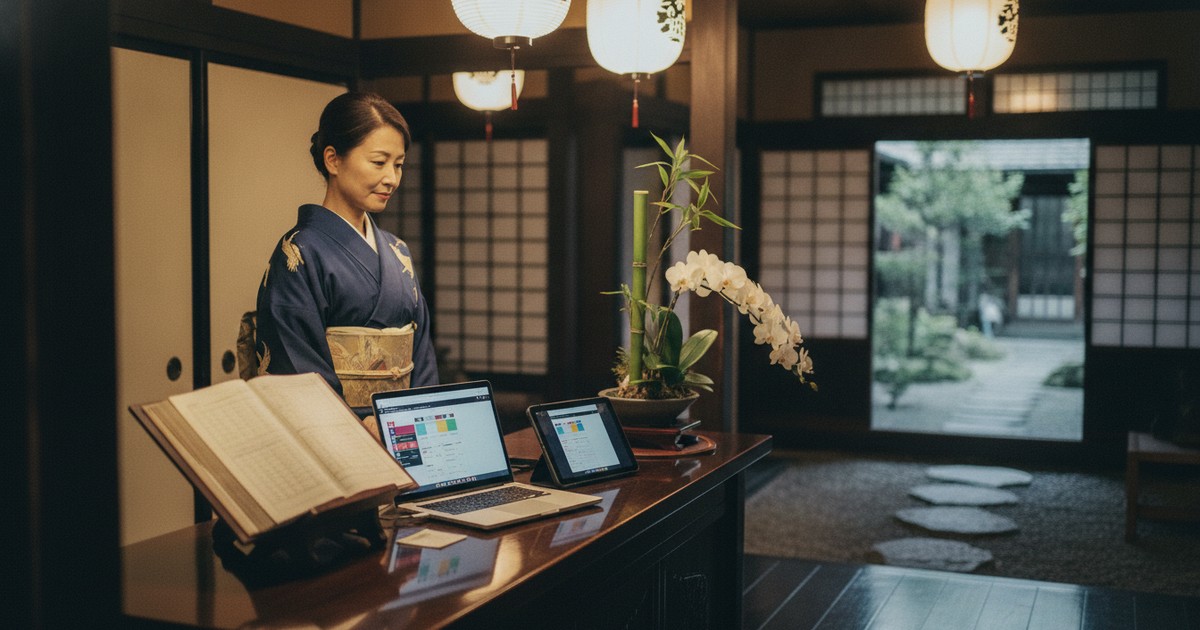
Under the Hotel Business Act (旅館業法), properties operating under a ryokan or simple lodging (簡易宿所) licence must maintain a genkan choba — a front-desk reception area at or adjacent to the entrance. The original purpose is guest identity verification: under Article 5 of the Hotel Business Act, operators are legally obliged to confirm the identity of every guest before or at check-in. For a property owner living in, say, Sydney or Frankfurt, maintaining a staffed physical reception around the clock is obviously not feasible.
The Japan Tourism Agency and Ministry of Health, Labour and Welfare have recognised this operational reality. In revised ministerial guidance, ICT-based alternatives to a staffed genkan choba are permitted under specific conditions: typically a combination of face-recognition or document-scanning systems, video call capability for identity confirmation, and electronic locks. These must be formally documented in your licence application — they are not assumed. The municipality has discretion in how strictly it interprets the ministerial guidance, and in our experience, that discretion varies meaningfully between, say, Kyoto Ward and a rural Hokkaido town.
Under the Housing Accommodation Business Act (住宅宿泊事業法, the Minpaku Law), the obligation is framed differently: operators must be reachable and able to respond within a defined timeframe, but the physical choba requirement does not apply in the same form. The 180-day annual operating cap remains regardless. The practical result is that many owners default to minpaku notification rather than a ryokan licence precisely to avoid the choba question — but that choice carries its own constraints on operating days and nightly revenue potential.
Where the ICT Alternative Works and Where It Fails
We have set up ICT-based check-in systems across properties in multiple prefectures. In practice, a compliant system typically requires: a kiosk or tablet with document capture at the entrance, a smart lock with a code issued only after identity verification is confirmed in the system, and an operator reachable by video or phone during check-in windows. The document capture system must meet the personal data protection requirements under the Act on the Protection of Personal Information (個人情報保護法).
The real failure point is not the hardware — it is the response layer. One winter evening at a property we manage in a central city ward, a guest’s passport scan failed the system’s OCR because of physical damage to the document. The smart lock would not release. The guest was standing in sub-zero temperatures in a narrow alley. Our on-call local coordinator had to attend in person within twenty minutes to manually verify the document, photograph it for our records, and override the lock — all while logging the decision chain for compliance purposes. No overseas owner could have handled that call. No automated system would have passed inspection if we had simply released the lock without the documented check. That kind of judgement call is what separates a genuine operation from a box-ticking arrangement.
Municipalities with stricter interpretations — Kyoto City has published detailed supplementary requirements, for instance — may require additional physical signage, specific camera placement, or periodic on-site inspection readiness. If your management company cannot describe how they handled their last local authority inspection, that is material information.
The Non-Resident Owner’s Specific Legal and Tax Exposure
Operating Japanese short-term rental property as a non-resident creates obligations that the property licensing process does not mention but that materially affect your net return.
Under the Income Tax Act, non-resident individuals receiving rental income sourced in Japan are subject to Japanese withholding tax, currently at a flat rate (check current Japan Tax Agency guidance for the applicable rate, as treaty positions vary by country). If your management company remits funds to an overseas account without applying withholding, the liability does not disappear — it transfers to you and, in some cases, to the management company as the paying agent. A compliant operator will apply withholding at source and issue you a withholding slip (源泉徴収票) for annual filing purposes.
Consumption tax (消費税) becomes relevant if the operation crosses the taxable threshold (which has historically been ¥10 million in taxable sales in a base year under the Consumption Tax Act, though the threshold and invoice system rules have been in transition — verify current status with a Japanese tax accountant). For most single-property overseas owners, this is not an immediate issue, but the introduction of the qualified invoice system (インボイス制度) from October 2023 has created new complexity in how management fees and cleaning costs are structured between operators and owners.
JPY payouts are a practical friction point. If you are paid in yen and convert monthly, exchange-rate variance over a quarter can move your effective yield by several percentage points. We recommend owners request monthly reporting in both JPY and their home currency, and consider whether they want payouts held in JPY until a favourable rate window rather than auto-converted.
Selecting and Supervising a Management Company You Cannot Meet
Management fees for minpaku and ryokan operations in Japan typically range from 10–25% of gross rental revenue, depending on the scope of services, property type, and the company involved. At the lower end, the operator may handle only reservations and cleaning coordination; at the upper end, full compliance management, guest communications in multiple languages, licence renewal, and local authority liaison are included. Understand exactly which services sit inside and outside the quoted percentage — cleaning fees, platform commissions, and consumables are frequently passed through on top.
Questions that actually distinguish operators from intermediaries:
- Who physically attends the property when the ICT check-in system fails at 11 pm?
- How is a noise complaint from a neighbouring resident logged, escalated and documented — and can you see that log in real time?
- What is the process when a guest causes damage and disputes liability?
- How do you handle a local authority inspection request with 48 hours’ notice?
- What does your monthly owner report contain, and can I see a redacted sample?
A management company that cannot answer the first question with a name and a response-time commitment is not equipped to hold an ICT-compliant ryokan licence on your behalf.
Tokku Minpaku and the Osaka Closure
National strategic special zones (国家戦略特区, tokku minpaku) previously allowed municipalities like Osaka City to exempt participating properties from the 180-day cap and some standard licensing requirements. As of 29 May 2026, Osaka City permanently closed new applications for tokku minpaku. Existing certified facilities under that scheme may continue to operate under their existing certification, but no new tokku minpaku can be established in Osaka. If you are evaluating a new Osaka property, your path is either the Minpaku Law notification (with the 180-day cap and any municipal restrictions) or a ryokan licence under the Hotel Business Act — which brings the genkan choba and ICT compliance requirements discussed above back into full scope.
Other tokku zones elsewhere in Japan operate under their own municipal rules; always verify current application status directly with the relevant city or ward office, as zone conditions change independently of national policy.
What Overseas Owners Should Establish Before Signing Anything
Before engaging a management company or signing a property purchase agreement, confirm in writing: which licence type the property will operate under and who holds it; how genkan choba compliance is maintained and documented; how withholding tax is applied and reported; the precise fee structure with itemised pass-throughs; and the escalation chain for out-of-hours incidents. If you cannot get clear written answers to those five points, you are taking on operational and legal risk that the purchase price does not reflect.
We are available to discuss specific properties and operating structures for overseas owners — without the generic answers.
Leave Your Vacation Rental Management to the Experts
Free Online ConsultationShuhei Makigi
Representative Director, Stay Buddy Co., Ltd.
Registered Housing Accommodation Management Business — Ministry of Land, Infrastructure, Transport and Tourism No. F03862. Stay Buddy operates short-term rentals and licensed hotels across Japan, supporting overseas investors with compliant, high-performing properties.
Written by the Stay Buddy Japan team. This content was produced with AI assistance and reviewed for accuracy.