Leave Your Vacation Rental Management to the Experts
Free Online ConsultationFire safety in Japan’s vacation rental market is not a checkbox exercise — it is one of the areas where overseas owners get caught out most consistently, and where the consequences of a gap between what’s on paper and what’s on-site are most serious. Whether you’re operating under the Housing Accommodation Business Act (the Minpaku Law, which imposes the 180-day annual cap on non-licensed properties) or holding a full ryokan business licence under the Hotel Business Act, the Fire Service Act (消防法) applies independently and carries its own inspection regime. This guide is written from the ground up, for property owners outside Japan who cannot walk through their own front door.
What the Fire Service Act Actually Requires in a Japan Vacation Rental
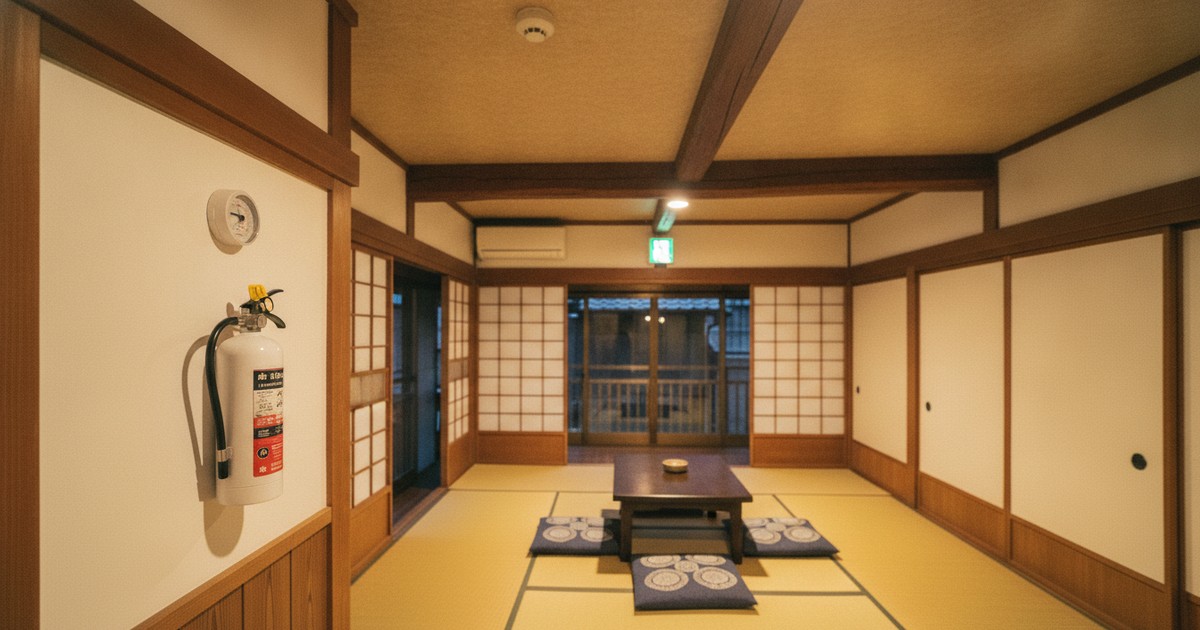
Under the Fire Service Act, the specific equipment required at your property depends on floor area, building type, occupancy classification, and the number of floors. For a standard minpaku registered under the Minpaku Law, the minimum baseline typically includes smoke detectors in each sleeping room and in corridors, a fire extinguisher appropriate to the floor area, and — in many cases — an emergency lighting unit and evacuation route signage. Properties operating under a ryokan business licence are classified differently (as a “specified facility” under the Fire Service Act) and face a stricter set of requirements, including automatic fire alarm systems in buildings above a certain size threshold and potentially sprinkler systems depending on total floor area and construction type.
The local fire department (消防署) for the ward or municipality in which your property sits is the authority that inspects and signs off compliance. This is not the same body that issues your minpaku notification or ryokan licence. We have seen situations where a property passed its prefectural notification review and then failed its fire department pre-inspection because the landlord had removed the original emergency lighting without realising it was a condition of the building’s existing fire safety classification — separate from and prior to the minpaku application entirely.
The Gap Between Notification and Ongoing Compliance
This is the part that catches non-resident owners. Passing an initial fire safety check at the point of registration does not mean your property remains compliant. Equipment ages, batteries in standalone smoke detectors discharge, extinguishers pass their inspection dates. Under the minpaku framework, the person responsible for maintaining safety standards is the operator of record — in practice, your management company or operator.
We manage a property in a central Kyoto machiya where the cleaning team flagged during a turnover that the extinguisher tag showed a service date more than 14 months old. That is above the 12-month threshold required for that extinguisher class. The cleaning vendor called us rather than the owner — rightly, because the owner is in London and the extinguisher needed to be swapped within 48 hours before the next check-in. We arranged the replacement through our preferred fire equipment maintenance contractor, billed it through, and updated the compliance log. The owner knew about it only when they received the quarterly report. That chain — cleaner flags, operator acts, owner informed — only works if your operator has built it deliberately. If your management company’s cleaner relationship is transactional, that flag never reaches anyone.
When evaluating a management company as a non-resident, ask specifically: who performs your periodic fire equipment checks, and at what interval? Do they have a written handover protocol with cleaning staff? Can they provide a compliance log for existing properties they manage? These are not hypothetical questions.
Licensing Structure and Where Fire Safety Fits In
Your choice of operating licence directly determines your fire safety obligations, so the two cannot be separated.
- Minpaku Law (Housing Accommodation Business Act): Caps operating nights at 180 per year nationally, unless a local municipality imposes a tighter restriction (many do — some Tokyo wards limit to weekends only, or to specific zones). Fire safety requirements under this route are lighter but are still enforced locally.
- Ryokan business licence (Hotel Business Act): No 180-day cap, but the licence requires satisfying both the prefectural public health authority and the local fire department before opening. Fire alarm systems, emergency lighting, and evacuation plans are standard requirements at this level, and inspections are ongoing.
- Tokku minpaku (national strategic special zones): This designation allowed certain zones to operate beyond the 180-day cap with a separate certification framework. As of 29 May 2026, Osaka City has permanently ended new applications for tokku minpaku. Existing certified facilities in Osaka may continue, but this route is closed to new entrants in that city. For new openings in Osaka, the applicable paths are the standard Minpaku Law or a full ryokan licence — and the fire safety obligations of whichever you choose apply in full.
Remote Oversight: What Non-Resident Owners Must Demand in Writing
You cannot inspect your property. That reality means your contractual relationship with your operator needs to do the work your physical presence cannot. On fire safety specifically, your management agreement should state explicitly who holds responsibility for periodic equipment servicing, who bears the cost of replacement parts (typically minor, but they need to be assigned), and how compliance records are maintained and shared with you.
Management fees in Japan’s short-term rental sector typically run in the range of 10–25% of gross revenue, depending on the scope of services, property type, and the operator involved. A company at the lower end of that range may be providing a lighter-touch service where fire safety checks are your responsibility to commission separately. A company at the higher end should be including compliance monitoring, guest communications, and local vendor coordination as part of the service. Neither structure is wrong, but you need to know which you have.
For non-resident owners, there are additional tax and financial considerations that sit alongside all of this. Income from Japanese rental property is subject to Japanese income tax, and non-residents are subject to a withholding tax obligation — typically 20.42% withheld at source on rental income paid to overseas recipients, under the Income Tax Act. Your management company or a Japanese tax accountant (税理士) should be structuring payments to you with this in mind. Separately, if your rental turnover crosses certain thresholds, consumption tax registration may apply. These are not optional considerations; they affect your actual net return and your legal standing.
Practical Steps for Owners Who Cannot Visit
The combination of the Fire Service Act’s ongoing requirements, the licensing framework you operate under, and your absence from Japan creates a specific set of risks. These are the areas where we have seen compliance failures occur with overseas owners:
- Expired fire extinguisher service tags discovered only at a municipal inspection, not flagged by the management company in the interim
- Smoke detector battery failure not caught because the cleaning team’s checklist did not include equipment testing
- Emergency lighting units that were present at registration but removed or disconnected during a renovation the owner approved remotely without understanding the fire safety implications
- No evacuation route signage in Japanese and English, required under the minpaku notification but never installed post-registration because no one tracked the outstanding item
The fix for each of these is the same: your operator needs a structured compliance checklist that is tied to the cleaning cycle, reviewed quarterly, and reported to you in writing. Ask to see the checklist template before you sign a management agreement. If there is no template, that tells you something.
Currency and remittance are a practical reality for overseas owners. Revenue is collected in JPY, and transfers abroad involve conversion costs and, depending on your home country, additional reporting obligations. Establish in advance how your operator handles remittance — frequency, the exchange rate basis, any fees applied — and factor this into your net yield calculation from the outset, not as an afterthought.
Work With Stay Buddy
We run properties in Japan — we hold the licences, manage the compliance cycle, coordinate with local fire departments and cleaning vendors, and handle the reporting chain that keeps non-resident owners genuinely informed rather than nominally informed. If you own a property in Japan or are evaluating one, and you want an operator who has built the systems described above rather than one who will build them after you have a problem, get in touch with the Stay Buddy team.
Leave Your Vacation Rental Management to the Experts
Free Online ConsultationShuhei Makigi
Representative Director, Stay Buddy Co., Ltd.
Registered Housing Accommodation Management Business — Ministry of Land, Infrastructure, Transport and Tourism No. F03862. Stay Buddy operates short-term rentals and licensed hotels across Japan, supporting overseas investors with compliant, high-performing properties.
Written by the Stay Buddy Japan team. This content was produced with AI assistance and reviewed for accuracy.