Leave Your Minpaku Management to the Experts
100% Free Online ConsultationMany prospective minpaku (vacation rental) owners wonder whether they’re legally required to explain their plans to neighbors before opening. This is a crucial point to clarify before launching your business. The short answer: the Private Lodging Business Act (Japan’s “minpaku law”) contains no explicit provision requiring advance notice to neighbors. However, concluding that “no explanation is necessary” would be a hasty and risky assumption.
In practice, there are documented cases where skipping neighbor communication led to disputes, prompting administrative guidance or even suspension of operations. Understanding not just the legal requirements but also the practical steps needed to maintain smooth, ongoing operations is essential for long-term stability in the minpaku business.
This article breaks down the legal framework and offers concrete guidance on how to handle neighbor relations in practice.
Understanding the Legal Basis for Neighbor Explanations in Minpaku Operations
The Private Lodging Business Act (enacted in 2018) establishes the notification procedures required to operate a minpaku, along with the 180-day annual operating limit. However, a close reading of the law reveals no explicit clause mandating that operators “must provide advance explanation to neighboring residents.” Notably, the documentation required for notification doesn’t include any proof of having conducted neighbor outreach.
That said, for condominiums, the Building Unit Ownership Act and building management regulations come into play. Many condo management regulations stipulate “residential use only” or prohibit “commercial use,” meaning approval from the management association may be required before starting a minpaku. In these cases, explaining your plans to the management association becomes a de facto obligation—operating without approval risks being flagged as a regulatory violation, with corrective action demanded. If you’re considering a condo-based minpaku, checking the management regulations should be your absolute first step.
Additional Restrictions Imposed by Local Ordinances
Even though the national law doesn’t explicitly require neighbor notification, individual municipalities may impose their own supplementary regulations through local ordinances. For example, some municipalities—including Kyoto City and Tokyo’s Shinjuku Ward—have ordinances requiring operators to make efforts to inform neighbors, or to follow certain procedures, as part of the notification process. Since these ordinances vary significantly from one municipality to another, it’s essential to check directly with the city, ward, or town office (or the department overseeing private lodging businesses) where your property is located.
Some municipalities also impose restrictions based on zoning classifications—for instance, prohibiting minpaku operations in residential-only zones, or permitting operation only during specific periods or days of the week. If a violation of local ordinance is discovered, you risk not only having your notification rejected but also having an existing notification revoked. Don’t assume “no explanation obligation means I’m fine”—always verify with the relevant local authority before opening.
Why Neighbor Explanations Are Practically Essential, Even Without a Legal Mandate
Even though the minpaku law doesn’t explicitly require it, proactively explaining your plans to neighbors is strongly recommended in practice. The biggest reason is the high cost of handling complaints after the fact. Issues unique to minpaku operations—late-night noise, improper garbage disposal, unauthorized use of shared hallways—often only come to light once neighbors file a direct complaint. Simply meeting neighbors in person beforehand, explaining your plans, and sharing your contact information dramatically increases the chances of resolving issues before they escalate.
Local authorities also place significant weight on “the number of complaints from neighboring residents” when monitoring minpaku facilities. Properties that receive multiple complaints become targets for administrative guidance, and in cases deemed egregious, this can lead to revocation of the business notification. According to materials published by the Ministry of Land, Infrastructure, Transport and Tourism and the Japan Tourism Agency, most administrative enforcement cases originate from neighbor disputes. Proactive neighbor communication is one of the most cost-effective ways to reduce the risk of losing your ability to operate.
Who Should You Talk to, and How Far Should Your Outreach Extend?
For Standalone Houses
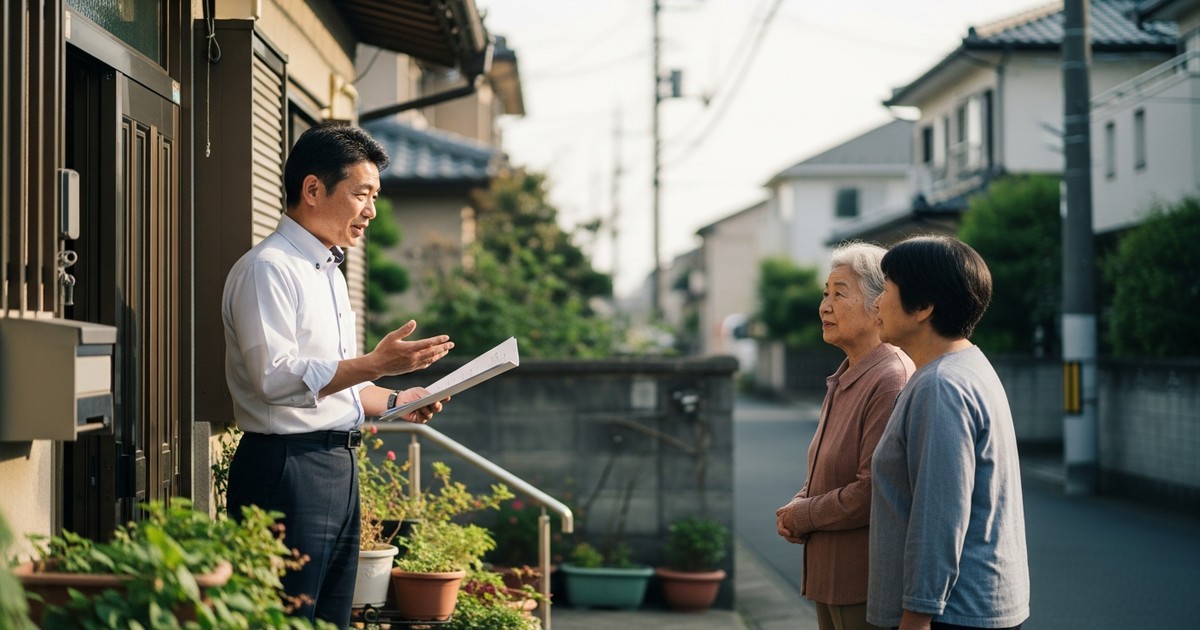
When operating a minpaku in a standalone house, priority should go to residents of directly adjacent buildings. Typically, this means the properties to the left, right, and behind—usually three to four households at minimum. In some areas, it’s also worthwhile to greet neighborhood association officials. This is especially important in residential neighborhoods, where good relationships with the local community directly support stable, ongoing operations. Simply explaining three things—”I’m starting a minpaku,” “here’s my emergency contact information,” and “here are the trash disposal rules”—can significantly ease residents’ concerns.
For Condominiums
For condos, applying to and consulting with the management association should come first. If the management regulations prohibit minpaku, operation simply isn’t possible from that point forward. Even in ambiguous cases, obtaining approval often requires a vote at the management association’s general meeting, a process that can take several months. Individual greetings to neighbors on the same floor should come after securing management association approval—not before. If the building has an on-site building manager, be sure to explain your plans to them as well.
For Apartments, Row Houses, and Multi-Unit Buildings
If you’re using a single unit within an apartment building as a minpaku, the first priority is explaining your plans to the property owner (landlord) and obtaining their consent. If your lease prohibits subletting or changes in intended use, operating a minpaku without the landlord’s consent constitutes a breach of contract. It’s also considerate to indirectly inform other residents in the building—for instance, by posting a notice outlining rules for using shared spaces and garbage disposal areas.
A Practical Step-by-Step Approach to Neighbor Communication
Timing and Method of the Visit
Ideally, greet your neighbors during the “preparation phase,” before your notification has been officially accepted. Visiting about a month before opening—rather than after notification—allows you to hear residents’ questions or concerns in advance and prepare responses before you actually start operating. Bringing a small gift (a box of sweets worth around 500–1,000 yen) and calling ahead to schedule the visit demonstrates courtesy and helps build trust.
Key Points to Cover and the Value of Written Documentation
Verbal explanations alone can lead to later disputes over “I was never told that.” It’s recommended to prepare a one- to two-page A4 handout covering the following: the facility name and address; the operator’s name and emergency contact number; the maximum number of guests; garbage disposal rules; rules regarding noise and shared spaces (and how these are communicated to guests); and a contact point for filing complaints. Having the recipient sign to confirm receipt, or taking a photo as a record, helps protect you in case of future disputes.
Setting Up a System to Handle Complaints and Inquiries
Even with thorough neighbor communication, complaints can still arise once operations begin. What matters most is having a system in place beforehand to respond quickly and sincerely. Specifically, share a contact number for the property manager that’s available 24/7, and establish an internal rule to respond to any complaint within 24 hours. Keeping a log of complaint responses also allows you to properly explain your handling of issues if local authorities ever make inquiries. Article 14 of the Private Lodging Business Act obligates operators to handle complaints appropriately—neglecting this duty can result in administrative guidance.
The Risks of Skipping Neighbor Communication—and Real-World Examples
The most direct risk of skipping neighbor communication is a formal complaint to local authorities. If a resident reports the property to the relevant prefectural or municipal office, authorities can conduct on-site inspections and issue improvement guidance to the operator. There are documented cases of business improvement orders issued under Article 18 of the Private Lodging Business Act—and if improvements aren’t made, the most severe penalty of all awaits: revocation of the business notification.
Common real-world complaints include noise from late-night check-ins, the sound of suitcases being dragged, and smoking in shared hallways. These issues can largely be prevented through clear house rules communicated to guests in advance. It’s effective to prepare house rules in multiple languages—Japanese, English, Chinese, Korean, and others—and reinforce them thoroughly through both booking confirmation emails and in-property signage. Regardless of whether an explicit legal obligation exists, maintaining good relationships with neighbors forms the foundation for successful, long-term minpaku operations.
Need Help With Neighbor Relations or Opening Procedures for Your Minpaku? Talk to Stay Buddy
Because neighbor communication and opening procedures for minpaku involve a complex web of laws, local ordinances, and management regulations, navigating them accurately on your own is no easy task. Stay Buddy Co., Ltd. is a specialized company offering comprehensive support—from notification assistance to advice on neighbor relations to full operational management. Our experienced staff can answer even detailed questions like “How much do I really need to explain?” or “What exactly should I tell the management association?” on a case-by-case basis.
Having supported numerous minpaku launches, we’ve built up practical know-how on trends in local ordinances across different municipalities, as well as proven strategies for preventing neighbor disputes before they happen. Consulting with us early—before you open—lets you move smoothly toward launch without costly missteps or rework.
Your first consultation is completely free. Just share your property’s location and intended operating style, and we’ll walk you through the specific procedures and neighbor-relations steps you’ll need. Even if you’re still just exploring the idea, feel free to reach out. Stay Buddy is fully committed to supporting you as you take your first step toward a safe, confident start to your minpaku business.