Leave Your Vacation Rental Management to the Experts
Free Online ConsultationWhy Your Condo Building Can Override Japanese Law on Short-Term Rentals
When overseas property owners research short-term rentals in Japan, most of the conversation centres on national legislation — specifically the Housing Accommodation Business Act of 2018, commonly called the Minpaku Law. That law established a nationwide framework permitting short-stay accommodation in ordinary residential properties, subject to a 180-night annual cap and various hygiene and safety requirements. What the headlines rarely explain is that the Minpaku Law deliberately left a door open for building management bodies to slam shut on short-term rental activity entirely. For owners living outside Japan, this single issue — building rules — can silently kill an investment thesis before a single guest ever checks in.
Understanding the hierarchy of rules, knowing what to look for before you purchase, and choosing a management partner who will proactively monitor compliance on your behalf is not optional. It is the foundation of any viable minpaku operation.
The Regulatory Stack: National Law, Local Government, and Building Rules
Japan’s short-term rental framework operates across three distinct layers, and each layer can restrict or block the one above it.
Layer One: The Minpaku Law (National Floor)
The Housing Accommodation Business Act created a legal pathway for homeowners and investors to rent residential property to guests for fewer than 180 nights per year without needing a full ryokan or hotel licence. Operators must register with their prefectural government, display a registration number, install fire safety equipment, maintain guest records, and respond to neighbour complaints. The 180-day ceiling is a hard national limit — you cannot legally exceed it under a minpaku registration, regardless of demand.
A separate route exists through the ryokan business licence (旅館業法 — Ryokan Gyohō), which removes the 180-day cap altogether but imposes considerably more stringent structural, fire safety, and frontage requirements. Most condominium units do not meet these standards without expensive retrofitting, and many municipal authorities in dense residential zones will not grant ryokan licences for standard apartment buildings regardless.
Layer Two: Special Zones and Municipal Variation
Certain designated areas — called National Strategic Special Zones (tokku) — operate under a third licensing track that can, in theory, allow higher operating days or relax some conditions. Tokyo’s Ōta Ward was historically the first to implement such rules. However, tokku licences typically impose stricter minimum-stay requirements (often two nights or more) and may require the owner or a registered manager to live in the vicinity. For overseas owners, these conditions are frequently impractical.
Beyond special zones, prefectures and municipalities layer on their own restrictions. Some local governments restrict minpaku operations to weekends only, or prohibit them entirely in certain residential zones. Kyoto, for instance, restricts the operating calendar heavily in many neighbourhoods. The practical result is that the effective operating cap can be far below 180 nights in many desirable locations. An owner selecting a property purely based on national law, without checking local restrictions, will be unpleasantly surprised.
Layer Three: Building Management Rules (Kanri Kumiai Rules)
This is where most overseas investors get caught out. Condominium buildings in Japan are governed by a body of owners called the kanri kumiai (管理組合), the owners’ association or management committee. This body sets the building’s internal rules — the kanri kisoku and the shiyo kisoku (use regulations). These are private contracts between co-owners, and they sit entirely outside the national minpaku framework.
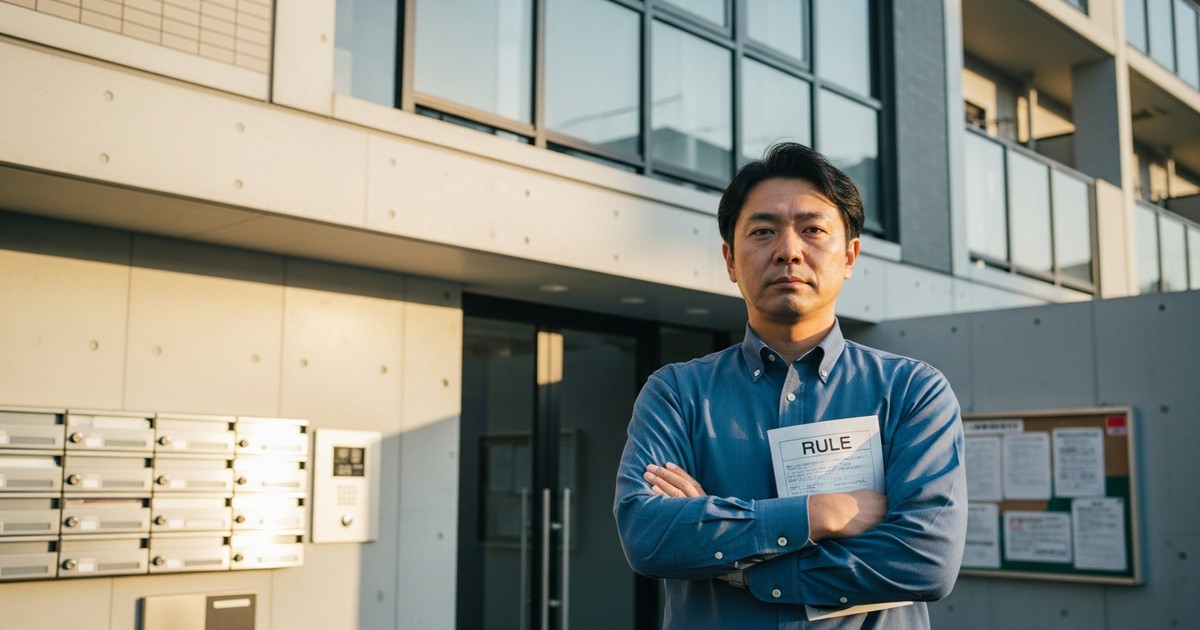
The Minpaku Law explicitly states that it does not override condominium management rules. If the building’s rules prohibit short-term rental, operating a minpaku in that building is a breach of civil contract, regardless of whether you hold a valid national registration. Buildings can — and increasingly do — pass resolutions banning minpaku activity outright, and the threshold for doing so is a simple majority vote of unit owners. Unlike changing the core management articles, which requires a three-quarters majority, a minpaku prohibition can pass with fifty per cent plus one.
How Buildings Restrict or Ban Minpaku Operations
The restrictions you will encounter fall along a spectrum. Understanding the types helps you interrogate a potential purchase properly.
Outright Prohibition
The most common restriction in buildings constructed or managed with long-term residents in mind is a flat ban on “accommodation business use” (宿泊営業 — shukuhaku eigyō) or on “use by unspecified persons” (不特定多数の者). These clauses were often written before the 2018 Minpaku Law existed, as a general measure against subletting and commercial activity. They are now routinely cited to block minpaku registrations. If the prefectural government’s registration office identifies that a building has such a clause, it will refuse to issue a minpaku registration.
Conditional Permission
Some buildings have passed resolutions permitting minpaku subject to conditions — for example, requiring unit owners to notify the management committee, imposing maximum guest numbers, prohibiting large-group bookings, or requiring the owner to maintain on-site contact details. These conditional regimes are workable but require ongoing compliance documentation, and the conditions can be tightened by a subsequent vote.
Silent Rules (The Dangerous Middle Ground)
Many buildings have rules that neither explicitly permit nor prohibit short-term rental. In these cases, the management committee’s interpretation is decisive. An enthusiastic committee chair might tolerate your operation for years; their successor might pass a prohibition resolution on three weeks’ notice. For an overseas owner, this ambiguity represents meaningful operational risk, and it is one of the most important things to investigate before completing a purchase.
What to Check Before You Buy
Due diligence on building rules is not a formality. It requires obtaining and reading the actual documents, not relying on a selling agent’s verbal assurance. The relevant documents are:
- Kanri kisoku (管理規約) — the master management articles, analogous to a strata title or leasehold deed of conditions in other jurisdictions.
- Shiyo kisoku (使用細則) — the detailed use regulations, which often contain the specific minpaku-related provisions.
- Minutes of recent management committee meetings (総会議事録) — ideally the last two to three years, to identify any pending resolutions, complaints about existing short-term rental activity, or signals of an imminent prohibition vote.
- Any formal notice issued to current owners regarding minpaku activity — if the building has been enforcement-minded about existing operators, that is a significant warning sign.
These documents are legally required to be disclosed to a prospective purchaser as part of the Tatemono Torihiki Gyōsha (licensed real estate agent) disclosure process, but the quality of explanation varies enormously. If you are purchasing from overseas through an intermediary, insist on receiving the full Japanese-language documents and have them properly reviewed, not summarised over email.
The Compliance Picture for Non-Resident Owners
Assuming you have confirmed that the building permits minpaku operations, you face a second compliance layer that is specific to non-resident owners: Japanese tax and financial reporting obligations.
Consumption Tax
Short-term accommodation revenue in Japan is subject to consumption tax (currently ten per cent) once the operator’s taxable sales in a given base period exceed the statutory threshold. Owners operating below this threshold as a simple minpaku business may fall outside the consumption tax net initially, but scaling up — or consolidating multiple properties — can push total turnover above it. Your management company should be tracking cumulative revenue and flagging this threshold proactively.
Withholding Tax for Non-Residents
This is the tax obligation that most surprises overseas investors. Under Japanese tax law, rental income paid to a non-resident individual is subject to withholding tax at source. The person or entity making the payment — which in a managed operation is typically the management company — is legally obligated to withhold a percentage and remit it to the Japanese tax authority. The applicable rate depends on whether Japan has a tax treaty with your country of residence and on the nature of the income characterisation. Working with a management company that has robust non-resident owner protocols and can provide clear quarterly withholding statements is not a luxury; it is a basic operational requirement.
Filing Obligations
Even where withholding is applied, non-resident owners may still be required to file a Japanese income tax return depending on their circumstances, particularly if they have deductible expenses — depreciation, management fees, repair costs — that reduce their net liability below the withheld amount. A management operator who provides itemised, auditable reporting makes this process tractable from overseas; one who provides opaque lump-sum remittances does not.
Operating Economics: What the Fee Stack Looks Like
For an overseas owner, understanding the layered cost structure of a professionally managed minpaku is essential to modelling returns honestly.
| Cost Layer | Typical Range | Notes |
|---|---|---|
| OTA platform commission (e.g. Airbnb, Booking.com) | 3%–15% of booking value | Varies by platform and pricing model; host-fee versus split-fee structures differ |
| Property management fee | 15%–30% of gross revenue | Full-service operators at the higher end; agents offering limited service at the lower end |
| Cleaning and linen turnover | Charged per stay or bundled | In Japan’s labour market, cleaning costs per stay are meaningful; confirm whether passed to guest or owner |
| Building management fees (kanri hi) | Fixed monthly — building-specific | Payable regardless of occupancy; factor into vacancy scenarios |
| Fixed-asset tax (kotei shisanzei) | Annual — assessed on property value | Due each year; management company should confirm payment schedule |
| Repairs and minor maintenance | Variable | Higher frequency with short-stay guest turnover than long-term rental |
One structural difference from many other markets is that cleaning costs in Japan are significant relative to nightly room rates at the budget end of the market. In a high-turnover minpaku operation with short stays, cleaning frequency is high. Some operators pass the cleaning fee directly to guests via the OTA listing, which is now common practice; others bundle it into the management fee. Whichever structure applies, you should know the actual per-stay cleaning cost, because it is one of the largest controllable variables in a minpaku P&L.
What to Ask a Management Company Before You Sign
Overseas owners entrusting a property to a Japanese management company are, in effect, relying on that company to be their eyes, ears, and compliance officer simultaneously. The questions below distinguish operators who treat this responsibility seriously from those who treat it as an ancillary service.
On Building Rules
- Have you obtained and reviewed the current kanri kisoku and shiyo kisoku for this building? Can you share them with me in full?
- Have you attended or reviewed minutes from the most recent annual general meeting of the owners’ association?
- Is there any indication that the committee is considering a minpaku restriction?
- If the rules change during our contract, what is the protocol and how quickly will you notify me?
On Licensing and Registration
- Will you manage the minpaku registration process end-to-end, including interaction with the prefectural government?
- Is this property in a zone subject to additional municipal restrictions on operating days or stay duration?
- Does the building or location make a ryokan licence a realistic alternative, and have you assessed the costs and feasibility?
On Reporting and Finances
- What does your monthly owner statement include? Can I see a sample for an active property?
- How do you handle withholding tax for non-resident owners, and what documentation do you provide for Japanese tax filing purposes?
- Are cleaning fees disclosed separately per stay, or bundled?
- How do you handle guest damage claims, and what is the timeline for resolution reporting to me?
On Operational Visibility
- Do you provide access to a real-time owner dashboard, or periodic statements only?
- Who is my named point of contact, and what is the expected response time for non-emergency queries from overseas time zones?
- How do you manage guest complaints that escalate to building management level, and how are they documented?
The Practical Reality of Remote Ownership in Japan
Japan’s minpaku market is genuinely attractive for overseas investors: strong inbound tourism, a culture of property maintenance, relatively straightforward leasehold structures in condominium buildings, and diverse demand across city, rural, and heritage accommodation types. But the regulatory and building-governance landscape requires someone physically present and fluent in Japanese bureaucratic processes to navigate it on your behalf.
The distinction between a management operator and a mere listing agent is material here. An agent lists your property on OTAs and forwards you remittances. An operator manages your registration, monitors your building’s governance meetings, maintains your compliance calendar under the 180-day Minpaku Law cap, handles tax withholding correctly, and tells you before problems become crises. For an owner who may visit Japan once a year — or not at all — the operator model is not a premium service. It is the minimum viable level of oversight for a compliant and financially transparent operation.
Building rules remain the single most common reason that a well-researched, legally registered minpaku operation in Japan fails unexpectedly. They are also the issue most amenable to advance due diligence. Knowing the rules before you buy, monitoring them after you purchase, and working with a management partner who treats compliance as core to their mandate rather than incidental to it — these are the non-negotiables for sustainable short-term rental investment in Japan.