Leave Your Vacation Rental Management to the Experts
Free Online ConsultationWhy Building Code Compliance Is the Foundation of Any Japan Rental Licence
Owning short-term rental property in Japan from abroad is genuinely viable — but it requires a level of regulatory diligence that surprises many overseas investors. Unlike property markets where a valid title deed and a listing on an OTA platform are enough to get started, Japan’s licensing framework for short-term accommodation links your legal right to operate directly to the physical condition of the building itself. A structural detail that seems minor — a fire door installed in the wrong position, an emergency lighting circuit that has never been tested, a corridor that is two centimetres narrower than code requires — can be the precise reason a licence application is refused or, worse, revoked after you have already begun hosting guests.
This article explains which building code requirements are most commonly implicated in licence problems, how the regulatory framework varies across Japan’s prefectures and special zones, and what you should be asking your management company to verify on your behalf when you cannot visit the property yourself.
The Two Licensing Tracks and Why the Building Rules Differ
Before addressing specific code requirements, it is worth being clear about which legal pathway applies to your property, because the building standards attached to each are meaningfully different.
Minpaku Licences Under the Housing Accommodation Business Act
The Minpaku Law — formally the Housing Accommodation Business Act, which came into force in June 2018 — created a nationwide framework allowing residential properties to be used for paid short-term accommodation. The law imposes a hard cap of 180 nights per calendar year per property, regardless of where in Japan the property sits. Operators must register with the prefectural governor (or, in designated cities, with the municipal authority), display a registration number, and meet a specific set of safety standards derived from building and fire codes.
Critically, the 180-day cap is not a target — it is a ceiling. Many municipalities have imposed additional restrictions that reduce the permitted operating days further, sometimes confining minpaku operation to weekends only or excluding certain residential zones altogether. For an overseas owner relying on rental income, understanding your local cap before purchase is essential, not optional.
Ryokan Business Licences Under the Hotel Business Act
If you want to operate without a day-count ceiling, the alternative is a ryokan gyō (旅館業) licence under the Hotel Business Act. This was the pre-existing framework for traditional inns and hotels, and it remains the route for anyone wishing to rent their property year-round. The trade-off is that the building requirements are considerably more demanding. The property must satisfy standards originally designed for commercial lodging facilities — structural fire resistance, minimum floor area per guest, sanitation facilities, and reception arrangements — rather than the lighter-touch residential safety requirements that apply under minpaku registration.
Some properties can be retrofitted to meet ryokan standards; many cannot, particularly older wooden machiya townhouses or compact urban apartments. The assessment of feasibility requires a qualified architect and, often, liaison with the local public health centre (hokenjo), which is the issuing authority for ryokan licences.
Special Zone (Tokku Minpaku) Properties
A third category exists in designated National Strategic Special Zones, commonly called tokku minpaku areas. These zones — which have included parts of Tokyo, Osaka, Niigata and Sendai, among others — allow short-term rental with a minimum stay requirement (typically two nights) but without the 180-day cap. The building requirements in special zones are set by the relevant municipal government and may differ from both the standard minpaku requirements and ryokan standards. If your property sits in a special zone, verify with your management company which specific standards apply, because assuming the national minpaku rules govern your situation could leave you operating with an incorrect compliance baseline.
The Building Code Requirements Most Likely to Cause Licence Problems
Fire Safety Infrastructure
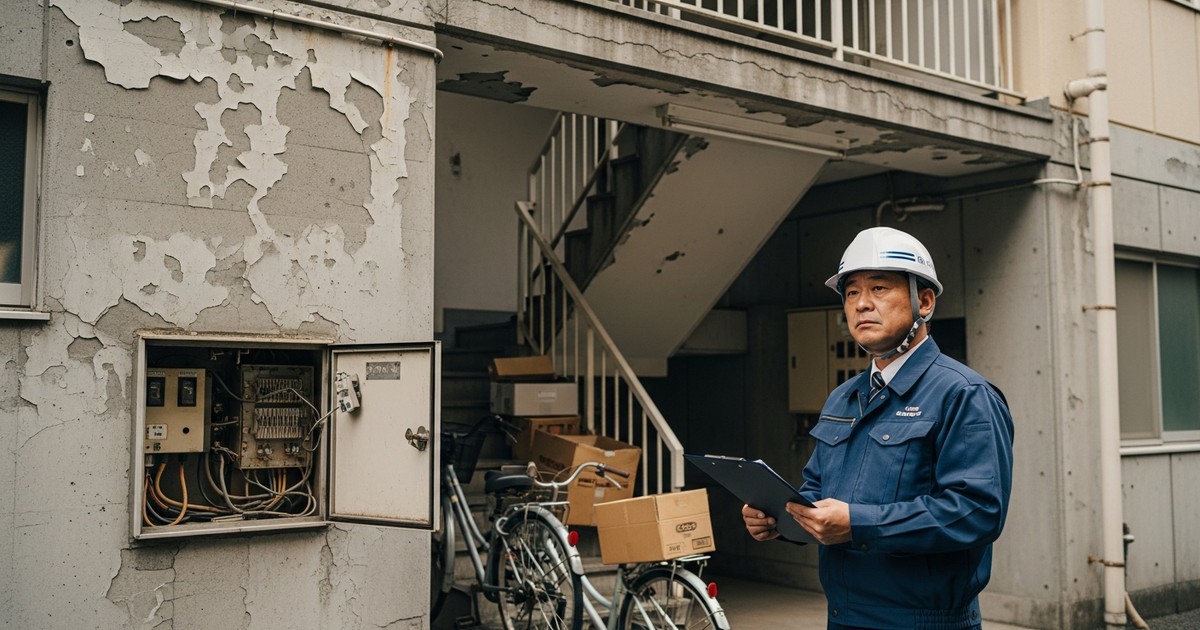
This is the single most common source of licence refusals and revocations for overseas-owned properties. Japan’s fire safety requirements for short-term accommodation draw on the Fire Service Act and are enforced by local fire departments, which conduct inspections independently of the registration authority. For minpaku properties, the core requirements include:
- Interconnected smoke detectors in every room, hallway and stairwell — battery-only units are not acceptable in all configurations; interconnection is the standard
- A fire extinguisher of appropriate capacity, positioned accessibly and within its service date
- An emergency evacuation plan posted in a visible location, in Japanese and at least one other language
- Emergency lighting that functions independently of mains power, in buildings above a certain size or occupancy threshold
- Fire doors that are self-closing, unobstructed and, where required, rated to a specific fire-resistance period
For ryokan-licensed properties, the requirements are stricter: automatic fire alarm systems, sprinkler installations in larger properties, emergency exit signage with backup illumination, and in some cases a direct line to the local fire station. Properties undergoing ryokan licence applications routinely require a pre-inspection visit from the fire department before any licence can be issued.
As an overseas owner, you cannot physically check whether a smoke detector has been replaced after a battery failure, whether a fire door has been propped open permanently because it inconveniences cleaning staff, or whether the extinguisher has passed its annual inspection. These are precisely the checks you need a management company to document and report to you on a scheduled basis, not merely on request.
Structural Classification and Use-Change Requirements
Japan’s Building Standards Act classifies buildings by their primary use (yōto), and that classification determines which structural and fire-resistance standards apply. A property registered as a single-family residence (jūtaku) carries a different compliance burden from one classified as a lodging facility (ryokan). When you apply for a ryokan business licence, the authorities will check whether the building’s registered use in the municipal records — held in the kenchiku kakunin (building confirmation) documentation — matches its intended operation.
If you are converting a property from residential use to a ryokan, you may need to submit a use-change application (yōto henkō kakunin) to demonstrate that the building meets the structural, egress and sanitation standards for its new classification. This process is not automatic, is not always quick, and will require a licensed architect to certify the building’s compliance. Properties that skip this step and begin operating as ryokan without the appropriate use classification on record face the possibility of enforcement action that goes beyond mere licence withdrawal — it can extend to orders to cease use of the building entirely.
Corridor Width, Ceiling Height and Egress Requirements
These requirements sit in the Building Standards Act and are enforced at the point of licence application, not retrospectively during normal residential occupation. Under ryokan standards, minimum corridor widths, staircase gradients, and ceiling heights must meet specified thresholds. In older properties — particularly machiya in Kyoto or pre-war buildings in Tokyo’s older wards — these measurements frequently fall short of current requirements.
There are legitimate pathways to address some of these shortfalls: existing non-conforming buildings (kizon futeigō) may be granted specific exemptions if they predate the relevant code changes and have not undergone substantial renovation since. However, the exemption is not automatic, must be specifically applied for, and typically does not extend to new construction or to buildings that have been substantially modified. An architect familiar with both the local code and the exemption framework is essential in these situations.
Sanitation and Water Facility Standards
For ryokan licences, the hokenjo (public health centre) inspects sanitation facilities as part of the approval process. Minimum requirements typically include a toilet and handwashing facility accessible to guests, hot water supply, and kitchen arrangements that meet food hygiene standards if meals are to be served. The specific thresholds vary by prefecture, which is one reason why a management company operating across multiple regions must maintain separate compliance knowledge for each area in which it operates.
For standard minpaku registration, the sanitation requirements are lighter — the property must be habitable and equipped for guests’ basic needs — but any deficiency that comes to the attention of the local authority during a complaint investigation can be used as grounds for suspension or cancellation of the registration.
How Municipal Variation Affects Your Compliance Obligations
One of the most important things overseas owners must understand is that Japan’s regulatory framework for short-term rentals is not uniform at the national level. The Minpaku Law sets the ceiling for what is permitted; local governments can, and routinely do, set requirements that are more restrictive.
Tokyo is a clear example: different wards within the same city impose different operational restrictions. Some wards permit minpaku operation only during school holiday periods. Others restrict operation to certain building types. Osaka City, by contrast, has generally been more permissive, but even within Osaka there are zone-by-zone variations. Kyoto has used its authority to impose restrictions that effectively make minpaku operation impractical in many of its most sought-after areas, while simultaneously encouraging ryokan-licensed machiya through a heritage preservation lens.
The practical implication for an overseas owner is that you cannot research the regulatory environment for a city and assume it applies to a specific property. You need ward-level, sometimes district-level, clarity before purchase — and you need a management company that can provide that specific confirmation in writing, not a general assurance that the area is “STR-friendly.”
Financial Obligations That Intersect with Licence Compliance
Building code violations create licence risk. But overseas owners also face a separate compliance layer in the form of Japanese tax obligations, and the two interact in ways that are worth understanding.
Non-resident property owners in Japan are subject to Japanese income tax on rental revenue. Where there is no tax treaty arrangement in place, a withholding obligation applies: the party making payment to a non-resident (which may be the management company or the OTA platform, depending on how the agreement is structured) is required to withhold a percentage of the gross payment and remit it to the Japanese tax authority. Management companies operating properly will account for this in the payment structure and provide documentation; arrangements that ignore it expose both the owner and the management company to tax authority scrutiny.
Consumption tax (currently ten per cent) applies to accommodation services, but the threshold above which a business becomes a taxable entity for consumption tax purposes means that smaller operations may not be required to register. Whether your operation crosses that threshold depends on total revenue across all your Japanese properties, not per-property revenue — a nuance that catches some owners off guard when they expand their portfolio.
These financial obligations are not directly building code issues, but they are part of the compliance picture that determines whether your operation is sustainable. A licence revoked for a building code violation also disrupts your tax filing position, particularly if you have already recognised rental income against which you are claiming depreciation and expense deductions.
A Comparison of Key Requirements Across Licence Types
| Requirement | Standard Minpaku (Minpaku Law) | Special Zone Minpaku (Tokku) | Ryokan Licence (Hotel Business Act) |
|---|---|---|---|
| Annual operating day cap | 180 days (further reduced locally) | No cap (minimum stay typically applies) | No cap |
| Fire safety standard | Residential-grade; smoke detectors, extinguisher, evacuation plan | Set by municipal authority; varies | Commercial-grade; alarm systems, emergency lighting, fire department inspection |
| Building use classification | Residential use typically acceptable | Varies by zone rules | Use-change application may be required |
| Sanitation inspection authority | Prefectural governor’s office | Municipal authority | Public health centre (hokenjo) |
| Corridor and egress standards | General habitability; not formally measured at application | Varies | Minimum dimensions specified; may require use-change confirmation |
| Manager presence requirement | Management company or local representative must be reachable | Varies by zone | Reception arrangements must be specified |
What to Ask Your Management Company — and Why It Matters More from Abroad
Managing a Japanese short-term rental from overseas means that your management company is not merely a service provider — they are effectively your compliance representative on the ground. The quality of their reporting and the depth of their property knowledge determines whether you maintain your licence or lose it to a violation you never knew existed.
There are specific questions you should be asking before you engage a management company, and on a continuing basis once operations begin:
- Can you provide documentary evidence of the current licence and its conditions? Not an assurance that the licence exists — the actual document, including any conditions or restrictions the local authority has attached.
- What is your fire safety inspection schedule, and who conducts it? Inspections should be carried out by a qualified person, not eyeballed by a cleaning crew, and the results should be logged and available to you.
- How do you handle fire extinguisher servicing and smoke detector replacement? There should be a defined process, not a reactive one.
- Have you confirmed with the ward authority which specific operating restrictions apply to this property? Not the city — the ward, because the restriction is often at ward level.
- What happens if we receive a guest complaint that triggers a local authority inspection? You want to know the response protocol before it becomes relevant.
- How is my withholding tax obligation handled, and will you provide documentation for my Japanese tax filing?
- What portion of OTA fees is deducted before I receive my net payment, and how is this reported to me? OTA platforms typically charge between ten and twenty per cent of the booking value in commission; management fees sit on top of that, commonly in the fifteen to thirty per cent range of net revenue, depending on service scope. You should be receiving an itemised statement, not a net transfer with no breakdown.
A management company that treats these questions as intrusive rather than reasonable is giving you a signal worth heeding. Operators who manage properties on behalf of absent owners carry a duty of transparency that goes beyond basic service delivery — the owner’s legal exposure in Japan is real, and it does not diminish because they are not physically present.
The Consequences of Operating with a Code Violation
It is worth being direct about what is at stake. If a short-term rental property in Japan is found to have a building code violation that affects its licence conditions, the consequences can escalate quickly:
- The prefectural governor (or relevant municipal authority) can issue a suspension order, halting all accommodation operations immediately
- Repeat or serious violations can result in licence cancellation, after which the property cannot legally accept paid guests under either the minpaku or ryokan framework for a defined period
- Where a violation involves a serious fire safety deficiency that has caused or could have caused harm to guests, criminal liability can attach to the property operator — which, in an overseas owner situation, may include both the management company and the owner of record
- OTA platforms are increasingly responsive to local regulatory enforcement: a property that has its registration number suspended or cancelled will typically be delisted, disrupting both revenue and review continuity
These are not hypothetical outcomes. Japanese local authorities have been actively increasing their inspection activity on short-term rental properties since the Minpaku Law came into force, and the combination of neighbour complaints and OTA data-sharing with local governments has made unregistered or non-compliant operations significantly harder to sustain without detection.
Keeping Your Licence Intact as an Overseas Owner
The building code requirements that underpin a Japan rental licence are not obstacles designed to frustrate overseas investment — they reflect genuine public safety concerns in a country where short-term rental accommodation sits within densely populated residential areas. Understanding them, and ensuring that your management company has the systems to monitor and maintain compliance on your behalf, is not a bureaucratic exercise. It is the foundation on which a viable, long-term rental operation is built.
If you are evaluating a property for purchase, commission a building compliance assessment before you complete. If you already own a property and are uncertain whether it meets current standards, ask for a documented audit — not reassurance. The distance between you and your property in Japan makes documentation the only reliable proxy for physical verification. An operator worth working with will provide it without being asked twice.