Leave Your Vacation Rental Management to the Experts
Free Online ConsultationWhy Fire Safety Is the Rule Overseas Owners Get Wrong Most Often
Owning a short-term rental property in Japan from abroad is genuinely achievable. The legal framework is clear, the demand from inbound travellers is strong, and professional management can handle the day-to-day operation you cannot. But fire safety compliance sits in a category of its own. It is the area where overseas owners most consistently underestimate what is required, partly because the obligations look deceptively similar to what they know from home, and partly because the consequences of getting it wrong — from fines to licence suspension to criminal liability — are far more serious than a failed inspection.
This article sets out exactly what Japan’s minpaku fire safety rules require, where they differ depending on how your property is licensed, and what questions you should be asking any management company you work with.
The Two Licensing Tracks and Why They Change Everything
Before getting into fire equipment specifics, it helps to understand that “minpaku” in Japan is not a single category. The way your property is licensed determines which fire safety regime applies to it.
Standard Minpaku Under the Housing Accommodation Business Act
The Housing Accommodation Business Act (Minpaku Shin-hō), which came into force in June 2018, allows residential properties to be rented to guests for a capped total of 180 nights per calendar year. Operators must register with their prefectural government, display a registration number, and comply with a set of baseline safety, hygiene and neighbourhood-management rules. The 180-day cap is a hard ceiling — not an average, not a guideline. Exceeding it invalidates your registration and can result in prosecution.
Ryokan Business Licence (Ryokan Gyōhō)
If you want to operate without the 180-day cap, you need a ryokan business licence under the Hotel Business Act. This is the route taken by many professionally managed guesthouses and boutique properties. The fire safety, structural and management requirements under this licence are considerably more stringent than standard minpaku, and the application process involves coordination with the local fire department, the public health centre and the municipal government simultaneously.
Special Zone Minpaku (Tokku Minpaku)
Certain nationally designated special zones — the most widely known being parts of Osaka and the former Ōta Ward scheme in Tokyo — operate under a separate framework called National Strategic Special Zone minpaku. These zones have their own minimum-stay rules (typically two nights), their own registration processes, and in some cases their own fire safety requirements layered on top of national standards. If your property sits in one of these zones, blanket advice about “standard minpaku” may not fully apply.
Japan Minpaku Fire Safety Rules: The National Baseline
At the national level, fire safety for registered minpaku properties is governed by a combination of the Minpaku Law itself, the Fire Service Act (Shōbōhō) and the Building Standards Act. The interaction between these three statutes is where much of the complexity lives.
Smoke Detectors
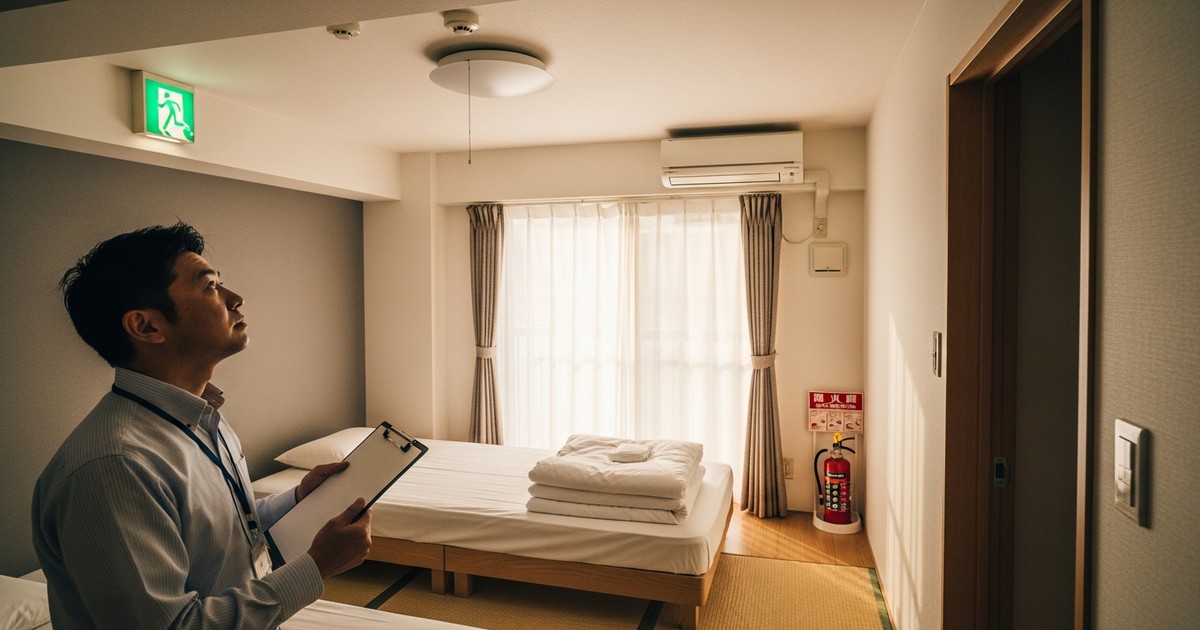
Every room used for guest accommodation, every corridor leading to an exit, and every kitchen must be fitted with a self-contained smoke detector that meets the specifications set out under the Fire Service Act. Detectors must be of an approved type and must be installed at the correct height and position — ceiling-mounted units have different placement rules from wall-mounted ones, and installing the right detector in the wrong location can fail an inspection as easily as having no detector at all.
Detectors must also be maintained. For an overseas owner, “maintained” means you need a local manager who tests units on a schedule and replaces batteries or units that have reached their service life. Detectors are typically rated for around ten years, after which the unit itself — not just the battery — should be replaced. A management company should be able to provide you with a maintenance log on request.
Fire Extinguishers
Registered minpaku properties are required to have at least one portable fire extinguisher that guests can locate and use without specialist knowledge. The extinguisher must be placed in a clearly visible location, and its position must be indicated on the floor plan that forms part of your registration documentation. Extinguishers require annual professional inspection and periodic recharging or replacement. Ask your management company for the inspection certificate — it should have a dated sticker attached to the unit and a paper record filed separately.
Emergency Lighting and Exit Signage
Properties that accommodate guests in multiple rooms, or where the layout makes egress non-obvious, are typically required to provide emergency lighting and illuminated exit signs. This requirement is more consistently enforced under the ryokan licence route, but fire departments in some municipalities apply it to standard minpaku registrations as well, particularly in older machiya townhouses and converted apartments where corridor layouts are complex.
Fire Escape Routes and Guest Notification
Under the Minpaku Law, operators are required to explain fire safety procedures to guests at check-in. For unmanned properties — which describe the majority of remotely managed minpaku — this explanation must be provided in writing and displayed visibly inside the property. The notice must include the location of fire extinguishers, the evacuation route, and emergency contact information. It must be available in the languages of the guests you are hosting; a Japanese-only notice posted in a property marketed to international travellers will not satisfy the requirement in practice, even if it technically ticks a box.
The evacuation route must also be physically clear. This sounds obvious, but properties that double as storage spaces between guest stays, or where interior layouts have been modified for aesthetic reasons, can inadvertently obstruct the designated escape path. Your management company should confirm the route is unobstructed as part of every turnover clean.
Where Municipal Rules Diverge From the National Standard
One of the most significant misunderstandings among overseas owners is treating Japan’s minpaku rules as uniform across the country. They are not. The Minpaku Law explicitly permits municipalities to restrict or expand the national baseline, and many have done so in ways that directly affect fire safety obligations.
Ward-Level Variation in Tokyo
Tokyo is not a single jurisdiction for minpaku purposes. Each of the 23 special wards operates its own registration system, with some wards imposing operating-day restrictions well below the national 180-day cap, restrictions tied to residential zoning, and additional safety documentation requirements. Shinjuku, Shibuya and Minato wards, for example, have each issued guidance that goes beyond the national minimum in various respects. Before assuming what applies to a property in one ward, confirm the rules for that specific ward in writing.
Kyoto’s Machiya Properties
Traditional wooden townhouse properties (machiya) in Kyoto are particularly complex from a fire safety perspective. The buildings are old, often constructed of highly combustible materials, and frequently lack the structural separation between floors that modern construction provides. The Kyoto City government has issued specific guidance for minpaku in these properties, and the local fire department tends to scrutinise applications closely. If you own a machiya and are considering minpaku registration, the fire safety retrofit costs can be materially higher than for a modern apartment.
Osaka’s Special Zone
Osaka’s designated special zone areas permit minpaku without the 180-day cap under the tokku framework, but the application process involves a separate safety checklist administered by the ward office. Properties in the special zone that are later brought under standard minpaku registration — for example, if the zone boundaries change — need to be re-assessed against different criteria.
Ryokan Licence Fire Safety: A Different Order of Magnitude
If your property operates under a ryokan business licence rather than standard minpaku registration, the fire safety obligations are substantially more demanding.
| Requirement | Standard Minpaku (180-day) | Ryokan Business Licence |
|---|---|---|
| Smoke detectors | Required in all guest rooms, corridors and kitchen | Required throughout, with automatic fire alarm system often mandatory depending on floor area |
| Fire extinguishers | At least one, clearly positioned | Number and type determined by floor area calculation under Fire Service Act |
| Emergency lighting | Situational; enforced at municipality level | Generally mandatory for corridors and stairwells |
| Exit signage | Situational | Mandatory, illuminated |
| Sprinkler system | Not typically required for small properties | Required above certain floor-area and storey thresholds |
| Fire prevention manager (Bōka Kanrisha) | Not required | Required for properties above certain capacity thresholds; must hold a qualification |
| Annual fire department inspection | Not scheduled by default; triggered by complaints or registration review | Periodic scheduled inspection by local fire department |
| Structural fire-resistance certification | Not typically required for existing residential buildings | May be required; older buildings sometimes require retrofitting |
The ryokan licence route is demanding, but for a property capable of operating year-round without a 180-day restriction, the additional compliance cost is often well justified commercially. The critical point for overseas owners is that neither licensing route is “simple” from a fire safety perspective — they are simply demanding in different ways.
What Overseas Owners Cannot Manage From Abroad (and Must Delegate)
Japan’s fire safety compliance framework assumes a responsible operator who can be physically present, respond quickly, and engage with local authorities in Japanese. For an overseas owner, this means that every single compliance function related to fire safety must be handled by a local operator — not just advised on, but actually carried out and documented.
There are specific tasks that your management company should be performing on your behalf:
- Pre-registration fire safety assessment: Before submitting a minpaku registration or ryokan licence application, a competent operator should walk the property against the applicable checklist and identify every item that needs to be installed, repaired or upgraded before the application can succeed.
- Installation coordination: Smoke detectors, extinguishers and emergency signage must be installed by competent persons and, in some cases, by licensed contractors. Your operator should be managing this, not leaving it to you to source remotely.
- Turnover inspection: Every time a guest checks out, the cleaning and inspection process should include a check that fire extinguishers are in position and accessible, detector test lights are functioning, and the evacuation route is clear.
- Annual and periodic maintenance logging: Fire extinguisher inspection records, detector test records and any remedial work should be logged and made available to you. If a management company cannot provide these records on request, that is a significant concern.
- Guest communication: The fire safety notice displayed in the property, the check-in communication that explains evacuation procedures, and the language versions of both should be prepared and maintained by your operator.
- Incident reporting: Under the Minpaku Law, certain incidents — including fire-related events — must be reported to the prefectural government. Your operator should have a clear process for this, and you should be notified promptly as the registered owner.
Questions to Ask Before You Appoint a Management Company
If you are based outside Japan and evaluating management companies, fire safety compliance is one of the areas where the quality of the operator matters most. The questions below are designed to help you distinguish operators who genuinely manage compliance from those who merely process bookings.
- Can you provide the current fire safety inspection records for properties you manage under a similar licence type to mine?
- Who physically carries out the annual fire extinguisher inspection, and how is that record filed?
- What does your turnover checklist cover in relation to fire safety, and can I see a copy?
- How do you handle a fire safety deficiency discovered between guest stays — who authorises the repair, and how quickly is it completed?
- If the local fire department contacts the property with an inspection or an enquiry, what is your process, and how do you keep me informed?
- How do you manage the multilingual fire safety notice requirement, and in which languages is it currently provided?
- Are you familiar with the specific requirements in the ward or municipality where my property is located, including any rules that go beyond the national minimum?
A management company that hesitates, gives vague answers, or frames these as unusual questions is telling you something important about how it operates.
The Financial Context: Why Compliance Is a Cost of Revenue, Not an Extra
Overseas owners sometimes treat fire safety installation and maintenance as a one-off expense to be minimised. In practice, it is an ongoing operational cost that sits alongside cleaning fees, OTA platform commissions and the management fee itself. OTA commissions in Japan typically run in a range that reflects the platform’s marketing reach, and management fees vary depending on whether the operator is providing full-service management or acting as a listing agent only. Fire safety maintenance — inspections, battery replacements, extinguisher servicing — is a modest but recurring line item that a full-service operator should be accounting for and reporting transparently.
For non-resident property owners, there is also a tax dimension. Japan requires withholding tax to be deducted from rental income paid to non-residents, and the operator or tenant acting as the withholding agent must handle this correctly. Separately, operators above the consumption tax registration threshold must charge consumption tax on their management fees. These are not fire safety issues, but they are part of the financial picture that an overseas owner needs to understand, and a management company that handles compliance professionally will also be structured to handle these obligations correctly.
Attempting to cut costs by operating outside the registration system — that is, running short-term rentals without minpaku registration or a ryokan licence — does not remove the fire safety obligation. It compounds it, because an unregistered operator has no legal standing and no recourse if something goes wrong, while bearing full criminal and civil liability for any harm to guests.
A Final Word on Operating Without Being There
Managing a property from abroad means accepting that you will never have direct, first-hand knowledge of its physical condition on any given day. That dependency on local management is not a weakness unique to Japan — it applies to any cross-border property investment. But Japan’s minpaku fire safety rules are specific enough, and enforced rigorously enough in many jurisdictions, that the quality of your local operator is directly reflected in your legal standing as an owner.
The right management company does not just list your property and forward the income. It maintains the physical compliance of the property, documents that maintenance, communicates with regulators on your behalf, and keeps you informed in a language you can act on. That is the standard to hold your operator to — and fire safety compliance is one of the clearest tests of whether they are meeting it.