Leave Your Vacation Rental Management to the Experts
Free Online ConsultationThe Problem With Managing Cleaning From Abroad
You own a property in Japan. Your guests check out at eleven, your next guests arrive at three, and you are sitting in London, Toronto or Sydney with no realistic way to be on the ground. That four-hour window is one of the most operationally complex moments in short-term rental management anywhere in the world — and in Japan it carries additional weight, because cleanliness is not simply a hygiene standard. It is a cultural expectation so deeply embedded that guests will notice the angle of a folded towel before they notice a missing amenity.
For overseas owners, the inability to supervise in person is not an occasional inconvenience; it is a permanent condition. Getting your cleaning operation right therefore depends almost entirely on how well you can brief, monitor and hold accountable a crew you may never meet. This article sets out how to do that in the specific Japanese context — covering the regulatory environment that shapes your operation, the communication structures that make remote oversight realistic, and the questions you should be asking any management company before you hand over your keys.
Understanding the Regulatory Layer First
Before any cleaning brief can be written, you need to understand the legal framework your property sits inside, because it directly determines how intensive your turnaround operation needs to be and how much leverage you actually have as an owner.
Minpaku Law: the 180-day cap and its operational consequences
The Housing Accommodation Business Act, known colloquially as the Minpaku Law, came into force in June 2018. Under a standard minpaku registration, a property may be let to guests for a maximum of 180 nights per calendar year. This cap is per property per year, and local municipalities are permitted — and many have chosen — to restrict it further. Some wards in Kyoto, for instance, apply restrictions so tight that a property may only be usable for short-term rentals during specific months or seasons.
For cleaning management, the 180-day ceiling has a direct consequence: because you cannot simply fill every night of the year, each occupied stay carries more revenue weight. A substandard cleaning outcome that triggers a poor review is proportionally more damaging when you have limited nights to recover occupancy. Your cleaning brief is not a back-office detail — it is integral to revenue protection.
Ryokan business licences and the higher bar
Properties operating under a ryokan business licence (旅館業法, Ryokan Gyouhou) are not subject to the 180-day cap and can accept guests year-round. The trade-off is that the licensing requirements are more demanding, covering structural standards, fire suppression, reception arrangements and hygiene protocols. Ryokan-licensed properties are expected to maintain standards closer to a hotel, which means your cleaning brief must reflect that — linen handling, sanitisation logs, inspection records and the ability to demonstrate compliance if a municipal officer visits.
Special zones and municipal variation
National Strategic Special Zones (tokku minpaku) allow a relaxed version of short-term rental in certain designated areas, sometimes permitting minimum stays as short as two nights rather than the standard minpaku requirement. The rules in a tokku zone differ from standard minpaku rules, and both differ from full ryokan licensing. In practice, this means there is no single cleaning and turnaround protocol that applies across all Japanese short-term rentals. Your procedures in Osaka’s Namba ward may need to differ from those in a rural area with a different municipal overlay.
As an overseas owner, you should know which category your property falls into before you write a single line of cleaning instructions, because the documentation requirements — and the consequences of non-compliance — vary accordingly.
What a Remote Cleaning Brief Actually Needs to Cover
A cleaning brief for a Japanese short-term rental is not a checklist of tasks. It is a communication system: a set of standing instructions, decision trees, escalation paths and verification mechanisms that function without you being present.
Standing instructions versus dynamic instructions
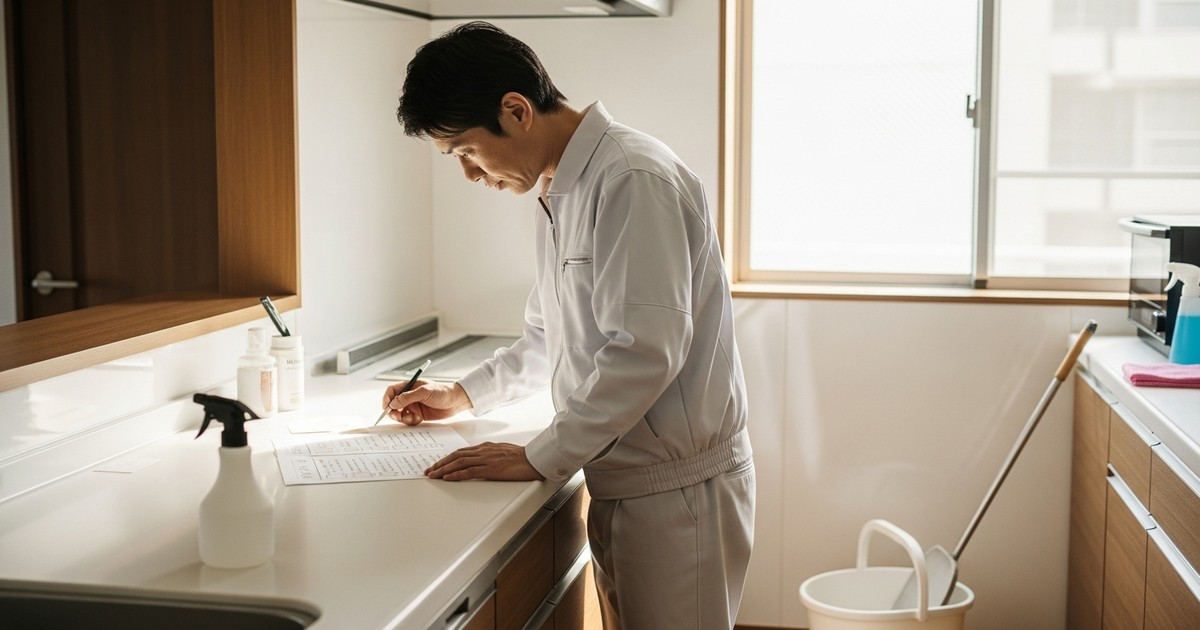
Standing instructions cover everything that does not change between guests: the sequence of rooms to be cleaned, the linen change protocol, which surfaces require which products, where consumables are stored, how refuse is sorted (Japan’s waste separation rules are strict and vary by municipality), what the crew does if they discover damage, and how the property is to be left before the next arrival.
Dynamic instructions are specific to each turnover: any notes from the departing guest, any pre-arrival requests from the incoming guest, restocking requirements and any seasonal or event-specific adjustments. A well-run management company should have a system that surfaces these dynamically to the crew lead without requiring you to intervene for each booking.
The role of a dedicated property brief document
Every property should have a written brief — ideally a living document that is updated after each significant change. This is not the same as the guest manual. The crew brief is internal. It should include:
- A labelled floor plan showing every storage location, circuit breaker, water stop-valve and cleaning supply cabinet
- Photographs of how every room, surface and storage area should look at completion
- A linen inventory with par levels and instructions for what to do when par is breached
- Municipal waste collection days and separation rules specific to that address
- Known quirks of the property: a window latch that sticks, a water pressure issue, a tatami mat that marks easily
- Emergency contacts and the escalation order if something goes wrong
As an overseas owner, you should request a copy of this document in English. If a management company cannot produce one, that is a significant red flag — not because they necessarily clean poorly, but because it tells you their operation is held together by individual knowledge rather than systems, and individual knowledge walks out the door.
Photo verification as a non-negotiable
In the absence of your physical presence, timestamped photographs are your primary evidence that a turnaround has been completed to standard. A professional management company should provide post-clean photo reports for every turnaround, not selectively. These do not need to be elaborate — a consistent set of angles covering each room, the bathroom, the kitchen, the entry area and the linen — but they need to be systematic and linked to the booking record.
Ask any prospective management company: how many photos are taken per turnaround, how are they stored, and can you access them at any time? The answer tells you immediately whether their reporting culture is built for owner transparency or primarily for internal use.
Structuring the Crew Brief for a Japanese Context
Cultural dimensions of cleaning standards
Japanese guests — who are likely to form a significant share of your bookings even on an internationally listed property — bring a detailed and instinctive assessment of cleanliness that is difficult to reduce to a checklist. The expectation is not merely that surfaces are clean but that the space feels cared for. Futon or bedding folded to a particular standard, entrance slippers aligned correctly, the bathroom smelling clean rather than chemically masked, kitchen surfaces free of watermarks not just food residue.
Your cleaning brief needs to acknowledge this cultural dimension explicitly, particularly if your crew has experience primarily with Western-style serviced accommodation. The brief should specify outcomes, not just tasks — not “wipe bathroom surfaces” but “bathroom mirrors to be streak-free under bathroom lighting, tiles to be free of soap residue at grout lines.”
Traditional elements that require specific instruction
If your property includes traditional Japanese elements — tatami flooring, shoji screens, an ofuro (deep soaking tub), or a tokonoma alcove — each requires specific care guidance:
- Tatami: Should be swept along the grain with a soft brush, not vacuumed aggressively. Wet mopping damages the rush matting and will shorten its lifespan significantly.
- Shoji screens: The washi paper is fragile. The crew brief should specify that these are to be wiped only on the wooden frame, and that any damage is photographed and reported immediately rather than concealed.
- Ofuro: The tub itself and the surrounding washroom area require separate protocols. Guests use the washroom floor and stool for pre-soak washing; both need thorough cleaning. The tub drain and any water circulation components need periodic deeper cleaning that a standard turnaround clean cannot cover.
- Tokonoma: If there is a seasonal display — a scroll, an ikebana arrangement, a ceramic piece — the brief should clarify who is responsible for updating it and what the crew’s role is in this space.
Waste separation: a specific operational risk
Japan’s municipal waste separation requirements are among the most detailed in the world, and they are enforced at neighbourhood level. Bags put out on the wrong day, or with incorrect separation, can be rejected by collection services and become a nuisance issue with neighbours — something that can complicate your property’s standing in a residential area, particularly under minpaku rules, which already require a degree of neighbourhood goodwill.
Your crew brief should include the specific collection schedule for your property’s address, the required bag colours or labelling, and a clear instruction about what the crew does with waste that cannot be collected on the day of turnaround. This is operational detail that many overseas owners overlook entirely until there is a complaint.
Fee Structures and What You Should Expect to Pay For
Understanding the cost structure of cleaning management in Japan helps you evaluate proposals honestly and avoid being either overcharged or, equally problematic, underserved by a suspiciously low-cost arrangement.
| Cost element | Typical arrangement | What to watch for |
|---|---|---|
| Cleaning fee charged to guest | Flat fee per stay, set on the OTA listing; varies by property size and location | Is this fee passed in full to the cleaning provider, or does the management company retain a margin? Clarify in writing. |
| Management company commission | Typically a percentage of gross rental revenue; ranges vary widely based on service scope | Does this include cleaning coordination, or is cleaning billed separately? Bundled versus unbundled structures affect your net differently depending on occupancy. |
| OTA platform fees | Platforms charge either a host-side commission or split commission between host and guest; this varies by platform and listing type | Ensure your management agreement specifies which platform fee structure is used and who absorbs cost changes if a platform adjusts its model. |
| Deep clean / periodic maintenance clean | Charged separately from turnaround cleans; frequency depends on property type and usage | Is this included in a maintenance allowance, or billed per event? For ryokan-licensed properties, periodic deep cleaning may be a compliance requirement, not optional. |
| Linen laundry and replacement | May be bundled with cleaning fee or billed on consumption; linen replacement on damage or wear is a separate cost | Understand the linen ownership model. Do you own the linen and pay for laundering, or is the management company supplying and charging a linen service fee? |
| Consumable restocking | Toiletries, bin liners, kitchen supplies, welcome amenities — billed at cost or with a small handling margin | Request itemised restocking reports. This category can drift if not monitored. |
Tax Considerations You Cannot Ignore as a Non-Resident Owner
Cleaning management costs do not exist in isolation from your overall financial position as a non-resident property owner in Japan. Two tax mechanisms affect overseas owners specifically and have practical implications for how you structure your management relationship.
Japan levies withholding tax on rental income paid to non-resident individuals. If your rental income is paid directly by a management company to a non-resident, the paying party may be obligated to withhold a portion at source before remitting to you. The applicable rate and the mechanism depend on whether Japan has a tax treaty with your country of residence. You should take local tax advice in both Japan and your home country; this is not an area to resolve with general guidance.
Consumption tax (currently ten per cent in Japan) applies to fees charged by your management company and cleaning providers if they are registered businesses. As a non-resident, you are unlikely to be registered for Japanese consumption tax yourself unless you are operating at a scale that triggers registration obligations. Understanding whether the fees you are quoted are inclusive or exclusive of consumption tax affects your cost modelling and your ability to compare proposals on a like-for-like basis.
These are not reasons to be deterred from owning property in Japan — they are simply facts of operation that a competent management partner should be able to explain clearly, and that you should factor into your return calculations from the outset.
Questions to Ask Before Appointing a Management Company
The right management company makes remote ownership workable. The wrong one makes it quietly disastrous, because you may not discover problems until they have accumulated into poor reviews, regulatory notices or undisclosed maintenance issues. Here are the questions that cut through sales presentation and reveal operational reality:
- Do you employ or directly coordinate the cleaning crew, or do you subcontract to a third party? Subcontracting is not automatically a problem, but you need to understand the accountability chain. Who is responsible when a subcontractor underperforms?
- Can I see a sample turnaround report from a comparable property? Reviewing a real report tells you immediately whether their photo and documentation standards are genuinely systematic.
- What is your escalation procedure if the cleaning crew reports damage, missing items or a situation that requires a decision before the next check-in? This question reveals whether there is a real decision-making protocol or whether everything gets held until it becomes urgent.
- How are cleaning and maintenance costs reported to me, and with what frequency? Monthly itemised statements should be the baseline. Anything less granular than that is insufficient for an overseas owner.
- Which ward or municipality is my property in, and what are the specific restrictions on short-term rental in that area? If a management company cannot answer this question specifically and accurately, they are not operating at the level of local regulatory knowledge you need.
- How do you handle the waste separation schedule for my specific address? A granular, operational question like this separates companies with genuine on-ground systems from those running a primarily administrative function.
- What happens if the cleaning crew identifies a maintenance issue — say, a leaking tap or a damaged tatami panel — that will affect the next booking? You want to hear a specific protocol, not a generalisation.
Building Transparency Into the Long-Term Relationship
A cleaning brief is not a document you write once and file. It is a system you build, test and refine over time — and as an overseas owner, that refinement depends entirely on the quality of information flowing back to you from your management company.
Establish from the outset that you expect regular operational reporting: not just financial statements, but turnaround photo logs, maintenance observations, guest feedback summaries and any communications with local authorities or neighbourhood associations. Some management companies provide access to owner portals where this information is aggregated; others operate on a monthly reporting cycle with structured summaries. Either can work, as long as the information is genuinely complete rather than selectively curated to avoid difficult conversations.
Request a quarterly review call — not to micromanage, but to stay calibrated. The condition of a property changes: appliances age, tatami loses colour, shoji screens get nicked. A management company that is genuinely operating your property rather than merely administering bookings will bring these observations to you proactively, with a recommendation, before a guest does in a review.
Managing a Japanese rental property from overseas is entirely achievable. It requires the right legal structure for your property type, a cleaning operation that reflects the genuine standards of your market, and a management partner whose reporting practices are built around your position as an owner who cannot be there. The brief you build for your cleaning crew is the foundation of that — specific enough to guide a crew on an ordinary Tuesday, robust enough to handle an extraordinary one.