Leave Your Minpaku Management to the Experts
Completely Free Online ConsultationCan You Turn a Back-Alley Old Japanese House Into a Café & Inn? The Harsh “Supplementary Ordinance” Road Access Rules That Can Kill Your Guesthouse License
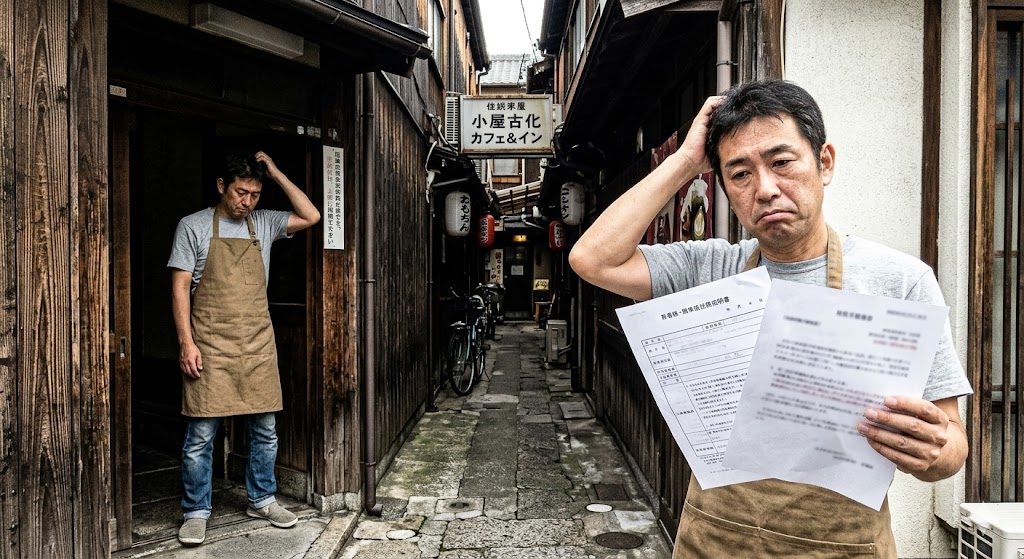
“There’s this atmospheric old Japanese house (kominka) tucked away down a narrow alley off the main street. If I renovate it—turn the first floor into a café and the second floor into a guesthouse (simple lodging) for inbound tourists—guests are sure to love it.”
Many people considering real estate investment or new business ventures dream up plans just like this, full of romantic appeal. A hidden, secluded location seems charming, and since properties tucked down alleys typically sell below market price, the projected yield looks even more attractive.
However, let us state the conclusion of this article upfront.
Operating a simple lodging facility (under the Hotel Business Act) in an old Japanese house down a back alley is, from a legal standpoint, close to “practically impossible.” This is because, on top of the basic “road access requirement” set out in the Building Standards Act, many local municipalities have established their own “supplementary ordinances” that impose extremely strict restrictions on operating special-use buildings (hotels and simple lodging facilities) on flag-shaped lots accessed via a narrow passage. If you purchase a property without knowing about this legal hurdle, you may find that permission is never granted—leaving tens of millions of yen in investment capital completely frozen, a fatal failure.
In this article, we thoroughly explain the terrifying reality of the “road access requirement” and “supplementary ordinances” that can fundamentally crush your dream of reviving an old Japanese house, as well as the one legal workaround remaining to monetize an appealing back-alley property.
Why Are Back-Alley Properties Cheap in the First Place? The Basic Rules of “Road Access Requirements”
There is a clear reason why old Japanese houses tucked down alleys are often sold below market price: they frequently fail to meet the “road access requirement,” a factor that greatly affects a property’s value as real estate.
The Absolute Standard of “4-Meter Road Width, 2-Meter Frontage” That Protects Lives
Japan’s Building Standards Act (Article 43) establishes the fundamental principle that “a building’s site must front a road at least 4 meters wide for a length of at least 2 meters.”
The purpose of this rule is to ensure that in the event of a fire, earthquake, or other disaster, emergency vehicles such as fire trucks and ambulances can reach directly in front of the site smoothly, and that residents can safely and quickly evacuate to the road. In other words, the road access requirement is a “minimum standard for protecting human life.”
The Label of “Unable to Rebuild”
Many charming back-alley townscapes were formed before the current Building Standards Act was put in place. The road (passage) in front may be only 2 meters wide, or the property may be a “landlocked lot” or “flag-shaped lot” (a lot accessed via a narrow passage) that requires crossing someone else’s land to reach a public road—failing to meet today’s standards.
Once a building on such a poorly-accessed property is demolished, a new house can never be built again, since doing so would violate current law. This is why such properties are called “non-rebuildable properties,” and since bank home loans won’t go through for them either, they end up on the market at bargain prices.
The Wall of “Special-Use Buildings” That Stands in the Way of Turning an Old House Into an Inn
“I understand I can’t rebuild it. But since I’m just renovating and using the current charming building as-is, that shouldn’t be a problem, right?”
Many people think this way—but the moment you try to convert an ordinary residence into “lodging facilities,” the law bares its teeth.
Compliance With Current Law Required for “Change of Use”
When operating an existing detached house or row house as a hotel or “simple lodging facility” under the Hotel Business Act, you must go through a “change of use” procedure that legally reclassifies the building’s purpose from “residence” to “hotel/inn.”
Because hotels and simple lodging facilities are used by an unspecified number of people who stay overnight, they fall under the Building Standards Act category of “special-use buildings,” which requires far stricter safety standards than ordinary residences.
When you submit a change-of-use confirmation application to the local government, the building must “comply with the current, strict Building Standards Act.” Even if a house was legally built (or tacitly permitted) in the past, the moment you attempt to change its use to a simple lodging facility, it undergoes a strict review against the current road access requirement. If the road access is found to be insufficient at this stage, the change of use will absolutely not be approved as “non-compliant with current law,” and as a result, the health center will also refuse to grant a hotel business license.
The Biggest Trap: How Local “Supplementary Ordinances” Can Completely Shatter Your Plans
“My old house is on a flag-shaped lot, but the passage width is just barely 2 meters, so it must clear the Building Standards Act, right?”
It’s too soon to breathe a sigh of relief. When considering the operation of a simple lodging facility, the most terrifying trap is each municipality’s own “supplementary ordinance.”
Severe Penalties for “Flag-Shaped Lots” Under Building Safety Ordinances
In addition to the nationally set Building Standards Act, prefectures and municipalities establish even stricter safety standards through ordinances tailored to local conditions (such as building safety ordinances).
Learning from past tragic fire incidents, many municipalities extremely strictly restrict the construction (or change of use) of special-use buildings—such as hotels and simple lodging facilities—on “flag-shaped lots” (properties accessed via a narrow passage leading to the site further inside).
Strict Requirements for Passage Width Relative to Passage Length
Under typical supplementary ordinances, the required “passage width” increases according to the “length of the alley-like portion (passage).”
For example: “If the passage length is less than 20 meters, a passage width of at least 3 meters is required,” or “if the length is 20 meters or more, a passage width of at least 4 meters is required.” In some even stricter municipalities, there are cases where special-use buildings are entirely prohibited on flag-shaped lots to begin with—meaning no construction or change of use is permitted at all.
If a fire breaks out in a back-alley property, fire trucks cannot get all the way in, and ladder trucks cannot reach it, making firefighting and rescue efforts desperately difficult. For this reason, even a passage width that might be overlooked for an ordinary residence will not be tolerated by authorities when it comes to lodging facilities responsible for the lives of an unspecified number of guests—the stance is an unequivocal “absolutely not permitted.”
Investors who plan a “back-alley old house café & inn” without knowing about these supplementary ordinances continue to appear one after another.
The “Only Way Around” This Seemingly Hopeless Wall to Monetize a Back-Alley Property
So, if you’ve already purchased such a back-alley old house, or if you absolutely want to run an inbound tourism business at that charming location no matter what, is it truly impossible? In fact, there is exactly one legal workaround.
Use the “Minpaku New Act (Private Lodging Business Act)” Instead of the Hotel Business Act
The most realistic and strategic workaround is to abandon the change of use to simple lodging facility status and instead utilize the **”Private Lodging Business Act (Minpaku New Act).”**
The biggest advantage of the Minpaku New Act is that it allows you to legally operate a lodging business while keeping the building classified as a “residence,” without changing its use to the special-use category of “hotel/inn.”
As long as the building’s use remains “residential,” you can bypass the strict Building Standards Act road access examination imposed on special-use buildings, as well as the restrictions on flag-shaped lots under supplementary ordinances. If the long-standing house is still existing as a “residence” today, you can start operating simply by filing a “notification” with the government. (Note: Installation of automatic fire alarm systems and other equipment required under the Fire Service Act is mandatory, and fire departments tend to be stricter with back-alley properties.)
Maximizing Profit With a Hybrid Operation That Offsets the 180-Day Limit
The Minpaku New Act comes with a restriction limiting annual operation to “180 days or fewer.”
However, this restriction can be offset through operational strategy. During “peak seasons”—such as cherry blossom and autumn foliage seasons, the New Year holidays, and Golden Week—when inbound demand surges and nightly rates soar, you operate the property as high-yield minpaku accommodation. Then, during the off-season or once you’ve reached the day limit, you switch to renting it out as a “monthly rental apartment” (fixed-term lease) on a month-by-month basis. Since monthly rentals are lease contracts, they are not counted toward the 180-day limit.
By building this hybrid operation model, even an old back-alley house blocked by legal restrictions can be fully transformed into a “hidden gem” property generating stable, high profits year-round.
Summary: Secure Legal Backing Before Falling for the Charm
The concept of a “hidden back-alley old-house getaway” is highly compelling from a marketing and customer-attraction standpoint. However, under Japan’s strict building regulations, it receives an entirely different evaluation: “an extremely dangerous location where rescue is difficult.”
- Old houses tucked down back alleys are often “non-rebuildable properties” that fail to meet road access requirements.
- When changing use to a simple lodging facility (special-use building), local “supplementary ordinances” stand in the way.
- Special-use buildings on flag-shaped lots are strictly restricted, and in most cases change of use will not be approved.
- To monetize legally, the realistic approach is to utilize the “Minpaku New Act,” which requires no change of use.
In real estate investment and lodging businesses, “I didn’t know” can become an irreversible, fatal mistake. Before you sign a purchase contract because you’re charmed by a property’s atmosphere, having the knowledge to calmly assess whether that property can actually make your business model legally viable is the first step of being a successful operator. Always conduct due diligence (a legal compliance survey) by a professional before signing any contract.
For Old-House Revival and High-Profit Operation Beyond the Legal Wall, Turn to Stay Buddy
“I’m considering purchasing an old house, but I want a professional to check whether it might run into supplementary ordinance restrictions.”
“I’ve already bought a back-alley property, but I want to legally monetize it using the Minpaku New Act.”
“I want to entrust everything from confirming fire safety equipment requirements and change-of-use procedures to post-opening operations, all in one place.”
Leave these crucial decisions and complex procedures entirely to us.
We at Stay Buddy Inc. are a team of lodging business consulting and management professionals specializing in the Osaka area.
We are thoroughly familiar with the strict examination standards imposed by local governments, as well as the know-how needed to legally clear (or work around) them.
- Precise legal compliance surveys and risk visualization before contract, conducted by our affiliated first-class registered architects and administrative scriveners
- Development of business plans that legally revive “problematic” properties with poor road access using the Minpaku New Act
- Representation in preliminary consultations with fire departments, and direction of equipment installation to ensure safety
- A complete management system offering monthly-rental operations to offset the 180-day limit and maximize revenue
Before taking on the risk of losing tens of millions of yen, please consult with true professionals first.
Stay Buddy is the strongest business partner to help you overcome the legal wall standing in your way and maximize your property’s value as an owner. To ensure your old-house revival project doesn’t fail, please feel free to contact us right away for a free property assessment and business consultation.