Leave Your Minpaku Management to Us
Completely Free Online ConsultationThe Complete Step-by-Step Guide to Getting Minpaku Permits for a Detached House
Detached-house minpaku offers something few other properties can: complete privacy and enough space to comfortably accommodate large groups. This unique appeal draws in travelers and holds real potential for strong returns.
But to unlock that potential and run your business legally, there’s one non-negotiable first step: obtaining formal “permission” or filing an official “notification” with the relevant government authorities, in accordance with national law.
“Where do I even begin?”
“What procedures are required, and how long will it take?”
Let’s get straight to the point.
Getting a minpaku permit for a detached house is a complex, meticulous project involving multiple laws and government agencies. The key to success lies in understanding the correct “process” and steadily clearing each requirement, step by step, ideally with the help of experienced professionals.
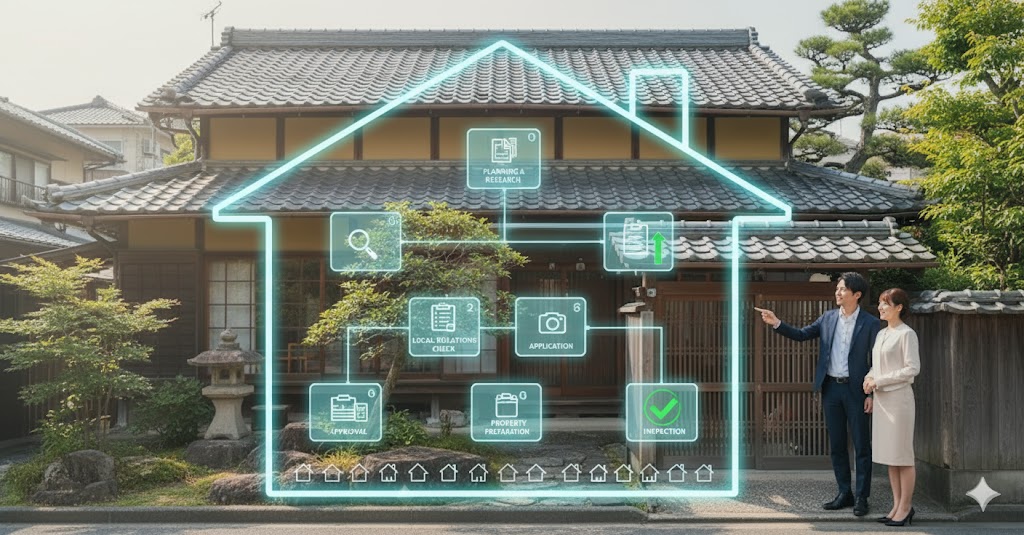
In this article, we’ll walk you through everything you need to know across 8 clear steps, so you can navigate this complex journey without getting lost and reach your goal—obtaining your permit—smoothly.
STEP 1: Choose Your Operating Style (Legal Framework)
First, decide which law your business will operate under, based on your goals. For detached houses, there are two main options.
- 1. Private Lodging Business Act (the “Minpaku Shinpo” Law):
- Characteristics: Operations are limited to 180 days per year. The registration process is relatively straightforward—a simple “notification” system.
- Best suited for: Those wanting to start small as a side business, or make use of part of their own home.
- 2. Hotel Business Act (Simple Lodging Category):
- Characteristics: Allows for 365-day operation, maximizing revenue potential. The process requires a rigorous review under a formal “permit” system.
- Best suited for: Those approaching minpaku as a serious business venture aiming for strong investment returns.
**If profitability and long-term business sustainability are your priorities, the Hotel Business Act (Simple Lodging) route is the one to pursue.** This article will focus primarily on the process of obtaining this hotel business permit.
STEP 2: Thoroughly Investigate the Property’s Legal Requirements
Based on your chosen legal framework, you’ll need to rigorously verify—from a legal standpoint—whether your detached house (or the one you’re planning to acquire) even qualifies as a candidate for minpaku operation in the first place.
Checking the Zoning Designation [Hotel Business Act: Most Critical]
- Why it matters: As a general rule, hotel businesses **cannot operate in “exclusively residential zones.”**
- How to check: Review the “zoning map” published on your local municipality’s website (typically under the urban planning department). If the property falls under “commercial zone,” “neighborhood commercial zone,” or “quasi-industrial zone,” you’ve cleared the first hurdle.
Verifying the Building’s Legal Compliance [Hotel Business Act: Important]
- Why it matters: A hotel business permit application generally requires a **”Certificate of Inspection” (kensa-zumisho)** proving the building was legally constructed.
- How to check: Review the property’s sales contract and disclosure statement (jūyō jikō setsumeisho). If the certificate has been lost, you’ll need to find out early on whether a reissue is possible, or whether an alternative approach—such as a compliance survey conducted by a specialist—will be necessary.
Building Standards Act Compliance
- Road access requirement: Does the property front a legally recognized road for at least 2 meters, as required under the Building Standards Act?
- Window size: Do the guest rooms have adequate window area for lighting and ventilation? Does the property meet the standards for “emergency entry points” required for firefighter access?
- Hallway and staircase width: Are the legally mandated widths in place to ensure safe evacuation routes?
STEP 3: [Critical] “Pre-Consultation” with the Three Key Government Offices
This is the single most important step to take before moving forward with any plans on your own judgment. Bring your property’s floor plans, site plans, and elevation drawings, and be sure to visit each of the following three offices.
- ① The Public Health Center (or equivalent department): Consult regarding the structural and facility requirements under the Hotel Business Act—guest room size, number of toilets and washbasins, alternative arrangements in place of a front desk, and more.
- ② The Fire Department (Fire Prevention Division): Receive specific guidance, from a fire safety law perspective, on what firefighting equipment your property will require—automatic fire alarms, emergency lighting, fire extinguishers—and where they need to be installed.
- ③ The Urban Planning / Building Administration Department (e.g., the Building Guidance Division): Get final confirmation on zoning, building legality, evacuation routes, and other matters under the Building Standards Act and City Planning Act.
This pre-consultation phase will reveal a clear, property-specific roadmap detailing exactly what needs to be done to obtain your permit.
STEP 4: Assemble Your Team of Experts and Plan Your Finances
To address the issues uncovered during your pre-consultation, you’ll need to assemble a team of trusted professionals.
- Gyoseishoshi (Administrative Scrivener): An expert in navigating complex application procedures, responsible for negotiations with the public health center.
- Architect: Responsible for preparing legally compliant design drawings, filing building confirmation applications (if required), and supervising construction.
- Fire safety equipment specialist / construction company: Responsible for installing fire safety equipment and carrying out any necessary renovation work.
Working with your team of experts, accurately calculate all construction, equipment, and application costs, and develop a realistic financial plan that combines your own capital with financing options (such as loans from the Japan Finance Corporation) and subsidies (such as vacant-house renovation grants).
STEP 5: Design, Renovation Work, and Fire Safety Equipment Installation
Construction begins based on detailed working drawings that fully incorporate all guidance received from the authorities.
- Renovation work: Includes floor plan changes, plumbing and bathroom renovations, and insulation upgrades necessary to meet Hotel Business Act standards.
- Fire safety equipment installation: Automatic fire alarms, emergency lighting, fire extinguishers, and other equipment are installed exactly as specified by the fire department.
STEP 6: Filing the Various Applications
As construction nears completion, your gyoseishoshi will take the lead in preparing and submitting the necessary application documents.
- To the fire department: File an “Application for Certificate of Fire Safety Compliance.” Once construction is complete, the fire department will conduct an inspection, and if everything checks out, the certificate will be issued.
- To the public health center: File the “Hotel Business Operating Permit Application,” attaching the Certificate of Fire Safety Compliance along with all other required documents. An application fee (varying by municipality, typically a few tens of thousands of yen) is required.
STEP 7: On-Site Government Inspection
Once your application is accepted, a public health center official will visit the property to conduct an on-site inspection. They’ll rigorously check the facility against the submitted drawings to confirm it matches what was applied for and fully meets all legal requirements. If any issues are identified, corrections will be required and a re-inspection scheduled.
STEP 8: Permit Issuance and Preparing to Launch
If the on-site inspection goes smoothly, your “Hotel Business Operating Permit” will finally be issued!
- Displaying the permit: You’re required to display the issued permit in a clearly visible location within the facility.
- Launch preparations: Update your listing information on OTA (booking) platforms—including your permit number—finalize your operations manual, confirm your cleaning and linen supply arrangements, and you’re finally ready to launch.
Timeline and Mindset for Getting Your Permit
- Timeline: From pre-consultation to permit issuance, timelines vary depending on the condition of the property, the scope of construction, and how the review process unfolds—but you should expect a minimum of 3 months even in the smoothest cases, with 6 months to a year being more typical.
- Mindset: The permit-acquisition process is, in essence, the process of building a business from the ground up. It demands significant time, money, and dedication. But on the other side of this challenging process lies something truly valuable: a legal, safe, and community-trusted minpaku business built to last.
Conclusion: “Careful Planning” and “Expert Guidance” Are the Keys to Detached-House Minpaku Permits
Obtaining a minpaku permit for a detached house is by no means an easy path. But it’s an achievable goal—one you can absolutely reach if you build the right knowledge, follow the correct steps, and assemble a team of trusted experts.
We hope this article serves as a solid first step on your own journey toward that goal.
Let Our Professionals Guide You Through That “Challenging Path”
“Now I understand the steps to getting a permit. But there’s no way I could handle all of this on my own…”
“How do I even find a trustworthy gyoseishoshi or architect?”
“Honestly, I just want someone to objectively assess whether my plan is worth the investment this whole complex process demands.”
If any of these concerns sound familiar, we’d love to hear from you.
At Stay Buddy Inc., we operate in Osaka City—one of the most competitive minpaku markets in Japan—where we’ve **successfully guided numerous clients through the entire hotel business (simple lodging) permit process, from property search to final approval, all as a single seamless service.** We are, quite simply, permit-acquisition professionals.
We’ll carefully assess your business plan and your property’s potential, then work alongside our partnered, highly experienced gyoseishoshi and architects to chart the fastest possible route to your permit.
- We handle the most time-consuming and labor-intensive part—pre-consultations with all three government offices—on your behalf
- From preparing and submitting the extensive application paperwork to attending the on-site government inspection
- Ongoing operational support after your permit is issued, designed to maximize your returns
We’ll walk alongside you as a team through every single step of the journey, right up until the day you open your doors as an owner.
Won’t you let us help make the most difficult—and most important—part of your business launch a sure thing?
Our deep knowledge of the Osaka market means we can offer value you won’t find elsewhere. We look forward to hearing from you.