Leave your vacation rental management to us
100% Free Online ConsultationSlip Past the “Road Access” Wall. Flag-Pole Lots That Can Never Become Hotels Are Prime Targets for High Yields Under the Minpaku Law
With inbound demand now firmly established and the accommodation market entering a mature phase, more and more investors are turning their attention to the “lodging business” as a high-yield real estate investment. However, properties in good locations have already seen their prices soar, making them difficult to acquire on a reasonable budget.
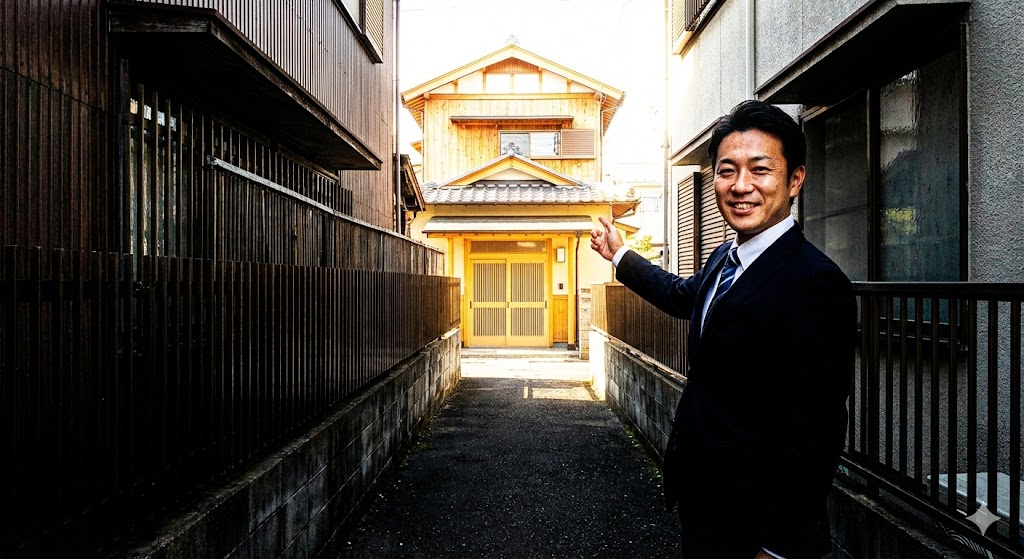
Amid this trend, one type of property is being sold at prices dramatically below market value: the “hata-zao-chi,” or flag-pole lot. This is land shaped like a flag on a pole—a narrow frontage leading to the road, with the building sitting at the far end of a slim passage. Real estate agents tend to steer buyers away from these properties, warning that “conversion into a hotel or ryokan is impossible.”
But it’s too early to give up. Let us share the conclusion of this article right away.
Flag-pole lots and properties with narrow frontages face extreme difficulty in obtaining permission for a “ryokan business” (hotel or simple lodging) license due to the strict road access requirements under the Building Standards Act. However, by leveraging the Private Lodging Business Act (commonly known as the “Minpaku Law”), it’s possible to legally operate the building as an accommodation facility while keeping its classification as a “residence.” Acquiring flag-pole lots at bargain prices and running them as high-priced, hideaway-style private lodgings is precisely the kind of high-yield real estate strategy known only to insiders.
In this article, we’ll thoroughly explain the legal mechanism behind why flag-pole lots can’t become hotels, the trick behind legally bypassing this obstacle through the Minpaku Law, and the operational techniques for maximizing profits.
Why Can’t “Flag-Pole Lots” Get Hotel (Ryokan Business) Permits?
Detached houses on flag-pole lots often appear on real estate portal sites at bargain prices. At first glance, they seem perfectly suited to becoming quiet, hideaway-style hotels. But when you try to obtain a ryokan business license, you run headlong into a formidable “legal wall.”
What Is the “Road Access Obligation” Under the Building Standards Act?
To ensure fire trucks can reach a building in an emergency and that people can evacuate safely, the Building Standards Act establishes a road access obligation (Article 43): “A building’s lot must be in contact with a road at least 4 meters wide for a length of at least 2 meters.”
Many flag-pole lots have a frontage of less than 2 meters. These are known as “non-rebuildable properties” (saikenchiku-fuka bukken)—once the existing structure is demolished, a new building can never be constructed on the site.
Even Stricter Ordinances for Special-Use Buildings (Hotels and Ryokan)
Even a flag-pole lot with a frontage of 2 meters or more—technically sufficient to build an ordinary house—isn’t necessarily safe.
Converting a building’s use from a general residence into a hotel, ryokan, or simple lodging facility requires a “change of use” procedure under the Building Standards Act. Because hotels and ryokan are classified as “special-use buildings” (tokushu kenchikubutsu) used by an unspecified number of people, local municipal ordinances impose even stricter road access requirements.
For example, many municipalities have strict rules stating that “a hotel may not, in principle, be built on a lot that is accessed via a narrow alley-like passage.” As a result, countless flag-pole lots that would be perfectly fine for an ordinary residence end up being denied a change of use for hotel purposes. This is precisely why obtaining a ryokan business license on a flag-pole lot is considered nearly hopeless.
The Savior: The Minpaku Law Lets You Go Legal Without Changing the Building’s Use
“If I can’t get a ryokan business permit, is this flag-pole lot simply a lost cause?”
For owners feeling this kind of disappointment, the game-changing solution is the Private Lodging Business Act—commonly known as the “Minpaku Law.”
The Advantage: Operating as a “Residence” Without Changing the Building’s Use
The single greatest advantage of the Minpaku Law—and the core of this investment strategy—is that it allows you to **run a lodging business while keeping the building classified as a “residence,” without ever changing its official use to “hotel” or “ryokan.”**
Because no change of use occurs, you sidestep the strict ordinances and road access reviews imposed on special-use buildings entirely. On paper, the building remains simply “a house where people live,” with travelers merely staying there. This framework means that even a flag-pole lot or a non-rebuildable property can be legally transformed into an accommodation facility using the existing structure as-is.
The Simplicity of Starting with a Mere Notification
While the Ryokan Business Act operates under a strict “permit system” involving rigorous government review, the Minpaku Law operates under a “notification system,” requiring only the submission of documents that satisfy certain requirements.
As long as basic facility requirements are met—such as having the four essentials of a kitchen, bathroom, toilet, and washbasin—you can begin operating smoothly simply by filing a notification. Being able to drastically cut the enormous time and inspection costs required to obtain a ryokan business permit is a major draw for investors.
3 Reasons Why Flag-Pole Lots × the Minpaku Law Deliver “High Yields”
“Even if I can get past the legal barrier, can I really turn a profit under a law that caps operations at 180 days a year?”
You might be wondering exactly that. But the combination of flag-pole lots and the Minpaku Law can generate astonishing returns on investment (ROI), for the following reasons.
1. Overwhelmingly Low Acquisition Costs Keep Initial Investment Down
Because flag-pole lots and properties with narrow frontages often make parking difficult and preclude rebuilding, general homebuyers tend to avoid them—so it’s not uncommon to find these properties listed for less than half of standard market value.
Since the initial acquisition cost can be kept extremely low, even with operations limited to 180 days a year, the speed at which invested capital is recovered is far faster than if you had purchased an expensive, well-located property.
2. The “Hideaway Feel” of a Back-Alley Location Resonates with Inbound Travelers
To Japanese people, “an old house tucked at the end of a narrow alley” might just seem inconvenient. But foreign tourists see it in a completely different light.
To them, a house nestled quietly down a side alley off the main street is a “secret hideaway”—a premium entertainment experience that lets them feel like they’re living the “local Japanese lifestyle.” Fully renovate the interior in a Japanese-modern style, add a small outdoor bath in the garden, and you’ll have an irresistible product that draws bookings from around the world—even at a premium price point of tens of thousands of yen per night for a whole-house rental.
3. Overcoming the “180-Day Cap” Through a Hybrid Approach with Monthly Rentals
The Minpaku Law’s biggest drawback—the 180-day-per-year cap—can be overcome with a clever operational approach.
During peak tourist seasons and weekends, operate the property as a high-priced “minpaku” rental. During the off-season, or once you’ve hit your annual day limit, switch to renting it out on a monthly basis as a “monthly apartment” (under a fixed-term lease contract). Because a monthly contract is treated as a standard lease, it doesn’t count toward the 180-day cap. By systematizing this hybrid operation, you can keep the property running at full capacity year-round and eliminate any missed revenue opportunities entirely.
Points to Watch When Starting a Minpaku on a Flag-Pole Lot
While flag-pole lot minpaku offers the potential for low risk and high returns, its unique location comes with specific issues that need to be addressed at the business planning stage.
Fire Safety Equipment and Evacuation Routes Are a Top Priority
Even if a change of use isn’t required under the Building Standards Act, you cannot escape the requirements of the Fire Service Act.
Because a flag-pole lot’s evacuation route to the road in the event of a fire is limited to a single narrow passage, the safety risks are elevated. This makes automatic fire alarm systems, guide lights, fire extinguishers, and flame-retardant materials essential. Consult with your local fire department in advance, and never compromise on the equipment investments needed to protect your guests’ lives.
Measures Against Noise and Soundproofing Disputes with Neighbors
Properties at the end of an alley are often surrounded on all sides by other homes, creating an environment where everyday sounds and voices carry easily.
The sound of a guest wheeling a suitcase at night, or a group chatting loudly, can quickly lead to disputes with neighbors. Install soundproofing measures such as double-glazed windows, and thoroughly communicate house rules—such as “please be quiet after a certain hour”—in multiple languages.
Calculating Delivery and Cleaning Costs in Advance
On a flag-pole lot where a car can’t pull right up to the entrance, bringing in materials during renovation work—and hauling in linens (sheets and towels) for daily cleaning—takes more effort and time than usual.
This increased burden on cleaning staff may drive up cleaning costs. When drafting your business plan, it’s important to budget generously for these ongoing operational expenses.
Conclusion: A Real Estate Strategy That Turns a Handicap Into a Strength
If you’re bound by conventional real estate wisdom, a flag-pole lot looks like a “burden property” you should never touch. But by combining legal knowledge with operational know-how, you can generate substantial profits from properties that no one else even glanced at.
- Flag-pole lots face difficulty in changing their use to a hotel due to the Building Standards Act’s strict road access requirements.
- The Minpaku Law (via notification) allows legal operation as a lodging facility while remaining classified as a residence.
- A bargain acquisition price combined with a hybrid operation alongside monthly rentals achieves high yields.
Can you transform what looks like a handicap—a location deep down an alley—into the value proposition of a “quiet hideaway”? Simply shifting your perspective opens up a business opportunity capable of generating extraordinary investment returns.
From Converting a Flag-Pole Lot into a Minpaku to Running It for High Profitability—Leave It to Stay Buddy
“I’ve found a flag-pole lot I can buy cheap, but I want a professional to verify whether a Minpaku Law notification is actually possible.”
“I’d like an expert to estimate the fire safety equipment costs in advance.”
“I want to outsource the entire hybrid operation—minpaku and monthly rentals—from guest acquisition to cleaning.”
Whatever your concern, leave it all to us.
We are Stay Buddy Co., Ltd., a team of professionals specializing in vacation rental management and real estate utilization focused exclusively on Osaka City.
We’ve successfully guided numerous challenging “problem property” turnarounds to success.
- Reliable legal compliance and fire safety equipment assessments before property acquisition, conducted by our partner architects and administrative scriveners
- Renovation direction combining “Japanese-modern” style with a “hideaway” atmosphere that captures the hearts of inbound travelers
- Seamless hybrid operation management combining monthly rental guest acquisition to perfectly offset the Minpaku Law’s 180-day cap
- 24/7/365 guest support and rigorous cleaning management to prevent neighborhood disputes unique to densely built areas before they happen
We’ll help you clear the legal hurdles and transform your valuable asset into a “treasure trove” that generates maximum returns.
If you’ve ever thought, “Is there any way to make this property profitable?”—please feel free to reach out to Stay Buddy for a free property assessment and business consultation.