Leave Your Minpaku Management to the Experts
Completely Free Online ConsultationCan You Change a Residential Property’s Use to a Simple Lodging Facility Yourself? A Complete Guide to the Application Process
When considering turning a vacant house or used apartment into a “simple lodging facility” (guesthouse/minpaku), the biggest obstacle is navigating the administrative application process. In particular, changing a property’s designated use from “residential” to “simple lodging” isn’t just a matter of submitting paperwork—it involves a demanding process of bringing the building into compliance with the Building Standards Act and the Fire Service Act.
Let’s start with this article’s bottom line.
In theory, you can handle the use-change process from residential to simple lodging on your own—but in practice, it’s extremely difficult. Because it requires drawings that only a licensed architect can produce and sophisticated negotiations with the fire department, many owners give up partway through. That said, understanding the overall process flow is crucial when choosing a contractor and managing your project’s progress.
In this article, we’ll comprehensively cover the concrete steps needed to successfully complete a use-change to a simple lodging facility, the risks of doing it yourself, and the points where you should rely on professionals.
The “Building Standards Act” Wall You Need to Understand Before Changing Use
First, let’s clarify what “use change” (yoto henko) actually means as a premise. It refers to legally reclassifying a building’s purpose from its current designation as “residential” to a different category—”lodging facility.”
The “200 Square Meter” Turning Point
Under the Building Standards Act, if the floor area subject to the use change exceeds 200 square meters (roughly 60 tsubo), you’re legally obligated to file a “confirmation application” (kakunin shinsei)—an official administrative procedure—with the authorities. This requires an architect’s license, making it impossible for a layperson to handle alone. If the area is 200 square meters or less, the confirmation application itself isn’t required—but that doesn’t mean you’re off the hook entirely. Even if the area is just 1 square meter, the building must fully satisfy lodging-facility standards (fire compartmentalization, evacuation routes, etc.); otherwise it constitutes an illegal structure, and no operating permit will be granted.
The Difference Between “Existing Non-Conforming” Buildings and Illegal Structures
When repurposing an older building, it’s often in a state of “existing non-conformity” (kison futekikaku)—meaning it doesn’t meet current legal standards, but was fully compliant when originally built. When changing the building’s use, you’ll need to bring it into alignment with “current law” (a process known as retroactive application). Making this determination requires advanced architectural expertise.
The Complete Flow to Obtaining a Simple Lodging Facility License
From the use change to the start of operations, you’ll need to clear four major phases.
1. Preliminary Consultation and On-Site Survey
First, visit the building guidance division, health department, and fire department of the municipality where the property is located. Ask them whether a simple lodging facility can be established “at this location, in this particular building.” At this stage, it’s essential to confirm the zoning classification (whether it falls within an exclusively residential zone, for example) and check whether there are any school facilities nearby (an inquiry process required by law).
2. Installing Fire Safety Equipment and Obtaining a Compliance Certificate
Lodging facilities are subject to stricter fire safety standards than ordinary residences. You’ll need to install required equipment such as automatic fire alarm systems, emergency exit signs, emergency lighting, and flame-retardant curtains and carpeting. After construction is complete, the fire department will conduct an inspection, and you’ll receive a “Fire Service Act Compliance Notice” (shobo horei tekigo tsuchisho). Without this document, you cannot proceed to the next step—the health department application.
3. Applying for an Operating License at the Health Department
Next, apply to the health department for a simple lodging facility operating license under the Hotel Business Act. Here, factors such as guest room floor area, window size (for ventilation and natural light), the number of washbasins, and toilet specifications are strictly checked. A health department official will conduct an on-site inspection, and once every standard is met, you’ll finally be issued your “Operating License” (eigyo kyokasho).
4. Notifying and Explaining to Nearby Residents
Many municipalities (Osaka City in particular) require, by ordinance, that you provide advance explanation to neighboring residents. You’ll need to hold information sessions or distribute notices, and then submit a report on these activities. If you fail to gain residents’ understanding at this stage, it can escalate into serious trouble once operations begin.
Risks and Precautions When Handling the Use Change Yourself
Some owners attempt to handle the application process themselves (DIY) to save on consulting fees—but this approach hides costs that aren’t immediately visible.
The Hurdle of Drawing Preparation
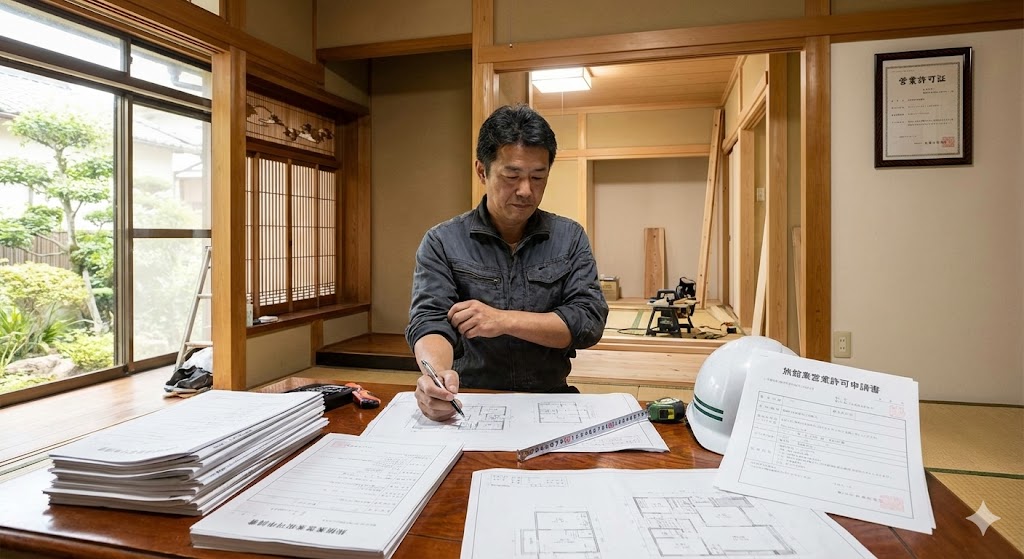
The drawings submitted to the health department and building guidance division must clearly specify exact dimensions, the intended use of each room, and the location of equipment. Hand-drawn or inaccurate drawings won’t be accepted, and you’ll be told to redo them over and over. In many cases, this back-and-forth alone wastes several months.
Over-Investing in Equipment—or Falling Short
Very often, owners who install fire safety equipment based on their own judgment end up either discovering “we actually didn’t need such extensive equipment” (over-investment), or the opposite: “we fell just a few centimeters short of the standard, and had to redo everything” (additional construction). When a professional is involved, they can propose the most efficient path to compliance, ultimately keeping construction costs down.
Delayed Opening Means “Lost Opportunity”
Suppose handling the application yourself causes your opening to be delayed by three months. If your projected monthly revenue is ¥500,000, that’s a loss of ¥1.5 million. Skimping on professional fees only to lose out on far greater revenue is a serious setback from a business standpoint.
Key Points for Successfully Operating a Simple Lodging Facility in Osaka City
Osaka City, with its option of Special Zone Minpaku (tokku minpaku) as an alternative, is a fiercely competitive market for lodging businesses. Within that landscape, the advantage of choosing a simple lodging facility (under the Hotel Business Act) is that there’s no minimum stay requirement, allowing for more flexible operations.
Whether a “Certificate of Inspection” for Building Confirmation Exists
When repurposing older properties in Osaka City, it’s not uncommon to find that the “Certificate of Inspection” (kensa-zumisho) issued at the time of construction is missing. Without it, the hurdle for a use change rises significantly—although in some cases, this can be substituted through investigation conducted in line with official guidelines. This is an area where the expertise of a specialist who has handled numerous Osaka properties becomes indispensable.
Designing with Operations in Mind, from the Start
Obtaining the license isn’t the final goal. Whether your layout considers operational practicality—is it easy to clean? Is there space to store linens? Can guests fully open their suitcases?—directly affects your post-opening reviews (aiming for that 5-star rating).
Conclusion: Use the “System” and “Professionals” Wisely for Your Use Change
The process of converting a residential property into a simple lodging facility is, at its core, an effort to transform real estate into a revenue-generating asset.
- Above 200 square meters, an architect is mandatory—and even below that threshold, legal compliance is unavoidable.
- You must simultaneously satisfy standards across three fronts: fire safety, health department, and building regulations.
- Weigh the effort and risk of doing it yourself against the revenue (or lost opportunity) after opening, and decide accordingly.
Understanding the process flow, then entrusting the complex parts to professionals while focusing your own energy as owner on business decisions—what kind of property to create, and how to attract guests—is truly the shortcut to success.
From the Complex Use-Change Process to Full Operations, Stay Buddy Provides One-Stop Support
“I want to turn my vacant house into a simple lodging facility, but I don’t know where to start.”
“I went to consult with the health department myself, but got turned away amid a flood of technical jargon.”
“I want to entrust not just license acquisition, but everything from post-opening cleaning to guest support, with complete peace of mind.”
Whatever your concerns, leave them all to us.
We at Stay Buddy Inc. are a professional team specializing in lodging businesses and minpaku management throughout Osaka City.
We’re not just an ordinary management agency.
- Complete, seamless support for use changes and license acquisition, in partnership with affiliated architects and administrative scriveners (gyoseishoshi)
- Advice on fire safety and interior construction that meets Osaka City’s strict standards while keeping costs down
- Proposals for profitable layouts and equipment from an operator’s perspective, backed by revenue and expense simulations
- Hotel-standard cleaning after opening, 24/7/365 guest support, and strategic marketing to drive bookings
Transforming your valuable property into a legally compliant, highly profitable lodging facility—we handle all the complex procedures required to make that happen.
Let us help bring your real estate vision to life. Please feel free to reach out for a free property assessment and personalized consultation to get started.