Essential Information for Starting a Vacation Rental Business in Furano
The first step to starting a vacation rental business in Furano is accurately understanding which legal framework applies to your property. Vacation rentals broadly fall into three categories: the “Private Lodging Business Act” (the minpaku law), the “Hotel Business Act” (simple lodging operation), and “vacation home rentals” (operated under the Hotel Business Act). Each has different permit requirements, operating-day limits, and facility standards.
Furano City is one of Hokkaido’s premier tourist destinations, welcoming more than two million visitors annually. Travelers from Japan and abroad flock to the area in summer for its lavender fields and agricultural experiences, and in winter for Furano Ski Resort. As inbound demand continues to recover, a shortage of accommodation has become apparent, driving growing interest in minpaku and vacation rental properties.
This article provides a comprehensive overview for owners considering a lodging business in the Furano area, covering legal requirements, initial costs, revenue simulations, and operational practicalities—based on the latest information as of 2026. It’s structured to be useful even before you acquire a property, so use it as a guide to grasp the full picture of your plan.
The Three Business Types and How to Choose the Best Fit for Furano
Notification Under the Private Lodging Business Act (Minpaku Law)
The Private Lodging Business Act, enacted in 2018, is a system that allows homes to be offered as lodging for up to 180 days per year, upon notification to the prefectural governor. Its advantages include a relatively low barrier to entry and the ability to use an existing residence as-is. Documents required for notification include floor plans of the home, documentation showing fire safety equipment installation, and—for rented properties—a sublease consent form. Notifications in this case are filed with the Hokkaido Prefectural Government.
However, Hokkaido ordinances may impose additional restrictions on zones and operating periods. In Furano City, you’ll need to check in advance whether there are any operating restrictions in exclusively residential zones. Also, because of the 180-day annual cap, it’s quite possible to use up your entire allowance during the peak summer (July–August) and winter (December–February) seasons alone. For owners seeking stable, year-round revenue, obtaining a Hotel Business Act license—discussed next—is a more realistic option.
Obtaining a License Under the Hotel Business Act (Simple Lodging Operation)
Obtaining a simple lodging operation license under the Hotel Business Act allows you to operate 365 days a year with no annual limit on operating days. In an area like Furano, with its two major seasons of summer and winter, this makes it possible to maximize annual occupancy, dramatically speeding up investment payback. Licensing requirements include a guest room area of at least 33 square meters (or at least 3.3 square meters per person if accommodating fewer than 10 guests), front desk facilities (or equivalent alternative measures), and a fire safety compliance certificate.
Applications must be submitted to the Furano Branch of the Kamikawa Public Health Center, and the process from application to approval generally takes about one to two months. In some cases, a change of building use under the Building Standards Act is required, and buildings with a total floor area exceeding 200 square meters require a confirmation application. As a rough guide, expect an application fee of around ¥22,000, fire safety equipment installation costs of ¥300,000–800,000, and design fees for the use-change application of ¥500,000–1,500,000.
Operating in the Vacation-Home-Rental Style
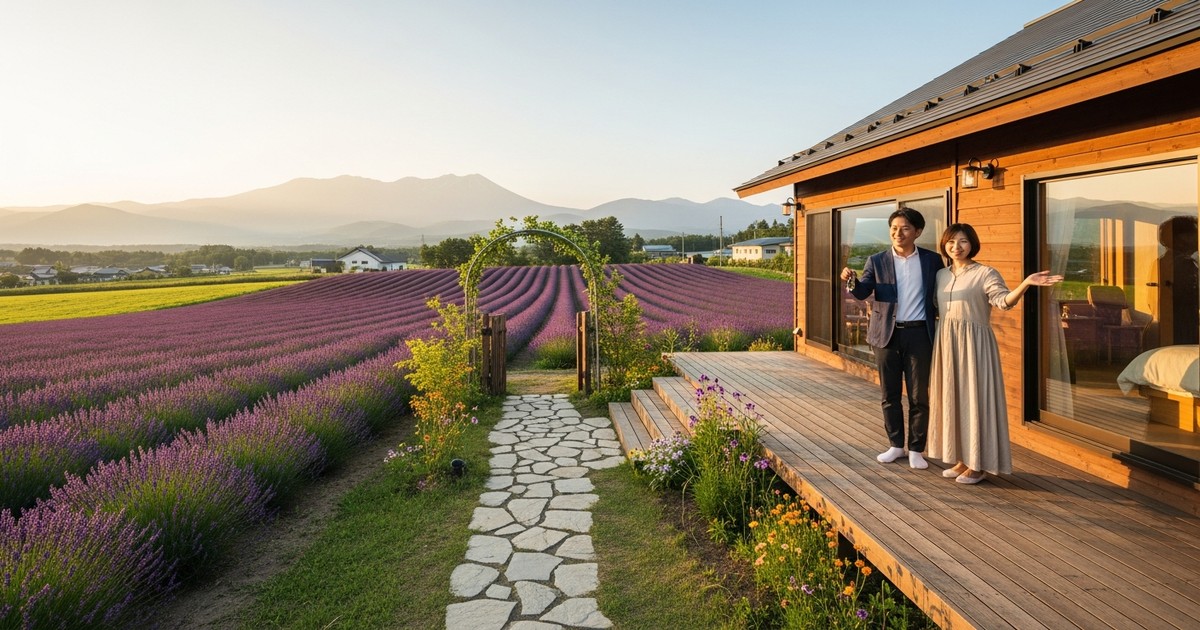
In the Furano area, whole-property vacation rentals are especially popular. Legally, most of these operate under a simple lodging operation license granted under the Hotel Business Act. This style appeals to group travelers and families and allows for higher per-night pricing. For a whole-property rental accommodating four to six guests, nightly rates of ¥30,000–60,000 in summer and ¥40,000–80,000 during the winter ski season are entirely realistic.
With a vacation rental, there’s no need for an on-site manager, but you must instead establish a system for responding to emergencies and maintaining good relations with neighbors. Furano has a long history as a resort area, and acquiring and renovating an existing used vacation home is an effective way to keep initial investment down. Depending on location, used vacation homes are available in the ¥5–15 million range, and even adding renovation costs of ¥3–8 million, the total investment can still come in lower than purchasing a single condominium unit in a major city.
Market Analysis and Revenue Simulation for the Furano Area
Characteristics of Tourist Demand and Target Guest Segments
Lodging demand in Furano is bimodal, centered on summer (June–September) lavender and flower-field tourism and winter (December–March) skiing and snowboarding. Summer visitors are mostly domestic travelers who tend to stay for short one- to two-night trips. Winter, on the other hand, sees a high proportion of long-staying inbound travelers, primarily from Australia and Southeast Asia, with stays of five to fourteen consecutive nights per group not at all uncommon.
This means property design that captures winter’s extended-stay demand is key. Specifically, a well-equipped kitchen, an in-unit washer-dryer, and dedicated space for drying and storing ski gear are all important points of differentiation. An analysis of Airbnb listings in the Furano area shows that whole-property rentals with kitchens average review scores of 4.7 or higher—clear evidence that they’re successfully capturing demand that would otherwise go to hotels and traditional ryokan.
Annual Revenue Simulation (Whole-Property Rental, Capacity of 6 Guests)
Below is a revenue model for a licensed whole-property rental accommodating six guests. In summer (June–September), with an average occupancy rate of 70% and an average nightly rate of ¥40,000, the property is booked for 85 of approximately 122 days, generating revenue of ¥3.4 million. In winter (December–March), with an average occupancy rate of 80% and an average nightly rate of ¥55,000, the property is booked for 97 of approximately 121 days, generating revenue of ¥5.34 million. During the shoulder seasons of spring and fall (April–May, October–November), with an average occupancy rate of 30% and an average nightly rate of ¥25,000, the property is booked for 37 of approximately 122 days, generating revenue of ¥930,000. Total annual revenue comes to approximately ¥9.67 million.
From this, operating expenses must be deducted: cleaning costs (¥8,000 per turnover × 219 stays) of ¥1.75 million; OTA commissions (3–15% of revenue) of approximately ¥1 million; utilities and communications of ¥600,000 per year; consumables and linens of ¥300,000; property management fees (assumed at 20% of revenue) of ¥1.94 million; and fixed asset tax and insurance of ¥300,000. Total expenses come to approximately ¥5.89 million, leaving the owner with an estimated net income of about ¥3.78 million per year. If property acquisition and renovation costs total ¥12 million, this works out to a payback period of roughly 3.2 years.
Concrete Procedures and Timeline Through Opening
Property Selection and Zoning Confirmation (6–12 Months Before Opening)
The first task is selecting a property and confirming its zoning designation. Check Furano City’s urban planning map to determine whether the property is in a zone where a lodging business is permitted. Type 1 low-rise exclusively residential zones will not be granted a hotel business license, so be sure to check with Furano City’s Urban Planning Division before purchasing any property. The Kitanomine area near Furano Ski Resort and the central downtown area are often designated as commercial or quasi-residential zones, making it easier to obtain a hotel business license there.
When acquiring a used vacation home, in addition to checking the building’s structure and age, always verify the condition of the plumbing and the capacity of the septic tank. Many properties in the outskirts of Furano lack connection to a public sewer system and instead rely on a combined treatment septic tank; if the property will be used as lodging, you’ll need a specialist to assess whether the tank’s treatment capacity, calculated per occupant, is sufficient. Replacing a septic tank can cost ¥1–2 million, so failing to check this in advance can lead to unexpected expenses.
Design, Renovation, and Fire Safety Equipment (3–6 Months Before Opening)
Once you’ve settled on a property, begin renovation work to meet the standards of the Hotel Business Act and the Fire Service Act. For simple lodging operations, automatic fire alarms, emergency exit lights, and fire extinguishers are mandatory. Buildings with two or more stories face stricter scrutiny of evacuation routes. Since preliminary consultations with the fire department are free of charge, we strongly recommend bringing your floor plans to the Furano Fire Department (under the Kamikawa Fire Department Association) for consultation at the design stage.
When it comes to renovation, addressing Hokkaido’s harsh cold-climate conditions is the top priority. Adding insulation, replacing windows with double glazing, and upgrading heating systems are investments that directly affect the guest experience in winter. Kerosene central heating is common, but a growing number of properties also incorporate heat-pump heating to manage running costs. Kerosene expenses typically run ¥150,000–250,000 over the four-month winter season, so be sure to accurately reflect utility cost estimates in your financial plan.
License Applications and Other Notifications (1–3 Months Before Opening)
Alongside renovation work, prepare the documents needed for your hotel business license application. Submit the application form, floor plans showing the facility’s structure and equipment, a fire safety compliance certificate, and (if using well water) water quality test results to the Furano Branch of the Kamikawa Public Health Center. Assuming no deficiencies in the documentation, a license will typically be issued within one to two months following an on-site inspection.
At the same time, begin preparing your listings for OTAs (online travel agencies) such as Airbnb, Booking.com, and Rakuten Travel. Professional photography of the property is an investment that directly drives bookings—data shows that a photography cost of ¥30,000–50,000 can boost booking rates by 20–30%. Additionally, if filing notification under the Private Lodging Business Act, you are required to notify minpaku intermediary businesses of your notification number.
Practical Points for Successful Operations
Pricing Strategy and Revenue Management
Because lodging rates in Furano fluctuate significantly by season, operating on a fixed-rate basis leads to lost opportunities. During peak periods—the lavender season in summer (mid-July to early August) and the ski high season in winter (late December to February)—demand peaks, allowing rates 1.5 to 2 times higher than the standard rate. Conversely, during the slow seasons of April–May and October–November, offering substantial discounts or weekly rates is an effective strategy for maintaining occupancy.
A practical approach is to adopt a dynamic pricing tool (such as PriceLabs or Wheelhaus), which automatically adjusts rates in real time based on analysis of competing properties’ pricing and booking status nearby. For a tool subscription cost of around ¥5,000–15,000 per month, there are reported cases of annual revenue increasing by 10–20%.
Building a Cleaning and Maintenance System
Securing cleaning staff can be more difficult in the Furano area than in urban centers. The typical cleaning cost for a whole-property rental runs ¥6,000–12,000 per turnover, but during peak season, cleaning companies’ schedules fill up quickly, sometimes making it impossible to accept new bookings. Signing contracts with multiple cleaning companies before opening, or securing a partnership with a local silver human resource center (a staffing service for retirees), is essential for stable operations.
Snow removal is a winter-specific maintenance task. Clearing parking areas and approach paths on the property is essential for guest safety. An annual contract with a snow removal company typically costs ¥100,000–200,000 per season, or ¥3,000–8,000 per visit if billed based on snowfall volume. Measures to prevent frozen pipes (such as installing drain-back valves and freeze-prevention heaters) are also essential equipment investments for winter operation.
Serving International Guests and Multilingual Communication
With a high proportion of inbound guests in winter, the ability to communicate in English, Chinese, and Thai has a direct impact on bookings in Furano. Preparing a multilingual guest guidebook—covering check-in procedures, how to use the facilities, garbage sorting rules, and information on nearby restaurants—can dramatically reduce the burden of responding to guest inquiries. Translation typically costs ¥30,000–50,000 per language, but once created, the guide can be reused for a long time, making it a highly cost-effective investment.
Installing a smart lock (such as RemoteLOCK or Sesame) enables contactless check-in, allowing for 24-hour availability while keeping labor costs down. Installation typically costs ¥30,000–60,000 per unit, plus a monthly fee of ¥1,000–2,000. By setting up a system that automatically sends guests their access code via message on check-in day, smooth operations are possible even when the owner is not on-site.
For Vacation Rental Management in Furano, Talk to Stay Buddy Inc.
Many owners considering a minpaku or vacation rental business in Furano feel anxious about the complexity of legal procedures and the challenges of managing a property remotely. Having a partner who can provide consistent support—from property selection and license applications to renovation planning, OTA management, and day-to-day guest communication—is a major key to business success.
Stay Buddy Inc., a vacation rental management company, has extensive experience managing minpaku and lodging businesses across Japan, including Hokkaido. From pricing strategy for maximizing revenue and multilingual guest support to cleaning coordination and issue resolution, we can handle every aspect of operations for you as a one-stop solution.
If you’re seriously considering opening a property in the Furano area, we invite you to start with a free consultation from Stay Buddy Inc. You’ll receive specific advice tailored to your situation, including a profitability assessment of your property and recommendations on the most suitable business format. Please feel free to get in touch through the Stay Buddy Inc. official website.