Leave Your Vacation Rental Management to Us
Free Online ConsultationAs the global vacation rental market continues to grow, more and more owners and operators are eager to actively attract guests from overseas.
However, once you decide you want to “promote your property internationally,” you need to become familiar with channels quite different from those used domestically—language and cultural barriers, the diversity of social media and search engines, and more. With inbound demand gradually recovering since the pandemic and the barriers to overseas travel continuing to fall, the value of actively reaching out to international audiences has never been greater.
This article dives deep into the theme of “social media and advertising strategies for promoting your vacation rental to overseas guests,” compiling concrete approaches and practical know-how.
We’ll cover everything from social media platforms to language considerations, advertising tips, and hands-on strategies—exploring the many possibilities for attracting international guests. At the end, we’ve included information on how to consult with experts who can provide comprehensive support for your rental operations. If you’re an owner or property manager looking to strengthen your overseas PR efforts, we hope you’ll find this useful.
1. Reaching a Global Audience: Broadening Your Perspective First
1-1. Different Countries and Regions Favor Different Social Platforms
When thinking about international PR, you might assume that since Facebook and Instagram are globally famous, using them is enough.
In reality, though, the dominant social platforms vary subtly from country to country and region to region. In China, for example, Facebook and Instagram are restricted, so WeChat, Weibo, and RED (Xiaohongshu) serve as the main platforms. In Russia, it’s VK; in South Korea, KakaoTalk; and across Southeast Asia, TikTok has become explosively popular.
From a global perspective, platforms like Twitter, TikTok, YouTube, Facebook, and Instagram still carry significant influence, but understanding the social media landscape of your target countries will allow for far more effective outreach.
1-2. The Need for Multilingual Support
If you want to reach users around the world, it’s ideal to consider supporting not just English but also major languages such as Chinese, Korean, Spanish, and French. While mastering every language completely may not be realistic, it’s a good approach to post primarily in English while incorporating the local language or relevant hashtags when focusing on a specific market.
If you’re not yet able to fully translate your property descriptions or website into multiple languages, using automated translation tools is one option—but be careful of nuance and phrasing errors. Whenever possible, having a native speaker review the content or having a professional translator supervise the work will help ensure smooth, misunderstanding-free communication.
2. Social Media Strategy: Which Platforms, and How to Use Them
2-1. Instagram / Facebook: Visual-Focused Branding
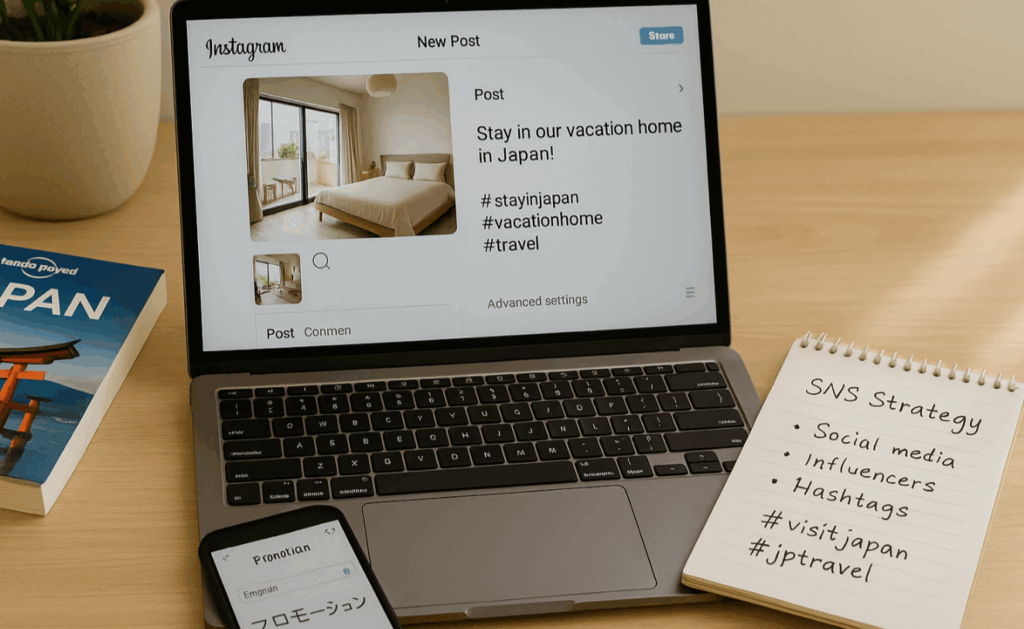
If you want to showcase photogenic interiors and nearby attractions, Instagram is essential. It’s widely used across a broad range of ages, from young people to middle-aged users, in English-speaking countries, Western markets, and Asia alike—making it easy to showcase your property’s appeal (interior design, location, host hospitality) through photos and reels.
Facebook’s user base skews slightly older, but you can leverage community groups to reach your target market. By joining travel- and tourism-related groups and posting property information or promotions, you may be able to attract interested users.
2-2. Twitter/X: Real-Time Engagement and Viral Reach
Twitter (now increasingly referred to as X), which has a massive global user base, is known for its high potential for virality. Using hashtags makes it easier for interested users to find your posts, and a chain of retweets can rapidly boost your visibility.
Posting short property highlights and photos aimed at English-speaking audiences, along with real-time announcements for booking promotions and campaigns, can be highly effective. Additionally, actively engaging with travel-related accounts and influencers in your target countries—following them, replying to their posts—can help you expand your exposure.
2-3. TikTok / Douyin (China)
TikTok, the globally popular short-video app, is a powerful tool thanks to its visual impact and concise storytelling. Packing a tour of your property’s interior or ideas for enjoying your stay into a video just tens of seconds long makes for engaging content that’s likely to spread.
Since Douyin is the Chinese equivalent, posting the same video content there is an effective way to reach Chinese tourists. Properties with stunning scenery or unique experiences have a great opportunity to capture attention quickly by leveraging the strengths of TikTok and Douyin.
2-4. Weibo, WeChat, RED (Xiaohongshu): Reaching Mainland China
China has developed its own unique ecosystem of social media and search engines, with Weibo and WeChat, as well as RED (Xiaohongshu), serving as the primary platforms. Weibo offers Twitter-like viral reach, WeChat functions as both a messaging app and a multi-purpose platform, and RED is centered around a predominantly female user base actively sharing beauty and travel information—each platform has its own target audience and posting style.
If you’re targeting Chinese tourists visiting Japan, you’ll need to either outsource the management of these platforms or hire staff proficient in Chinese to run them in-house, tailoring your content to local culture and platform rules.
2-5. YouTube: Long-Form Room Tours and Travel Guides
Another strategy is to build a YouTube channel with English or multilingual subtitles, creating 360-degree room tour videos and introducing the property along with nearby facilities. YouTube also functions as a powerful search engine—for instance, matching search terms like “Kyoto Airbnb” or “Tokyo pet-friendly lodging” can help you catch the interest of viewers browsing travel videos and vlogs.
Since YouTube videos can run longer than short-form content, it’s also a great opportunity to take your time showcasing the host’s attention to detail and local highlights, building trust and a sense of familiarity with viewers.
3. Advertising Strategy: How to Run Ads Aimed at International Audiences
3-1. Setting Location and Language in Google Ads
When advertising internationally, Google Ads remains one of the fundamental tools. You can set geographic targeting to narrow your delivery to regions like Asia or Western countries. By preparing ad copy in English or Chinese separately from your domestic Japanese campaigns and leveraging search keywords and display ads, you can effectively reach travelers from overseas.
One important point is to fine-tune your campaign’s language and regional settings carefully. Rather than targeting too broad an audience, optimize toward users with clear travel intent, such as those searching for something like “Japan trip + [country name].”
3-2. Multilingual Campaigns with Facebook Ads / Instagram Ads
Building on the social media strategies mentioned earlier, Facebook Ads and Instagram Ads allow you to precisely target users based on location, interests, and language settings. For example, you could display a photo ad featuring your rental property specifically to English-speaking users interested in “Japan Travel.”
Additionally, testing multiple ad creatives (images, videos, and copy) through A/B testing to determine which combination generates the highest click-through and conversion rates lets you make the most efficient use of your ad budget.
3-3. Consider Advertising Within Overseas OTAs Too
Moving away from over-reliance on OTAs doesn’t necessarily mean abandoning listings altogether. One option is to advertise within international OTAs such as Booking.com and Expedia. Using “boost” features that push your property higher in platform rankings could help you achieve top placement in local-language searches.
However, since OTA advertising means paying additional fees on top of standard commissions, you’ll need to carefully weigh the cost-effectiveness before proceeding. Ultimately, direct bookings through your own channels and social media are the ideal long-term goal, but using OTA advertising as a transitional strategy isn’t a bad choice.
Leave Your Vacation Rental Management to Us
Free Online Consultation4. Practical Considerations for Day-to-Day Operations
4-1. Language Support and Guest Communication
If you’re attracting overseas guests through social media and advertising, having a system in place for smooth communication during inquiries and bookings is essential. If you’re a host who isn’t confident in English, consider translation tools, multilingual staff, or outsourced call center services.
Slow responses or poorly translated messages that cause confusion won’t just cost you a potential guest’s interest—they can also lead to real problems. Prompt replies and courteous communication increase guest satisfaction and are more likely to lead to positive word-of-mouth.
4-2. Cultural and Religious Sensitivity
Travelers from overseas come from diverse backgrounds with varying dietary customs, traditions, and religious requirements. Providing information on halal-friendly restaurants nearby for Muslim guests, or nearby supermarkets and ingredients for vegetarian guests, shows cultural and religious awareness that helps build a reputation as being “welcoming to international guests.”
Highlighting these considerations specifically in your social media posts and advertisements can enhance your appeal to certain guest segments and serve as an effective point of differentiation.
4-3. Time Zone Differences and the Use of Translation Tools
Communicating with overseas guests inevitably involves time zone differences, which can make it challenging to maintain a policy of replying within 24 hours. Setting up automated responses and message templates helps, and if a reply is delayed, being upfront—such as saying “We apologize for the delay due to the time difference“—shows sincerity.
It’s also a good idea to draft messages using translation tools (Google Translate, DeepL, etc.) and then have a native speaker or bilingual staff member review them before sending, minimizing the risk of trouble caused by mistranslations.
5. Conclusion: Break Free from OTA Dependence by Fully Leveraging Social Media and Advertising
By putting “social media and advertising strategies for promoting your vacation rental to overseas guests” into practice, you can build a booking channel independent of OTAs and strengthen your brand. In particular, by mastering both globally used platforms (Instagram, TikTok, YouTube, etc.) and region-specific platforms (Weibo, WeChat, RED), and by tailoring your language and cultural approach to each target country, you can drive direct bookings more effectively.
By also establishing multilingual support in English, Chinese, and other languages, and building a clear pathway from inquiries via your own site or social media to actual bookings, you can minimize the impact of OTA commissions and algorithm changes. That said, reaching international audiences requires additional cost and effort—translation, time zone management, cultural sensitivity, and more. Once you’ve addressed these challenges and effectively used social media and advertising to build a loyal following, you’ll have a strong chance of achieving stable occupancy and profitability over the long term.
Even if issues arise during day-to-day operations, responding sincerely on social media and review platforms—and demonstrating a genuine commitment to improvement—helps build trust with overseas guests. Given the risks of relying solely on OTAs, now is the time to seriously consider these social media and advertising strategies, and take control of your international bookings yourself.
For International PR of Your Vacation Rental, Contact Stay Buddy Inc.!
If you want to promote your vacation rental to overseas audiences but aren’t sure where to start—whether it’s social media management, running ads, or language support—please feel free to reach out to Stay Buddy Inc.
Drawing on our extensive track record of connecting vacation rental properties with international demand, we offer comprehensive support—from choosing the right social media and advertising platforms for each country, to campaign planning and translation/communication assistance. Let’s work together to move beyond OTA dependence and build a system for attracting overseas guests directly, aiming for greater profitability and stability.