
Leave Your Minpaku Management to the Experts
Free Online ConsultationFor facilities operating under Japan’s Ryokan Business Act, accurately recording foreign guests in the guest registry and properly verifying their identity form the foundation of legal compliance. With the continued rise in inbound tourism, correctly understanding and implementing the guest registry requirements and identity verification procedures mandated by the Ryokan Business Act has become an unavoidable challenge for every accommodation facility.
In practice, however, many facility operators still grapple with questions such as: “Do we need to keep a copy of a foreign guest’s passport?” “How much information does the guest registry actually need to include?” and “What’s the correct procedure for unmanned check-ins?” Getting these answers wrong can expose a facility to administrative penalties or fines.
This article provides a comprehensive, practical guide—covering everything from the overall framework of obligations toward foreign guests under the Ryokan Business Act, to the specific items required in the guest registry, hands-on identity verification procedures, and common violation cases along with how to avoid them—so facility operators can put these practices into action right away.
The Full Picture of Guest Registry Obligations for Foreign Guests Under the Ryokan Business Act
Article 6 of the Ryokan Business Act requires ryokan business operators to maintain a guest registry and record entries accurately. While this obligation applies to all guests, a key distinguishing feature is that additional entry items are required specifically for foreign guests. Specifically, in addition to the basic information required for Japanese guests—such as name, address, and occupation—the registry must also include the “nationality” and “passport number” for foreign guests. This is explicitly stipulated in Article 4-2 of the Enforcement Regulations of the Ryokan Business Act, and every ryokan business facility must comply without exception.
This system exists for the administrative purpose of tracking the accommodation activities of foreign nationals from an immigration control perspective. Prefectural governors and public health centers have the authority to inspect guest registries, and any deficiencies can result in corrective guidance or administrative penalties. Under Article 10 of the Ryokan Business Act, violators may face fines of up to 500,000 yen, making this a serious obligation that cannot be excused by claiming ignorance of the law. Additionally, the 2023 revision to the Ryokan Business Act clarified that guest registries must be retained for three years. Facilities must maintain a system to reliably preserve records—whether paper or electronic—for the entire required retention period.
Specific Items to Include in the Guest Registry, with Example Entries
Basic Entry Items Required for All Guests, Including Japanese Guests
First, regardless of nationality, all guests must have the following items recorded: “name,” “address,” “occupation,” “date(s) of stay,” and “contact information (phone number).” Since the 2023 legal revision, recording contact information has also become mandatory as an infectious disease control measure. In principle, these items are recorded based on the guest’s self-declaration; however, it is recommended to cross-check this information against identity documents in case false information is later discovered.
Additional Entry Items Required for Foreign Guests
For foreign guests, the law requires recording “nationality” and “passport number” in addition to the basic items listed above. For example, this might look like: Name field – “John Smith”; Address field – “123 Main Street, New York, USA”; Nationality field – “United States of America”; Passport Number field – “AB1234567.” The most accurate approach is to transcribe the name exactly as it appears in Roman letters on the passport. Even foreign nationals who hold a residence address in Japan (i.e., Residence Card holders) must still have their nationality and passport number recorded in the guest registry under the Ryokan Business Act. Whether a Residence Card number can be used as a substitute varies by municipality, so it’s advisable to confirm with your local public health center in advance.
Registry Format and Retention Methods
There is no legally mandated uniform format for the guest registry—as long as all required items are covered, either paper or electronic data is acceptable. That said, records must be kept in a state where they can be presented immediately during a public health center inspection. For electronic records, it’s advisable to manage data in a format that’s easy to search and view (such as Excel or a database within your PMS), and to keep backups for added security. The retention period is three years, calculated from the checkout date. For example, the registry entry for a guest who checked out on April 1, 2024, must be retained until March 31, 2027.
Correct Procedures for Verifying and Copying Passports
The Obligation to Verify the Original Passport
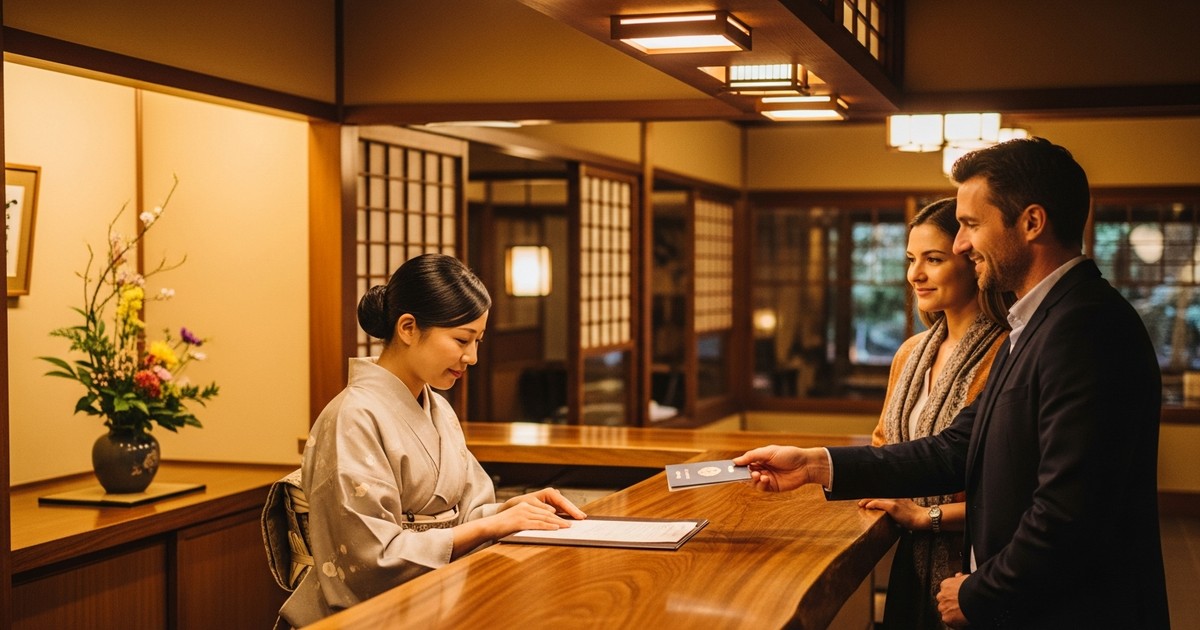
The Ryokan Business Act requires that the original passport of a foreign guest be “verified.” This means visually confirming the original document and cross-checking the information it contains (name, nationality, passport number, and photo) against the guest presenting it. In practice, this typically involves front desk staff having the guest open their passport to the photo page at check-in, transcribing the required details into the registry, and comparing the guest’s face with the photo. Skipping this step and relying solely on self-declared information constitutes a violation of the law, so caution is essential.
Is It Necessary to Keep a Copy of the Passport?
Retaining a copy of the passport is not explicitly required by the Ryokan Business Act. However, guidelines from the Ministry of Health, Labour and Welfare, as well as guidance from many local governments, recommend keeping a copy of the passport alongside the guest registry as “best practice.” In practice, retaining a copy allows facilities to verify the accuracy of registry entries after the fact, which is why nearly all ryokan and hotels do so. When obtaining a copy, facilities must clearly state the purpose of use (recording information in the guest registry as required by law) in accordance with the Act on the Protection of Personal Information. Displaying a multilingual privacy policy is an effective way to prevent disputes.
Using ICT Devices for Verification
In recent years, systems that use tablets or smartphones to photograph passports and apply OCR (optical character recognition) to automate registry entry have become increasingly common. For example, holding a passport up to a check-in terminal can automatically read the guest’s name, nationality, and passport number, registering the information directly into the guest registry database. Adopting such systems helps both prevent entry errors and improve operational efficiency. However, administrative guidance requires that identity verification not rely solely on machine reading—facial matching by staff, whether in person or via video call, must always be used in conjunction.
Key Considerations for Handling Foreign Guests at Unmanned Check-in Facilities
The 2023 revision to the Ryokan Business Act reviewed the requirements for front desk functions, allowing remote support via ICT equipment under certain conditions. This has led to a growing adoption of unmanned check-in systems, but especially strict procedures are still required when verifying the identity of foreign guests. Even at unmanned facilities, verification of the original passport and facial matching cannot be omitted.
A common approach is to equip the check-in terminal with a camera function, allowing a remote staff member to review, in real time, footage of the guest holding their passport up to the terminal. During this process, the remote staff member visually compares the photo in the passport with the guest’s face as shown on the terminal’s camera, and completes check-in once verification is successful. It’s recommended to retain the recorded footage as supplementary documentation alongside the guest registry for the duration of the retention period. Some municipalities impose their own additional requirements for handling foreign guests at unmanned facilities, so be sure to confirm the details with your local public health center when applying for a business license.
Common Violation Cases and the Risk of Administrative Penalties
Missing or Incomplete Entries in the Guest Registry
The most common violation involves failing to record a foreign guest’s nationality or passport number. A typical case is when only the same items required for Japanese guests are recorded, while the additional required items are overlooked. There have also been reported cases where, particularly during busy periods or group check-ins, only the representative guest’s information is recorded while details for accompanying guests are omitted. Under the Ryokan Business Act, a separate guest registry entry must be created for each individual guest, meaning entries are mandatory for every accompanying guest as well.
Checking In Guests Without Verifying Their Passport
Many facilities mistakenly believe that since a guest entered their passport details during the reservation process, no on-site verification is necessary at check-in. However, the Ryokan Business Act requires verification of the original document at check-in—information entered online in advance is merely a supplementary measure. If a facility completes check-in without verifying the original passport, it risks being flagged during a public health center inspection, potentially leading to improvement orders or even suspension of business. In fact, there have been multiple reported cases across various municipalities where administrative guidance was issued due to inadequate identity verification.
Violations of the Registry Retention Period
Violations of the three-year retention requirement for guest registries are also occasionally observed. Examples include paper registries stored in a warehouse becoming illegible due to humidity, or old data being deleted during a system migration. Whether using electronic or paper records, it is essential to perform regular backups (for electronic data) or ensure proper storage conditions (for paper records). If a facility cannot produce the required records when requested by a public health center during the retention period, this itself constitutes a legal violation subject to penalties.
Multilingual Support and Building a System for Welcoming Foreign Guests
Beyond simply fulfilling legal obligations, creating an environment where foreign guests can check in smoothly is important both for enhancing a facility’s reputation and for preventing trouble. As a practical step, it’s effective to offer guest registry forms and check-in terminal screens in at least four languages: English, Chinese (both Simplified and Traditional), and Korean. According to Japan Tourism Agency surveys, approximately 85% of inbound visitors come from regions where these four languages are spoken.
It also helps to display multilingual signage explaining why passport presentation is required, making it easier for guests to understand and reducing the burden on staff to explain in person. For example, a Japanese notice stating the equivalent of “Under Japanese law, foreign guests are required to present their passport at check-in” can be displayed in English exactly as such. Preparing multilingual explanations about the handling of personal information as well will facilitate smoother communication with guests, which in turn helps improve the accuracy of guest registry entries.
Need Help with Foreign Guest Compliance? Consult Stay Buddy Inc.
Fulfilling the obligations toward foreign guests under the Ryokan Business Act involves a wide range of practical tasks—accurately maintaining the guest registry, verifying identity through passports, and properly retaining records. For facilities that have adopted unmanned check-in systems, or for operators managing multiple properties, maintaining a fully compliant operational system across every location is far from simple.
Stay Buddy Inc., a specialist in minpaku (private lodging) management, provides comprehensive support for ryokan business operations, handling everything from foreign guest identity verification to the creation and retention of legally compliant guest registries. Our services—including building multilingual check-in systems, advising on the selection and implementation of ICT systems, and providing guidance on public health center interactions—significantly reduce the operational burden on facility operators.
If you’re wondering whether your current operations meet legal requirements, looking to overhaul your foreign guest procedures, or struggling to keep up with management as your portfolio of properties grows, please don’t hesitate to reach out to Stay Buddy Inc. Our experienced team will propose the optimal operational plan tailored to your facility’s specific situation.