What Are the Structural Standards for Ryokan Business Licenses? 3 Common Pitfalls in Hokkaido
When considering a lodging business in Hokkaido, an increasing number of owners are aiming to obtain a Ryokan Business License (Simple Lodging category)—which allows operation 365 days a year—rather than simply filing a notification under the Private Lodging Business Act. However, the Ryokan Business Act sets forth strict structural and facility standards, and attempting to repurpose an ordinary residential home as-is often results in substantial renovation costs, or worse, outright rejection of the license application. In Hokkaido, with its vast land and harsh natural environment, region-specific rules and climate conditions can pose particular hurdles.
This article provides a detailed overview of the structural standards essential for obtaining a Ryokan Business License, along with three points that require special attention for properties in Hokkaido—compared against the broader real estate market.
The Basics of Structural Standards for Ryokan Business Licenses
The structural and facility standards under the Ryokan Business Act exist to protect the safety, hygiene, and privacy of guests. Requirements include basic sanitary conditions such as guest room floor area, ventilation, natural light, lighting, and moisture control, as well as fire evacuation routes—closely tied to the Building Standards Act and Fire Service Act.
For Simple Lodging operations, guest room floor space must total at least 33 square meters (or, for fewer than 10 guests, 3.3 square meters multiplied by the number of guests). An appropriate number of bathing facilities, washbasins, and toilets must also be installed. While some of these standards are applied nationwide, a key characteristic is that the detailed application of these rules varies significantly depending on the ordinances set by each local health center (Hokenjo).
Hokkaido Pitfall #1: Front Desk Installation and Alternative Measures
When applying for a Ryokan Business License in Hokkaido—particularly in urban areas like Sapporo—the biggest hurdle is often the requirement to install a front desk (genkan-chōba). In principle, the Ryokan Business Act requires a space for verifying guest identity, handling key exchanges, and conducting face-to-face interactions.
In the past, even small-scale simple lodging facilities were required to have a physical counter. Today, however, non-face-to-face identity verification using ICT (video calls and smart locks) is increasingly permitted. That said, ordinances in cities like Sapporo remain strict: if a property does not have a front desk, strict additional conditions apply—such as maintaining a management office capable of emergency response within a certain distance of the property, or installing equipment that allows constant video monitoring.
Interpretations can vary even further among regional municipalities. Owners who approach this with a casual “let’s turn part of my house into a private rental” mindset often overlook the cost of establishing this management system.
Hokkaido Pitfall #2: The Relationship Between Sanitary Facility Count and Guest Capacity
The next point to watch is the number of toilets and washbasins required. Under the Ryokan Business Act, the number of necessary facilities is determined based on guest capacity.
Most ordinary homes are designed with a single toilet and single washbasin, built with a single family’s use in mind. However, when aiming to accommodate larger groups as a Simple Lodging facility, some municipalities impose stricter requirements—for example, two toilets or two washbasins for a capacity of five guests.
Although many detached houses in Hokkaido feature spacious layouts, adding plumbing for additional water facilities requires piping work, which can push renovation costs up by several million yen. Confirming with the local health center beforehand—how many guests the existing facilities in a given building can be approved for—is an essential rule of thumb for protecting your investment returns before purchasing a property.
Hokkaido Pitfall #3: Evacuation Routes and Snow Countermeasures Unique to Cold Regions
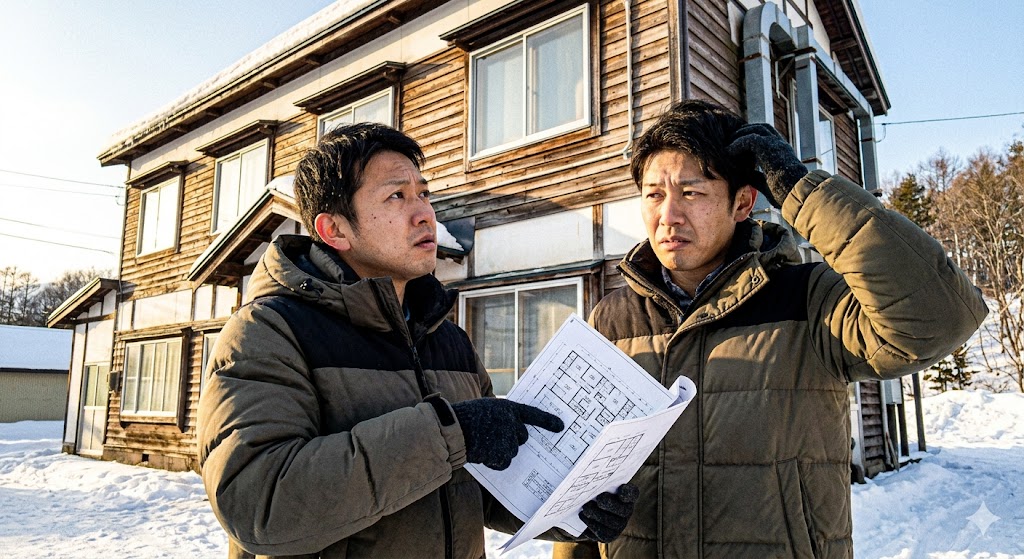
A point unique to Hokkaido is ensuring safety during the winter months. The Ryokan Business Act and the Fire Service Act mandate that evacuation routes be secured in the event of fire or disaster—but in Hokkaido, the risk of snow blocking these routes must also be taken into account.
For instance, if an emergency exit door risks being blocked by snow, or if the structure allows snow to accumulate at the base of an evacuation staircase and prevent descent, corrections will be required during the licensing process. Designs where falling snow from the roof could strike an evacuation route are also strictly scrutinized.
Furthermore, insulation structures and heating equipment specific to cold regions are rigorously assessed for fire safety. Details often overlooked in ordinary residential homes—such as the placement of stoves, the distance from walls, and the structure of exhaust flues—are frequently flagged as non-compliant during Ryokan business inspections.
Comparison with General Rental and Sales Market Trends
Comparing Hokkaido’s real estate market—particularly within Sapporo City—against general residential rentals and sales reveals a stark contrast in profitability and risk between the two.
Prices for condominiums and detached homes in Sapporo have been trending upward, particularly in central areas, which has caused surface yields on general rentals to decline. When renting out a property as a standard residence, yields typically fall in the 4% to 6% range—offering stable returns, but little prospect of rapid asset appreciation. Additionally, since rent levels are constrained by local income levels, even substantial renovations struggle to justify significant rent increases.
By contrast, a lodging business operating under a Ryokan Business License draws its revenue directly from global tourism demand. Nightly rates can be set independently of local rental market prices, allowing for aggressive pricing—sometimes tens of thousands of yen per night during peak season. The potential to achieve real yields of 10% or more is a unique strength of the lodging business.
That said, lodging businesses come with high upfront licensing costs, ongoing cleaning and management expenses, and occupancy risk driven by seasonal fluctuations. If general rentals represent a stable investment, the lodging business is closer to an operational enterprise—where returns fluctuate significantly based on the quality of management. Currently, Sapporo is seeing an increase in the supply of lodging facilities, and there is a clear risk that properties with poor locations or low-quality operations could end up earning less than a standard rental.
Concrete Customer Acquisition Strategies for Private Rental Operations
When operating 365 days a year under a Ryokan Business License, a strategic approach to guest acquisition that leverages this advantage is essential.
Target Setting and OTA Utilization
Focus your targeting on guests seeking a sense of privacy that hotels cannot offer—specifically, families from Asia or Western countries touring Hokkaido by rental car, or larger groups of five or more adults. Since photo quality heavily influences booking rates, professional photography is a must. Visually convey the value of the stay experience: a cozy living room for gathering together, windows overlooking snowy scenery, and a fully equipped kitchen.
Dynamic Pricing Based on Seasonality
Because demand in Hokkaido fluctuates so dramatically by season, operating with a flat nightly rate represents a missed opportunity. A carefully designed pricing strategy is essential—maximizing rates during the winter ski season and summer tourist season, while offering long-stay discounts during the off-season. In particular, taking advantage of year-round operation under the Ryokan Business License, targeting remote workers or local tourists near Sapporo during the off-season can boost annual revenue.
Added Value for Differentiation
In the highly competitive Sapporo market, a property that offers nothing more than a place to sleep will simply blend into the crowd. Features like a private sauna, a home theater experience with a projector, or curated local food delivery options give guests a reason to choose your property specifically—driving repeat bookings and sustaining higher price points.
Building an Operational System That Protects Long-Term Asset Value
Succeeding in the lodging business across Hokkaido’s vast landscape requires more than simply clearing legal structural standards—that’s merely the starting line. Withstanding harsh winters and continuously meeting the ever-shifting demands of the tourism market requires thorough on-site management and strategic operational expertise.
Cutting corners on initial renovation costs in pursuit of a half-hearted license approval often leads to frequent operational troubles down the road, ultimately resulting in significant losses. Correctly understanding structural standards and developing a property with a future exit strategy in mind is what truly enhances its value as a real estate asset.
The lodging business is a dynamic form of investment that generates returns by actively putting real estate to work. By complying with local regulations and consistently delivering an outstanding guest experience, you can build an asset whose value remains undiminished for years to come.
Leave Your Hokkaido Private Rental Launch and Management to Us
To all owners considering a lodging business in Sapporo and the wider Hokkaido region: from clearing the structural standards required for Ryokan Business Licensing, to planning and constructing properties designed to maximize revenue, to day-to-day operational management—leave every step of the launch process to Stay Buddy Co., Ltd.
We are a team of professionals deeply familiar with Hokkaido’s climate, region-specific ordinances, and tourism market trends. We respect each owner’s budget and goals when navigating complex legal procedures and often costly renovation work, proposing the most efficient solutions possible. Leave your private rental launch and management in Sapporo and across Hokkaido to us.
From harsh winter cold and snow countermeasures, to multilingual guest support, to data-driven pricing—we take on every hassle that comes with running a lodging business. We are committed to giving owners the experience of stable revenue and the satisfaction of watching their assets grow. Please feel free to reach out to Stay Buddy Co., Ltd. for an initial consultation. Our specialist staff will carefully propose the optimal operational plan tailored to your specific needs. We look forward to hearing from you.