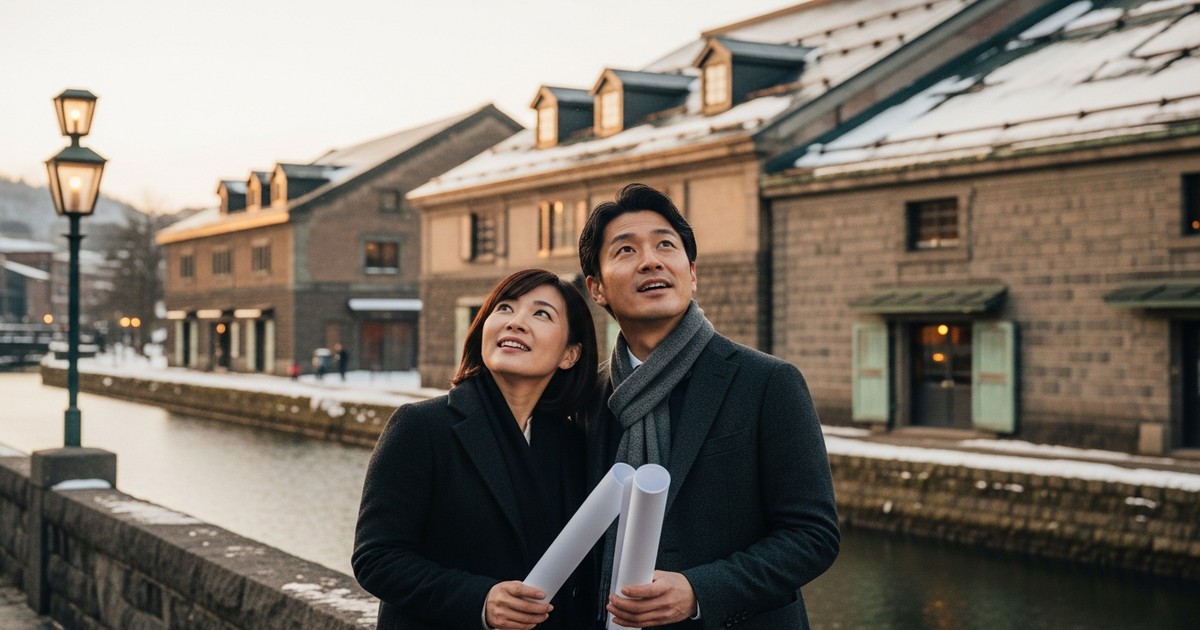
Investing in an accommodation property in Otaru has become an increasingly attractive real estate strategy as tourism demand continues to climb. This city of canals and historic architecture draws roughly 8 million domestic and international visitors each year, creating a stable base of lodging demand. However, the path from finding a property to actually opening for business involves numerous steps, and failing to grasp the full process in advance can lead to unexpected costs and wasted time.
This article walks through the concrete steps involved in accommodation investment in Otaru, from selecting a property to obtaining the necessary licenses, renovating, and finally opening your doors—for those considering entering this market. We’ve also included cost estimates and decision-making criteria at each stage to help you build a realistic action plan.
Step 1: Area Selection and Market Research for Accommodation Investment in Otaru
Narrowing Down Your Target Area
When searching for a property to use as an accommodation facility in Otaru, the first priority is narrowing down your target area. Considering tourist flow patterns, the three most promising areas are around Otaru Canal, Sakaimachi Street, and within walking distance of Otaru Station. The canal area draws strong numbers of international visitors, Sakaimachi Street sees heavy day-trip traffic but also solid overnight demand, and the area near the station offers convenient access from Sapporo, with potential for business travelers as well.
Property prices per tsubo vary significantly by area. In the commercial zone around the canal, expect roughly ¥150,000–¥300,000 per tsubo, while residential areas farther from the station run around ¥50,000–¥100,000 per tsubo. To secure a solid return on investment, you’ll need to balance your acquisition cost against your projected room rate. For example, running a property at a nightly rate of ¥15,000 with a 60% occupancy rate would generate annual revenue of approximately ¥3.28 million per room—a useful benchmark for working backward to determine the maximum property price you should consider.
Researching Competitors and Understanding Demand
Otaru is home to more than 200 accommodation facilities, including hotels, ryokan, guesthouses, and minpaku. Search OTA (online travel agency) sites for properties in your target area and check their pricing, review scores, and occupancy patterns. Areas with a high concentration of properties boasting numerous reviews and ratings of 4.0 or higher indicate strong demand—but also signal intense competition.
Seasonal fluctuation is another crucial factor to analyze. Demand in Otaru peaks during the summer months of July and August, as well as during the Snow Light Path Festival season from December through February, while April–May and October–November tend to be relatively quiet. A realistic assumption for average annual occupancy is 60–70%; building a financial plan around peak-season occupancy alone is a risky approach.
Step 2: Property Search and Acquisition Criteria
Channels for Gathering Property Information
For investment properties in Otaru, it’s worth reaching out directly to local real estate agents in addition to browsing general property portal sites. Otaru has no shortage of unlisted properties—historic buildings over 50 years old, former warehouses, and the like—that never make it onto the major portals. Visiting three to five local agencies and letting them know you’re looking to purchase for accommodation use can put you first in line when a matching property comes up.
As a rough price guide, wooden detached houses over 40 years old (with a total floor area of 80–120㎡) typically run ¥5–15 million, while former commercial buildings or warehouses (150–300㎡) generally fall in the ¥10–30 million range. That said, since Otaru sits in a heavy-snowfall, cold-climate region, it’s essential to thoroughly check the condition of the roof, exterior walls, insulation, and plumbing—repair costs for these elements can easily exceed the purchase price of the property itself.
Due Diligence Before Purchase
During your on-site inspection, focus on checking the building’s structural integrity, any signs of water leakage, cracks in the foundation, and the condition of plumbing fixtures. Where possible, commission an inspection from a licensed architect (typically ¥50,000–¥150,000). Confirming the zoning designation is also essential—under Otaru’s city planning regulations, properties located in Category 1 Low-Rise Exclusive Residential Zones may not qualify for a ryokan business license, so check with the city’s Building Guidance Division in advance.
You’ll also need to verify road access requirements (whether the property fronts a road at least 4m wide with at least 2m of frontage) and fire code requirements. Purchasing a property that fails to meet these conditions risks derailing your project at the licensing stage. Don’t be tempted by a low price alone—scrutinizing whether a property can legally operate as an accommodation facility is the single most important safeguard against investment failure.
Step 3: Developing a Business Plan and Securing Financing
Building a Revenue and Expense Simulation
Your business plan should clearly lay out initial investment costs, monthly fixed and variable expenses, and revenue projections. For example, with a property acquisition cost of ¥12 million, renovation costs of ¥8 million, ¥2 million for furniture, appliances, and supplies, and ¥500,000 for licensing-related expenses, your total initial investment comes to roughly ¥22.5 million. Monthly fixed costs might include loan repayments (around ¥80,000/month, assuming a 2% interest rate over a 20-year term), a prorated share of property tax (¥10,000–¥20,000/month), utilities (¥30,000–¥50,000/month), and communication, OTA commission, and cleaning fees—bringing your total monthly costs to roughly ¥200,000–¥300,000.
Revenue is calculated as “number of rooms × nightly rate × occupancy rate × 30 days.” For a two-room property at ¥12,000/night with 65% occupancy, monthly revenue comes to approximately ¥468,000. After subtracting operating costs, this leaves a monthly profit of roughly ¥160,000–¥260,000, meaning it would take 7 to 12 years to recoup your initial investment. Whether this payback period is acceptable is a key factor in your investment decision.
Balancing Loans and Personal Capital
For accommodation investment, you can turn to startup loans from the Japan Finance Corporation or proprietary loans from regional banks. With the Japan Finance Corporation, it’s common to secure financing at two to three times your available capital—so with ¥7 million in personal funds, you could typically expect to borrow ¥14–21 million. Since the quality of your business plan directly affects loan approval, it’s wise to build your revenue simulations using conservative figures.
Credit unions and regional banks throughout Hokkaido tend to be receptive to financing ventures tied to tourism development. Consulting in advance with institutions such as Otaru Shinkin Bank or Hokkaido Bank—and asking to be connected with a representative experienced in accommodation investment—can help the process go more smoothly. Interest rates typically range from 1.5% to 3.0%, so be sure to negotiate repayment terms and any grace periods as well.
Step 4: Obtaining Licenses and Completing Legal Procedures
Choosing Between a Ryokan Business License and Private Lodging Business Notification
To legally operate an accommodation facility in Otaru, you have two options: obtaining a license under the Hotel Business Act, or filing a notification under the Private Lodging Business Act (the “minpaku law”). A hotel business license places no limit on operating days, allowing year-round operation, but comes with strict structural and fire safety requirements. Filing under the Private Lodging Business Act is a relatively simpler process, but caps annual operating days at 180.
For investment efficiency, the standard strategy is to pursue a hotel business license—specifically the “simple lodging” (kan’i shukusho) category—which allows for year-round operation. Key requirements for this license include a total guest room floor area of at least 33㎡ (or at least 3.3㎡ per guest if hosting fewer than 10 people), proper ventilation, lighting, and humidity-control equipment, and front-desk functionality (either in-person or via ICT-based identity verification). The process from application to approval typically takes one to two months.
Preliminary Consultations with the Fire Department and Health Center
Before applying for your hotel business license, it’s essential to consult in advance with both the Otaru Fire Department and the Otaru Health Center. The fire department will provide guidance on requirements for automatic fire alarms, exit signage, and fire extinguisher placement. Depending on the size and structure of your property, you may be required to install a sprinkler system, which can add several million yen in costs. Confirming these requirements early lets you build fire safety measures directly into your renovation design.
The health center will review your guest room layout and sanitation facilities—including the number and placement of toilets, sinks, and bathing facilities—as well as ventilation systems. Bringing your floor plans to a consultation with health center staff lets them point out specific areas for improvement, minimizing costly design revisions later. Application fees for a simple lodging license run approximately ¥22,000.
Step 5: Renovation and Interior Design
Key Design Considerations for an Accommodation Facility
When renovating an older building in Otaru, insulation upgrades should be your top priority. Winter temperatures in Hokkaido can drop below -10°C, and poor insulation not only drives up utility costs to ¥50,000 or more per month but also significantly hurts guest satisfaction. Budget around ¥2–4 million for replacing insulation in walls, ceilings, and floors, along with installing double-glazed windows.
An interior design concept that draws on Otaru’s history and port-town atmosphere can be a powerful point of differentiation. Incorporating local materials—brick and reclaimed wood accents, lighting fixtures made from Otaru glass—can support a higher nightly rate. In fact, properties that lean into regional character have been known to maintain high occupancy even while charging ¥3,000–¥5,000 more per night than generic business hotels.
Selecting a Contractor and Managing the Construction Schedule
It’s important to choose a contractor with a track record of renovating accommodation properties specifically. General residential remodeling contractors often lack experience meeting fire safety equipment standards and the structural requirements of the Hotel Business Act, which can lead to costly rework and additional construction. Get quotes from at least three contractors with proven experience in accommodation property construction in Otaru or the greater Sapporo area, and compare carefully.
Construction timelines vary depending on the size of the property and scope of renovation, but for a detached house with roughly 100㎡ of floor space, expect two to four months. Since exterior work is limited by snowfall during the winter months (December–March), it’s ideal to begin construction between April and September. Delays in the construction schedule push back your opening date directly, and missing peak season can significantly impact your first year’s revenue. Share a detailed timeline with your contractor and check in on progress every two weeks without fail.
Step 6: OTA Registration, Building Your Operations Structure, and Final Opening Preparations
OTA Registration and Pricing Strategy
Starting one to two months before opening, begin registering your property with major OTAs such as Booking.com, Airbnb, Rakuten Travel, and Jalan. Hire a professional photographer (typically ¥30,000–¥80,000) and post at least 20 photos covering the guest rooms, bathroom/kitchen facilities, exterior, and nearby tourist attractions. Photo quality has a direct impact on booking conversion rates—data shows that properties with professional photography see booking rates 20–30% higher than those relying on amateur shots.
For pricing, it’s effective to reference comparable properties in the area, launch at 10–15% below market rate right after opening, and gradually raise prices as reviews accumulate. Consider implementing dynamic pricing with a 30–50% price difference between peak and off-peak seasons to help smooth out occupancy throughout the year.
Establishing Operations and Check-In Procedures
If you’re managing the property yourself, you’ll need to handle cleaning, linen changes, guest communication, and any issues that arise on your own. Cleaning typically takes one to two hours per room, or two to three hours including linen changes. If you’re operating multiple rooms or hold a full-time job elsewhere, consider outsourcing cleaning (roughly ¥3,000–¥5,000 per visit) or check-in support.
Contactless check-in using smart locks paired with a tablet device has become the standard approach. Smart lock installation typically costs ¥30,000–¥50,000 per unit, with a monthly service fee of ¥1,000–¥2,000. However, since the Hotel Business Act requires in-person or equivalent identity verification, you’ll also need a video-call identity verification system (roughly ¥5,000–¥10,000 per month). Be sure to test these systems thoroughly before opening so everything runs smoothly for your very first guests.
Considering an Accommodation Investment in Otaru? Talk to Stay Buddy Inc.
From property search and licensing to renovation and OTA management, accommodation investment demands a broad range of specialized knowledge and hands-on experience. For those entering the hospitality business for the first time in particular, there’s real risk of missteps at any given stage. Stay Buddy Inc., a minpaku management specialist, provides comprehensive support across this entire process.
Stay Buddy Inc. offers one-stop support covering everything from property selection advice and revenue simulation to license application assistance, and post-opening OTA management, cleaning coordination, and guest support. By partnering with a management company, owners can focus their energy on acquiring the right property and structuring their financing, while dramatically reducing the day-to-day operational burden.
If you’re interested in accommodation investment in Otaru, please don’t hesitate to reach out to Stay Buddy Inc. Our experienced staff will walk you through the local market conditions and help you develop a concrete investment plan tailored to your goals.