Leave Your Vacation Rental Management to the Experts
Completely Free Online ConsultationEarning Income with Whole-House Vacation Rentals in Traditional Japanese Homes: The Model Answer for Vacant Property Utilization?
Across Japan, the number of “vacant homes” continues to rise. In particular, “kominka” (traditional Japanese folk houses) standing quietly in rural areas and suburbs have become a source of anxiety for many owners—losing the people who once managed them and turning into “negative assets” that generate nothing but ongoing property tax bills.
“It’s too old to rent out.” “No one wants to buy it.” “Demolition would cost a fortune.”…
Amid this seemingly hopeless situation, one business model has emerged as a genuine “answer” and is now attracting enormous attention: **whole-house vacation rentals created by restoring traditional kominka homes.**
Let’s start with this article’s conclusion.
Whole-house vacation rentals in restored kominka homes represent a business with extraordinary potential—one that could serve as the “model answer” for vacant property utilization, perfectly matching the “experiential value” today’s travelers seek with the “storytelling power” inherent in vacant homes.
However, this doesn’t mean “anyone can easily make money.”
In this article, we’ll take a professional deep dive into why whole-house kominka rentals can be so profitable, revealing the secrets behind their revenue structure and the essential “hurdles” you absolutely must clear to achieve success.
Why Do “Whole-House Kominka Rentals” Captivate Travelers So Powerfully?
There are three overwhelming strengths unique to kominka homes that neither convenient city hotels nor sleek new-construction condo rentals can match.
1. The Value of a Truly Unique “Extraordinary Experience”
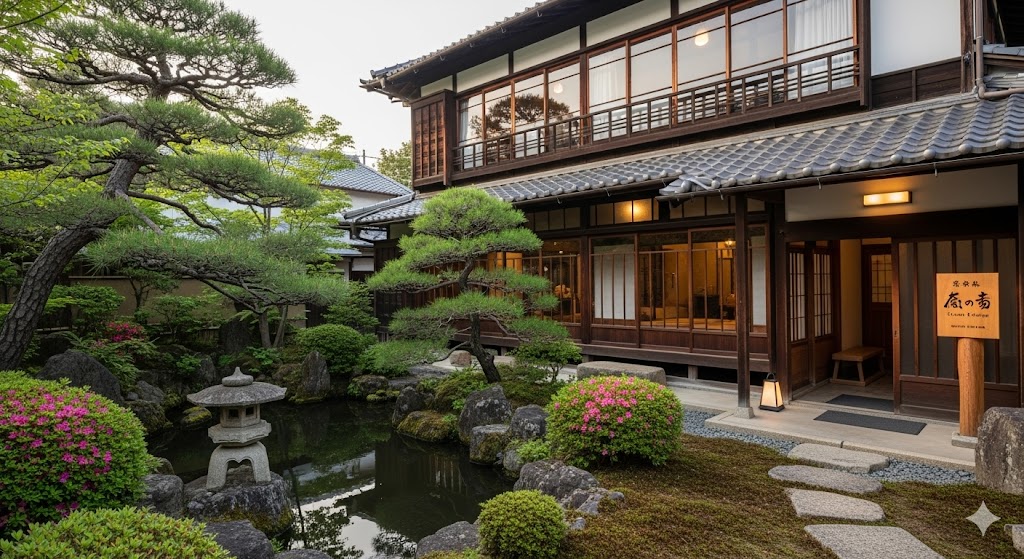
Glossy, weathered thick beams and central pillars, earthen floors and sunken hearths, beautifully carved transom panels (ranma). The rich, warm atmosphere these elements create simply cannot be experienced in a modern, functionally efficient home. For international visitors who long for a taste of traditional Japanese living in particular, **staying in a kominka home itself can become the very “purpose” of their trip.**
2. The Modern Need for “the Luxury of Doing Nothing”
Worn down by information overload in today’s society, people increasingly crave time to genuinely relax rather than rushing between tourist attractions. Sipping tea on the veranda while gazing at the garden, waking up to birdsong, quietly spending time under a sky full of stars… The “luxury of doing nothing” that a rural kominka home offers holds tremendous value as the ultimate healing experience.
3. Higher Rates and Guaranteed Privacy Through “Whole-House Rental”
Given their structure, kominka homes are exceptionally well-suited to “whole-house rentals.” This allows you to capture the entire demand for large-group stays—families, three-generation trips, groups of friends. As a result, you can set premium price points ranging from tens of thousands to well over a hundred thousand yen per night (ADR), dramatically boosting profitability.
The Secret to a Profitable Revenue Structure
The reason whole-house kominka rentals can be so profitable lies in the business model itself.
Maximizing Revenue
- Premium Pricing (ADR): As mentioned above, capturing large-group demand combined with a one-of-a-kind experience makes premium pricing achievable.
- High Occupancy (OCC): Because guests actively seek out “an experience available only here,” you can overcome location disadvantages and maintain solid occupancy rates even during off-peak seasons.
- Additional Revenue: Beyond the nightly rate, you can generate extra income through paid options such as “sunken hearth experience sets,” “firewood for wood-burning stoves,” and “harvest experiences at partner farms.”
Optimizing Costs
- Initial Investment:
- Property Acquisition Cost: By leveraging vacant home databases (akiya banks) and similar resources, you may be able to acquire the property itself for anywhere from a few hundred thousand to a few million yen—a relatively low price.
- Renovation Costs: This is the biggest expense. However, by maximizing use of **”vacant home renovation subsidies”** offered by national and local governments, you may be able to dramatically reduce this financial burden.
- Operating Costs (Running Costs):
- Variable Costs: These include OTA commissions, cleaning fees, and linen costs, but if you can maintain premium pricing, these expenses remain relatively low as a percentage of revenue.
- Fixed Costs: Property taxes, utilities, and communication expenses apply here just as they would in any standard rental property business.
The “3 Major Hurdles” to Clear—and How to Overcome Them
To earn the reward of a profitable business, you must first overcome “risks (investments and hurdles)” many times greater.
Hurdle 1: [Most Critical] The Trap of “Restoration Costs”
- The Challenge: The most important thing in kominka restoration is not to be seduced by a low purchase price. The real cost lies in the **”renovation expenses”** incurred after purchase. In particular, ①seismic reinforcement, ②improved insulation performance, and ③complete renovation of water areas (bath, toilet, kitchen) are essential to ensure guest safety and comfort—and it’s not uncommon for these combined to run several million to over ten million yen.
- How to Overcome It:
- Expert Building Inspection: Before purchasing, always have an architect with extensive kominka restoration experience conduct a **building inspection** to accurately estimate the total cost involved.
- Thorough Financial Planning: Create a detailed business plan and build a solid financing strategy that combines **subsidies** with **loans** from sources such as the **Japan Finance Corporation.**
Hurdle 2: [Legal Hurdle] The Wall of the “Hotel Business Act”
- The Challenge: If you’re aiming to operate 365 days a year, obtaining a permit under the **”Hotel Business Act (Simple Lodging)”** is essential. However, this comes with extremely strict requirements, including ①zoning restrictions (generally prohibited in residential-only zones), ②fire safety regulations (such as automatic fire alarms), and ③building code compliance (including certificate of inspection and evacuation routes).
- How to Overcome It:
- Assemble a Team of Experts: Handling this alone is virtually impossible. From the property search stage onward, forming a team with a **licensed administrative scrivener (gyoseishoshi)** and **architect** experienced in the hotel business, and thoroughly conducting **”pre-consultations”** with the public health center and fire department, is an absolute prerequisite for success.
Hurdle 3: [Human Hurdle] Coexisting with the “Local Community”
- The Challenge: Especially in quiet rural areas, it’s not uncommon for local residents to feel uneasy or uncomfortable about unfamiliar travelers coming and going frequently. Noise complaints and garbage disposal disputes represent the single greatest risk to the survival of your business.
- How to Overcome It:
- Proactive Greetings and Explanations: Before construction begins and before opening, be sure to visit the local ward chief and neighbors, courteously introduce yourself, and explain your business in detail to earn their understanding. The first priority is dispelling the anxiety of “not knowing what kind of people will be coming.”
- Commit to Becoming Part of the Community: Actively participate in local festivals and cleanup activities, and strive to be a “good neighbor” yourself first. This is the single most effective way to prevent trouble.
Conclusion: “Whole-House Kominka Rentals” Are a “Business Development” Requiring Both Resolve and Strategy
Whole-house kominka vacation rentals go far beyond simple “vacant home utilization”—they carry the local area’s history and culture into the future and inject new vitality into the community, making this a “restoration business” with profound social significance.
The road ahead is anything but smooth. Yet if you have the resolve to overcome the “hurdles” outlined in this article through passion, expert knowledge, and a meticulous business plan, your vacant home will undoubtedly transform into a “profitable treasure chest.”
Let Our Professionals Help You Open That “Treasure Chest”
“I love the idea of kominka restoration, but I have no idea where to even start…”
“I can’t even begin to guess how much the renovation costs will run…”
“Getting a hotel business permit sounds far too complicated to handle alone…”
Please bring us these hopes and concerns—we’re here to help.
We at Stay Buddy Co., Ltd. are operational experts who have guided numerous vacation rental properties to success in urban Osaka, and at the same time, we’re business development professionals dedicated to turning your dream into a sustainable **”business.”**
Here’s what we offer:
- ①A free diagnosis of whether your kominka home (or property you’re considering) can become a profitable business, based on a thorough analysis of legal regulations, market needs, and renovation costs.
- ②Support with subsidy applications and assistance securing loans from the Japan Finance Corporation, working together with you on a fundraising strategy to minimize your initial investment.
- ③One-stop support for navigating the complex **”hotel business permit”** application process, in partnership with our experienced network of **licensed administrative scriveners and architects.**
Turning your “passion” into sustainable “profit.”
Why not work with us to map out the most realistic, most reliable path forward? We’d love to hear about the untapped potential your vacant home holds—please reach out and let’s talk.