What You Need to Know About the Otaru Market Before Investing in Accommodation
When considering an investment in accommodation in Otaru, the first thing to understand is the overall market trend. Otaru City is one of Hokkaido’s premier tourist destinations, welcoming roughly 8 million visitors a year. The retro streetscapes centered around the canal, along with glasswork and sushi culture, draw huge popularity from both domestic and international travelers.
In recent years, as inbound demand has recovered, accommodation demand in Otaru has remained solid. However, occupancy rates and average nightly rates vary enormously depending on where a property is located within the city, which makes property selection the single biggest factor in investment success. This article compares two representative areas—the Canal Area and the suburbs—examining profitability, risk, and ease of operation from multiple angles.
Investing in the Canal Area|Location Strengths and Revenue Potential
Overwhelming Drawing Power from Sitting on the Tourist Route
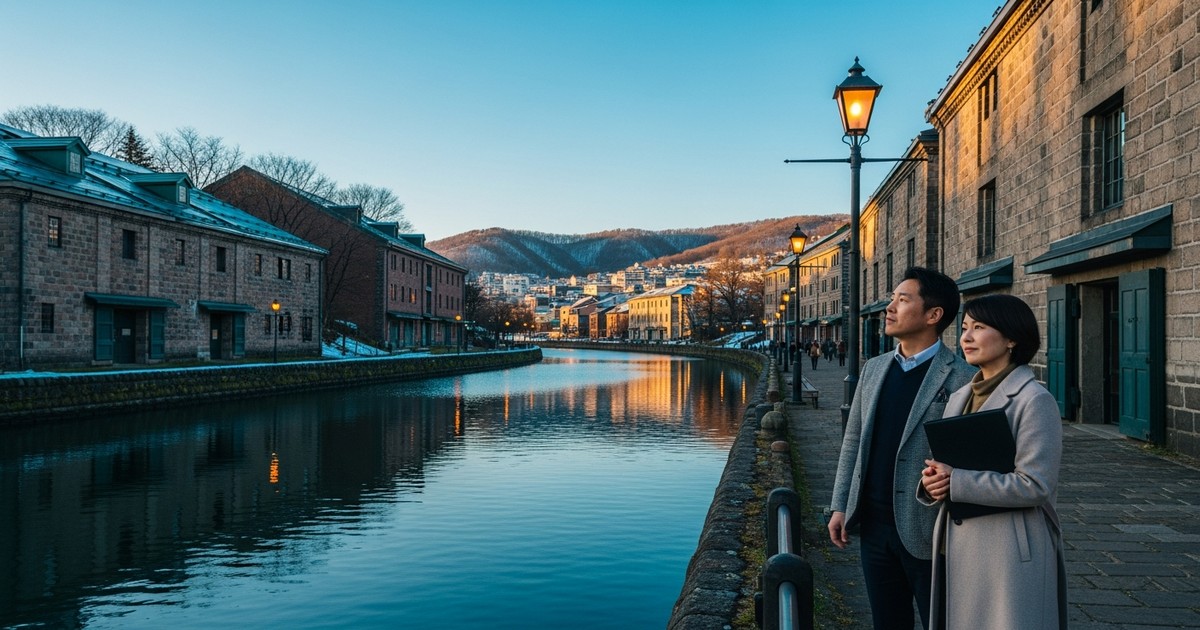
The Otaru Canal Area is the heart of Otaru tourism, with major attractions such as the canal itself, Sakaimachi Street, Kitaichi Glass, and the LeTAO flagship store all clustered within about a 10-minute walk of JR Otaru Station. An accommodation located in this area naturally sits along the flow of tourist foot traffic, which tends to translate into higher search rankings and click-through rates on OTAs (online travel agencies).
Indeed, it’s not uncommon for accommodations in the Canal Area to see occupancy rates exceeding 90% during peak seasons (summer in July–August and the Snow Light Path festival in February). Many properties can expect an average annual occupancy of around 70–80%, meaning the location itself functions as a powerful engine for attracting guests.
High Average Nightly Rates and Target Guest Segments
Accommodations in the Canal Area often command nightly rates in the ¥15,000–¥30,000 range. In particular, whole-house rentals in renovated traditional Japanese homes—aimed at inbound tourists and couples/married guests—tend to fill up even at premium rates of ¥30,000–¥50,000 per night.
This is because the experiential value of staying in one of Otaru’s historic buildings is readily accepted as a premium on top of the room rate. Properties converted from stone warehouses, or renovated merchant houses from the Taisho to early Showa eras, offer a uniqueness unavailable elsewhere, making them less susceptible to price competition.
Property Acquisition Costs and Barriers to Entry
On the other hand, property acquisition costs in the Canal Area are the highest in Otaru City. Older commercial buildings typically run ¥15–40 million, and when renovation costs are included, total investment often reaches ¥30–60 million. Properties within the historic townscape preservation ordinance zone may also face restrictions on exterior renovations, reducing design and construction flexibility—something to factor into your planning.
Furthermore, because this is such a popular area, the number of properties available for sale is limited, and many quality properties are snapped up through local networks before they’re ever listed on real estate websites. Quick decision-making and strong relationships with local real estate agents are essential for securing a property in the Canal Area.
Investing in the Suburbs|Low-Cost Entry and Differentiation Strategies
Dramatically Lower Property Acquisition Costs
In Otaru’s suburban areas—specifically Asari, Shioya, Ranshima, and Oshoro—detached houses can be acquired for roughly ¥3–10 million. Even with renovation costs added, total investment often stays within ¥8–20 million, roughly a third to half of what’s required in the Canal Area.
This low-cost structure directly shortens the payback period. For example, if a property generating ¥300,000 in monthly revenue required a total investment of ¥12 million, and net annual profit after expenses were ¥1.5 million, the investment would pay back in about 8 years. For individual investors looking to enter the market with a smaller budget, the suburbs represent a realistic option.
Demand for Nature-Based Experiences and Long-Term Stays
Suburban properties can secure revenue by targeting a different guest segment than the Canal Area. Around Asarigawa Onsen, winter demand can be captured by combining hot springs with skiing, while the Ranshima and Shioya areas can tap into summer demand for activities like swimming and sea kayaking.
With the spread of remote work, demand for stays lasting one week to a month is also well-suited to suburban properties. A property equipped with Wi-Fi and a workspace can be operated as a monthly rental for around ¥100,000–150,000 even during the off-season, helping boost occupancy year-round. While nightly rates of ¥5,000–12,000 are lower than in the Canal Area, this can be offset with a strategy built around stable income from longer stays.
Weaker Drawing Power and Seasonal Fluctuation Risk
The biggest challenge for suburban areas is that the location alone lacks strong drawing power. When people search “Otaru accommodation” on OTAs, Canal Area properties dominate the top results, so suburban properties risk getting buried unless they differentiate themselves through high-quality photos, strong reviews, and unique experience programs.
In addition, properties reliant on swimming or skiing face significant seasonal swings—occupancy can hit 90% during peak season but drop to just 20–30% in the off-season. When building an annual budget, it’s essential to run a conservative simulation that accounts for off-season losses.
Comparing Revenue: Canal Area vs. Suburbs on Common Metrics
Comparing Initial Investment and Yield
Assuming a total investment of ¥40 million in the Canal Area and annual revenue of ¥6 million (based on an average occupancy of 75%, an average nightly rate of ¥20,000, and one booking group per day), net annual profit after operating expenses (management fees, cleaning costs, OTA commissions, utilities, etc.) would be roughly ¥2.5–3 million, giving a gross yield of about 15% and a net yield of around 6–7.5%.
For a suburban property with a total investment of ¥15 million and annual revenue of ¥2.5 million (based on an average occupancy of 55%, an average nightly rate of ¥8,000, and one booking group per day), net annual profit would be roughly ¥1–1.3 million, giving a gross yield of about 16.7% and a net yield of around 6.7–8.7%. Looking at yield alone, the suburbs come out slightly ahead, but the Canal Area wins in terms of absolute net profit.
Operating Costs and Management Burden
Due to tourist-area pricing, cleaning fees for Canal Area properties are often set higher, at ¥5,000–8,000 per visit, and securing cleaning staff can even become difficult during peak season. In contrast, the going rate in the suburbs is ¥3,000–5,000 per visit, and it’s often possible to hire local residents as part-time cleaners—giving suburban properties a cost advantage.
That said, suburban properties are less accessible from the station or city center, creating additional operational burdens such as guiding guests, arranging transportation, and clearing snow in winter. Otaru sees especially heavy snowfall, so it’s important to budget roughly ¥30,000–50,000 per month for snow removal from December through March. If you’re not using a management service, the workload on the owner tends to be heavier in the suburbs.
Exit Strategy and Asset Value
Looking ahead to a future resale, Canal Area properties tend to hold their asset value well, supported by consistent tourism demand. Given their rarity as historic buildings, they also offer flexibility for conversion into restaurants or galleries in addition to accommodation use, giving owners a wider range of exit options.
Suburban properties, without a proven operating track record (occupancy, revenue, guest reviews) as accommodations, carry a risk of significant depreciation upon resale. In particularly depopulating areas, there’s even a chance no buyer will be found at all. It’s important to plan around reliably collecting cash flow during the investment period, without placing too much hope on residual asset value.
Checklist for Choosing the Right Property When Investing in Accommodation in Otaru
Confirm Zoning and Legal Regulations
Operating accommodation in Otaru generally requires a permit under the Hotel Business Act. Depending on the zoning district in which a property is located, running a hotel or inn business may not be permitted at all, so be sure to check with Otaru City’s Building Guidance Division or the public health center before signing any property contract. In particular, suburban properties located in exclusively residential zones may not be granted a simple lodging permit.
Equipment required under the Fire Service Act (automatic fire alarms, exit guide lights, etc.) is also necessary, and older properties may require an additional ¥500,000–1,500,000 in equipment investment. Purchasing a property that can’t clear these legal requirements can derail an entire investment plan from the ground up, which is why due diligence should be the top priority.
Assessing Local Competition and Room for Differentiation
In recent years, new accommodation businesses have been entering the Canal Area at an increasing pace. The number of properties listed on Airbnb within Otaru City exceeds 200, with dozens concentrated in the Canal Area alone. To avoid getting caught in a price war, it’s essential to clearly define your target guest segment (e.g., families, pet-friendly, sauna-equipped) and invest in facilities to match.
In the suburbs, while competition is lighter, overall search volume is also much smaller, making self-driven marketing efforts—such as social media promotion and exposure through local media—essential. It’s important to build an investment plan that accounts not only for the appeal of the property itself, but also for the cost and effort required for marketing.
Sharpening the Accuracy of Your Financial Projections
The final decision on which property to choose should be based on a realistic financial simulation. Rather than relying on peak-season occupancy figures, estimate a conservative annual average occupancy rate (65–70% for the Canal Area, 50–55% for the suburbs), then compare net yields after deducting cleaning costs, OTA commissions (15–20% of revenue), utilities, repair reserves, and management fees.
It’s also recommended to set aside 5–10% of annual revenue as a reserve for unexpected repairs. Older properties are prone to costly plumbing and roof repairs, and unplanned expenses like these can significantly eat into your yield. Making calm, numbers-based decisions is the single most powerful tool for succeeding with an accommodation investment in Otaru.
Considering an Accommodation Investment in Otaru? Talk to Stay Buddy Inc.
Succeeding with an accommodation investment in Otaru requires expertise across a wide range of areas—from property selection to regulatory compliance, operational setup, and marketing strategy. For owners living far from Otaru in particular, keeping up with real-time local market trends and competitive conditions is no easy task.
Stay Buddy Inc., a full-service minpaku management company, provides one-stop support for everything you need to run an accommodation business—from consulting at the property selection stage, to support obtaining Hotel Business Act permits, OTA listing and pricing optimization, cleaning coordination, and guest support.
If you’d like to determine whether the Canal Area or the suburbs better suits your investment strategy based on a concrete financial simulation, please feel free to reach out to Stay Buddy Inc. Our experienced staff will work with you to design the optimal strategy for your accommodation investment in Otaru.