Leave Your Minpaku Management to the Experts
Free Online Consultation“No Access for Emergency Vehicles” Can Be a Fatal Flaw: Why Municipalities Are So Strict About Road Width When Applying for a Hotel Business License
“I found a charming old house tucked away in a back alley near the station. It’s cheap, so let’s renovate it into a place for inbound tourists to stay.”
When considering entering the hotel or ryokan business—whether as a real estate investment or a new venture—many people come up with plans like this. But have you checked whether the road in front of that property is wide enough?
Let’s start with the conclusion of this article.
If the road width fronting a building’s lot is less than 4 meters, that property generally cannot obtain a license under the Hotel Business Act (for hotels, ryokan, or simple lodging). This is because the municipal building administration department and the fire department review applications with one absolute, life-or-death condition in mind: “Can fire trucks and ambulances smoothly enter and operate on-site in the event of a fire?” If you purchase a property without considering this critical factor of “emergency vehicle access,” you may find yourself unable to open your lodging facility at all—turning a massive investment into a total loss.
In this article, we’ll thoroughly explain why municipalities take such a strict stance on road width (frontage width) when reviewing hotel business license applications. We’ll dig into the underlying reason—the realities of firefighting and life-saving operations—as well as the legal hurdles that business operators need to understand.
The Rationale Behind “4 Meters”: The Non-Negotiable Need for Emergency Vehicle Access
Article 43 of the Building Standards Act establishes a fundamental principle (the frontage road requirement): “A building’s lot must be adjacent to a road at least 4 meters wide, with at least 2 meters of frontage.” So why was the figure of “4 meters” chosen?
The “Bare Minimum Space” Needed for a Pump Truck to Enter and Operate
When a fire breaks out, the fire pump truck that rushes to the scene first is typically nearly 2 meters wide.
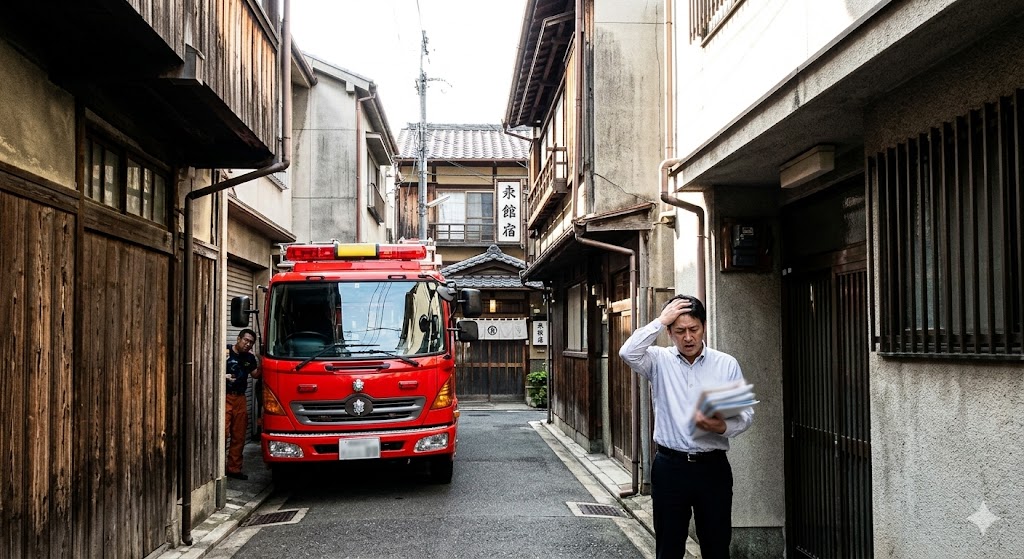
If a road is only 2 or 3 meters wide, even if the truck can barely squeeze in, there simply won’t be enough physical space for firefighters to open the doors and jump out, or to extend hoses and prepare for firefighting operations.
Furthermore, when you factor in the need for ambulances to pass each other or for evacuating residents to cross paths safely, “vehicle width (about 2m) + operational/evacuation space (about 2m) = a total of 4 meters” becomes the absolute minimum deadline for conducting safe rescue operations.
“One Minute’s Delay” Can Cost the Lives of Many Strangers
In an ordinary private home, the number of residents is limited, and everyone knows the layout of the building well, so evacuation during a fire tends to go relatively smoothly.
Hotels, ryokan, and simple lodging facilities are a different story. They house “an unspecified number of travelers who are unfamiliar with the building’s layout.” If a fire breaks out in the middle of the night, rescuing panicked guests requires immediate initial firefighting and professional evacuation guidance.
“The road was too narrow for the fire truck to get all the way in, and by the time they’d connected multiple hose lengths, the fire had already spread.” To absolutely prevent this kind of scenario, municipalities refuse to compromise on frontage road width for lodging facilities.
The “Special-Use Building” Wall: Where the Hotel Business Act Meets the Building Standards Act
You might think, “Even if the building is old, it’s been standing there for years—so why not just renovate it as-is and use it?” But when it comes to converting an ordinary residence into a lodging facility, the law bares its teeth.
“Change of Use” Triggers Compliance with Current Law
When converting an existing detached house or apartment into a hotel or simple lodging facility under the Hotel Business Act, a procedure called a **”change of use”** under the Building Standards Act becomes necessary. Because hotels and ryokan are used by an unspecified number of people who also sleep on the premises, the Building Standards Act classifies them as **”special-use buildings”**—a category subject to extremely strict safety standards.
When you submit a confirmation application for a change of use to the local government, the building is reviewed against “the current, strict Building Standards Act (present-day regulations).” Even if a house was legally built long ago (making it “legally non-conforming” under grandfather clauses), the moment you attempt to change its use to a lodging facility—a “special-use building”—it gets strictly checked against the current frontage road requirement (4-meter width). If the review determines that “the road in front is too narrow for emergency vehicles to enter,” the change of use will be denied as non-compliant with current law, and as a result, the health department will never issue a hotel business license either.
Additional Restrictions Under Municipal “Supplementary Ordinances”
What makes this even trickier is that, on top of the nationally established Building Standards Act, individual municipalities (prefectures, cities, and wards) often have their own additional regulations—such as “building safety ordinances”—that impose further restrictions.
Drawing on lessons learned from tragic fires in the past, many municipalities have established even stricter frontage rules for special-use buildings.
For example, in the case of a “flag-lot” property—where a narrow passage connects the road to a lot set back further inside—it’s common to see strict restrictions such as: “Special-use buildings may not be constructed if the passage length exceeds a certain number of meters.” This is because a fire breaking out in a set-back location makes it virtually impossible to use large vehicles like ladder trucks, making rescue operations extremely difficult.
The Municipality’s Real Motive: Preventing Trouble with Neighboring Residents
Fire safety isn’t the only reason municipalities are strict about frontage width. There’s also a very practical administrative concern: “preserving the surrounding living environment and preventing disputes.”
Road “Blockage” Caused by Delivery and Pickup Vehicles
Once a lodging facility opens, a variety of commercial vehicles will come and go daily—linen (sheets and towels) pickup services, cleaning company vehicles, garbage collection trucks, and more.
If the road in front is narrow, simply having these vehicles parked can completely block the street. If nearby residents can no longer get their own cars in or out, or if pedestrians can’t pass through, complaints to the local government will start pouring in immediately.
Traffic Congestion from Guest Pickups and Drop-offs
It’s also reasonable to expect that groups of inbound tourists or guests with large suitcases will arrive by taxi or shuttle van. If a taxi gets stuck trying to make a U-turn in a narrow alley, or if idling engine noise echoes through the neighborhood, it can become a major source of stress for residents who have lived quietly in the area for years.
To prevent these kinds of traffic and noise disputes—which are all but certain to occur once a facility opens—municipalities are reluctant to approve lodging businesses on properties fronting roads without sufficient width.
The Tragedy of Buying a Property with Insufficient Frontage—and the Only Way Out
If you sign a purchase contract for a property without checking its frontage width—thinking “it’s cheaper than market rate and looks like it’ll have a great yield”—a grim outcome awaits you as an investor.
When the License Gets Denied, Your Capital Gets Frozen
Only after you’ve drawn up renovation blueprints and gone to the local government office for a preliminary consultation do you learn that “the frontage width is insufficient, so a change of use is not possible.” The property you spent tens of millions of yen on becomes nothing more than an old house that can never be turned into a hotel, and your entire business plan collapses.
Since banks are reluctant to finance such properties, reselling becomes difficult too—leaving your invested capital completely frozen.
The Only Way Out: Switching to the “Minpaku Act” (Private Lodging Business Act)
If you’ve already acquired a property with insufficient frontage width (such as one that can’t legally be rebuilt), there’s one legal path remaining to operate a lodging business: leveraging the **”Private Lodging Business Act” (Minpaku Act)**.
The Minpaku Act allows you to host guests while keeping the building classified as a “residence,” without needing to change its use to a “special-use building” (hotel/ryokan). Since no change of use is required, you can bypass the strict frontage road requirement review under the Building Standards Act.
*Note: Installation of fire safety equipment (such as automatic fire alarm systems) required under the Fire Service Act is still mandatory, and you must follow the guidance of the local fire department.
There is a limit of 180 operating days per year, but by adopting a “hybrid operation” model—renting the property out as a minpaku during peak season and as a monthly rental (fixed-term lease) during the off-season—it’s entirely possible to generate a legal, high-yield return even from a “problem property” with insufficient frontage.
Conclusion: Choose Properties by Asking, “Can a Fire Truck Park Here?”
When reviewing hotel business license applications, municipalities enforce these strict standards for one clear and legitimate reason: protecting human life.
- A frontage width of 4 meters is the absolute minimum needed for emergency vehicles to enter and safely conduct rescue and firefighting operations.
- Changing a building’s use to a “special-use building” for accommodating an unspecified number of guests triggers strict, present-day frontage road requirements.
- Properties with insufficient frontage will not be granted a hotel business license, which is why upfront legal compliance research can make or break your business.
Before you think about design or marketing, first stand in front of the property on the road and picture the scene: “If a fire broke out here right now, could a fire truck pull up smoothly?”
Having that mindset is the very first step toward a successful lodging business investment.
From Thorough Legal Risk Assessment to Legal, High-Yield Operations—Leave It to Stay Buddy
“I’m considering purchasing an old house, but the road is a bit narrow. I want someone to check whether I can obtain a hotel business license.”
“I already bought a property with poor frontage, but I want to find a way to make it profitable using the Minpaku Act.”
“I want to entrust everything from fire safety equipment requirements and change-of-use procedures to post-opening operations to a single team.”
Leave these critical decisions and complex procedures entirely to us.
We are Stay Buddy Inc., a professional team of lodging business consultants and property managers specializing in the city of Osaka.
We have deep expertise in navigating strict administrative review standards and the know-how to legally satisfy—or work around—them.
- Precise legal compliance research and risk visualization before you sign a property contract, conducted in partnership with licensed architects and administrative scriveners
- Development of business plans to legally revitalize “problem properties” with poor frontage using the Minpaku Act
- Representation in preliminary consultations with the fire department, plus direction on installing safety equipment
- Full-service property management, including monthly rental operations to offset the 180-day limit and maximize your returns
Before you find yourself facing a loss of tens of millions of yen, consult with genuine professionals first.
Stay Buddy is the ultimate management partner to help you overcome legal obstacles and maximize the value of your real estate. Contact us today for a free property assessment and business consultation.