Leave Your Minpaku Management to the Experts
Free Online Consultation10 Tips to Minimize Initial Costs in Minpaku Investment
Minpaku (private lodging) investment is a business model that can generate higher yields compared to traditional real estate rental businesses. However, opening a property requires substantial “initial costs,” including property acquisition fees, renovation expenses, furniture and appliance purchases, and licensing fees.
“I can’t get started because I don’t have enough capital…”
“The initial investment is so large that it’ll take forever to recoup…”
Many investors likely share these concerns.
Let’s cut straight to the conclusion of this article.
The fastest path to minpaku investment success—meaning early return on investment and high ROI—lies in intelligently reducing “initial costs” while maintaining quality.
This doesn’t mean going cheap across the board. What matters is “strategic prioritization”—spending where it counts while thoroughly cutting costs where you can.
In this article, we’ll comprehensively cover “10 tips” that professional investors use to smartly reduce initial costs, from property selection to interior design.
Why Does Cutting “Initial Costs” Determine Success in Minpaku Management?
In minpaku investment, reducing initial costs carries significance far beyond simply lowering your out-of-pocket cash outlay.
- Shortened Payback Period: If you halve your initial costs, simple math tells us your payback period is also halved. Faster returns mean you can reinvest sooner in your next property, accelerating the growth of your asset portfolio.
- Lower Break-Even Point: Lower initial investment means lighter fixed cost burdens like monthly depreciation. This builds a resilient business that’s less likely to fall into deficit, even during slow seasons or unexpected downturns.
- Reduced Risk: Should you ever need to exit the business, keeping initial investment low minimizes potential damage (such as losses from sale or disposal of assets).
[Complete Guide] 10 Tips to Minimize Initial Costs in Minpaku Investment
So, how exactly can you control costs in practice? Here are 10 practical techniques.
《Property Acquisition & Contracts》
1. Start Small with “Rental (Subleasing)” Instead of Purchasing
Purchasing a property requires tens of thousands of dollars in capital or a loan. On the other hand, with a “sublease” model—renting a property and operating it as a minpaku—your initial costs (deposit, key money, agent fees, typically 5-6 months’ rent) allow you to start your business at a fraction of the cost, sometimes just a tenth or less. Building a track record and accumulating know-how through renting first, then considering purchase later, is a smart strategy.
2. Negotiate “Free Rent” Periods
When starting with a rental property, negotiate “free rent” with the landlord. Minpaku operations typically require 2-3 months of preparation time between signing the contract and actually opening for business—for licensing procedures and interior work. By negotiating free rent (1-2 months) for this period, you can eliminate wasteful spending on an empty, unproductive property. Key negotiation tactics include demonstrating your intent for a long-term lease and highlighting how your renovations will increase the property’s value.
3. Target “Turnkey Properties” or “Former Minpaku Properties”
Setting up fire safety equipment and furnishings from scratch requires substantial expense. However, if you can take over a property that was already operating as a minpaku (a property from a previous operator exiting the business) or one that comes furnished with appliances, you may be able to bring fire safety equipment installation and furniture purchase costs down to nearly zero. Regularly check minpaku-specialized real estate listings and information from property management companies.
《Interior & Equipment》
4. Fully Leverage National and Local Government “Subsidies and Grants”
National and local governments often offer non-repayable subsidies related to vacant property utilization, inbound tourism initiatives, and energy-efficient renovations. Programs like “vacant home renovation subsidies” and “tourism promotion grants” can potentially cover **1/2 to 2/3 of your renovation costs (potentially tens of thousands of dollars)**. Always consult with your local municipal office before signing any construction contracts.
5. Clearly Separate What to Hire Professionals For and What to “DIY”
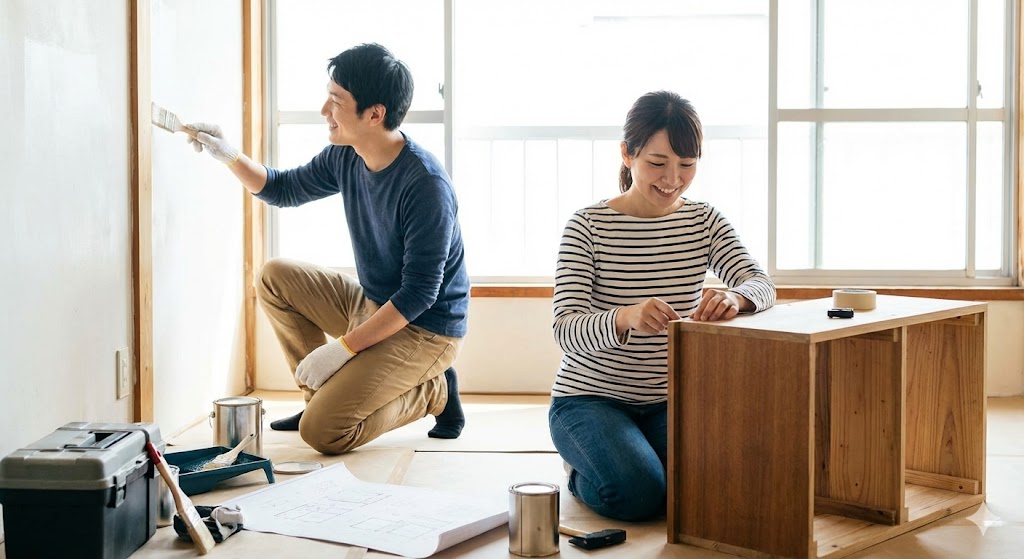
Much of your renovation budget goes toward labor costs. While work requiring specialized licenses—electrical, gas, plumbing—should be left to professionals, tasks like wall painting, wallpaper installation, and cushion flooring can dramatically cut costs when done yourself. It requires personal effort, but it also fosters attachment to the property and adds a story-driven charm to your guesthouse.
6. Source Furniture and Appliances from “Jimoty” or Recycle Shops
There’s no need to insist on brand-new items. Especially for furniture like tables, chairs, and shelving, you can find items on classified sites like Jimoty or at recycle shops for a fraction of the cost of new items—sometimes even free. Vintage-feeling furniture often adds character to your minpaku rather than detracting from it.
7. Use “Subscription (Rental) Services” for High-End Appliances
For expensive appliances that boost guest satisfaction—like drum-type washer-dryers, large TVs, or premium hair dryers—consider using subscription services instead of purchasing outright. This keeps initial costs low while allowing you to treat expenses as monthly operating costs, which also improves cash flow.
8. Apply “Selective Splurging” for Strategic Impact
Furnishing everything with cheap items creates a low-quality impression that hurts bookings. But you don’t need to make everything high-end either.
Invest properly in items that directly impact guest satisfaction—**the “sofa” where guests spend the most time, the “mattress” that determines sleep quality, and “lighting” that draws attention**—while keeping costs down on consumables and supporting furniture from stores like Nitori, IKEA, or 100-yen shops. This “strategic prioritization” is the secret to creating a space that looks expensive even on a modest budget.
《Operational Preparation》
9. Handle Licensing Application Paperwork “Yourself”
Hiring an administrative scrivener (gyoseishoshi) to file applications under the Hotel Business Act or Minpaku New Law typically costs ¥150,000-300,000 in fees. If you visit the health center and fire department multiple times yourself, seeking their guidance and preparing/filing the documents on your own, you can reduce this expense to actual costs only (a few thousand yen in fees). It takes time, but it’s also a great opportunity to deeply understand the regulatory framework.
10. Practice Thorough “Minimalism”—Buy Only What You Need
Thinking “it might be nice to have this too” and over-purchasing amenities wastes your initial budget. Starting with only essential equipment and supplies, then gradually adding items as needed based on guest reviews and requests, is the most efficient investment approach.
Warning! 3 Areas Where You Should Never Cut Corners
Cost reduction is crucial for maximizing profit. However, cutting corners in the wrong places can damage your property’s reputation and ultimately lead to significant losses.
When operating a minpaku, properly investing in and ensuring quality in the following three areas is the shortcut to success.
1. Cleanliness (Cleaning Costs)
An unclean room is an instant deal-breaker for minpaku.
No matter how beautiful the interior, a single hair or spot of mold in the bathroom can destroy guest trust.
Choose high-quality cleaning supplies and linens that convey cleanliness. When outsourcing cleaning, don’t select based on price alone—prioritize **”quality,”** such as whether they have a proper quality-check system in place.
2. Safety (Fire Safety Equipment & Locks)
Never compromise on equipment related to guest life and safety.
Choose reliable fire safety equipment that meets legal standards, along with high-quality, stably-functioning security items like smart locks.
Cutting corners here and experiencing an accident or serious problem could lead to irreversible consequences and jeopardize your entire business.
3. Photography
In OTA (booking platform) marketing, “photos” are said to determine roughly 90% of whether a booking happens.
Dark photos taken casually with a smartphone won’t convey the appeal of even the most wonderful room, and bookings simply won’t come in.
Photos are the “face” of your property. We strongly recommend investing a few tens of thousands of yen to hire a professional photographer and secure that perfect shot that makes guests think, “I want to stay here!”
Conclusion: Smart Cost Control Is the First Step Toward Maximizing Profit
Reducing initial costs in minpaku investment isn’t just about “saving money.” It’s an essential “business strategy” for maximizing investment efficiency (ROI) and controlling risk.
By combining the 10 tips introduced here and reinvesting the funds you save into advertising and improving guest services, your minpaku business can reach the path to success faster and with more certainty.
Let the Pros Propose the Optimal Solution for Your “Cost Reduction”
“I want to DIY, but I’m not sure how much I can realistically handle myself.”
“Subsidy applications and negotiating free rent sound complicated—I don’t feel confident.”
“I want to create an interior that looks premium and commands high rates, while keeping costs down.”
Please feel free to bring these concerns to us.
We at Stay Buddy Inc. are a team of professionals who have supported the launch and operation of numerous minpaku properties in the Osaka market.
We offer:
- ① Advice on rent negotiation and securing free-rent periods, starting from the property selection stage.
- ② Research and application support for available subsidies, powerfully backing your fundraising efforts.
- ③ Interior coordination that looks premium within your budget, plus help selecting cost-effective furniture and appliances.
Building a property that generates maximum revenue without wasting a single dollar on unnecessary costs.
We’re ready to generously share the knowledge and know-how to make that happen. As your partner in smart investing, please feel free to reach out to us anytime.