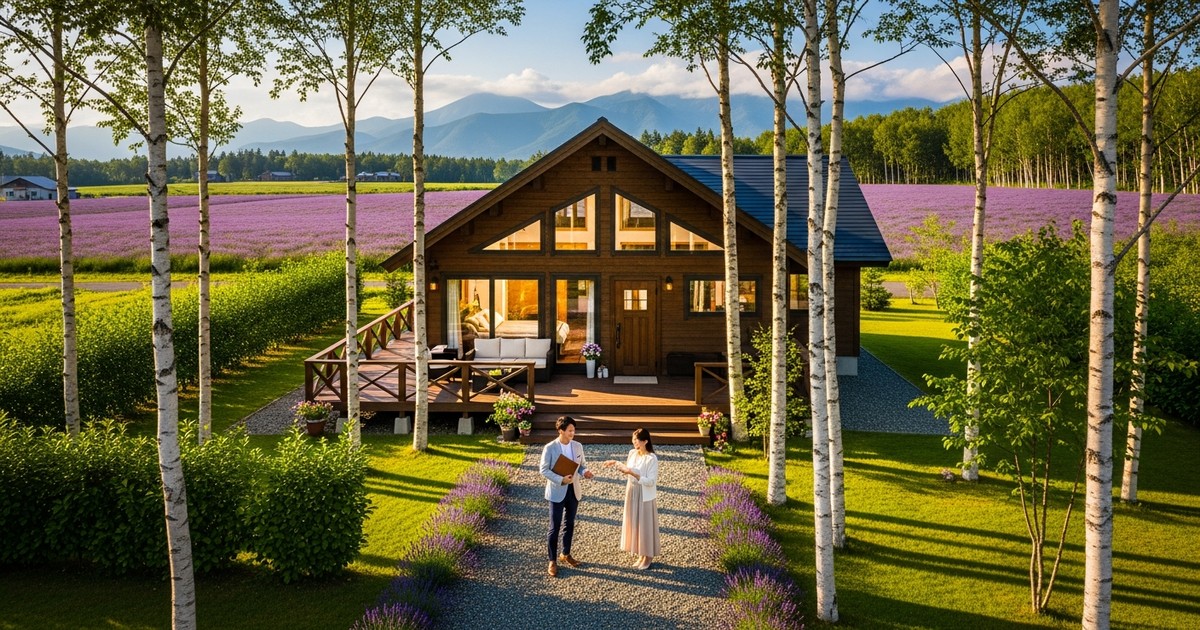
The Appeal of Operating a Furano Villa as a Minpaku, and Key Assumptions
Many owners of vacation homes in Furano find that they only get to use their property a limited number of times each year. With the Furano area drawing large numbers of tourists during the summer lavender season and the winter ski season, converting a villa into a minpaku (private lodging) or licensed guesthouse can generate income that helps offset maintenance costs. In this article, we run through a concrete annual revenue and expense simulation for operating a Furano villa either as a minpaku or under Japan’s Hotel Business Act, and examine just how realistic the profitability actually is.
For this simulation, we’ll assume the property is a detached villa located within Furano City, approximately 15 years old, with a total floor area of about 80 square meters and capacity for 6 guests. Since the property is already owned as a personal villa, acquisition costs are excluded from this analysis—our focus is purely on the costs and revenue involved in operating it as accommodation. We’ll compare two operating models: registration under the Private Lodging Business Act (the “minpaku law”) and obtaining a simple lodging (kan’i shukusho) license under the Hotel Business Act.
Furano sees tourist demand year-round, but the seasonal swings are dramatic. July–August (lavender season and summer tourism) and December–March (ski season) are peak periods, while April–June and September–November are the off-season. How accurately you set occupancy rates for these seasonal fluctuations will determine how precise your revenue simulation turns out to be.
Hotel Business License vs. the Minpaku Law: The Choice That Shapes Your Revenue Structure
When operating a villa in Furano as guest accommodation, the first decision is which operating framework to use. Minpaku registration under the Private Lodging Business Act is relatively easy to enter, since it only requires notification—but it caps annual operating days at a maximum of 180. Obtaining a simple lodging license under the Hotel Business Act, on the other hand, allows 365-day operation, but comes with higher hurdles, including fire safety equipment requirements and change-of-use procedures under the Building Standards Act.
In an area like Furano, where the gap between peak and off-season demand is so pronounced, the 180-day cap under the minpaku law can sometimes be enough to cover peak periods. However, since the winter ski season alone can generate demand for more than 90 days, combining it with the summer peak season is likely to exceed the 180-day limit. If your goal is to maximize revenue year-round, obtaining a simple lodging license is the more advantageous route. Initial costs for obtaining this license—including fire safety equipment installation and drawing preparation—typically run in the range of ¥500,000 to ¥1.5 million.
Annual Revenue Simulation
Peak Season Revenue Projection (Winter: December–March)
Thanks to winter sports demand centered around Furano Ski Resort, the roughly 120 days from December through March can expect strong occupancy rates. Demand from inbound tourists is particularly strong, and nightly rates for whole-house rentals typically run between ¥25,000 and ¥40,000. For this simulation, we’ll set an average nightly rate of ¥30,000 with a 70% occupancy rate. That gives us 120 days × 70% × ¥30,000, for winter revenue of approximately ¥2.52 million.
Peak Season Revenue Projection (Summer: July–August)
Furano, famous for its lavender fields, draws large numbers of tourists from both Japan and abroad during the summer. For the roughly 60 days spanning July and August, we’ll set a 60% occupancy rate and an average nightly rate of ¥25,000. That’s 60 days × 60% × ¥25,000, for summer revenue of approximately ¥900,000. While extended-stay demand isn’t as strong as in winter, a certain amount of multi-night bookings can still be expected.
Off-Season Revenue Projection (April–June, September–November)
There is some demand during the lingering-snow period in spring and the autumn foliage season, but it drops significantly compared to peak periods. For the roughly 185 off-season days, we’ll set a 25% occupancy rate and an average nightly rate of ¥18,000. That’s 185 days × 25% × ¥18,000, for off-season revenue of approximately ¥830,000. Setting prices too low during the off-season can eat into profitability, so it’s important to establish a floor rate that still covers cleaning fees and utility costs.
Total Annual Revenue
Adding these figures together, total projected annual revenue under a simple lodging license (with 365-day operation permitted) comes to approximately ¥4.25 million. Under the minpaku law’s 180-day cap, even prioritizing peak-season bookings, annual revenue would likely be limited to roughly ¥2.5 million to ¥3 million. This gap is a major factor to weigh when choosing your operating model.
Breakdown of Annual Expenses
Cleaning Costs
Cleaning is required after every guest checkout. For an 80-square-meter detached house, cleaning typically costs between ¥8,000 and ¥12,000 per visit in the Furano area. Assuming ¥10,000 per cleaning and roughly 170 operating days per year (factoring in guest turnover, that’s roughly 100 turnovers annually), total annual cleaning costs come to approximately ¥1 million. Since winter tends to see more multi-night stays, the actual number of checkouts—and thus cleaning costs—may come in somewhat lower.
Utilities and Internet
Winter heating costs are a significant burden in Hokkaido. Depending on the villa’s heating system, kerosene central heating alone can cost ¥50,000–¥80,000 per month during the four winter months. Annual electricity, gas, water, and kerosene costs combined typically run ¥500,000–¥700,000, plus around ¥60,000 annually for internet service. For this simulation, we’ll set combined utilities and internet costs at ¥650,000 per year.
Property Management Fees
Since it’s rarely practical for an owner living far away to manage a villa personally, outsourcing to a property management company is the common approach. Management fees typically run 10%–30% of revenue (depending on the company and scope of services), covering reservation management, guest communication, key handoff, and issue resolution. Applying a 20% fee rate to our ¥4.25 million revenue figure yields approximately ¥850,000 per year.
OTA Fees (Booking Platform Commissions)
Airbnb charges hosts roughly 3% in fees, while Booking.com’s fees run around 12%–15%. Assuming an average commission rate of 10% across multiple OTAs, that comes to approximately ¥425,000 per year. Property management companies that drive more direct bookings through their own booking sites may be able to reduce this cost.
Consumables and Supplies
This covers items such as towels, linens, amenities, restocking kitchenware, and appliance repairs or replacements. Expect approximately ¥150,000–¥250,000 per year. For this simulation, we’ll set this cost at ¥200,000 annually. In the first year of operation, an additional initial investment of ¥300,000–¥500,000 is typically needed to purchase a full set of bedding and kitchen items.
Property Tax and Insurance
Property tax on a villa within Furano City depends on the assessed value, but generally runs ¥100,000–¥200,000 per year. Additionally, for properties operating as guest accommodation, facility liability insurance is recommended, with annual premiums of ¥30,000–¥50,000. We’ll set the combined total at approximately ¥200,000 per year.
Other Expenses
Snow removal is an unavoidable cost in Furano, with seasonal contracts running ¥100,000–¥200,000 per year. Factoring in additional items such as building repair reserves and tax accountant fees for annual filings, we’ll budget approximately ¥200,000 per year for miscellaneous expenses.
Annual Financial Results and Profit Analysis
Putting these figures together, the annual financial picture under a simple lodging license looks as follows. Against annual revenue of approximately ¥4.25 million, total annual expenses come to approximately ¥3.525 million—comprising ¥1 million in cleaning costs, ¥650,000 in utilities and internet, ¥850,000 in property management fees, ¥425,000 in OTA fees, ¥200,000 in consumables, ¥200,000 in property tax and insurance, and ¥200,000 in other expenses. This leaves an annual profit of approximately ¥725,000.
Under the minpaku law’s 180-day cap, on the other hand, assuming annual revenue of roughly ¥2.8 million, expenses would be partially reduced due to fewer operating days (cleaning costs of ¥650,000, utilities of ¥550,000, management fees of ¥560,000, OTA fees of ¥280,000, and so on)—but since fixed costs remain largely unchanged, total expenses come to approximately ¥2.84 million, leaving the business roughly breaking even, or even carrying a slight risk of loss. This comparison makes clear that if your goal is stable revenue year-round, obtaining a hotel business license is the preferable path.
Practical Tips for Maximizing Revenue
Dynamic Pricing Aligned with the Seasons
In an area like Furano with such dramatic seasonal swings, pushing peak-season rates as high as the market will bear is key to profitability. During peak ski season (year-end/New Year holidays and Lunar New Year), nightly rates of ¥50,000 or more can still fill up with bookings. Conversely, during the off-season, it’s often more effective to lower rates and prioritize maintaining occupancy in order to recover fixed costs.
Strengthening Your Inbound Guest Strategy
Furano is a popular destination for international tourists, particularly ski visitors from Australia and Southeast Asia. Investing in a well-developed English-language listing page, multilingual house manuals, and expanded presence on international OTAs can boost both occupancy and average nightly rates. In practice, properties where foreign guests make up more than 50% of bookings tend to see average nightly rates 20%–30% higher than properties catering primarily to domestic guests.
Multi-Night Discounts and Extended-Stay Plans
Winter sees strong demand for stays of a week or longer. Offering multi-night discounts (such as 10%–15% off for stays of 7 nights or more) allows you to reduce cleaning frequency—and thus costs—while maintaining stable occupancy. If you save ¥10,000 on a single cleaning, that alone can offset the discount and still leave you with a profit.
Points to Watch When Converting a Furano Villa into a Minpaku
Even though this simulation projects a profit, there are several risk factors worth understanding. First, depending on Furano City’s zoning regulations and local ordinances, a hotel business license may not be approved in every case. If the property is located within an urbanization control area, or if the homeowners’ association or resort community bylaws prohibit lodging operations, running the business may not be possible at all. Confirming the situation with Furano City Hall and the local public health center in advance is essential.
It’s also important to prepare for issues unique to Hokkaido, such as frozen pipes in winter and building damage from heavy snowfall. Costs for anti-freeze heating systems and guest complaints stemming from delayed snow removal can hurt your review scores—and, in turn, your future revenue. Whether you have a trustworthy local management partner on the ground is one of the biggest factors determining success or failure when operating accommodation in Furano.
For Minpaku Operation Consulting, Contact Stay Buddy Inc.
If you’re an owner considering turning your Furano villa into a minpaku or licensed guesthouse, please reach out to Stay Buddy Inc., specialists in minpaku property management. We provide comprehensive, one-stop support—from creating a revenue simulation tailored to your property’s location and characteristics, to helping you obtain your hotel business license, to handling guest communication, cleaning arrangements, and pricing optimization once operations are underway.
Stay Buddy has a proven track record managing minpaku properties across Japan, including the Hokkaido region, and has built up extensive know-how for maximizing revenue in resort areas with dramatic seasonal fluctuations. We offer a support structure that lets owners living far from their property manage operations with complete peace of mind.
If you’re ready to change a situation where your villa is doing nothing but racking up maintenance costs, or if you’d like to explore concrete ways to turn your property into a revenue-generating asset, please feel free to contact Stay Buddy Inc. We also offer free online consultations.