That Building Could Be Earning You More: The Secret to Maximizing Revenue from Buildings in Osaka City
For owners of buildings in Osaka City, we are currently at an unprecedented “turning point in asset management.” With shifting demand for office space and the explosive resurgence of inbound tourism, traditional “rental management that simply fills vacancies” is highly likely to be leaving substantial revenue on the table.
Let’s start with the conclusion of this article.
The secret to maximizing building revenue in Osaka City lies in abandoning the fixed notion of “office leasing” and instead combining conversion to “special zone minpaku” or “hotels” tailored to local demand, along with “unmanned operations powered by IT.”
We’ll walk you through concrete strategies to unlock 120% of your building’s potential and dramatically improve your cash flow.
The Current State of Building Management in Osaka City and the “Opportunity Cost” at Play
In present-day Osaka City, clear “winning patterns” for revenue generation have emerged, depending on location.
Office Oversupply, Accommodation Shortage
In business districts like Honmachi and Yodoyabashi, tenants are flocking to newly built, large-scale buildings, leaving older small and mid-sized buildings with persistently high vacancy rates. Meanwhile, in areas like Namba, Shinsaibashi, and Shin-Osaka, accommodation facilities are overwhelmingly insufficient to meet the rising number of foreign visitors.
Rather than lowering rent to fill vacancies, the key to multiplying your revenue several times over is changing the “use” of your property.
Rethinking Productivity Per Square Foot
It’s clear which earns more: leasing space as an office at ¥20,000 per tsubo, or operating it as a guest room at ¥30,000 per night. Of course, operating costs are involved, but in a city with the powerful tourism resources of Osaka, a building should no longer be viewed simply as a “box”—it should be seen as a “device” that generates services.
Secret #1: Fully Leveraging “Special Zone Minpaku,” Osaka City’s Unique Advantage
When it comes to building utilization in Osaka City, the “National Strategic Special Zone Minpaku” system offers the single greatest advantage unavailable in other cities.
The Overwhelming Advantage of 365-Day Operation
Standard minpaku (under the Private Lodging Business Act) is limited to just 180 operating days per year. However, with certification as a “special zone minpaku” in Osaka City, you can operate at full capacity 365 days a year. By converting an entire building into a minpaku, you can effectively achieve hotel-equivalent operations, with profitability reaching 2 to 3 times that of office leasing—which is far from unusual.
Cornering the Market on Demand for Spacious Rooms
When renovating a building, you can design each floor as a single spacious room, or perhaps two. In Osaka right now, there’s a critical shortage of “spacious accommodations” where three-generation families or groups can stay together. By filling this need—one that major hotel chains struggle to address—you can achieve both a high average daily rate (ADR) and a high occupancy rate simultaneously.
Secret #2: Boosting Asset Value Through Conversion (Change of Use)
When it comes to monetizing a building, “conversion” paired with renovation is an extremely effective approach.
Why Older Buildings Are Better Suited to Accommodation
Buildings that are 30 or 40 years old tend to be shunned as office space, but as accommodation facilities, they can leverage distinctive traits that new hotels lack—”retro design,” “large windows,” “high ceilings.” By giving the interior a strong concept, you can transform the building’s age itself into “added value,” enabling you to command a higher nightly rate.
Enhanced Valuation as an Exit Strategy
As profitability rises, so does the property’s market value (income capitalization value). When it comes time to eventually sell the building, this also means you can sell it to investors at a higher price as an “operating asset” that generates stable accommodation income.
Secret #3: Cutting Operating Costs Through “Smart” Technology
Concerns that “turning a building into a hotel will drive up labor costs” can be resolved with the latest IT technology.
Achieving Unmanned, Labor-Light Operations
By introducing smart locks (electronic locks) and self-check-in systems, there’s no longer a need to keep staff stationed at the front desk. For smaller buildings in Osaka City, eliminating the physical front desk in favor of remote identity verification via tablet can dramatically reduce labor costs—which typically account for the largest share of operating expenses.
Optimizing Outsourced Cleaning and Maintenance
By entrusting cleaning, waste disposal, and facility maintenance to a specialized property management company, you can maintain professional-quality management while eliminating hassle for yourself as the owner. Shifting toward a “variable cost” model—where costs are incurred only when needed, and only as much as needed—is the ultimate secret to boosting your final take-home profit.
What Makes a Building in Osaka City Ripe for Transformation?
Not every building is suited to accommodation use. Here are the characteristics of buildings with strong potential for maximized revenue:
- Within a 10-minute walk of a station: Since inbound guests travel with heavy luggage, proximity to a station is an absolute must.
- Shops or a convenience store on the ground floor: This adds convenience and makes it easier to command a higher nightly rate.
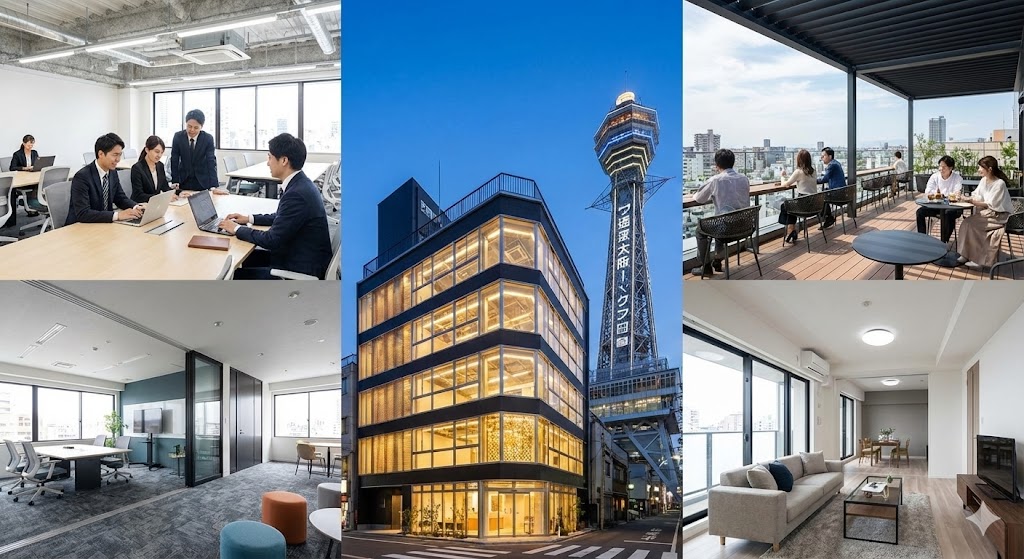
- Plenty of windows and an open feel: The abundance of windows typical of office buildings translates into high guest satisfaction when converted into rooms.
- Rooftop usability: If the rooftop can be opened up as a terrace or bar, it becomes a decisive point of differentiation from nearby properties.
Conclusion: Rewrite Your Existing Asset into a Next-Generation Revenue Source
For building owners in Osaka City, continuing with the same old rental management approach means continuing to carry hidden risks.
- Consider converting to a special zone minpaku or simple lodging, and raise your rates.
- Narrow your target to “groups and affluent travelers,” and win out over major chains.
- Leverage IT and outsourcing to minimize operating costs.
Follow these three steps, and your building will be reborn as “the highest-earning asset in the area.” Let’s turn the momentum of the city of Osaka into a tailwind for your building management business.
Your Partner for Maximizing Revenue, from Building Renewal to Accommodation Operations
“My building’s vacancies won’t fill, and the property tax burden is heavy.”
“I want an estimate of how much I’d be left with if I converted the entire building into a minpaku or hotel.”
“I want to hand off everything—from permit applications for the conversion to post-launch management.”
Bring those concerns to us.
We are Stay Buddy Inc., a team of professionals specializing in the accommodation business within Osaka City.
We’re not just a property management company.
- Total consulting spanning architecture, regulations, and operations—designed to unlock your building’s full potential
- High-precision profit and loss simulations built on local area data
- Low-cost, high-profit unmanned operation models built using the latest DX tools
- Thorough, hotel-standard cleaning management and hospitality that keeps guests satisfied
We provide all of this as a one-stop service, and we’ve helped transform the assets of many building owners into “high-earning properties.”
Your building still holds significant untapped value. To turn that value into numbers, please feel free to reach out to us for a free property assessment and revenue consultation.