Essential Knowledge Before Searching for Minpaku or Ryokan Business Properties in Furano
If you’re thinking about starting a minpaku business in Furano, the first thing to understand is the difference between the “Private Lodging Business Act” (the new minpaku law) and the “Hotel Business Act” (ryokan gyoho). Properties registered under the new minpaku law are limited to 180 operating days per year, while obtaining a license under the Hotel Business Act allows for year-round operation, 365 days a year. Furano is a two-season tourist destination where demand is concentrated around the lavender season (roughly July) and the ski season (December through March), so the legal framework you choose to operate under will significantly affect your revenue structure.
For example, if you operate under the 180-day cap of the new minpaku law, a realistic strategy is to concentrate operations solely during peak seasons. On the other hand, obtaining a Hotel Business Act license enables year-round operation, allowing you to fully capitalize on both the summer and winter peak seasons. To obtain this license within Furano City, you’ll need to confirm the zoning classification, install fire safety equipment, and ensure compliance with building codes—so it’s essential to verify whether a property can meet these conditions during the property-selection stage. The cost of obtaining a license, including fire safety equipment installation and interior renovations, typically ranges from ¥3 million to ¥8 million, varying significantly depending on the property’s condition.
Criteria for Identifying Areas Suited to Minpaku in Furano
When searching for minpaku properties in Furano, area selection is the single biggest factor determining profitability. Candidate locations should be evaluated from four perspectives: tourist flow patterns, accessibility, competition from nearby accommodations, and zoning classification. Furano can be broadly divided into four areas: “Furano City Center,” “Kitanomine,” “Nakafurano/Kamifurano,” and “Minamifurano,” each with distinct target demographics and revenue models.
One thing that’s easy to overlook during area selection is zoning verification. To obtain a Hotel Business Act license, operations are generally prohibited in Category 1 Low-Rise Exclusive Residential Districts and Category 1 Mid/High-Rise Exclusive Residential Districts. Be sure to check Furano City’s urban planning maps in advance to confirm whether a property falls within a commercial district, neighborhood commercial district, quasi-residential district, or Category 2 residential district. Rural properties designated as urbanization control areas tend to be cheaper, but they can present higher hurdles when it comes to obtaining a license.
Furano City Center
The city center area around JR Furano Station offers restaurants and convenience stores within walking distance, making it a highly convenient location for independent travelers and backpackers without a rental car. Since much of this area falls under commercial or neighborhood commercial zoning, it offers the advantage of being easier to obtain a Hotel Business Act license for. Detached houses over 30 years old typically cost ¥5 million to ¥15 million, and factoring in renovation costs, total investment usually falls in the range of ¥10 million to ¥25 million.
That said, the city center faces intense competition from existing business hotels and traditional ryokan, and nightly rates tend to settle around ¥10,000–¥15,000 even during the busy summer season, dropping to ¥5,000–¥8,000 during the winter off-season. To differentiate your property, it’s important to establish a clear concept—such as “a traditional Japanese house offering an authentic Hokkaido living experience” or “a self-catering property geared toward extended stays.”
Kitanomine
Located adjacent to Furano Ski Resort, Kitanomine is the top candidate area if you’re targeting winter inbound demand. Ski tourists from Australia and Southeast Asia are on the rise, and demand for whole-property condominium-style accommodations continues to grow. During the ski season (December through March), nightly rates for an entire unit can reach ¥30,000–¥80,000, meaning that operating over just these four months has the potential to generate 60–70% of annual revenue.
On the other hand, property prices in this area tend to run higher than elsewhere in Furano, with used pensions and condominiums priced at approximately ¥15 million to ¥40 million. Given the heavy snowfall, you should budget for monthly snow removal costs of ¥50,000–¥100,000, and selecting a property with a snow-load-resistant roof structure and freeze-protected plumbing will help keep initial costs down.
Nakafurano and Kamifurano
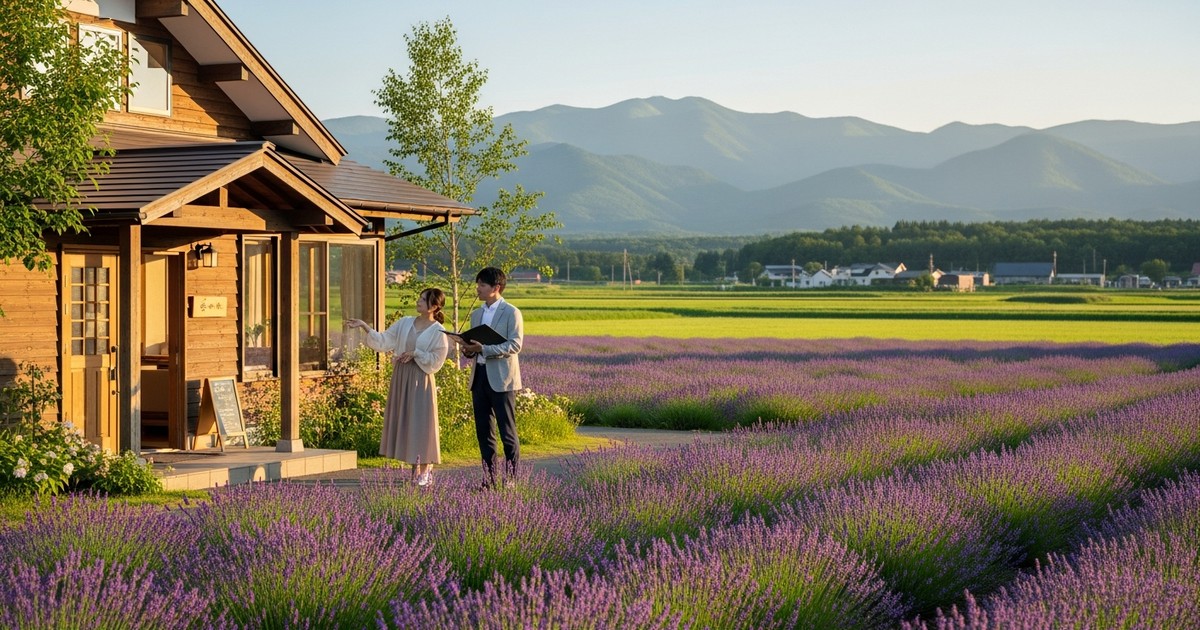
This area, home to famous lavender fields such as Farm Tomita and Kanno Farm, draws overwhelming crowds during the summer (June through August). It’s not unusual for nearby accommodations to be fully booked during the peak lavender season in July, when nightly rates of ¥15,000–¥25,000 are achievable. Renting out an entire house surrounded by farmland and pastoral scenery is particularly popular with families and small groups.
One point of caution is that demand drops off sharply in winter. Since access to ski resorts isn’t as convenient as from Kitanomine, year-round high occupancy is difficult to achieve here. A realistic approach is to plan for an annual occupancy rate of around 40–55%, with a business plan that relies on summer revenue to cover annual expenses. Older detached houses can be acquired relatively cheaply, at ¥3 million to ¥10 million, making this area well-suited to those looking to keep initial investment low.
Minamifurano
Centered around Lake Kanayama, Minamifurano is popular for outdoor activities such as canoeing, fishing, and camping, making it well-suited to niche minpaku operations targeting adventure-tourism-minded travelers. Property prices here range from ¥2 million to ¥8 million—the cheapest in the Furano area—but public transportation access is limited, meaning nearly all guests will need a rental car.
While low population density reduces the risk of disputes with neighbors, building a management system poses a challenge. If you live far from the property, outsourcing tasks such as cleaning, check-in support, and issue resolution to a property management service becomes essentially mandatory, and you should budget for management fees of roughly 10%–30% of revenue (varying by company and scope of services).
Specific Checkpoints to Verify During Property Selection
Once you’ve narrowed down the area, it’s time to scrutinize individual properties. Choosing a property for conversion into a minpaku or ryokan business requires a different perspective than a typical home purchase. Here, we’ll walk through the specific items that are commonly overlooked.
Compliance with Building Codes and Fire Safety Regulations
To obtain a Hotel Business Act license, the building must comply with the “ryokan/hotel” usage classification under the Building Standards Act. When converting an existing residence, a change-of-use confirmation application may be required. Buildings with a total floor area exceeding 200 square meters generally must file this application, which typically costs ¥300,000–¥800,000.
Under the Fire Service Act, automatic fire alarm systems and emergency exit lighting are required. For properties without these already installed, expect an additional ¥500,000–¥1.5 million in construction costs. Checking for existing fire safety equipment during a property viewing—and prioritizing properties that already have it in place—can significantly reduce initial costs.
Condition of Plumbing and Water Systems
Winter temperatures in Furano can drop below -20°C, making frozen and burst pipes a serious risk. For older properties, be sure to check the location of the water drain-off valve, the insulation of the plumbing, and the type and remaining service life of the boiler. Boiler replacement typically costs ¥400,000–¥800,000, which can become an unexpected expense if replacement is needed shortly after purchase.
Additionally, when operating as an accommodation facility, the number and size of bathrooms and toilets directly impacts guest satisfaction. For a whole-house rental accommodating six guests, it’s ideal to have at least two toilets and two shower or bath facilities. Adding a new plumbing fixture typically costs ¥800,000–¥1.5 million per unit, so it’s advisable to prioritize properties that already have multiple bathroom facilities.
Parking and Ease of Snow Removal
Since most guests in Furano get around by rental car, you’ll need at least two parking spaces on the property. Because winter snowfall shrinks available parking space, choose a property with ample room during summer. As a rule of thumb, if there’s space for three cars in summer, you can typically still fit two in winter.
Snow removal is another important consideration. If the road in front of the property is a municipal road, the local government will handle snow clearing; but for private roads or properties set back from the main road, you’ll need to arrange removal yourself. A snow blower typically costs ¥200,000–¥500,000, while contracting out snow removal runs about ¥100,000–¥300,000 per season. Be sure to factor these ongoing costs into your financial planning.
How to Build a Financial Projection and What’s a Realistic Yield
To avoid failure with a minpaku investment in Furano, it’s essential to build a financial plan that isn’t overly optimistic. Here, we present a realistic financial model based on concrete figures.
How to Estimate Revenue
Accommodation demand in Furano is concentrated in summer (June–August) and winter (December–March). Taking a whole-house rental for six guests as an example: during the summer peak, expect nightly rates of ¥20,000–¥30,000 with 80% occupancy; during the winter peak, ¥25,000–¥40,000 with 70% occupancy; and during the spring/autumn off-season, ¥10,000–¥15,000 with roughly 30% occupancy. Under these conditions, annual revenue works out to approximately ¥5 million–¥7 million.
However, OTA (online travel agency) platforms such as Airbnb and Rakuten Travel deduct commissions of 3–15% of revenue. Cleaning costs run ¥5,000–¥10,000 per turnover, and linen replacement costs ¥1,000–¥3,000 per turnover, meaning your effective gross profit typically settles at around 60–70% of revenue.
Expenses and a Guideline for Yield
Major fixed expenses include property tax (¥100,000–¥300,000 annually), fire insurance (¥50,000–¥150,000 annually), utilities (¥300,000–¥600,000 annually), communication costs (¥50,000–¥100,000 annually), and snow removal (¥100,000–¥300,000 annually). If you use a property management service, add 10%–30% of revenue (varying by company and scope of services). After deducting these expenses, actual annual net income often falls in the range of ¥1.5 million–¥3 million, giving a real yield of roughly 10–20% for an initial investment of ¥15 million—a useful benchmark.
One thing people often forget when calculating yield is setting aside funds for repairs. Given Furano’s harsh climate, exterior walls and roofing tend to deteriorate faster than in mainland Japan, so it’s recommended to set aside about 10% of annual revenue for a repair reserve fund. Neglecting this can result in the need for major renovations once the property passes the 10-year mark, causing cash flow to deteriorate sharply.
Consult Stay Buddy Inc. About Minpaku Management
Launching a minpaku or ryokan business in Furano requires specialized expertise across a wide range of areas—from area selection and property research to license acquisition and building an operational structure. For owners living far from the property in particular, how you set up local management is the key to success.
Drawing on extensive experience in minpaku property management, Stay Buddy Inc. offers one-stop support that covers everything from property selection advice and pre-launch preparation to day-to-day operational management. We provide a system that maximizes revenue while minimizing the workload for owners—handling cleaning arrangements, guest communication, pricing adjustments, and OTA management.
If you’re interested in starting a minpaku business in Furano, please feel free to reach out to Stay Buddy Inc. We’re happy to consult with you on property selection and area-by-area profitability using concrete data.