Leave your vacation rental management to us
Completely Free Online ConsultationHow to Start a Kominka (Traditional Japanese House) Vacation Rental: Preparation and Operational Hurdles for Success
The “kominka” — traditional Japanese houses nestled in the countryside — represent one of the most iconic images of rural Japan.
Yet many of these houses sit unused as “akiya” (vacant homes), becoming what owners often see as “negative assets” burdened by maintenance costs and property taxes.
However, the very “age” and “inconvenience” that make these houses seem like liabilities are exactly what today’s travelers—especially inbound visitors from overseas—see as **”the ultimate experiential value,”** something worth paying a premium for.
Let’s start with the conclusion of this article.
A kominka vacation rental, when renovated through the right process and operated in a way that leverages its inherent “storytelling,” can be an extraordinarily compelling business model—one that solves the vacant house problem while generating substantial revenue. That said, this path isn’t one that passion alone can carry you through.
In this article, we’ll comprehensively walk you through the concrete steps to transform your dream of restoring a kominka into a sustainable business—covering the hurdles you’re bound to face, and the keys to overcoming them.
Why “Kominka” Are the Ultimate Accommodation Content Right Now
Kominka offer three overwhelming strengths that convenient city hotels and shiny new vacation rentals simply can’t match.
1. The Value of a Truly Unique “Extraordinary Experience”
Thick, dark-lacquered beams and central pillars, earthen floors, sunken hearths, and beautifully carved transom panels (ranma) create a rich, warm atmosphere impossible to replicate in modern, efficiency-driven housing. Simply staying in a kominka can become the highlight of a guest’s entire trip.
2. Meeting the Modern Demand for “The Luxury of Doing Nothing”
Exhausted by information overload, today’s travelers increasingly crave genuine relaxation over hectic sightseeing schedules. Sipping tea on the engawa (veranda) while gazing at the garden, waking to birdsong, spending quiet moments under a sky full of stars—the “luxury of doing nothing” that a countryside kominka offers has become an incredibly valuable form of healing.
3. Higher Price Points and Privacy Through “Whole-House Rentals”
The very structure of a kominka lends itself naturally to whole-house rentals. This allows you to **capture the demand of larger groups**—families, multi-generational trips, or groups of friends—exclusively. As a result, you can command price points ranging from tens of thousands to over a hundred thousand yen per night, dramatically boosting your profitability.
Starting a Kominka Vacation Rental Business in 7 Steps
Restoring a kominka isn’t something passion alone can accomplish. Successfully clearing each of the following seven steps, one by one, is the path to success.
STEP 1: Define the Core “Concept” of Your Business
- Clarify your target audience: Picture concretely “who” you want to spend “what kind of time” in this space. Whether it’s “families enjoying quality time across three generations,” “groups of friends gathering around the hearth to talk,” or “creators seeking a quiet environment to focus on their craft”—the clearer your target audience, the more consistent your space design and marketing strategy will be down the line.
- Put the experience into words: Express the appeal of your property in short, resonant phrases—like “the luxury of doing nothing in a 100-year-old kominka” or “a farmhouse stay experiencing life in the satoyama countryside.”
STEP 2: [Most Critical] Finding a Property and Accurately Assessing “Restoration Costs”
- Where to find properties: The “akiya bank” (vacant house databases) run by local municipalities are the most valuable resources, often featuring properties priced below market rate. Local real estate agents and NPOs may also have leads on hidden gems.
- The trap of restoration costs: The most important thing in kominka restoration is not to be seduced by a low purchase price. The real cost lies in the **”renovation expenses”** that follow the purchase. In particular, ① seismic reinforcement, ② improving insulation performance, and ③ a full renovation of the plumbing areas (bath, toilet, kitchen) are non-negotiable requirements for ensuring guest safety and comfort—and combined, these can easily run from several million to over ten million yen. Accurately estimating this cost as part of your initial investment is the foundation of your entire business plan.
STEP 3: Confirming Legal Regulations and Building Your Expert Team
- Confirming the law: If you’re aiming for year-round, 365-day operation, obtaining a **”Ryokan Business Act (simple lodging)” license** is essential. From the property-search stage, you’ll need to confirm whether the zoning designation (properties in residential-only zones are generally prohibited) and building structure can meet the requirements of the Ryokan Business Act. (Under the Minpaku Act, which caps operations at 180 days per year, running a full-scale business is difficult.)
- Assembling your expert team: Kominka restoration and obtaining a Ryokan Business license simply aren’t things you can handle alone. Building a trusted team early on—including an architect with a solid track record in kominka restoration, an administrative scrivener well-versed in the Ryokan Business Act, and a skilled local carpenter or construction firm—is key to your project’s success.
STEP 4: Data-Driven Business Planning and Fundraising
- Revenue and cost simulation: Research the room rates and occupancy rates of nearby competing properties to forecast realistic revenue. From there, subtract your initial investment (including renovation costs) and all ongoing operational expenses to calculate your payback period and expected yield.
- Fundraising: Based on this business plan, make full use of financing from the Japan Finance Corporation and **”akiya renovation subsidies”** offered by national and local governments to cover any gap beyond your own capital.
STEP 5: [Restoration] Translating Your Concept into a Physical Space
- Deciding what to preserve and what to change: While preserving as much of the kominka’s inherent “character”—its pillars, beams, and fittings—as possible, you should thoroughly pursue modern comfort in areas guests directly interact with, such as plumbing and bedroom insulation for good sleep. This “fusion of old and new” is what elevates guest satisfaction.
- Amenities as experiential devices: Features like a sunken hearth (irori), a wood-burning stove, a goemonburo (cast-iron bath), an engawa veranda, or a wooden deck aren’t merely functional—they’re crucial “experiential devices” that immerse guests in the story of “living in a kominka.”
STEP 6: [Most Critical] Building “Good Relationships” with the Local Community
A business in a rural area simply cannot succeed without coexisting with the local community.
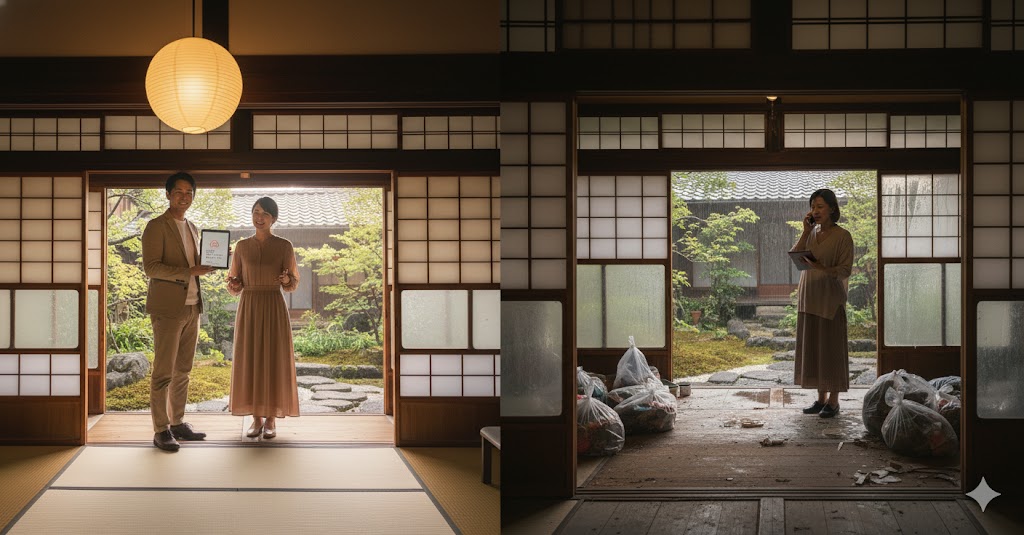
- Greeting the community in advance: Before construction begins and again before opening, be sure to visit the neighborhood association leader and nearby residents to politely introduce yourself and explain your business, making an effort to earn their understanding. Alleviating the anxiety of “not knowing what kind of people will be coming” is the first priority.
- Contributing to the community: Actively participate in local festivals and clean-up activities—an attitude of becoming “part of the community” builds long-term trust. Establishing and communicating strict rules to prevent noise complaints and garbage-disposal issues from guests is also a crucial responsibility for any host.
STEP 7: Marketing Strategy—Building a Fanbase Beyond OTAs
- Telling your story on social media: Use platforms like Instagram and note to continually share the restoration process, daily life in the countryside, and beautiful scenery. This isn’t just promotion—it’s an activity that builds a “fanbase” of people who resonate with your values.
- Your own direct booking channels: Encouraging direct bookings through your own website or social media DMs reduces the fees you pay to OTAs and boosts your profit margin. “Direct booking perks” can also be an effective incentive.
- Partnering with local media: Getting featured by local tourism associations or information sites is another important way to spread the word while engaging the community.
The “3 Hurdles” to Avoiding Failure—and How to Overcome Them
Hurdle 1: Legal and Regulatory Hurdles (Ryokan Business Act, Fire Service Act, etc.)
- Solution: Never make judgment calls on your own. The only path forward is to work closely with the expert team you assembled in Step 3 (administrative scrivener, architect), thoroughly conducting “preliminary consultations” with the public health center and fire department from the earliest design stages, clarifying each required standard one by one.
Hurdle 2: High Initial Investment (Renovation Costs)
- Solution: Don’t be swayed by a low purchase price—work rigorously with experts to estimate the “restoration costs” outlined in Step 2. It’s also essential to thoroughly research the “subsidies” and “financing” options mentioned in Step 4, building a funding plan that minimizes the burden on your own capital.
Hurdle 3: Relationships with the Local Community
- Solution: Rather than adopting a “business first” mindset, embrace the commitment to becoming a “member” of the local community, as outlined in Step 6. Respecting local rules and maintaining sincere, ongoing communication with residents is the single best way to prevent trouble.
In Summary: Restoring a Kominka Is Work That Shapes a Community’s “Future”
Renting out a whole kominka isn’t merely a real estate strategy. It’s a profoundly creative and socially meaningful “business”—one that preserves Japan’s disappearing traditional landscapes, brings new energy and foot traffic to local communities, and etches unforgettable memories into the hearts of those who visit.
The road ahead is far from smooth, but it offers a level of fulfillment and genuine richness that city-based businesses simply can’t provide.
Let’s Turn That “Dream” Into a “Business” Together
“I’m drawn to the idea of restoring a kominka, but I have no idea where to even start…”
“I have no idea how much renovation is even going to cost.”
“Getting a Ryokan Business license seems way too complicated to handle on my own…”
Please bring us your hopes and your concerns.
At Stay Buddy Co., Ltd., we’re not just operations experts who’ve guided numerous vacation rental properties to success in urban Osaka—we’re also business development professionals dedicated to turning your dream into a sustainable **”business.”**
We will:
- ① Elevate your dream into a data-backed “business concept,”
- ② Navigate complex “legal regulations” alongside our partner experts (architects and administrative scriveners),
- ③ Support you in creating a “business plan” that will convince financial institutions and secure funding,
- And ultimately, **④ carry it all the way through to your post-launch “marketing strategy.”**
We’ll walk alongside you through **every single process required to realize your dream of “kominka restoration,” all in one place.**
When your passion combines with our business-building expertise, something truly wonderful is bound to emerge.
Please reach out to us as you start drafting that very first blueprint. We look forward to hearing from you.