Leave Your Vacation Rental Management to Us
Completely Free Online ConsultationCommunity Building Through Vacant Home Revitalization
The number of “vacant homes” across Japan continues to grow at an alarming rate. These aren’t simply “unused houses”—they represent a serious social problem, degrading neighborhood landscapes, raising security concerns, and draining the vitality out of communities.
Many owners struggle with the burden of property taxes and maintenance, agonizing over how to handle what feels like a “negative asset.”
But shift your perspective, and a vacant home stops being a “problem” and becomes an irreplaceable **”community resource”**—brimming with potential to enrich the area’s future.
Let’s start with this article’s conclusion.
Revitalizing a vacant home can go far beyond simply generating personal asset income. It can become **the most dynamic, practical form of “community building” itself—generating new flows of people, circulating economic activity, and regenerating community life.**
In this article, we’ll thoroughly explore concrete revitalization ideas and the essential perspectives needed for success—ideas that transform a vacant home from a single isolated “point” into a vibrant “surface” that illuminates the entire community.
Why Does “Vacant Home Revitalization” Become “Community Building”?
The moment a vacant home transforms from a “negative asset” into a “community resource” is the moment **”human activity”** returns to that space.
1. Creating a New “Relationship Population”
When a vacant home is reborn as an attractive lodging facility, café, or event space, people who previously had no connection to the area begin arriving as “visitors.” This “relationship population” spends money locally and shares the area’s charm on social media, generating fresh economic impact and new flows of people.
2. Restoring a “Gathering Place” for the Community
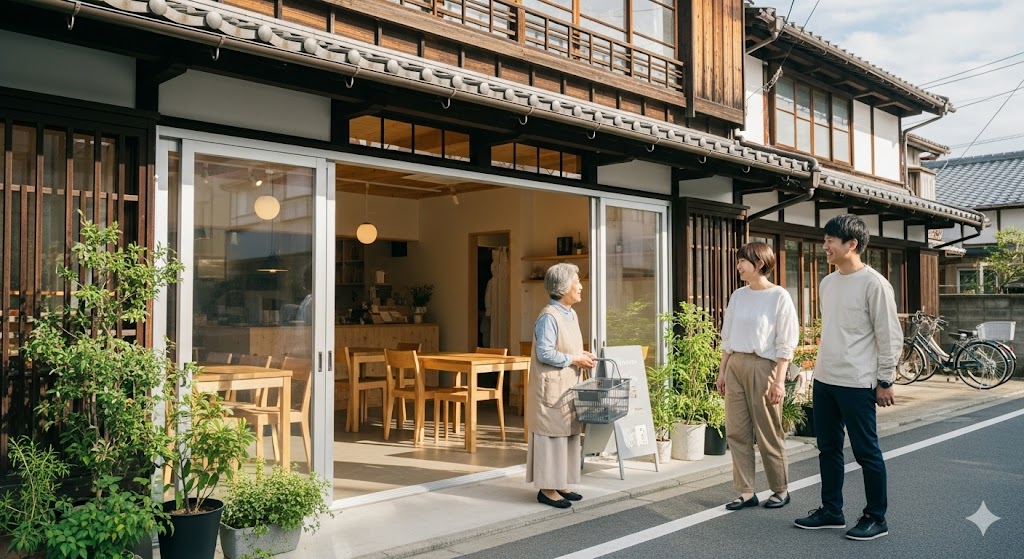
When a vacant home is revived as a community space or shared house, people gather there and interactions naturally follow. It can become a “gathering place” that prevents elderly isolation, or a “cultural hub” where young people congregate—re-weaving the community bonds that so often grow thin over time.
3. Generating New “Employment” and “Business”
Once a business built around a vacant home gets off the ground, it creates “employment”—staff needed for cleaning, operations, and hospitality. What’s more, a single success story can inspire the next challenger to think “I want to try that too,” sparking an entrepreneurial spirit that ripples throughout the entire community.
[Practical Guide] 5 Vacant Home Revitalization Ideas That Drive Community Building
We’ve carefully selected five high-value revitalization ideas that go beyond simple monetization to genuinely contribute to “community building.”
1. [The Ultimate Draw] Vacation Rentals / Whole-House Lodging
- Community Impact: Among all vacant home uses, lodging facilities most directly—and from the widest range—attract a “relationship population.” A whole-house rental in a restored traditional Japanese home can become the very “purpose of the trip” itself. As guests patronize nearby restaurants and shops, the direct ripple effect on the local economy is at its greatest.
- Keys to Success: Aim to obtain a hotel business license (simple lodging category) that allows year-round operation. Rather than offering just a place to sleep, incorporate “experiential content” unique to the area—such as an irori (traditional hearth) experience or farm work. Above all, securing understanding from neighboring residents from the planning stage, and building a system where the whole community welcomes guests, is the key to long-term success.
2. [A Community Gathering Place] Community Café / Dining Hall
- Community Impact: Creates a “gathering place” where local residents of all generations can come together. This can take many forms—a café where parents and young children gather, a salon where elderly residents can drop by casually, or a “children’s cafeteria” serving local ingredients. The interactions that happen here become the seeds of community watchfulness and new local activities.
- Keys to Success: Clarify the concept of “who this place is for.” It’s also essential to partner with local government, NPOs, and social welfare councils to build a sustainable operating model that goes beyond simple café management—leveraging subsidies and collaborating with volunteers.
3. [A New Way of Working] Shared Office / Coworking Space
- Community Impact: Attracts freelancers who work independently of location, as well as satellite offices for urban companies. This creates a reverse flow of business—from the city to the countryside—bringing people with diverse skill sets into the local area.
- Keys to Success: Beyond obvious infrastructure like high-speed Wi-Fi and printers, offer added value that city offices simply can’t match—the quiet, focused atmosphere of a traditional Japanese home, or a relaxing engawa veranda. It’s also effective to organize local business networking events that nurture a community among users.
4. [A Gateway to Relocation] Shared Housing / Trial Relocation Housing
- Community Impact: Provides a “trial” living space for young people and creatives interested in relocating to the area, before they commit to a full-scale move. This simultaneously solves the two biggest hurdles to relocation—housing and community—functioning as an “incubator” that nurtures future residents.
- Keys to Success: Rather than just providing housing, invest thought into designing a “shared living room” where residents can naturally interact with each other and with local residents. A coordinator-type role that connects tenants with key figures in the community is also important.
5. [A Community Landmark] Mixed-Use Facility (e.g., Café + Lodging + Shop)
- Community Impact: By packing multiple functions—a bakery, a general store, lodging, an event space—into a single vacant home, you create a true landmark, a “face of the town” where people with all kinds of purposes gather throughout the day. A single building becomes the “core” that boosts the appeal and foot traffic of the entire area.
- Keys to Success: A meticulous business plan is essential to generate the **”synergy effect”** where each function draws customers to the others. For example, design an internal economic cycle where “guests eat breakfast at the café, then buy souvenirs at the general store.” Running multiple businesses simultaneously demands strong management capability.
3 Common Threads for Successful “Community Building” Through Vacant Home Revitalization
1. Engage Local Residents as “Stakeholders”
This is the single most important factor for success. From the planning stage, engage in dialogue with local residents—ask “Wouldn’t it be great to have a place like this?”, gather their opinions, and build the project together. This process transforms opposition into understanding, and indifference into a sense of ownership—”this is our place.”
2. Blend an “Outsider’s” Perspective with “Love for the Community”
Rediscover and unearth the “treasures” that local residents have grown too accustomed to notice—a beautiful landscape, a unique culture, delicious local ingredients—through the fresh eyes of an “outsider.” Then, polish that value into a business with genuine respect and love for the community. This balance is what gives rise to truly distinctive ventures.
3. Balance “Passion” with “Business Viability”
Passion for “community building” and “regional contribution” is essential, but passion alone can’t sustain a business. Rather than relying solely on subsidies, you need a clear-eyed business plan and daily improvement efforts to secure enough revenue to become self-sustaining. Pursuing this “business viability” is the most crucial foundation for ensuring your aspirations don’t fizzle out like a one-time fireworks display.
Conclusion: Vacant Home Revitalization Is the Most Accessible Form of “Community Building” You Can Do Yourself
Vacant home revitalization is no longer simply an issue for property owners alone. It is “community building” itself—something that concerns everyone: the people who live there, the people who want to visit, and future generations.
What possibilities might your vacant home hold?
The revival of that single “point” can create a new “line” (a flow of people) through the community, eventually enriching the entire area as a “surface.” Why not take the first step in this grand project yourself?
Let Our Professionals Turn Your “Vision” Into a Real “Business”
“I want to contribute to community building…”
“…but I have no idea how to turn that into a sustainable ‘revenue-generating business.'”
“I want to start a vacation rental or café, but the complex regulations and financial planning are more than I can handle alone.”
Please bring us both your noble “vision” and your very real “anxieties.”
Stay Buddy Inc. is not just a vacation rental management company. We are real estate revitalization professionals who transform owners’ visions—and the dormant potential of their properties—into “revenue-generating businesses” built on data and strategy.
Here’s what we do:
- ① We thoroughly analyze the unique character of your vacant property and the market needs of its area, then propose the optimal business concept—whether a vacation rental, mixed-use facility, or something else—that achieves both “community building” and “profitability.”
- ② We translate that vision into a highly precise “business plan” convincing enough to win over financial institutions, supporting you through subsidy applications and financing.
- ③ We walk alongside your project as a one-stop partner, handling everything from complex permit acquisition (such as under the Hotel Business Act) to space design, and guest acquisition once operations launch.
Turn your “vision” into a sustainable “business.”
Why not chart the most realistic, most reliable path forward together with us? We’d love to hear more about the untapped potential your vacant home holds.