Leave Your Minpaku Management to the Experts
Completely Free Online ConsultationThe Number One Reason Renovation Hotel Projects Collapse: The “Road Access” Trap in Legally Non-Conforming Buildings
Buying an old building, row house, or traditional Japanese home and renovating it into a modern hotel or simple lodging facility—the “renovation hotel” investment—has become increasingly popular. With the promise of lower upfront costs and high yields, many investors and corporations are looking to enter this market.
But let us give you the conclusion of this article up front.
The number one reason renovation hotel projects fall apart is this: the property is a “legally non-conforming building,” and because it fails to meet the “road access requirement” (frontage of at least 2 meters on a road at least 4 meters wide), the government will absolutely never approve a “change of use” to operate it as a hotel. If you purchase a property without knowing about this legal trap, you will never obtain a lodging business license, and your investment—anywhere from tens of millions to hundreds of millions of yen—will become permanently frozen. This is a fatal mistake.
In this article, we will thoroughly explain the terrifying relationship between “legally non-conforming status” and the “road access requirement” that can send investors into a nightmare, the hidden traps within the change-of-use application process, and the legal remedies still available to you if you’re already considering a property with this issue.
Why Does “Legally Non-Conforming Building” Status Become a Barrier to Renovation?
If you’ve been searching for real estate, you may have come across the term “legally non-conforming.” This is different from illegal construction, but it becomes an extremely troublesome issue when starting a lodging business.
What “Legally Non-Conforming” Actually Means
Japan’s Building Standards Act and City Planning Act have been revised numerous times over the years, with safety standards becoming progressively stricter. A “legally non-conforming building” is one that was fully compliant with the law at the time it was built, but which no longer meets current legal standards due to subsequent amendments to the law.
Continuing to use the building as-is is not immediately illegal, and there are no penalties. This is why so many old buildings and traditional houses throughout Japan continue to be bought and sold normally despite falling into this legally non-conforming category.
The Moment “Change of Use” Triggers Current Law to Bare Its Teeth
“It’s been used just fine up until now, so renovating the interior and turning it into a hotel shouldn’t be a problem, right?”
This is the common assumption—and it’s exactly where the biggest trap lies.
When you want to operate a typical single-family home or office building as a hotel or simple lodging facility under Japan’s Hotel Business Act, you need to go through a legal procedure under the Building Standards Act called a **”change of use,”** which formally changes the building’s designated purpose to “hotel/inn” (this applies when the floor area subject to the change of use exceeds 200 square meters).
When you submit an application for this change-of-use confirmation to your local government office, the building is strictly required to comply with “the current, most up-to-date Building Standards Act.” In other words, every non-conforming element that had previously been overlooked must now be renovated to meet today’s rules.
The Absolute Rule of “Road Access Requirements” Standing in the Way of Hotel and Inn Businesses
Among non-conforming elements, some can be resolved with renovation work (for example, adding emergency stairways or switching to fire-resistant materials) if you’re willing to spend the money. However, there is one fatal non-conforming issue that money simply cannot fix: the “road access requirement.”
The Wall of “4-Meter Width, 2-Meter Frontage” That Protects Human Life
Article 43 of the Building Standards Act stipulates that “a building’s lot must have frontage of at least 2 meters on a road with a width of at least 4 meters.”
This is an absolute minimum standard designed to ensure that fire trucks and ambulances can arrive smoothly and carry out safe rescue and firefighting operations during disasters such as fires or earthquakes.
Among old row houses and traditional homes tucked away in back alleys, countless properties exist where the road in front is only 2 meters wide, or where you can only reach the public road by crossing someone else’s land. These are textbook cases of legally non-conforming buildings due to insufficient road access—commonly known as “properties that cannot be rebuilt.”
The Strictness of “Add-On Ordinances” for Special-Use Buildings
What’s more, because hotels and simple lodging facilities are used by an unspecified number of people who stay overnight, they are classified under the Building Standards Act as “special-use buildings”—an extremely strict category.
Many local governments have established their own additional “building safety ordinances” (add-on ordinances) for special-use buildings to further enhance safety. For example: “Lodging facilities may not, in principle, be built on flag-shaped lots accessed only via a narrow alley-like passage,” or “Hotels above a certain size must have frontage on a road at least 6 meters wide.”
No amount of beautiful interior renovation can resolve insufficient road access. Widening a public road is simply beyond the power of any individual. As a result, the change-of-use application is rejected, and the lodging business license is never granted.
The Tragic Fate of Investors Who Fall Into the Road Access Trap
What happens if you sign a purchase contract based purely on yield and location, without knowing the rules surrounding “legally non-conforming status” and the requirement to meet current law when changing a building’s use?
The Lodging License Never Comes Through, and Massive Capital Gets Frozen
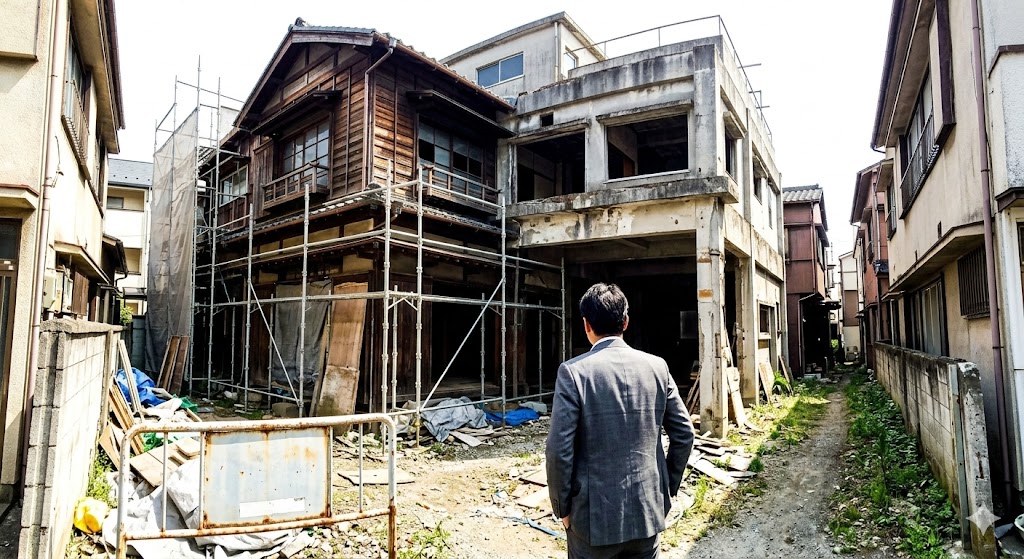
It’s only after purchasing the property, hiring an architect to draw up renovation plans, and going to the local government office for preliminary consultation that you’re finally hit with the reality: “Change of use is not possible due to insufficient road access.”
Not only is the renovation design fee wasted, but the entire hotel business plan is scrapped completely. The business plan you built around high-yield inbound tourism lodging collapses, and tens of millions—sometimes hundreds of millions—of yen in purchase capital becomes permanently frozen.
#### The Property Becomes a “Negative Asset” That’s Hard to Finance or Resell
You might think, “Well, if I can’t make it a hotel, I’ll just resell it quickly and recover my capital”—but it’s not that simple.
Properties with insufficient road access (properties that cannot be rebuilt) are given extremely low collateral valuations by financial institutions, which makes it very difficult for a subsequent buyer to secure a standard real estate investment loan or mortgage. This limits your pool of buyers to those who can pay in cash outright, and very few people actively want to buy “a property that can’t be rebuilt and can’t become a hotel.”
In the end, your only options are to sell at a steep loss compared to your purchase price, or to rent it out as a cheap residential unit and eke out a small return.
The One Legal Route to Escape This Hopeless Situation: The Minpaku New Law
So, if you’ve already ended up with a legally non-conforming property with insufficient road access, or if you’re determined to run a lodging business out of that charming back-alley property no matter what, is it truly impossible? Not quite—there is one legal workaround.
Being Treated as a “Residence” Means No Change of Use Is Required
Giving up on a change of use to a hotel/inn under the Hotel Business Act, and instead leveraging the **”Private Lodging Business Act” (the Minpaku New Law)**, is the most realistic and strategic way to sidestep this problem.
The Minpaku New Law is a system that allows you to legally operate a lodging business while keeping the building classified as a “residence”—without ever changing its use to the special-use category of “hotel/inn.”
Because no change-of-use procedure is triggered, you can bypass the strict road access review under the Building Standards Act (the review that checks compliance with current law). If the old house has continuously existed as a “residence” up to the present day, you can begin operations simply by filing a “notification” with the government—even while remaining legally non-conforming in other respects. (Note: installation of automatic fire alarm systems and other fire-code equipment required under the Fire Service Act is still mandatory.)
A Hybrid Operation Model to Offset the 180-Day Limit
The Minpaku New Law comes with a restriction limiting annual operating days to 180 days or fewer.
However, this constraint can be managed with the right operational strategy. During “peak seasons”—cherry blossom season, autumn foliage season, major holiday periods—when inbound demand surges and nightly rates soar, you operate the property as a high-yield minpaku. Then, during the off-season or once you hit your day limit, you switch to renting the unit out as a “monthly apartment” under a fixed-term lease. Since monthly rentals are structured as standard leases, they don’t count toward the 180-day cap.
By building this hybrid operating model, it’s entirely possible to maximize year-round revenue even from a “problem property” with insufficient road access.
Conclusion: Legal Compliance Due Diligence Before Purchase Decides Everything
In a renovation hotel business, thinking about design and marketing strategy is something that only comes after you’ve cleared every legal hurdle.
- Many old buildings are “legally non-conforming,” and a change of use requires bringing them into compliance with current law.
- In particular, “road access violations” cannot be fixed through renovation, and they decisively block any change of use to a hotel.
- If you want to run a lodging business on a property with insufficient road access, leverage the “Minpaku New Law,” which doesn’t require a change of use.
In real estate investment, “I didn’t know” can be fatal. Before jumping at an attractive yield or a charming property, having the knowledge to calmly assess whether that property can legally support your business model is the first step toward becoming a true business owner. Always conduct professional due diligence (legal compliance investigation) before signing a contract.
From Eliminating Legal Risk to Legal, High-Yield Operations—Leave It to Stay Buddy
“I want a professional to investigate whether the traditional house I’m considering purchasing is legally non-conforming.”
“I’ve already bought a property with insufficient road access, but I want to legally monetize it using the Minpaku New Law.”
“I want to hand off everything from property search to legal procedures, renovation, and post-launch operations.”
Leave these critical decisions and operations entirely to us.
We at Stay Buddy Inc. are a professional team specializing in lodging business consulting and full-service management, focused exclusively on Osaka City.
We know the gaps in the law and the true value of real estate inside and out.
- Precise legal compliance investigation and risk assessment before you sign a purchase contract, conducted by our partner licensed architects and administrative scriveners
- Business plan development to legally revive “problem properties” ineligible for change of use, through the Minpaku New Law
- Direction for installing safety equipment in strict compliance with the Fire Service Act
- A full-service management system that combines monthly rental operations to offset the 180-day limit with revenue maximization strategies
Before you take on a loss risk of tens of millions of yen, consult with real professionals first.
Stay Buddy turns “impossible” into “possible,” making us the ultimate business partner for maximizing your property’s value and your business’s revenue. For a renovation hotel project that won’t fail, start today with a free property assessment and business consultation—reach out to us anytime.