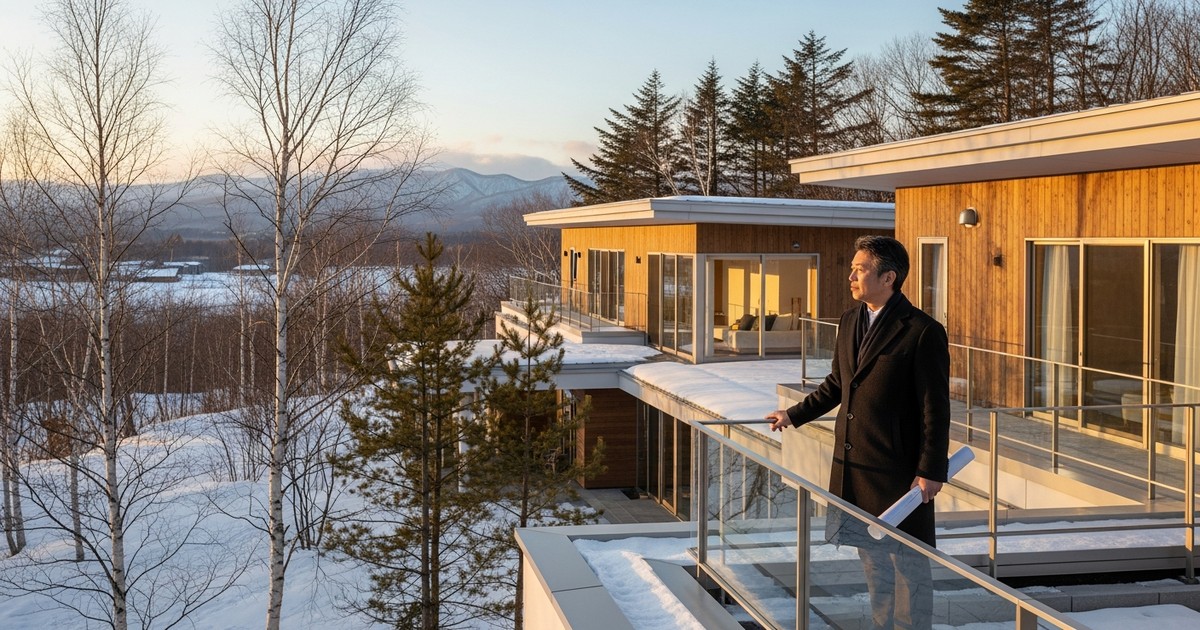
What You Should Know About the Market Before Considering Hotel Development in Hokkaido
To succeed in hotel development in Hokkaido, it’s essential to first accurately understand the demand characteristics of each area. Hokkaido attracts more than 50 million tourist visits annually, making it one of Japan’s leading tourist destinations with a stable ability to draw visitors. In major areas such as Niseko, Furano, Sapporo, and Hakodate in particular, average room rates have been trending upward alongside the recovery in inbound demand, and it’s not uncommon for properties to achieve annual average occupancy rates of 70–80%.
On the other hand, the seasonal fluctuation risk unique to Hokkaido shouldn’t be overlooked. While demand is concentrated during the winter ski season and the summer season for escaping the heat, some areas see occupancy rates drop into the 40% range during the shoulder seasons of spring and autumn. For this reason, it’s important to design concepts geared toward year-round occupancy and to level out revenue through strategies such as introducing workation and long-stay plans. In the Niseko area, for example, the average daily rate (ADR) during winter can reach ¥30,000–50,000, while in summer it may stay around ¥10,000–20,000—making year-round revenue simulations essential.
An Overview of Business Schemes for Hotel Development in Hokkaido
Hotel business schemes generally fall into four categories: “self-owned and self-operated,” “separation of ownership and operation,” “franchise affiliation,” and “condominium hotel type.” Because hotel development in Hokkaido requires integrated project management spanning land acquisition, design and construction, and post-opening operations, the choice of scheme significantly affects the initial investment amount, operational risk, and expected yield.
In the self-owned and self-operated scheme, the land and building are acquired using owner funds or financing, and operations are also handled in-house. While this allows the owner to capture 100% of the profits, it also places a heavy burden in terms of operational know-how and staffing. In contrast, under the MC (management contract) model, the owner retains ownership while entrusting operations to a specialized management company. In Hokkaido, foreign hotel brands have entered the Niseko and Lake Toya areas using the MC model, typically paying a brand fee of 3–5% of revenue and an incentive fee of 8–12% of GOP (gross operating profit).
Self-Owned and Self-Operated Model
In this scheme, the owner bears the full cost of land acquisition, construction, and FF&E (furniture, fixtures, and equipment), and also handles the hotel’s day-to-day operations with in-house staff. In Hokkaido’s regional areas, land acquisition costs tend to be relatively low, so construction costs typically account for a larger share of total project costs. For example, developing a 50-room business hotel in Sapporo would generally require a total project cost of around ¥1.0–1.5 billion, including land.
The advantage is that the owner keeps 100% of the profits, but in Hokkaido, winter heating costs can run 1.5–2 times higher than in Honshu, so managing utility expenses is critical to profitability. Additionally, hiring is challenging, and securing year-round staff is a particular issue in regional resort areas. For owners entering the hotel business for the first time, this is generally the highest-risk scheme.
MC (Management Contract) Model
The MC model separates ownership from operation: the owner holds the real estate, while a management company handles all day-to-day operations, marketing, and reservation management. Contract terms typically run 15–25 years, and early termination usually incurs a penalty. The management company is paid a base fee of 2–5% of revenue, plus an incentive fee tied to operating profit.
In Hokkaido, foreign brands such as Park Hyatt and The Ritz-Carlton have entered the Niseko area under this model, leveraging brand strength to attract higher-paying guests. However, foreign brands typically require construction specifications that meet brand standards, which can push construction costs up to ¥1.5–2 million per tsubo. For properties with 80–120 rooms, total project costs can reach ¥3–6 billion, making precise fundraising planning essential.
Franchise (FC) Model
The franchise model allows the owner to leverage an existing hotel chain’s brand, reservation system, and operations manual, while the owner handles actual operations. Franchise fees typically range from several million to tens of millions of yen, with royalties of 4–6% of revenue. Chains such as Route Inn, Dormy Inn, and Toyoko Inn operate throughout Hokkaido and offer a certain level of built-in customer draw.
The key difference from the MC model is that operational discretion remains with the owner. As a result, staffing and service quality management become the owner’s responsibility. For a business hotel near Sapporo Station, typical benchmarks are an occupancy rate of 75%, ADR of ¥8,000, and RevPAR of around ¥6,000, and business plans are often built around a 10–15 year payback period based on these figures.
Condominium Hotel Model (Sectional Ownership)
A scheme that has become increasingly common in Niseko and Furano in recent years is the condominium hotel model. Rooms are sold as sectionally-owned units to individual investors and rented out as hotel rooms when not in use by the owner. The developer recoups construction costs through unit sales and receives 20–30% of rental income as a management fee.
In the Niseko area, units are often sold for ¥30–100 million each, with owners generally expecting annual yields of 3–6%. For developers, sectional sales allow for faster recovery of initial investment, but coordinating with the management association and building systems to maintain quality become ongoing challenges. It’s also necessary to confirm consistency with the management bylaws specific to sectionally-owned buildings when obtaining licensing under the Hotel Business Act.
Specific Processes by Development Phase
Hotel development projects can be broadly divided into four phases: “planning and site selection,” “design and permitting,” “construction,” and “opening preparation.” A point unique to Hokkaido is the construction schedule constraint for foundation work in snowy regions. In areas north of Sapporo, foundation work is difficult during the ground-freezing period from November to March, so construction typically begins in April or May. As a result, overall construction periods tend to run 3–6 months longer than for comparably-sized projects in Honshu.
During site selection, confirming the zoning designation under the City Planning Act is essential. In Hokkaido’s hot spring and resort areas, development restrictions under the Natural Parks Act or the Forest Act may apply, and preliminary surveys can take 2–3 months. At the design stage, compliance with Hokkaido’s energy efficiency standards (Insulation Grade 4 or higher is effectively mandatory) affects construction costs, and it’s necessary to budget for an additional ¥50,000–100,000 per tsubo just for insulation and ventilation equipment.
Planning and Site Selection Phase
This phase involves market research, competitive analysis, and financial simulations to establish the basis for investment decisions. In Hokkaido’s major tourist destinations, demand data by nationality of inbound visitors (Australia, Southeast Asia, East Asia, etc.) is analyzed to design a facility concept suited to the target guest segment. Land acquisition costs vary widely—¥800,000–2,000,000 per tsubo in central Sapporo, ¥300,000–800,000 in the Niseko Hirafu area, and ¥50,000–200,000 in regional cities—so site selection directly impacts the business’s financial performance.
When using financing, in addition to regional banks and credit unions within Hokkaido, tourism-related loan programs from the Development Bank of Japan and the Shoko Chukin Bank can be effective options. A general benchmark is an equity ratio of 20–30% of total project costs, with the remainder raised through project financing or mezzanine loans.
Permitting and Design Phase
Hotel operations require a business license under the Hotel Business Act. In Hokkaido, applications are handled through local public health centers, and it typically takes 1–2 months from application to approval. For hotel and ryokan operations, room sizes must be at least 7 square meters per room (9 square meters or more is recommended for Western-style rooms), and whether a front desk is required varies by local ordinance. Notification as a fire-protected building under the Fire Service Act and confirmation of use change under the Building Standards Act must also be processed in parallel.
Design must account for Hokkaido’s climate conditions. Standard specifications include exterior wall insulation of at least 100mm thick, triple-glazed sash windows, road heating (for parking areas and entrances), and roof design to prevent snow slides. These specifications should be factored into the business plan as they typically increase construction costs by 15–25% compared to a similarly-sized hotel in Honshu.
Construction and Opening Preparation Phase
Selecting a local general contractor is critical during the construction phase. Construction companies within Hokkaido have expertise in cold-climate construction, which helps minimize protective measures needed for winter construction. For a 50-room property, the standard construction period is 12–18 months. FF&E (furniture, fixtures, and equipment) procurement should begin six months before opening, with a budget of roughly ¥1–3 million per room.
During the opening preparation phase, staff recruitment should begin 3–4 months before opening. Since seasonal employment is the norm in some of Hokkaido’s resort areas, providing staff housing or housing allowances can be effective for securing year-round staff. Preparations for OTA (online travel agency) listings, building a company website, and planning pre-opening events should proceed in parallel, with the goal of achieving an occupancy rate of at least 50% in the first month of operation.
Key Points for Profitability During the Operational Phase
After opening, maximizing RevPAR (revenue per available room) becomes the primary focus of the operational phase. The typical cost structure for hotels in Hokkaido consists of labor costs at 25–35% of revenue, utilities at 8–15%, OTA commissions at 10–15%, and food costs (for properties offering breakfast) at 5–10%. Utility costs in particular are affected by Hokkaido’s heating demands, and can exceed 15% of revenue during winter.
Implementing revenue management is essential. Dynamic pricing based on demand forecasting is common practice, with rate differences of 2–3 times between peak and off-peak seasons. In the Niseko area, for example, some properties generate 50–60% of their annual revenue during the winter ski season (December–March), meaning pricing decisions during this period largely determine annual financial results. During the off-season, combining offerings such as adventure tourism and culinary experience packages can help boost occupancy.
Financing and Investment Payback Simulation
Financing methods for hotel development in Hokkaido are diverse, including bank loans, real estate funds, crowdfunding, and private bonds. For a project with total costs of ¥2 billion, a typical capital structure might be 70% senior loans (¥1.4 billion), 10% mezzanine loans (¥200 million), and 20% equity (¥400 million). Recent interest rates in Hokkaido have ranged from 1.5–3.0% for senior loans and 5–8% for mezzanine loans.
As an example investment payback calculation, consider an 80-room business hotel in Sapporo. Assuming total project costs of ¥1.5 billion, annual revenue of ¥450 million (ADR of ¥9,000 × 75% occupancy × 365 days × 80 rooms), a GOP margin of 35% (¥157.5 million), and annual cash flow of ¥80 million after loan repayment and depreciation, the ¥300 million in equity would be recouped in approximately 4 years, while the total investment would be recovered in roughly 15–18 years. For resort-type properties, where seasonal fluctuation is greater, it’s safer to plan conservatively for a payback period of 20 years or more.
Considering a Hotel Business in Hokkaido? Talk to Stay Buddy Inc.
Hotel development and operation in Hokkaido requires specialized knowledge across a wide range of areas—from site selection and business scheme design to permitting and post-opening revenue management. For owners entering the accommodation business for the first time in particular, deciding which scheme best suits their financial capacity and risk tolerance can be a challenging decision.
Stay Buddy Inc., a vacation rental management company, provides end-to-end support from the planning stage through operations, for properties ranging from small vacation rentals to hotel-scale accommodations. We offer concrete advice tailored to each owner’s business stage, including preparing financial simulations, proposing operational schemes, and developing OTA listing strategies.
Please feel free to contact Stay Buddy Inc. with any questions about accommodation business ventures in Hokkaido. Your first consultation is free of charge. Even if you don’t yet have specific property information, we’re happy to discuss market analysis for your area of interest and provide rough revenue models.