Leave Your Minpaku Management to Us
Completely Free Online ConsultationHow to Start a Home-Based Minpaku: Your Step-by-Step Path to Profit
“I wonder if I could put that empty room in my house to better use…”
“It would be amazing if I could rent out a room to travelers, help cover the rent, and enjoy some cross-cultural exchange at the same time…”
If you’ve ever had thoughts like these, there’s a concrete way to make that dream a reality. It’s called “owner-occupied” minpaku—running a home-stay business using part of your own residence.
Let’s start with the conclusion of this article.
If you follow the right steps and understand the rules you need to follow, it’s entirely possible to turn your home into a new source of income without a massive upfront investment.
In this article, we’ll walk you through everything from how to get started with a home-based minpaku to welcoming your very first guest and earning your first income—explained step by step in a way that’s easy for beginners to follow.
3 Unique Benefits of Owner-Occupied Home Minpaku
Unlike minpaku businesses built around purchasing property purely as an investment, running a minpaku out of your own home offers unique rewards that go far beyond money.
1. Low Startup Costs
The biggest advantage is that you don’t need to purchase or rent a new property. By using the room you already have, along with your existing furniture and fixtures, you can dramatically cut down on initial costs. In most cases, renovations are limited to simply tidying up the guest room.
2. Cross-Cultural Exchange and New Connections
Sharing part of your living space with guests naturally leads to genuine, organic conversations. Sharing a meal with people from around the world, introducing them to the charms of your local area—these once-in-a-lifetime encounters add a richness to your everyday life that money simply can’t buy.
3. Reduced Rent or Mortgage Burden
Once your spare room starts generating steady monthly income, it can become a major boost to your household finances. Putting that income toward rent or mortgage payments can significantly ease your financial burden.
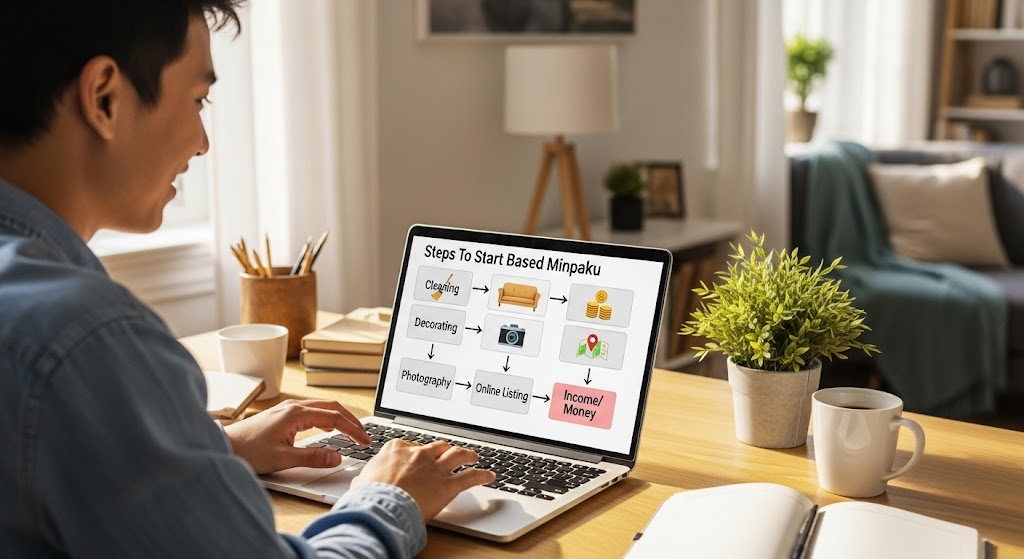
[Complete Guide] 7 Steps to Starting a Home Minpaku
Now let’s take a look at the seven concrete steps to actually launching your home minpaku.
STEP 1: [Most Important] Check the Rules of Your Residence
This very first step determines whether you can even run a minpaku out of your home in the first place.
- If you own a detached house: There are generally no major restrictions, but if you have a mortgage, it’s a good idea to double-check your loan agreement for any clause specifying “residential use only,” just to be safe.
- If you own a condominium unit: This is usually the biggest hurdle. Carefully review your condo’s “management regulations” for any language prohibiting minpaku, such as bans on “commercial use” or “allowing unspecified numbers of outsiders to enter.” Even if there’s no explicit prohibition, be sure to consult with the management association and obtain permission to avoid any future disputes.
- If you’re renting: You absolutely must obtain written consent from your landlord. Running a minpaku without permission constitutes a serious breach of your lease agreement and could result in forced eviction.
STEP 2: Choose Your Operating Framework (Legal Category)
For most home-based minpaku businesses, you’ll operate under the Private Lodging Business Act (the “Minpaku Law”). This law was specifically designed with scenarios like utilizing spare rooms at home in mind, and it comes with several notable features.
- Maximum of 180 operating days per year: You can’t run it as a full-time, year-round business, but this limit is more than sufficient if you’re starting it as a side income stream.
- No need to outsource management if you’re an owner-occupant: Normally, minpaku properties without a resident owner are required to contract a licensed “housing accommodation management business” to handle operations. However, if you live on-site, this requirement doesn’t apply—a significant advantage.
STEP 3: Install Safety Equipment
Protecting your guests’ safety is a host’s most important responsibility. You’ll need to equip your home to meet fire safety code requirements.
- Fire alarms: In addition to your existing residential smoke detectors, you may need to install additional units depending on your room layout.
- Fire extinguisher: Place a household fire extinguisher somewhere easily accessible.
- Evacuation route diagram: Post a diagram showing the escape route from the room to the building’s exit in a visible location, such as on the guest room door. Note that these are only the minimum requirements—be sure to consult with your local fire department before starting your business to get guidance on any additional equipment you may need.
STEP 4: Prepare the Guest Space and Amenities
Now it’s time to create a space where your guests can feel comfortable.
- Guest room: Provide clean sheets and bedding, and make sure there’s storage space where guests can keep their belongings. Be sure to install a lock on the room door to protect their privacy.
- Amenities: Stock up on a full set of toiletries—towels, bath towels, toothbrushes, shampoo, conditioner, and body soap.
- Wi-Fi: This is essential infrastructure nowadays. Make sure you have a reliable, fast internet connection, and clearly display the network ID and password.
STEP 5: File with Local Authorities and Reach Out to Neighbors
Once your preparations are complete, it’s time to handle the administrative procedures.
- Notification to local government: Prepare the required notification documents under the Private Lodging Business Act and submit them to the relevant department (such as the public health center) in your property’s municipality. An increasing number of local governments now accept online submissions.
- Talking to your neighbors: While not a legal requirement, this step is extremely important for preventing future disputes. We strongly recommend politely explaining to your neighbors—including those living above, below, and next to you—that you’ll be renting out part of your home to vetted travelers, and getting their understanding beforehand.
STEP 6: List Your Property and Showcase Its Appeal
Now it’s finally time to start attracting guests. Sign up as a host on a booking platform like Airbnb.
- Let your photos do the talking: Photos are the single most important element. Tidy up your room and take pictures during the bright hours of the day. In addition to the guest room, include photos of shared spaces like the living room and kitchen, and even a smiling photo of yourself as the host—it helps put guests at ease.
- Write a thoughtful self-introduction: Share your personality by writing something like, “I’m [name], and I live in [area]. My hobbies include [hobby], and I love this spot called [place] in my neighborhood.” This kind of personal touch makes guests feel like they’re booking a stay with a real person they’re excited to meet, not just a room.
STEP 7: Welcome Your First Guests and Earn Reviews
Your first few guests play an outsized role in shaping your minpaku’s reputation.
- Your first reviews are key: When you’re just starting out, it’s worth lowering your rates a bit if that’s what it takes to secure bookings and gather positive reviews. It’s said that once you accumulate five or more positive reviews, bookings tend to come in much more easily.
- Hospitality from the heart: Prepare a welcome message card, recommend your favorite local spots—these small, heartfelt gestures are what lead to glowing reviews.
3 Mindsets for Success with Home Minpaku
Mindset 1: Strike the Right Balance with Privacy
Sharing part of your living space with strangers takes more consideration than you might expect. Clearly defining which areas guests can access (the guest room, shared bathroom and toilet) versus your own private areas—and communicating those boundaries clearly upfront—is the key to reducing stress for both you and your guests.
Mindset 2: Embrace Your Role as a Host
Even if it’s your own home, the moment you accept payment to host guests, you become a business owner. You need to take responsibility for your guests’ safety and comfort. Respond promptly to guest inquiries, keep shared spaces consistently clean, and maintain a professional mindset at all times.
Mindset 3: Don’t Forget to File Your Taxes
Income earned from minpaku is subject to income tax. If you’re a salaried employee, you’re generally required to file a tax return if your non-salary income exceeds ¥200,000 per year. Minpaku income is typically reported as “miscellaneous income” (zatsu shotoku). Make it a habit to keep accurate records of your revenue and expenses (such as consumables and a portion of your utility bills) on an ongoing basis.
Conclusion: Home Minpaku Is a New Lifestyle That Connects You to the World
Turning your spare room into a source of income is more than just a side hustle. It’s an opportunity to meet people from all over the world, experience different cultures, and rediscover the charm of your own neighborhood—all from the comfort of your living room. Home minpaku opens the door to a wonderful lifestyle that brings a breath of fresh air into your daily life and makes it that much richer.
If this article has helped give you the push you need to take that new step forward, there’s nothing that would make us happier.
Let the Pros Turn Your “I Want to Start” Into Reality
“Home minpaku sounds really appealing, but checking management regulations, consulting the fire department, filing with the local government—it all seems so complicated…”
“I really want to try it, but I’m worried I’ll give up before I even get past all the tedious initial paperwork.”
We completely understand how you feel. The specialized, complex procedures involved in starting something new can feel like an intimidating barrier to anyone. And it would be such a shame to let that valuable “I want to try this” feeling fizzle out in the face of red tape.
At Stay Buddy Inc., a minpaku management company, our primary business is managing investment properties—but the extensive know-how we’ve built for launching minpaku businesses smoothly while staying fully compliant with the law makes us a powerful ally for anyone hoping to start a home-based minpaku.
Beyond full-scale operational management, we also offer startup consulting services. From legal reviews of condominium management regulations to handling fire department consultations on your behalf and supporting you through the tedious paperwork of official filings, our team of minpaku professionals is here to help you through the most challenging and stressful parts of the process—right up until you welcome your very first guest.
Why not take that first confident step toward a new lifestyle? We look forward to hearing from you.