What You Need to Know Before Attracting Ski Guests to Your Hokkaido Vacation Rental
To achieve steady bookings during ski season at your Hokkaido vacation rental, OTA (Online Travel Agency) strategy before the season begins is essential. In world-renowned ski resort areas like Niseko, Furano, and Tomamu, inbound demand from overseas continues to grow year after year, and it’s not uncommon for nightly rates to jump two to three times the off-season rate during the December-to-March peak period.
However, high demand doesn’t mean bookings will fill up on their own without any effort. On major OTAs like Airbnb, Booking.com, and Vrbo, hundreds of competing properties are packed into the same areas. In the Niseko area alone, more than 500 properties are listed on Airbnb, and the reality is that if you don’t rank near the top of search results, your listing won’t even be seen. This article walks through, step by step, the concrete OTA strategies you should tackle before the season starts.
The Big Picture: OTA Strategies That Actually Drive Ski Guest Bookings
OTA strategy aimed at ski guests can be broken down into four main pillars: “listing optimization,” “pricing strategy,” “review acquisition,” and “coordination with external channels.” Completing these by October or November is directly tied to securing bookings from December onward.
What’s important to understand is that ski guests follow a clear, predictable search pattern. Data shows that roughly 65% of overseas ski guests book their accommodation two to three months before departure. If your listing isn’t ready by November, you’ll miss out on the segment of travelers with the strongest booking intent. Below, we break each step down into actionable details.
Step 1: Clearly Define Your Target Ski Guest Persona
The first thing to tackle is deciding, in concrete terms, what type of ski guest you want to host. Guests visiting Hokkaido’s ski resorts generally fall into three categories. The first is long-stay groups from Australia and Western countries (average stay of 5-7 nights, groups of 4-8). The second is short-stay families from Asia (average stay of 2-3 nights, groups of 2-4). The third is domestic ski enthusiasts—couples or small groups (1-2 nights, 2-3 people).
The information you need to highlight in your listing changes depending on your target guest. For example, for long-stay groups from Western countries, having a kitchen, washer/dryer, and ski drying room are critical factors in the booking decision. On the other hand, families from Asia tend to respond well to airport transfer options and lift ticket arrangement support. You don’t need to narrow your focus to just one persona, but setting priorities and designing your listing’s selling points around them is the first step toward improving your conversion rate.
Step 2: Optimize Your Listing Title and Photos
Include Ski-Related Keywords in Your Title
In Airbnb’s search algorithm, the keywords included in your title affect your search ranking. A generic title like “Cozy Apartment in Niseko” makes it harder to reach people searching specifically for ski trips. Instead, use concrete terms that ski guests actually search for, such as “Ski-in/Ski-out Chalet|5min to Gondola|Ski Storage.” For Japanese-language listings as well, including phrases like “3-minute walk to the slopes,” “ski drying room available,” or “discounted lift tickets” highlights your facilities and access advantages, changing how your listing stands out in search results.
Prioritize Winter Exterior Shots and Ski-Related Amenities in Your Photos
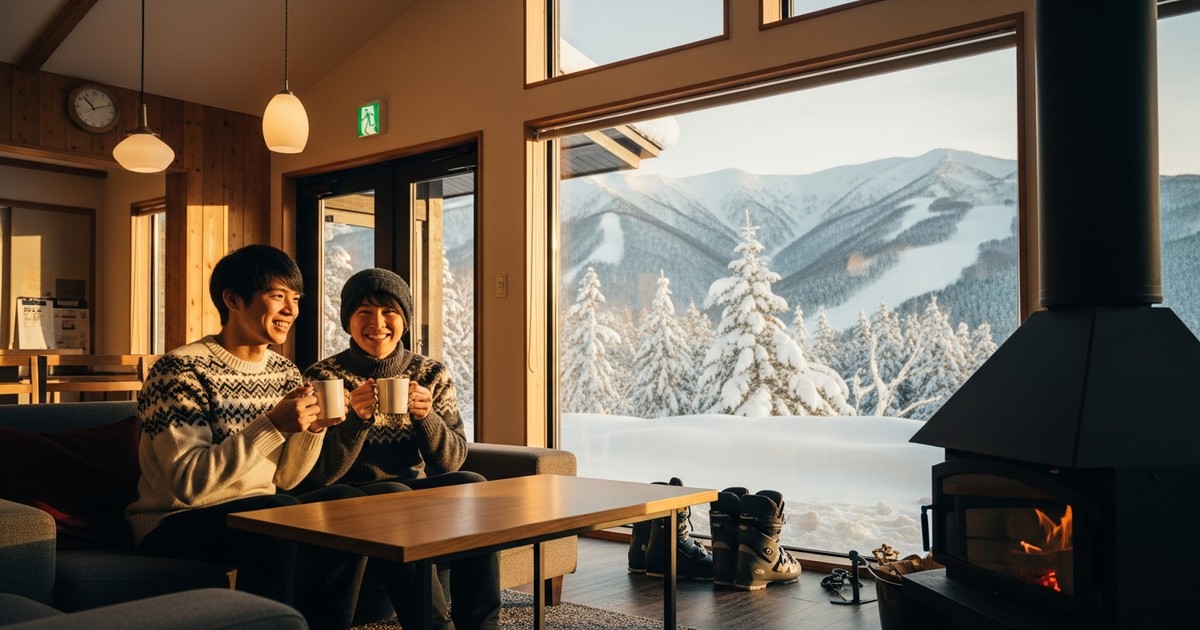
The cover photo displayed first in OTA search results is the single biggest factor affecting your click-through rate. It’s not uncommon to see listings still using summer exterior photos with green scenery, but for ski guests, a snowy exterior photo dramatically outperforms in click-through rate. If you don’t have winter photos from a previous season, plan to photograph your property as soon as the first snow falls. Placing photos of winter-specific amenities—ski racks, drying rooms, fireplaces, snow-viewing baths—in positions two through five encourages viewers to spend more time browsing and increases booking conversion. According to Airbnb’s own data, listings that use professionally shot photos see booking increases of up to 40%.
Step 3: Design a Pricing Strategy for Ski Season
Divide the Season into Three Pricing Tiers
Ski season pricing shouldn’t be a single flat rate—it should be divided into at least three tiers based on demand. As a general guideline: early season (early to mid-December) at 1.5x the off-season rate, high season (late December to mid-February) at 2x to 3x, and late season (late February to March) at 1.3x to 1.5x. In the Niseko area, nightly rates of ¥50,000 to ¥100,000 are common during the week of New Year’s, and leaving your rates unchanged during this period represents a significant missed opportunity.
Combine Minimum Stay Requirements with Early-Bird Discounts
Setting a minimum stay of 3 to 5 nights during high season reduces the number of cleanings required while maximizing revenue. Some popular Niseko properties even set a 7-night minimum stay from late December through early January. At the same time, offering a 10-15% early-bird discount to guests who book in October or November lets you lock in occupancy well before the season begins. Rather than relying solely on Airbnb’s Smart Pricing feature, introducing dynamic pricing tools like PriceLabs, Wheelhaus, or BeyondPricing allows for automatic adjustments that reflect competitor pricing trends, with expected revenue gains of 15-25% per season.
Step 4: Set Up Ski-Guest-Friendly Amenities and Services—and Reflect Them in Your Listing
Install a Ski Drying Room and Storage Space
The single highest-priority amenity ski guests look for in accommodation is a drying room for skis and boots. Simply providing warm-air boot dryers (roughly ¥5,000-15,000 per unit) for the number of guests and installing a rack near the entrance or mudroom for storing skis can serve as a key differentiator for your listing. If Airbnb’s amenities section allows you to add tags like “Ski-in/Ski-out” or “Ski storage,” be sure to set them. Whether or not these tags are present affects whether your listing appears in ski-related filtered searches.
Provide Concierge-Style Information on Transfers and Rentals
Many overseas ski guests feel anxious about how to get from New Chitose Airport to their accommodation. Simply including in your listing description a booking link for a direct airport shuttle bus (such as the Hokkaido Resort Liner, roughly ¥4,000-6,000 one way) and estimated taxi fares (roughly ¥25,000-35,000 between New Chitose and Niseko) can ease guests’ concerns and improve booking conversion. Additionally, preparing a “guest guide” PDF that compiles links to ski rental shops and online lift ticket purchases in advance, then sending it via message once a booking is confirmed, tends to earn higher review ratings.
Step 5: Boost Your OTA Search Ranking with a Review Strategy
In OTA algorithms, the number and quality of reviews is one of the most critical factors determining search ranking. Airbnb requires an overall rating of 4.8 or higher for Superhost status, but properties with fewer than 10 reviews going into ski season are at a significant disadvantage in search results. One effective way to build up reviews before the season starts is to capture autumn foliage or workation demand during the September-November off-season, offering discounted rates in exchange for reviews.
Data shows that sending guests a personalized message the day after checkout—something like, “We hope you enjoyed your stay! We’d love it if you could leave us a review”—improves review submission rates by an average of 15-20%. Additionally, responding thoughtfully to any negative reviews within 24 hours demonstrates a sincere approach to management to future viewers, minimizing any negative impact on bookings.
Step 6: List on Multiple OTAs and Introduce a Channel Manager
Relying on Airbnb alone for bookings carries significant risk. Listing simultaneously on multiple OTAs—Booking.com, Vrbo, Expedia, and others—expands your exposure. Booking.com in particular has a high share of searches from Europe and Australia, making it an essential channel for reaching Western ski guests visiting Niseko and Furano. Vrbo excels with families and groups looking for whole-property rentals, making it worth listing on if your property can accommodate four or more guests.
To prevent double-booking risk when listing across multiple OTAs, you’ll need to introduce a channel manager—such as Beds24, Hostaway, or Guesthouse—to manage your calendar centrally. Monthly costs vary depending on the number of properties and features, but typically run around ¥3,000-10,000 per property per month. A channel manager also lets you update pricing across all OTAs at once, making it easy to sync with the dynamic pricing strategy discussed in Step 3.
Step 7: Cut OTA Fees Using Social Media and Your Own Website
Bookings made through OTAs come with platform fees (around 3% on the host side for Airbnb, roughly 15% for Booking.com). During high-rate periods like ski season, these fees can add up to hundreds of thousands of yen—or more—in costs over the course of a year. Posting winter property photos and videos of nearby powder snow on Instagram, then directing followers from your profile to your own direct booking site, lets you cut OTA fees while building direct repeat business.
Using tools like STAYS, BookDirectPro, or Smoobu, you can build a direct booking site with payment functionality for around ¥5,000-15,000 per month. Some Hokkaido vacation rental owners who hand guests a card at checkout saying something like “Book directly with us next time for 10% off” have reported repeat booking rates reaching around 25% in their second season and beyond.
Struggling to Attract Ski Season Guests? Talk to Stay Buddy Inc.
Each of the OTA strategies covered here is achievable on its own, but handling listing optimization, pricing, review management, and multi-channel operations all by yourself requires a substantial amount of time and effort. Hokkaido’s ski season, in particular, has a limited preparation window—it’s an unforgiving market where success or failure is often decided in just the two months of October and November.
Stay Buddy Inc., a vacation rental management company, provides one-stop support for everything you need to maximize revenue during ski season—from creating and optimizing OTA listings, to dynamic pricing, multilingual guest communication, and channel manager implementation and operation. Drawing on our know-how in attracting ski guests to the Hokkaido area, we’ll propose a custom operating plan tailored to your property’s unique characteristics.
If you’re thinking, “This season, I really want to boost my occupancy rate and nightly rate,” or “I don’t know where to start with OTA strategy,” please feel free to reach out to Stay Buddy Inc. Your first consultation is completely free.