The Basics of Expensing Equipment Investments for Minpaku in Hokkaido
If you’re running a minpaku (short-term rental) business in Hokkaido, properly expensing cold-climate-specific equipment investments like studless tires and snowblowers is key to improving your profitability. If you can properly record the expenses necessary for ensuring winter safety and providing a comfortable guest experience, you can reduce your income tax and resident tax burden.
However, when it comes to expensing equipment investments, there are items that can be recorded in full as “consumable supplies expenses” and items that require depreciation, with the treatment differing depending on the amount and useful life. Furthermore, whether the equipment is used exclusively for the minpaku business or shared with personal use also requires allocation calculations. This article explains the specific steps and precautions Hokkaido minpaku owners should know regarding expensing equipment investments, using real-world amount examples.
To avoid losing out at tax filing time, it’s important to understand how to handle expenses before you even make a purchase. Let’s walk through the specific steps in order.
Step 1: List Out the Types of Equipment Investments Needed for Minpaku Operations
The first thing to do is comprehensively list out all the equipment investments needed to run a minpaku business in Hokkaido. By organizing not just winter-specific items but also year-round necessary equipment, you can ensure no expenses are missed when filing your tax return.
Equipment Needed for Winter Preparations
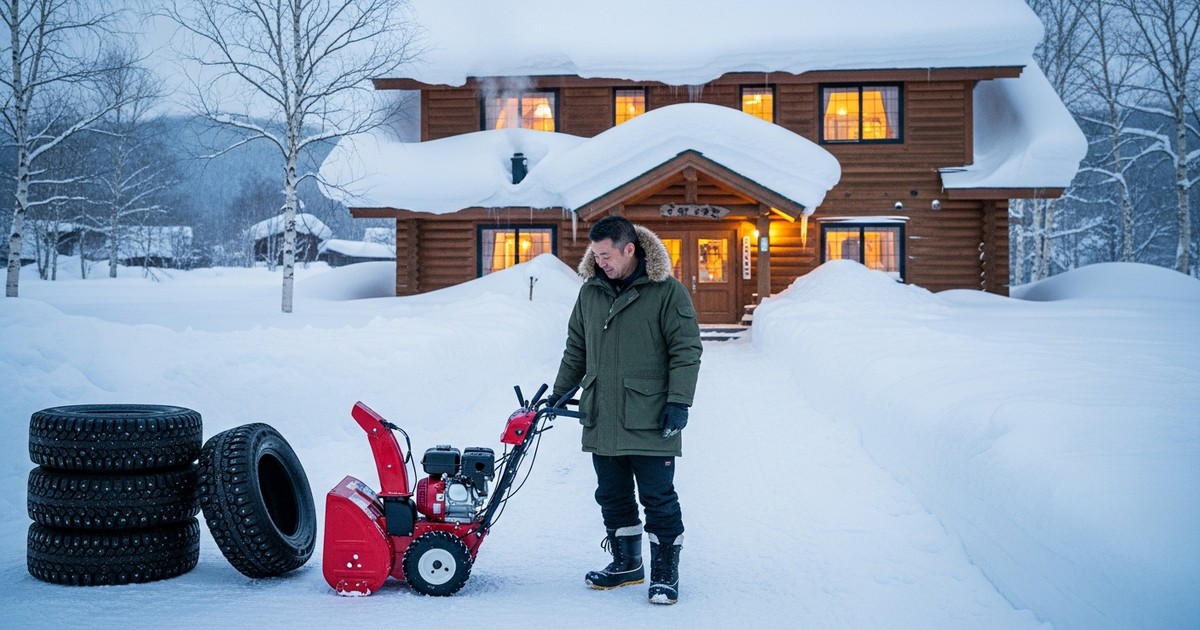
The most representative examples of equipment unique to Hokkaido are snowblowers and studless tires. A small household snowblower typically costs between ¥150,000 and ¥400,000, while commercial-grade units can exceed ¥800,000. If you’re fitting studless tires on a vehicle used for guest transportation, one set typically costs between ¥40,000 and ¥120,000. In addition, Hokkaido minpaku operators may also need items such as snow-melting mats (¥30,000–¥80,000 per unit), kerosene heaters or FF-type heaters (¥50,000–¥200,000), and road heating systems (¥500,000–¥1,500,000 including installation).
Equipment Needed Year-Round
Beyond winter preparations, running a minpaku business requires a lot of other equipment, including Wi-Fi routers (¥10,000–¥30,000), smart locks (¥30,000–¥60,000), furniture and appliance sets (¥300,000–¥1,000,000), and security cameras (¥20,000–¥50,000 per unit). All of these can potentially be recorded as expenses, so be sure to keep receipts at the time of purchase and note the purchase date, amount, and purpose for each item.
Step 2: Determine the Expense Treatment Method Based on the ¥100,000 Threshold
Once you’ve listed your equipment investments, the next step is to determine the expense treatment method for each item based on its acquisition cost. If this determination is made incorrectly, there’s a risk it could be disallowed in a tax audit, so it’s essential to accurately understand the amount thresholds.
Under ¥100,000: Record in Full as Consumable Supplies Expenses
Equipment with an acquisition cost of less than ¥100,000 per item or set can be recorded in full as a “consumable supplies expense” in the year of purchase. For example, if a set of studless tires costs ¥80,000, it can be recorded as a lump-sum expense for that year. The same applies to items like a ¥70,000 kerosene heater or a ¥50,000 smart lock. One important point here is that the determination should be made “per set,” not “per item.” If a set of tires consists of four tires, the judgment is based on the combined price of all four.
¥100,000 to Under ¥200,000: Lump-Sum Depreciable Assets
Equipment costing between ¥100,000 and under ¥200,000 can be treated as a “lump-sum depreciable asset,” allowing you to depreciate it evenly over three years. For example, if you purchase a small snowblower for ¥150,000, you would record ¥50,000 as an expense each year for three years. The advantage of this method is that it allows for a uniform three-year depreciation period regardless of the type of asset. Under standard depreciation, useful life varies by asset type, but with lump-sum depreciable assets, the calculation becomes much simpler.
¥100,000 to Under ¥300,000: Special Provision for Small Depreciable Assets
Sole proprietors or small businesses filing blue-form tax returns can use the “Special Provision for Small Depreciable Assets,” which allows assets costing under ¥300,000 to be expensed in full in the year of purchase. The annual total limit is ¥3,000,000. For example, if you purchase a snowblower for ¥250,000, normally you would depreciate it over several years, but using this special provision, you can expense the full ¥250,000 in the year of purchase. To maximize the tax-saving effect, be sure to have completed your blue-form tax return registration.
¥300,000 and Above: Standard Depreciation
Equipment costing ¥300,000 or more must be depreciated based on its statutory useful life. Machinery such as snowblowers generally has a useful life of 7 years, while building attachments like road heating systems have a guideline useful life of 15 years. For example, if you purchase a commercial-grade snowblower for ¥700,000, using the straight-line method, you would record ¥100,000 as an expense each year over 7 years. Since the first year’s depreciation is prorated based on the number of months from the purchase month to the end of the fiscal year, the timing of purchase is also an important factor. The earlier in the year you make the purchase, the larger the depreciation amount you can record in the first year.
Step 3: Set the Allocation Ratio Between Business and Personal Use
If equipment is used exclusively for the minpaku business, you can expense the full amount. However, if you use studless tires on a personal vehicle that also transports guests, or use a snowblower at a property that serves as both your home and minpaku listing, you’ll need to allocate the expense between business and personal use (a “household allocation”). If this allocation ratio is set vaguely, it can become a point of contention with the tax office.
How to Calculate the Allocation Ratio
The allocation ratio must be calculated reasonably based on actual usage. For vehicle studless tires, it’s common to calculate the ratio based on mileage records — specifically, “the proportion of total mileage used for minpaku-related transportation or errands.” For example, if your monthly mileage is 1,000 km and 400 km of that was for minpaku-related purposes, the allocation ratio would be 40%. For a set of studless tires costing ¥80,000, you could expense ¥32,000.
How to Keep Records to Support Your Allocation
Since tax audits may require you to justify your allocation ratio, it’s important to keep records on an ongoing basis. Effective methods include keeping a vehicle log recording the “date, destination, purpose, and mileage” for each trip, and recording the date and location (minpaku property or personal residence) of each snow-removal task. Even simple management using Excel or a spreadsheet can serve as sufficient supporting documentation. If a snowblower is used only on the premises of a property dedicated exclusively to minpaku use, it can be treated as 100% business use without issue.
Step 4: File Correctly on Your Tax Return
Once you’ve determined the amount classification and allocation ratio for your equipment investments, you need to reflect them accurately on your tax return. Errors in entries or calculations here can lead to additional tax assessments or late payment penalties, so proceed carefully.
How to Record It on the Blue Return Financial Statement
Assets requiring depreciation should be recorded in the “Depreciation Expense Calculation” section of the blue return financial statement. The entry fields include: asset name (e.g., snowblower), acquisition date, acquisition cost, useful life, depreciation method (straight-line or declining-balance), current year’s depreciation expense, and business-use percentage. For example, if you purchase a snowblower for ¥350,000 in July, with a useful life of 7 years, using the straight-line method, and a business-use percentage of 100%, the first year’s depreciation expense would be ¥350,000 ÷ 7 years × 6 months ÷ 12 months = ¥25,000.
Recording Consumable Supplies Expenses and Small Depreciable Assets
Items under ¥100,000 treated as consumable supplies expenses should be combined and recorded in the “Consumable Supplies Expenses” section of the income statement. When using the special provision for small depreciable assets, record the item in the depreciation expense calculation section, and note “Article 28-2 of the Special Taxation Measures Act” in the remarks column to clearly indicate that the special provision has been applied. For lump-sum depreciable assets, similarly record them in the depreciation expense calculation section, entering the depreciation method as “lump-sum” and the amount for the three-year even depreciation.
Step 5: Purchase Timing and Strategies to Maximize Tax-Saving Effects
Even when purchasing the same equipment, you can increase the tax-saving effect by being strategic about timing and purchase methods. This is especially important for Hokkaido minpaku operations, where revenue tends to fluctuate seasonally due to winter demand, making equipment investment timing a key strategic consideration.
The Benefits of Purchasing Early in the Fiscal Year (January–March)
For sole proprietors, the fiscal year runs from January to December. If you purchase a depreciable asset earlier in the year, you can record a larger depreciation expense in the first year. For example, if you purchase a snowblower with a useful life of 7 years and an acquisition cost of ¥700,000 in January, the first-year depreciation expense would be ¥100,000 (¥700,000 ÷ 7 years). But if purchased in December, it would only be about ¥8,333 (¥100,000 × 1 month ÷ 12 months). Since items eligible for the special provision for small depreciable assets can be expensed in full regardless of the purchase month, there’s no issue with making a last-minute purchase at year-end.
Using Used Equipment to Shorten the Useful Life
Purchasing a used snowblower or heating equipment can shorten the useful life, which increases the annual depreciation expense. The useful life of a used asset is calculated as “statutory useful life − elapsed years + (elapsed years × 20%).” For example, if you purchase a snowblower with a statutory useful life of 7 years that is 4 years old, the useful life would be 7 years − 4 years + (4 years × 0.2) = 3.8 years, which rounds down to 3 years. If purchased for ¥300,000, you could record ¥100,000 in depreciation expense each year for 3 years — completing the expensing process much faster than the 7 years required for a new unit.
Commonly Overlooked Expense Items in Hokkaido Minpaku Operations
While it’s easy to focus on major equipment investments like studless tires and snowblowers, there are many other expense items that Hokkaido minpaku operators tend to overlook. Capturing all of these can lead to tens of thousands to hundreds of thousands of yen in tax savings per year.
Increased Winter Utility Costs
For minpaku properties in Hokkaido, it’s not uncommon for winter heating costs to be 3 to 5 times higher than in summer. There are cases where kerosene or gas costs jump from ¥30,000 per month to over ¥100,000 in winter. If the property is also used as a personal residence, allocation is required, but if it’s used exclusively for minpaku, the full amount can be expensed. Be sure to organize your invoices and receipts by month.
Outsourced Snow Removal Costs
If you can’t handle all the snow removal yourself, you may need to hire a contractor for snow hauling. Seasonal contracts typically cost ¥100,000 to ¥300,000, while spot requests run ¥10,000 to ¥30,000 per visit. These can be expensed as “outsourcing costs” or “contracted service fees.” Be sure to keep your contracts and invoices on file.
Costs for Freeze Prevention and Burst Pipe Countermeasures
Costs such as the electricity for water pipe anti-freeze heaters, the purchase cost of anti-freeze insulation wrap (¥3,000–¥8,000 per unit), and repair costs in case of a burst pipe can also be expensed. Repairing a burst pipe caused by freezing can cost anywhere from ¥50,000 to ¥200,000, so it’s well worth properly expensing your preventive measures.
For Questions About Equipment Investments and Expenses for Your Minpaku, Contact Stay Buddy Inc.
Running a minpaku business in Hokkaido involves a lot of cold-climate-specific equipment investment, which can make expense processing quite complex. There are many areas where decisions can be tricky — from depreciating studless tires and snowblowers, to setting allocation ratios, to making the most of the special provision for small depreciable assets.
At Stay Buddy Inc., a minpaku management company, we don’t just handle property operations — we also provide advice to help maximize your profitability. We can assist with practical questions from the planning stage of your equipment investments, including what to purchase and when, and which expense treatment method will be most advantageous for you.
If you’re considering starting a minpaku business in Hokkaido, or if you’re already operating one and feel uncertain about how to handle expenses, please don’t hesitate to contact Stay Buddy Inc. Our experienced staff will provide comprehensive support for your minpaku business.