If you’re operating a minpaku (private lodging) or hospitality business in Hokkaido, you’ll know that the snowmelt season brings a wave of unique problems. Issues that stayed hidden under the snow all winter suddenly surface as spring temperatures rise. Snowmelt-related trouble at minpaku properties ranges from structural damage to guest safety concerns, and if left unaddressed, repair costs can easily balloon into the hundreds of thousands of yen.
In Hokkaido, snowmelt typically progresses from late March through early May, though the timing varies considerably by region. In central and southern Hokkaido, melting can begin as early as mid-March, while in northern and eastern Hokkaido, snow can linger until late April. During this period, owners face a concentrated set of tasks: managing meltwater drainage, checking for exterior deterioration, and ensuring safety across the property grounds.
This article outlines the specific problems that commonly occur at Hokkaido minpaku and lodging facilities during the snowmelt season, along with prevention strategies and solutions for each. We cover everything from pre-spring preparation to the realistic costs involved when trouble does strike—use this as a practical reference for your property management.
An Overview of Common Snowmelt-Season Trouble at Minpaku Properties
At minpaku properties across Hokkaido, reports of building, equipment, and grounds-related trouble surge as snowmelt begins in late March and continues through May. According to a survey by the Hokkaido Association of Architects and Building Engineers, spring repair inquiries for buildings in the region reach approximately 1.8 times the winter volume. Minpaku facilities are no exception, and the risk is especially elevated for wooden detached-house-style properties.
Snowmelt trouble broadly falls into four categories: “water damage and flooding,” “structural damage,” “grounds and exterior features,” and “guest safety.” These issues can occur independently or in combination. A classic chain reaction, for instance, involves falling snow from the roof damaging the exterior wall, which then allows meltwater to seep in and cause a leak inside the building. Below, we’ll walk through each type of trouble in detail, along with countermeasures.
Flooding and Leaks Caused by Meltwater
Flooding from the Foundation
When snow that has accumulated around a building all winter melts rapidly, large volumes of meltwater concentrate around the foundation. Every year, Hokkaido minpaku properties report cases where water seeps through cracks in the foundation into basements or under first-floor flooring. This risk is especially high in properties over 20 years old, where age-related deterioration of the foundation concrete makes cracking more likely—and cracks wider than 0.3mm sharply increase the risk of flooding. If flooding does occur, drying out the crawl space and applying anti-mold treatment typically costs 150,000 to 300,000 yen, and if flooring replacement becomes necessary, costs can exceed 500,000 yen.
An effective countermeasure is to inspect the foundation for cracks in the fall and seal any found with epoxy resin filler. You should also check the drainage slope around the building to confirm that meltwater won’t flow toward the foundation. Correcting a drainage slope typically costs 50,000 to 100,000 yen—a far more cost-effective investment compared to the repair costs of flood damage.
Leaks from the Roof and Ceiling
Buildings in Hokkaido bear heavy loads on their roofs throughout the winter—snow load can reach over 300kg per square meter—and this weight can loosen roofing material joints or shift waterproof sheeting out of place. As snowmelt progresses, meltwater seeps through these gaps into the space above the ceiling, eventually appearing as leaks inside the building. If a leak occurs while guests are staying, it can directly lead to refund requests and negative reviews, causing significant damage to revenue.
As a preventive measure, we recommend having a roofing specialist inspect the roof twice a year: once before the snow season begins in November, and again after the snow melts in April. Inspection typically costs 15,000 to 30,000 yen per visit. This allows early detection of issues specific to Hokkaido roof structures, such as loosened seams on sheet-metal roofs, rust holes in tin roofing, or clogged drainage outlets on snow-duct roof systems.
Structural Damage and Safety Risks from Falling Snow and Icicles
Exterior and Equipment Damage from Roof Avalanches
As temperatures rise, snow remaining on the roof can slide off in large chunks all at once. The impact of falling snow is greater than most people expect—if a 50cm-thick block of snow falls from a roof 5 meters high, it can strike the ground with a force of several hundred kilograms. A direct hit can damage outdoor equipment such as air conditioner units, kerosene tanks, and water heater boilers. Replacing an air conditioner unit typically costs 80,000 to 150,000 yen, while replacing and reinstalling a kerosene tank can cost 100,000 to 200,000 yen.
One countermeasure is to install a protective eave or barrier above outdoor equipment to prevent falling snow from striking it directly. Installation typically costs 30,000 to 80,000 yen per unit. Adding snow stoppers (snow guard brackets) to the roof can also help prevent large amounts of snow from sliding off all at once. Installation costs vary depending on roof size, but generally run 100,000 to 250,000 yen for a typical detached house.
Injury Risk to Guests from Icicles
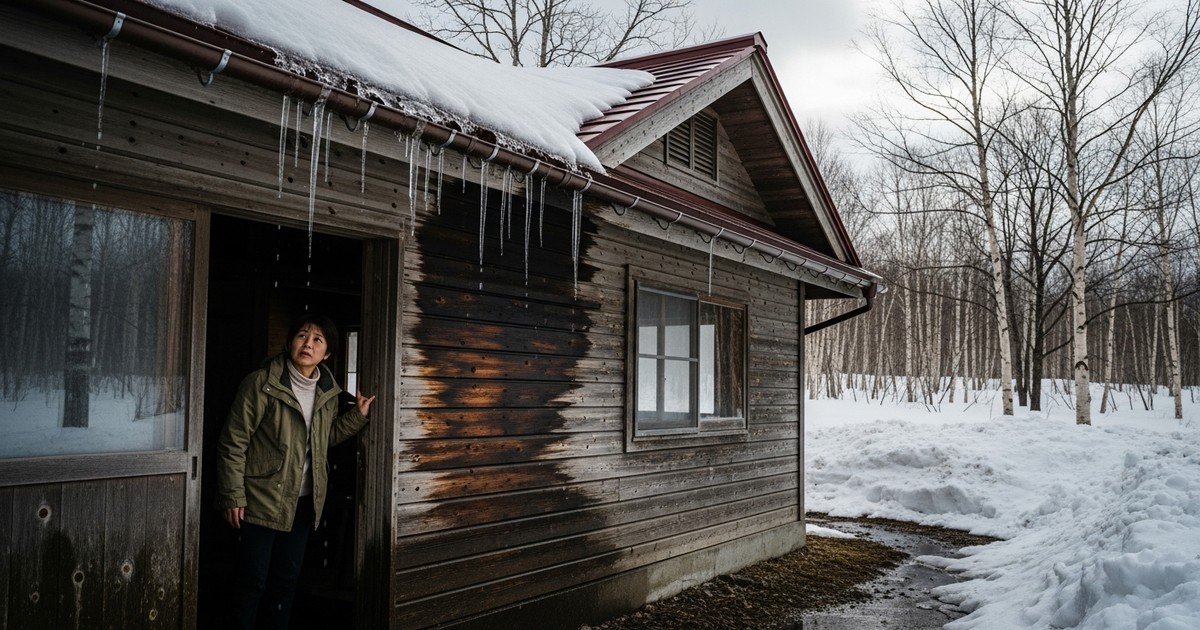
During the snowmelt season, temperatures repeatedly swing above freezing during the day and drop back below freezing at night. This temperature fluctuation causes large icicles to form along the eaves. An icicle longer than 1 meter can cause serious injury if it falls on a guest walking underneath. If a guest is injured at a lodging facility, the facility’s duty of care comes into question, potentially leading not just to medical cost coverage but also liability claims.
The basic countermeasure is to design guest walkways so they don’t pass directly beneath the eaves. If rerouting an existing walkway isn’t feasible, consider installing warning signage alongside a snowmelt heater along the eaves to prevent icicles from forming in the first place. Snowmelt heater installation costs roughly 10,000 to 20,000 yen per meter, with running costs of about 3,000 to 5,000 yen per month. Facility liability insurance is also essential—an annual premium of 15,000 to 50,000 yen can provide coverage worth several million yen.
Frozen and Clogged Drainage Trouble
Frozen Drainage Pipe Bursts and Repair Costs
Drainage pipes that freeze over the winter can repeatedly expand and contract with the temperature swings of the snowmelt season, eventually bursting—a common occurrence in Hokkaido. Pipes exposed outdoors, or those running under poorly insulated flooring, are especially at risk. When a drainage pipe bursts, wastewater can leak under the floor, creating both hygiene problems and unpleasant odors. Repair costs for locating the burst and replacing the pipe typically run 80,000 to 200,000 yen, and can exceed 300,000 yen when cleaning and disinfecting the crawl space is also required.
As a preventive measure, if the property will be vacant for extended periods during winter, it’s standard practice to open the drain valve and empty the pipes of water. Wrapping pipes with anti-freeze heating cable costs 5,000 to 15,000 yen per location, with electricity costs of only about 1,000 to 2,000 yen per month. It’s also wise to have a contractor run a water flow test on the plumbing in early March, before the snow melts, to check for any cracks caused by freezing.
Clogged Drains and Gutters from Meltwater
Dead leaves, debris, and gravel blown in by winter winds accumulate under the snow, and when the snow melts, all of this material washes into drains and gutters, causing clogs. When drainage is obstructed, water pools on the property, increasing the risk of flooding around the building’s foundation. Standing water can also soak guests’ shoes and track dirt indoors, adding to cleaning costs.
The solution is to remove the drain covers and clear out accumulated debris before snowmelt begins. Doing this yourself costs nothing, but hiring a professional for high-pressure cleaning typically runs 15,000 to 30,000 yen. It also helps to install a strainer (mesh filter) at the drain opening to significantly reduce debris inflow. These cost only 500 to 2,000 yen each, making them a highly cost-effective countermeasure.
Damage to Grounds and Exterior Features, and Declining Curb Appeal
Cracking and Sinking of Asphalt and Concrete
Hokkaido winters bring a phenomenon called “frost heave,” in which moisture in the ground freezes and expands. Frost heave can lift the asphalt of a parking area or the concrete of an entrance walkway, and once the snow melts, this shows up as cracks or uneven surfaces. A height difference of 5cm or more poses a tripping hazard for guests and can also make it difficult for cars to enter or exit. Repairing parking lot asphalt typically costs 3,000 to 8,000 yen per square meter, while a full repaving job can run 300,000 to 500,000 yen or more.
The fundamental solution is to account for frost depth (60cm to 120cm in Hokkaido) when laying the foundation for parking areas and walkways during construction. For existing pavement, promptly checking its condition after the snow melts and filling small cracks with repair material early on can prevent them from developing into larger damage. DIY asphalt repair material costs about 1,500 to 3,000 yen per 10kg bag, making minor repairs something you can handle yourself.
Fallen Trees and Damaged Landscaping
The weight of accumulated winter snow can break tree branches or cause trees themselves to lean. Often this damage only becomes apparent after the snow melts, and in some cases a fallen tree may have damaged a fence or encroached onto a neighboring property. Removing a fallen tree typically costs 20,000 to 100,000 yen, and including fence repairs can push the total above 150,000 yen. Since damaged landscaping directly affects guests’ first impressions, it can also impact booking rates.
The basic countermeasure is to protect trees from the weight of snow with winter wrapping (such as rope bracing or snow-guard ropes) in November, before snow falls. Winter wrapping for 5 to 10 garden trees typically costs 20,000 to 50,000 yen. After the snow melts, inspect the entire garden as soon as possible to remove broken branches and straighten any leaning trees. Neglecting this can cause root rot, risking the tree’s complete death in subsequent years.
Guest-Facing and Operational Challenges
Increased Snow Removal and Cleaning Workload Around Check-In
During the snowmelt season, snow that melts during the day refreezes overnight, turning entrances and walkways into icy surfaces. Ensuring safe passage before guests check in requires snow removal and the application of de-icing salt. On top of regular cleaning, this added outdoor work can extend the time needed per cleaning session to 1.5 to 2 times longer than in summer. Factoring in cleaning staff labor costs and de-icing salt (2,000 to 4,000 yen per 25kg bag), operating costs from March through May can run 15–20% higher than the annual average.
One way to improve efficiency is installing radiant snowmelt heating (an underground heating system) at the entrance walkway. Initial costs are steep—300,000 to 600,000 yen for a 10-square-meter area—but it eliminates the need for daily snow removal and, over the long term, reduces labor costs while improving guest satisfaction. If this isn’t feasible, combining anti-slip mats (5,000 to 10,000 yen each) with regular applications of de-icing salt can provide a minimum level of safety.
Providing Information to Prevent Negative Reviews
Some guests visiting Hokkaido during the snowmelt season may be put off by mud splashes or standing water on the property. International guests in particular, who may not be familiar with the concept of snowmelt at all, sometimes interpret a waterlogged property as a sign of poor management. Reviews posted during the snowmelt season occasionally include comments like “the outside was dirty” or “the parking lot was full of puddles.”
An effective solution is to explain the snowmelt-season conditions to guests in advance, through a message sent after booking confirmation. Something as simple as, “From March through May, it’s snowmelt season, and puddles may temporarily form on the property. We’ve provided rain boots at the entrance for your convenience,” can significantly ease guests’ concerns. The cost of keeping two or three pairs of rain boots on hand is only about 3,000 to 6,000 yen—an extremely cheap investment when you consider the value of a single review.
Pre-Snowmelt Inspection Checklist
Much of the trouble associated with snowmelt can be minimized through advance inspection and preparation. Aim to complete the following checklist by early March. For the roof, first check what’s visible from the ground using binoculars, and call in a professional for a detailed inspection if you notice anything unusual. Walk the full perimeter of the building to visually check the foundation for cracks or water stain marks. For drainage, remove the drain covers to clear out debris and run a water flow test to confirm proper drainage.
For outdoor equipment, check the kerosene tank, boiler, and air conditioner units for loose mounting bolts and any visible damage. It’s also important to check the property’s asphalt and concrete surfaces for new cracks or uneven areas. If you hire a contractor to handle all of these inspections, the total cost typically runs 50,000 to 100,000 yen—a worthwhile preventive investment when you consider that flooding or equipment repairs can cost several hundred thousand yen. Handling what you can yourself and calling in professionals only where specialized knowledge is needed is the most cost-effective approach.
For All Your Minpaku Management Needs, Consult Stay Buddy Inc.
Running a minpaku business in Hokkaido comes with a number of region-specific challenges not found on Japan’s main island—snowmelt-season trouble being just one of them. Managing building upkeep, guest communication, cleaning schedules, and repair contractors all on your own as an owner is a substantial burden.
Stay Buddy Inc. offers full-service property management for minpaku operators, providing comprehensive support that covers everything from property management and guest communication to arranging seasonal maintenance. We have the operational know-how to handle Hokkaido’s climate, including creating pre-snowmelt inspection checklists and building relationships with local repair contractors.
If you’re struggling with remote property management, can’t keep up with seasonal maintenance, or feel uneasy about handling unexpected trouble, please don’t hesitate to reach out to Stay Buddy Inc. We’ll propose the optimal management plan tailored to your property’s situation and your goals as an owner.