Many owners running minpaku (private lodging) properties in Asahikawa rely heavily on short-term guests concentrated around the summer Asahiyama Zoo season and the winter ski season. However, if you can tap into mid- to long-term stay demand for your Asahikawa minpaku, you can significantly reduce the vacancy risk during the off-season and achieve stable revenue throughout the year. In fact, demand for stays lasting anywhere from a week to several months is already emerging in Asahikawa City, driven by things like medical staff training dispatches and “trial relocation” experiences for remote workers.
This article walks through the concrete, step-by-step measures for attracting mid- to long-term guests during the slow season when tourist numbers drop. It covers everything from target setting and pricing design to acquisition channels, equipment investment, and contract considerations—at a level of detail you can put into practice right after reading.
Understanding Why Mid- to Long-Term Stay Demand Exists for Asahikawa Minpaku
Although Asahikawa is Hokkaido’s second-largest city, lodging demand tends to be heavily skewed toward the tourist season. Asahiyama Zoo draws roughly 1.3 to 1.4 million visitors annually, with the vast majority concentrated in June through August and during the winter “penguin walk” season. Conversely, it’s not uncommon for hotel occupancy rates to drop to around 50% in April–May and October–November, and minpaku properties are no exception.
At the same time, medical institutions such as Asahikawa Medical University Hospital and Asahikawa Red Cross Hospital receive resident doctors and nurses dispatched from across Japan, resulting in stays of roughly two weeks to three months. Additionally, designers working in the Asahikawa furniture and craft industries increasingly stay for several months to use the area as a production base, and more remote workers are choosing early autumn—avoiding the harsh winter—for relocation trial experiences. For these groups, hotels are too expensive, yet their stays aren’t long enough to justify signing a standard rental lease—making minpaku the “just-right” option.
Step 1: Clearly Define Your Mid- to Long-Term Guest Target
Rather than vaguely targeting “people who stay a long time,” build your personas by working backward from Asahikawa’s specific location advantages. The four main target types are as follows. First, medical-related business travelers and trainees: a steady stream of trainees is dispatched each year, centered around Asahikawa Medical University, typically staying two weeks to three months with a budget of around 80,000–120,000 yen per month. Second, construction and infrastructure workers: road and bridge repair work occurs year-round within Asahikawa City, and groups of three to five workers sometimes stay for one to two months.
The third target is remote workers and prospective relocators. According to a survey by the Ministry of Internal Affairs and Communications, roughly 25% of urban residents in their 20s to 40s express interest in trial relocation to rural areas. Asahikawa has good airport access and a lower cost of living than Sapporo, making it an attractive destination for a one-to-three-month relocation trial. The fourth target is students and their families who need short-term housing while preparing for university or vocational school entrance exams and enrollment. Since equipment needs and price ranges differ by target group, deciding who to focus on first will keep all subsequent measures consistent and effective.
Step 2: Design Pricing Plans for Mid- to Long-Term Stays
Build a Weekly and Monthly Discount Structure
According to Airbnb data, properties offering weekly discounts see booking rates rise by an average of 10%, while those offering monthly discounts see an additional 15% increase. For an Asahikawa minpaku with an off-season nightly rate of 5,000 yen, you might set tiered discounts such as 4,000 yen per night (20% off) for stays of 7+ nights and 2,800 yen per night (44% off) for stays of 30+ nights. Converted to a monthly rate, that comes to about 84,000 yen—putting it in a competitive price range against Asahikawa’s typical monthly apartment rentals (70,000–100,000 yen).
Clarify How Utilities and Cleaning Fees Are Handled
Utility costs become a significant burden during mid- to long-term stays. In Asahikawa, heating costs alone can reach 20,000–30,000 yen per month in winter, so you need to decide in advance whether utilities are included in the monthly rate or billed separately. A recommended approach is to build a utility cap into the monthly rate (e.g., up to 15,000 yen included, with any excess billed at cost). For cleaning, it’s common to offer a weekly mid-stay cleaning option for 3,000 yen, while charging a separate final cleaning fee of 8,000–12,000 yen upon checkout. This lets guests know the total cost upfront, lowering the barrier to booking.
Step 3: Equip Your Property for Mid- to Long-Term Stays
Enhance the Kitchen and Laundry Setup
A simple kitchen setup may be fine for short-term guests, but stays of a week or longer typically assume guests will cook for themselves. A two-burner IH stove, a refrigerator of 200L or larger, a rice cooker, a microwave, and a full set of basic cookware and dishware are all essential. Since chain restaurants in Asahikawa are concentrated in the city center, the quality of kitchen equipment becomes an even bigger booking factor for properties in the suburbs. A drum-type washer-dryer combo handles both washing and drying in a single unit, which is especially appreciated in Asahikawa, where hanging laundry outside isn’t practical in winter. As for investment, a drum-type washer-dryer costs roughly 100,000–150,000 yen and replacing the IH stove costs about 30,000–50,000 yen—costs that can be fully recovered with just a single mid- to long-term booking of a few months.
Workspace and Internet Connectivity
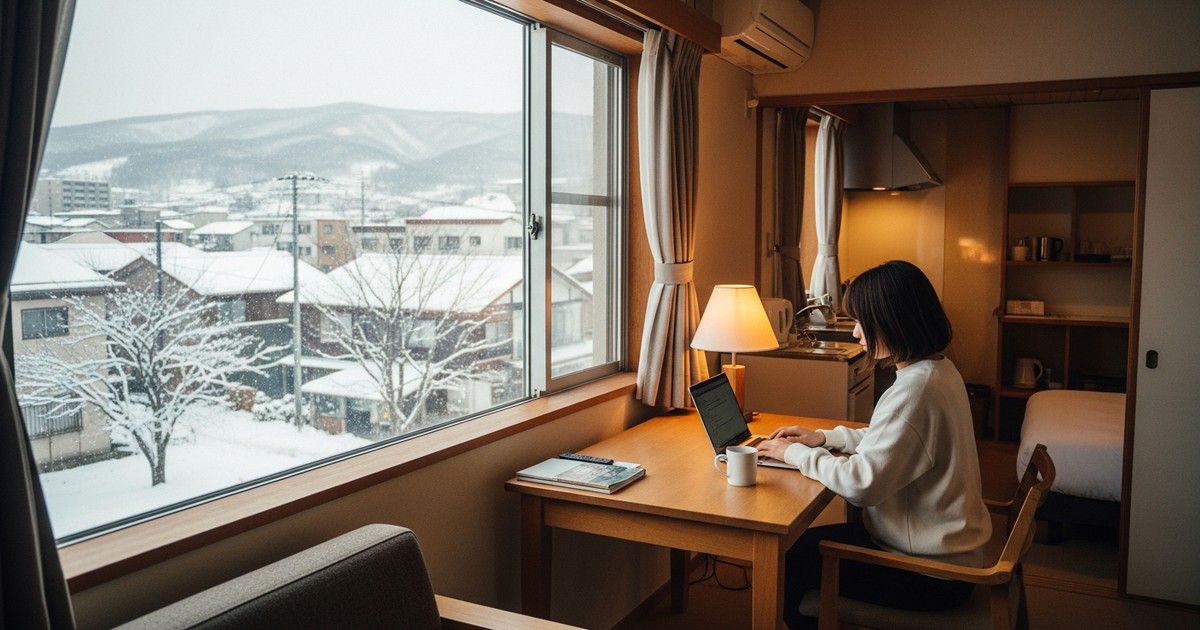
If you’re targeting remote workers, provide a business-grade desk and chair. A desk at least 100cm wide paired with an armrest-equipped office chair can comfortably support eight hours of work per day. For connectivity, install fiber-optic internet (1Gbps up/down) and use a mesh-compatible Wi-Fi router to ensure stable connections throughout the unit. An environment where Zoom calls never drop directly affects guest reviews. Since the desk and chair together cost only about 20,000–40,000 yen, this is an extremely cost-effective investment.
Step 4: Build Acquisition Channels Specifically for the Off-Season
Set Up Long-Term Stay Plans on OTAs
On Airbnb, enabling a “monthly discount” makes your listing appear in monthly-stay search results, increasing visibility to prospective long-term guests. Booking.com also has a “long-term stay plan” filter, and setting rates for stays of 28+ nights can drive search traffic even during the off-season. By configuring weekly and monthly discounts in each OTA’s dashboard and raising the minimum stay requirement to 3–7 nights during the off-season, you can reduce the hassle of handling short-term bookings while prioritizing longer stays.
Direct Sales to Companies and Organizations
Sending flyers or PDF materials describing your lodging plans directly to construction companies, hospital administration departments, and university offices in Asahikawa is an effective way to reduce OTA commission fees (which range from 10%–30% (varying by company and scope of service)). For example, for a property priced at 80,000 yen per month, instead of receiving 64,000 yen after OTA fees, a direct corporate contract could offer a rate of 75,000 yen—benefiting both parties. Using the Asahikawa Chamber of Commerce and Industry’s member directory or a list of employers posting job openings at Hello Work Asahikawa can help you efficiently identify companies to approach.
List on Relocation Support Platforms
Listing your property on relocation support sites—such as Hokkaido’s own “Live in Hokkaido” platform or the private service SMOUT—is another effective approach. SMOUT allows you to promote property listings free of charge, and it has a track record of listings used as trial relocation housing. By also coordinating with Asahikawa City’s relocation consultation desk to be included on their referral list for inquiries, you can gain prospective guests at zero advertising cost.
Step 5: Work Within the 180-Day Limit of the Private Lodging Business Act
Minpaku properties registered under the Private Lodging Business Act (Minpaku Shinpō) are limited to 180 operating days per year. Strategic calendar management is essential—for example, allocating the 90 days of peak tourist season to short-term bookings and the remaining 90 days to mid- to long-term stays. For instance, you could accept high-rate, per-night short-term bookings during the 90 days from June through August, then dedicate the 90 days from September through November to monthly mid- to long-term stay plans, maximizing use of your 180-day allowance.
If you want to operate beyond 180 days, one option is to obtain a simple lodging (kan’i shukusho) business license under the Hotel Business Act. In Asahikawa, the first step is to check zoning restrictions and any relaxed requirements for front desk staffing, then consult with the local public health center in advance. Obtaining this license involves an application fee of about 22,000 yen and firefighting equipment installation costs (approximately 150,000–300,000 yen for an automatic fire alarm system), but it enables year-round operation—a major advantage for a mid- to long-term strategy.
Step 6: Adapt Guest Communication and Contracts for Mid- to Long-Term Stays
Create House Rules and a Living Guide
Mid- to long-term guests function less like “customers” and more like “temporary residents,” so it’s important to prepare a written guide covering trash disposal rules, noise etiquette, and greeting neighbors. Since Asahikawa City has an especially detailed waste sorting system with 14 or more categories, laminating a photo-based waste sorting sheet and posting it in the kitchen can significantly reduce trouble. It’s also worth putting together a booklet covering local infrastructure—nearby supermarkets (e.g., Coop Sapporo, AEON Asahikawa Ekimae), hospitals, and coin laundries—which boosts guest satisfaction and encourages repeat stays and positive reviews.
Set Up a Mid- to Long-Term Contract and Security Deposit
For stays of 30 nights or more, the standard OTA terms of service alone are often insufficient. Draw up your own contract that clearly addresses property damage, lost keys, and restoration of the unit at checkout. It’s common practice to collect a security deposit equal to 50% of the monthly rate (e.g., 40,000 yen for an 80,000-yen monthly rate) at the time of payment, then settle and refund it after checkout. For direct contracts made outside of Airbnb, be sure to document how the deposit is handled in writing to prevent disputes.
Contact Stay Buddy Inc. to Optimize Your Minpaku Operations
Consistently attracting mid- to long-term guests requires expertise across a wide range of areas—pricing design, equipment investment, building acquisition channels, and regulatory compliance. Building all of this from scratch on your own as an owner takes significant time and money. Stay Buddy Inc., a full-service minpaku management company, analyzes the specific location characteristics of each property and provides comprehensive support for maximizing revenue during the off-season.
From optimizing pricing plans and managing OTA operations to handling corporate sales outreach and guest communication, we can take on the full range of operational tasks as a one-stop solution. If you own a minpaku property in the Asahikawa area and are concerned about occupancy rates, please feel free to reach out to Stay Buddy Inc. first.
From an initial hearing about your property’s current situation to a revenue simulation, your first consultation with us is completely free. Let’s take the first concrete step together toward turning off-season vacancies into revenue.