Leave Your Vacation Rental Management to Us
100% Free Online ConsultationHow Your Vacation Rental Check-In Process Shapes the Guest Experience
Improving your vacation rental’s check-in process leads directly to higher guest satisfaction and better reviews. In fact, according to Airbnb data, listings with check-in experience ratings of 4.5 or higher see booking rates roughly 30% higher than those rated below 4.0. In other words, the quality of your check-in process has a direct impact on revenue.
Yet many hosts set up their check-in system once and then leave it untouched. Guest demographics and travel trends are constantly evolving, and what worked best a few years ago may no longer be optimal today. This article systematically walks through the specific points hosts should revisit when reviewing their check-in process, covering pre-arrival preparation, day-of handling, and post-check-in follow-up.
Whether you handle check-ins in person or have already switched to self-check-in, it’s worth checking whether there’s room for improvement. Small, incremental improvements can add up to make a significant difference in your occupancy rate and review scores over the course of a year.
Reviewing Pre-Arrival Preparation to Improve Vacation Rental Check-In
Optimizing Check-In Instruction Messages
Check-in instructions are among the messages guests read most carefully. Even so, it’s common to see cases where there’s so much information that the key details get buried, or conversely, where too little information leads to a flood of follow-up questions from guests. One host who switched to sending check-in instructions in three stages—at booking confirmation, three days before arrival, and on the day of arrival—saw check-in-related inquiries drop from 15 per month to just 3.
Specifically, sending “check-in time and a general overview” at the time of booking confirmation, “access directions and key pickup steps” three days before arrival, and “essential last-minute details (such as door codes and Wi-Fi passwords)” right before arrival allows guests to receive the right information at the right time. Cramming everything into a single message just leads guests to skim past long blocks of text—and they end up asking “where’s the key?” anyway.
Improving the Accuracy of Multilingual Support
For vacation rentals where inbound travelers make up 60-70% of guests, multilingual check-in instructions are essential. However, awkward wording from raw machine translation has caused real problems for hosts. In one case, a guest couldn’t understand mistranslated instructions on “how to unlock the auto-lock” and ended up stranded in front of the entrance late at night.
As a countermeasure, we recommend preparing native-checked templates for at least three languages: English, Simplified Chinese, and Korean. Translation typically costs around 5,000-10,000 yen per language, and once created, the templates can be reused indefinitely. Pairing this with a visual guide featuring photos can further lower the language barrier—showing the route from the station to the property with around 10 photos alone can dramatically reduce guests getting lost upon arrival.
Building in Flexibility for Check-In Times
Many vacation rentals set check-in start times at 3:00 or 4:00 PM, but guests’ actual arrival times vary widely depending on flight schedules and transportation circumstances. Data shows that properties offering a wide check-in window—say, 2:00 PM to 10:00 PM—are rated as “easy check-in” on Airbnb about 1.4 times more often than properties limited to a narrow 3:00-6:00 PM window.
That said, accepting unlimited early arrivals isn’t realistic given cleaning schedules. A practical solution is to offer early check-in (before 2:00 PM) as a paid option for an additional 1,000-2,000 yen. If you coordinate with your cleaning staff to ensure the unit is ready by noon, this can even become an additional revenue stream.
Rethinking the Check-In Method Itself
Introducing and Refining Smart Lock Operations
Smart locks are one of the most widely adopted tools for self-check-in at vacation rentals. Depending on the model, initial costs typically run 15,000-40,000 yen per unit. Choosing a product that issues a unique code for each guest and automatically deactivates it after checkout can also ease security concerns.
That said, even hosts who’ve already installed smart locks regularly encounter issues like dead batteries, Bluetooth connection glitches, and guest operation errors. Effective countermeasures include setting up a monthly routine to check battery levels, maintaining a backup physical key in a lockbox as a dual system, and sending guests a 30-second video demonstrating how to use the lock. One host reported that after introducing an instructional video for the smart lock, key-related inquiries dropped to zero.
Elevating the Quality of In-Person Check-In
Japan’s Private Lodging Business Act requires identity verification, either in person or through an equivalent IT-based method. If you’ve chosen in-person check-in, raising its quality can become a real point of differentiation. Rather than simply checking a passport and handing over the key, giving guests a map of nearby restaurants or demonstrating the trash disposal rules can dramatically improve the guest experience.
The ideal duration for in-person check-in is 5-10 minutes. Beyond 15 minutes, more guests start to feel it’s dragging on; under 3 minutes, it can come across as impersonal or overly transactional. Preparing a checklist and practicing so you can cover the four essentials—identity verification, key instructions, house rules, and a neighborhood overview—within 5 minutes helps you maintain consistent quality.
Identity Verification via Tablet or Video Call
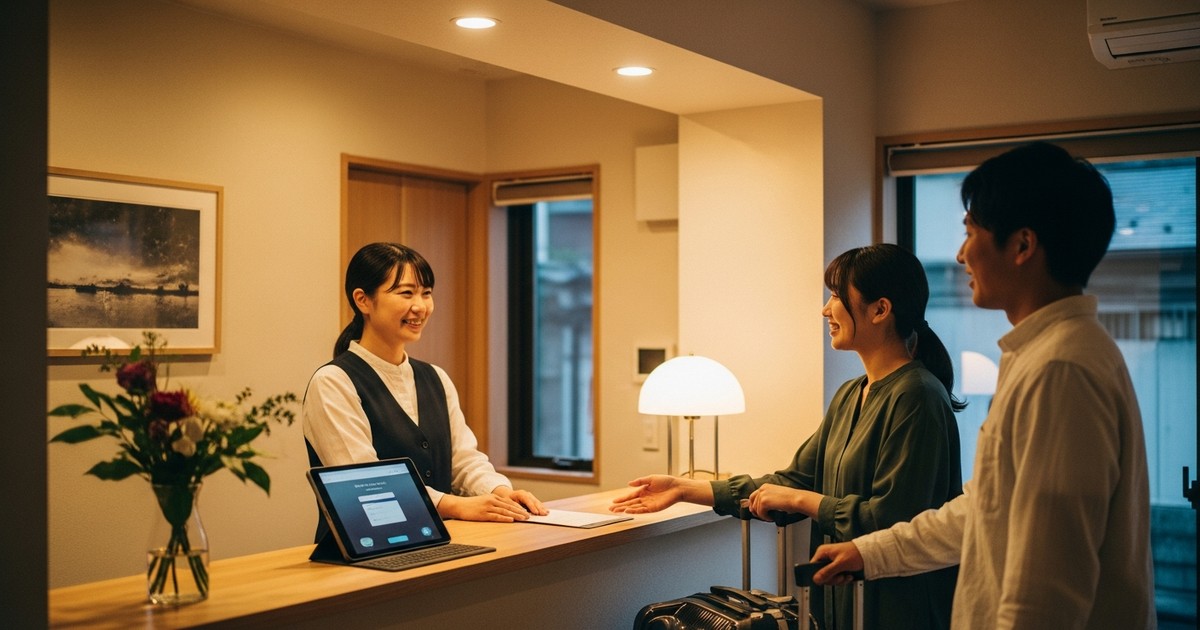
When in-person check-in isn’t practical every time, installing a tablet for video-call-based identity verification is another option. Dedicated check-in systems typically run 3,000-10,000 yen per month, but given the labor savings involved, this often pays for itself. If you’re handling 20 in-person check-ins per property per month, and each one takes 30 minutes round-trip in travel time, that adds up to 10 hours saved per month.
When implementing video-call check-in, a stable internet connection is the single most important factor. Confirm that your property’s Wi-Fi delivers download speeds of at least 20 Mbps, and if it falls short, consider a backup solution like a pocket Wi-Fi router or wired connection. A choppy video call only heightens guest anxiety, so it’s worth investing generously in connection quality—it pays off in the long run.
Building a System for Handling Day-Of Check-In Issues
Setting Up Emergency Contacts and Response Protocols
The three most common check-in problems are: guests can’t find the property, the lock won’t open, and the unit doesn’t match what was booked. If guests don’t have a reliable way to reach you the moment one of these issues arises, your review scores will suffer. Ideally, you should offer multiple contact channels—phone, messaging, LINE, and so on—and be able to respond within 5 minutes during check-in hours (say, 2:00 PM to 10:00 PM).
If you’re operating solo, it’s crucial to line up a partner or property management service who can cover the hours you’re unavailable. There have been real cases where a host’s failure to respond to a check-in issue for over 30 minutes resulted in a one-star review, followed by a 20%-plus drop in booking rate over the next two months. It’s worth keeping in mind that a single review can translate into tens of thousands of yen in lost revenue.
Being Considerate of Neighbors and Briefing Guests in Advance
Noise from arriving guests and the sound of rolling suitcases are common sources of friction with neighbors during check-in. This is especially true for apartment-style vacation rentals, where a noise complaint over a late-night check-in can escalate into a dispute with the building’s management association that threatens the property’s ability to keep operating.
A practical countermeasure is to include specific requests in your check-in instructions, such as “Please refrain from talking in shared areas after 10:00 PM” or “Please carry your suitcase past the elevator lobby rather than rolling it.” Creating these instructions with illustrations and posting them just inside the front door can also positively influence guest behavior after check-in. Preventing conflicts with neighbors should be treated as an integral part of the check-in process, not an afterthought.
Standing Out with Post-Check-In Follow-Up
A Follow-Up Message Within 30 Minutes of Arrival
Simply sending a message within 30 minutes of a guest checking in—something like, “Did you make it to the room okay? Please don’t hesitate to reach out if you need anything”—can make a real difference in guest satisfaction. One host who started this practice saw their rate of five-star reviews rise from 62% to 78%.
This follow-up message can be automated with minimal effort using tools like Beds24 or Hostaway, which typically cost 2,000-5,000 yen per month. Given how much a boost in reviews can improve your booking rate, it’s a worthwhile investment. Adding a few restaurant recommendations that didn’t make it into the original check-in instructions can leave an even better impression.
Collecting Check-In Feedback and Building an Improvement Cycle
Regularly gathering guest feedback about check-in and feeding it back into ongoing improvements is essential for long-term quality gains. Beyond just reading reviews, keeping a spreadsheet log of the questions and inquiries guests raise during check-in can reveal recurring patterns and pain points.
For example, if you get more than three inquiries a month about “not being able to find the way from the nearest station,” that’s a signal to improve your directions or add a video guide. If “how to use the air conditioner” comes up repeatedly, sticking bilingual (Japanese/English) labels on the remote control could be the fix. Implementing just one small improvement like this per month can significantly reduce check-in-related issues within six months—and lighten your operational workload in the process.
Reviewing Check-In Procedures Through the Lens of Legal Compliance
Identity Verification Methods and Record Keeping
Japan’s Private Lodging Business Act requires operators to verify guests’ identities and keep records of that verification. For in-person verification, this means visually checking a passport or ID and retaining a record (a copy or photo). When using IT-based methods, you must meet a standard equivalent to in-person verification—for example, confirming a guest’s face and passport simultaneously via video call.
By law, these records must be kept for three years. While a paper logbook is one option, managing records digitally in the cloud is far superior in terms of searchability and storage. If you’ve implemented a check-in system, identity verification records are automatically stored in a database, allowing you to respond quickly to any government inspection. Legal compliance is the foundation of your operation—if there’s a gap here, no other improvement really matters.
Accurately Preparing the Guest Registry
Whether you’re operating under a hotel business license or have registered under the Private Lodging Business Act, maintaining a guest registry is a shared legal obligation. The registry must include each guest’s name, address, nationality, and passport number (for foreign nationals), so it’s essential to accurately collect this information at check-in.
Building the registry-creation process seamlessly into your check-in flow is key to reducing the burden on guests. If you have guests fill in their information ahead of time through an online form at the time of booking, and simply confirm it on the day of check-in, you can shave 2-3 minutes off the on-site process. A free tool like Google Forms is more than sufficient for this purpose.
Struggling to Improve Your Check-In Process? Talk to Stay Buddy Co., Ltd.
Improving your check-in process isn’t a one-time task—it requires ongoing review as guest patterns and technology continue to evolve. But for individual hosts already juggling day-to-day operations, continually researching and implementing new improvements can be a heavy burden.
Stay Buddy Co., Ltd., a full-service vacation rental management company, provides end-to-end support for every aspect of check-in—from designing the overall process and handling multilingual guest communication, to selecting and installing smart locks, to responding to emergencies as they arise. Drawing on the improvement know-how we’ve built through years of hands-on management experience, we help hosts boost their review scores while easing their operational workload at the same time.
If you’re thinking “I’d like to leave check-in to the professionals” or “I’m not sure if my current approach is really the best one,” we’d love to hear from you at Stay Buddy Co., Ltd. From an initial consultation about your current situation to concrete improvement proposals, we’re here to help every step of the way.
Feel free to reach out through Stay Buddy Co., Ltd.’s official website. We’ll propose the optimal check-in setup tailored to your property’s unique situation.