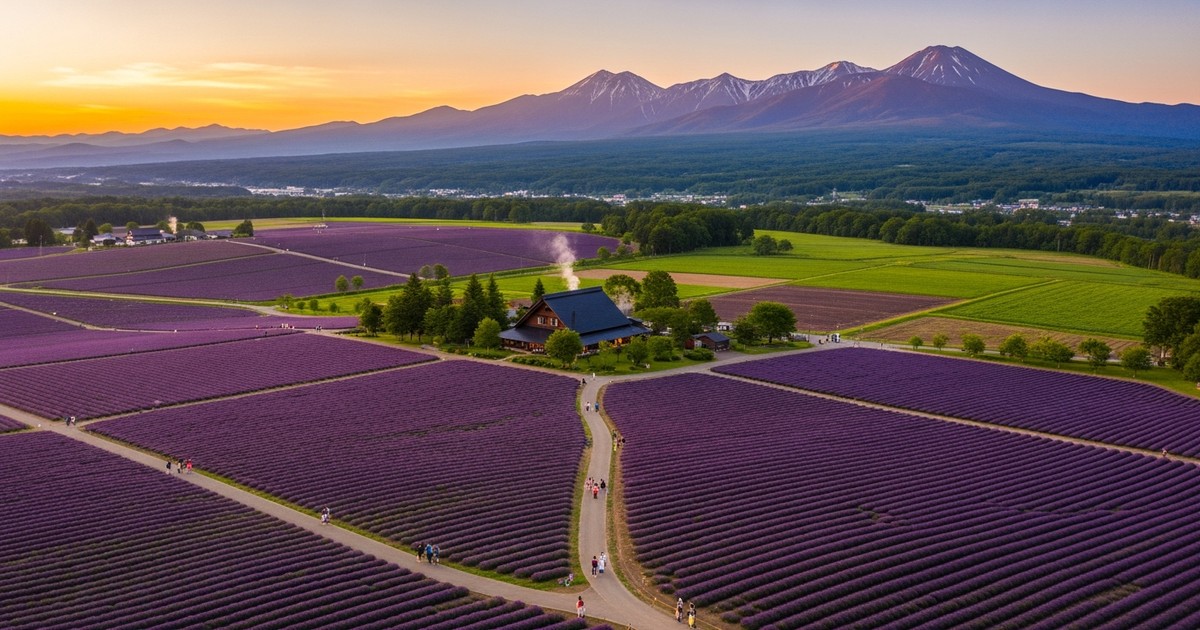
Furano City, one of Hokkaido’s premier tourist destinations, draws large numbers of travelers from both Japan and abroad throughout the year. With visitors flocking to see the lavender fields and enjoy the ski resorts, accommodation demand here fluctuates dramatically depending on the season. In this article, we’ll dig into the real picture of minpaku (private lodging) revenue in Furano by examining the area’s unique characteristics, offering concrete revenue simulations by property type along with a look at the operational risks involved.
When considering starting a minpaku business, it’s essential to build your business plan on accurate demand data and a solid understanding of the regulations involved. Entering the market based purely on gut-feeling expectations can lead to unpleasant surprises when the gap between peak and off-season revenue turns out to be much larger than anticipated, often resulting in disappointing profits. Below, we’ll walk through everything from an overview of the area to the steps for opening a business and the operational risks to watch out for.
Area Overview and Accommodation Demand Data Shaping Minpaku Revenue in Furano City
Furano City sees roughly 1.5 million visitors annually, and the proportion of international tourists among them has been trending upward in recent years. Demand is particularly concentrated during two distinct peak periods: the lavender season from July to August, and the ski season (centered around Furano Ski Resort) from December to March. This “twin-peak” demand pattern means that while minpaku operators can aim for high profitability during peak seasons, securing occupancy during the off-season tends to be a persistent challenge.
Standard accommodation rates at typical lodging facilities in Furano (pensions, hotels, etc.) generally run between ¥8,000 and ¥15,000 per room per night. Minpaku pricing varies depending on property size and amenities, but it’s not unusual to see rates of ¥20,000 or more per night during peak lavender season, with some properties maintaining similar rates through the ski season as well. On the other hand, occupancy can drop to as low as 20-30% during the off-season months of spring and autumn, making year-round revenue planning essential. Major tourist draws in the area include the lavender fields at Farm Tomita, Furano Ski Resort, and filming locations from the TV drama “Kita no Kuni Kara” (From the North Country) — all of which are widely recognized by both domestic and international travelers, giving the area strong underlying potential for attracting guests.
Revenue Simulations by Property Type
When starting a minpaku business in Furano City, the initial investment, occupancy rate, and average nightly rate all vary significantly depending on the type of property. Below, we outline estimated occupancy rates, nightly rates, annual revenue, and initial investment for three representative property types. These are simulations only, but they can serve as a useful starting point for your business planning.
Apartment/Condominium Type
Minpaku operations using apartments or condominiums in Furano City tend to keep initial investment relatively low. For a typical 1LDK to 2LDK unit, initial investment (including furniture, appliances, interior setup, and application fees) generally runs around ¥500,000 to ¥1,000,000. Nightly rates are commonly set between ¥8,000 and ¥12,000. Assuming peak-season occupancy (July-August, December-March) of 60-70% and off-season occupancy of 20-30%, average annual occupancy works out to roughly 35-45%. As a rough revenue benchmark, at an average of 10 bookings per month at ¥10,000 per night over 12 months, annual gross revenue comes to around ¥1.2 million. However, after deducting management fees, cleaning costs, and platform commissions (roughly 3-15% of sales), net profit can end up being less than half of that figure.
A major challenge with apartment/condo-type properties is restrictions under building management regulations. Many condominiums with divided ownership prohibit minpaku operations under their management association bylaws, so it’s essential to confirm these regulations before selecting a property. In many cases, things go more smoothly with a wholly-owned apartment building or a converted single-family home.
Single-Family Home Type
Single-family homes represent one of the highest-potential property types for minpaku in Furano City. Their strength lies in offering a whole-house private rental experience, which appeals strongly to groups and families. For a 3LDK to 4LDK house accommodating 4-8 guests, nightly rates can often be set between ¥15,000 and ¥25,000. Assuming peak-season occupancy of 65-75% and off-season occupancy of 25-35%, average annual occupancy comes to around 40-50%. One possible revenue scenario, based on an average of 13 bookings per month at ¥20,000 per night over 12 months, would yield annual gross revenue of approximately ¥3.12 million. Initial investment depends on the property’s condition but generally falls in the range of ¥1.5 million to ¥4 million, including renovations, furniture and appliances, and application fees.
A key consideration with single-family homes is the ongoing cost of building maintenance. Winter temperatures in Hokkaido can drop to nearly -20°C, requiring annual investment in freeze prevention and heating system maintenance. It’s also essential to establish a relationship with a local property management company in advance, so that equipment issues can be handled promptly even when the owner isn’t on-site.
Traditional Farmhouse/Renovation Type
The rural areas surrounding Furano City have a scattering of vacant houses and traditional farmhouses (kominka), and minpaku properties created by renovating these tend to score highly with travelers seeking a distinctive, “away-from-everyday-life” experience. A carefully renovated wooden farmhouse with authentic Hokkaido character can turn the stay itself into a selling point, sometimes commanding premium nightly rates of ¥20,000 to ¥35,000. That said, initial investment is substantial — renovation costs alone can range from ¥3 million to over ¥10 million. As a revenue estimate, an average of 10 bookings per month at ¥25,000 per night over 12 months would generate roughly ¥3 million in annual gross revenue, though it’s not uncommon for the payback period on the initial investment to stretch to 5-10 years or more.
While kominka properties can sometimes be acquired at low cost (for example, through vacant-house banks), many of these buildings have poor insulation, requiring extensive renovation work to operate through Hokkaido’s winters. Skimping on insulation and heating investment can lead to poor guest reviews, which directly hurts occupancy — so it’s important to plan your renovation budget with a comfortable margin.
Understanding the Difference Between the Minpaku Act and the Hotel Business Act
Correctly understanding the applicable legal framework is essential before starting a minpaku business in Furano City. Currently, there are two main legal frameworks for operating minpaku: the “Private Lodging Business Act” (commonly known as the Minpaku Act) and the “Hotel Business Act” (specifically, simple lodging operations). Under the Minpaku Act, annual operating days are capped at 180, but in exchange, a residential property can be operated simply by filing a notification. Under the Hotel Business Act’s simple lodging category, there’s no cap on operating days, allowing for more flexible operation, but the property must meet fire safety equipment standards and requirements set by prefectural and municipal ordinances.
Whether Furano City has designated restricted zones under the Minpaku Act (such as further limits on operating days in specific areas), and the specific requirements for a Hotel Business Act application, vary by municipality — so be sure to confirm directly with the relevant Furano City and Hokkaido prefectural offices. Legal interpretation often requires case-by-case judgment, and relying solely on information found online carries the risk of discovering unmet requirements only after submitting your application. Consulting with a specialist (such as an administrative scrivener or minpaku consultant) is also a worthwhile option.
Key Considerations and Estimated Initial Costs When Opening a Minpaku
The general process for opening a minpaku business runs as follows: property selection → determining the legal framework → preparing required documents → filing notifications/applications → equipment setup and interior work → registering on booking platforms → beginning operations. Under the Minpaku Act, a notification must be filed with the prefecture, while under the Hotel Business Act, a permit application must be submitted to the local health center. The time from application to approval/acceptance can take anywhere from one to three months for Hotel Business Act applications. Before opening, be sure to confirm that the property’s fire safety equipment (automatic fire alarms, emergency lighting, etc.) meets required standards, and carry out any necessary equipment work in advance.
Estimated initial costs vary considerably by property type, but even for minimal setup of a single-family home or apartment, you should budget at least ¥500,000 to ¥1.5 million. Typical cost items include furniture, appliances, and bedding (roughly ¥200,000-¥600,000), fire safety equipment work (roughly ¥50,000-¥200,000), application and administrative scrivener fees (roughly ¥30,000-¥100,000), initial stock of cleaning supplies and amenities (around ¥50,000), and platform setup and photography costs (roughly ¥30,000-¥100,000). As for neighborhood relations, greeting and explaining your plans to local residents before opening, along with clearly sharing emergency contact information and rules on noise and trash disposal, goes a long way toward preventing disputes. This kind of thoughtful communication is especially valuable in a smaller regional city like Furano, where relationships with the local community can directly affect the long-term sustainability of your operation.
Operational Risks and Strategies for Sustaining Occupancy
The biggest risk facing minpaku operators in Furano City is revenue instability caused by seasonal fluctuation. While the lavender season (July-August) and ski season (December-March) bring high occupancy and support premium pricing, demand drops sharply during spring (April-June) and autumn (September-November). Effective strategies for boosting off-season occupancy include targeting specific guest segments — such as “Furano nature experiences (autumn foliage, farming experiences),” “plans for visitors to nearby golf courses,” or “workation and long-stay packages.” Dynamic pricing, which flexibly adjusts rates by season, is also useful for maximizing revenue.
As a countermeasure against cancellation risk, the basic approach is to balance early-booking discounts with a strict cancellation policy. It’s also important to avoid over-reliance on any single platform by listing simultaneously across multiple booking channels (such as Airbnb, Rakuten Travel, and Jalan) to diversify your distribution. Equipment failures (frozen pipes, heating breakdowns, etc.) are a risk specific to Hokkaido winters, and building a relationship with local repair contractors in advance enables a swift response when issues arise. For guest complaints and disputes with neighbors, establishing a 24-hour response system — or outsourcing management to a minpaku operation company — can reduce the burden on the owner while maintaining guest satisfaction.
Contact Stay Buddy for Minpaku Openings and Revenue Improvement in Furano
Stay Buddy Inc. is a minpaku operation company offering end-to-end support, from opening a minpaku or simple lodging business through to day-to-day operational management. Even in areas with major seasonal fluctuation like Furano City, we provide the know-how needed to maximize revenue — from designing demand-based pricing strategies to optimizing listings across multiple booking platforms. We regularly hear from property owners who say things like “I have a property, but I’m not sure where to start” or “I’m worried about managing things after opening,” and we tailor our proposals to each owner’s specific situation.
Our free consultations also cover guidance on permit application procedures and estimates of a property’s revenue potential. Our specialist staff are happy to walk you through concrete questions such as “How much annual revenue could I expect from this property?” or “Which legal framework should I choose?” If you’re seriously considering entering the minpaku market in the Furano area, we encourage you to reach out to us first.
Whether you’re feeling uncertain about launching your first minpaku or you’re struggling to boost occupancy at an existing property, we invite you to take advantage of a free consultation with Stay Buddy. We’re here to provide comprehensive support in turning Furano’s tourism demand into solid, sustainable revenue. You can reach us via the contact form on our website or by phone.