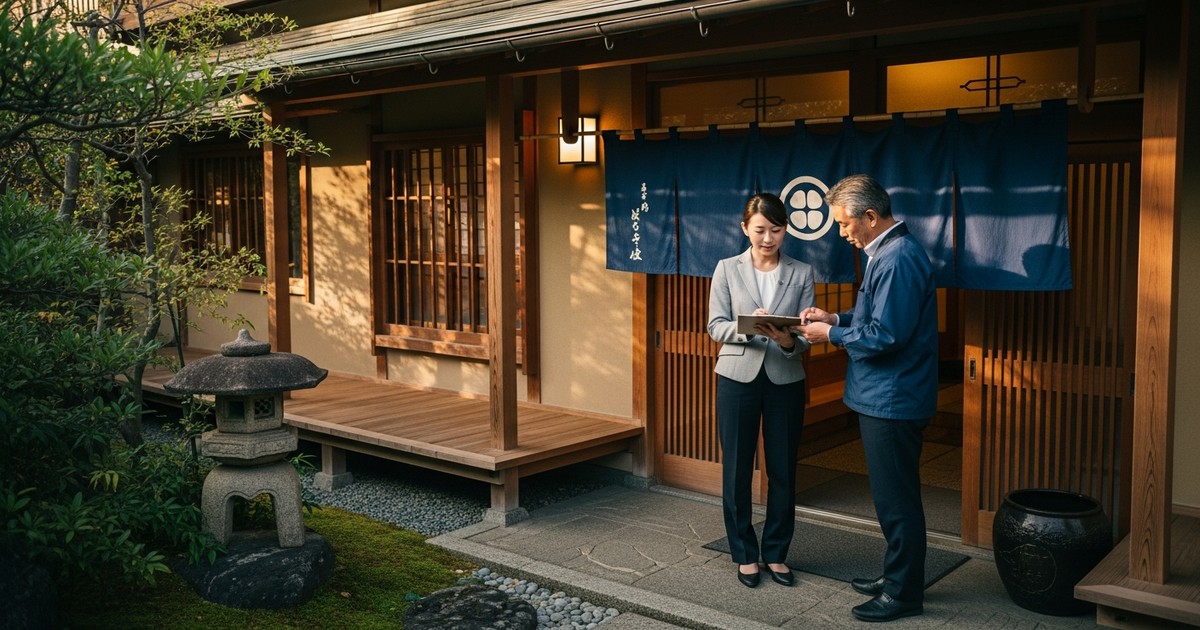
Leave Your Vacation Rental Management to the Experts
Completely Free Online ConsultationRyokan business management outsourcing services have drawn significant attention from property owners as a way to hand off the day-to-day operations of an accommodation facility to professionals. However, choosing the wrong management partner can not only hold back your revenue but also become a source of serious trouble. This article explains the fundamentals of management outsourcing for ryokan businesses, the scope of tasks that can be delegated, and the specific points to look for when identifying a trustworthy partner.
Many owners hold a valid license to operate an accommodation facility under the Ryokan Business Act, yet lack the time or expertise to run it themselves. This is especially true for investors who own multiple properties, as well as owners who run their rental business alongside a full-time job. For these owners, management outsourcing is a powerful way to maximize revenue while keeping hands-on effort to a minimum.
That said, there are countless management companies out there, each offering a different scope of services, fee structure, and area of specialization by property type. Signing a contract without understanding the key factors for comparison can leave you frustrated by the gap between what you expected and what you actually get. Let’s walk through the specific scope of services and comparison criteria one by one.
What Is Ryokan Business Management Outsourcing? Basic Structure and Benefits
Ryokan business management outsourcing is a service in which a specialized company handles the day-to-day operation of an accommodation facility on behalf of the owner who holds the business license under the Ryokan Business Act. The owner remains the property’s owner and the named license holder—retaining legal responsibility—while entrusting the practical, hands-on work to an outside company. This is often confused with private lodging (minpaku) management outsourcing, but a key difference is that facilities licensed under the Ryokan Business Act are not subject to the 180-day annual limit imposed by the Private Lodging Business Act, meaning they can operate 365 days a year.
The biggest benefit is the ability to maintain a stable occupancy rate while dramatically reducing the operational workload. For example, running a property yourself requires handling reservation management, guest communication, cleaning arrangements, and pricing adjustments every single day—work estimated at 40 to 60 hours per month per property. Once you outsource operations, the owner’s involvement is reduced to reviewing monthly reports and making management decisions, shrinking the workload to roughly 2 to 3 hours per month. On the other hand, a management fee of 10% to 30% of revenue (the exact rate depends on the company and the scope of services entrusted) will apply, so it’s essential to build a financial plan that remains profitable even after these fees are deducted.
Scope of Services You Can Delegate to a Management Company
Management companies handle a wide range of tasks. However, not every company offers all of the following services—the scope varies depending on the plan and contract terms. Let’s look at each of the main service categories individually.
Reservation Management and Channel Management
This covers listing the property on multiple OTAs (online travel agencies) such as Airbnb, Booking.com, Rakuten Travel, and Jalan, along with inventory synchronization to prevent double bookings. It’s common practice to use a channel management tool to consolidate reservation status across all channels into a single dashboard. Since commission rates vary by OTA (around 3% for Airbnb and roughly 15% for Booking.com, for example), determining the optimal distribution of listings across channels requires real expertise.
Dynamic Pricing (Rate Adjustment)
This involves analyzing local demand, competitor pricing, seasonal factors, and event information to set the optimal nightly rate day by day. Effective pricing adjustments improve the balance between occupancy rate and average nightly rate, and it’s not uncommon to see revenue increase by 10% to 30% as a result. Companies that use dedicated tools such as PriceLabs or Beyond Pricing can be expected to deliver highly accurate, data-driven pricing.
Guest Communication and Multilingual Support
This covers everything from sending pre-check-in instructions and handling inquiries during the stay to encouraging reviews after check-out. For properties catering to international visitors, support in English, Chinese, and Korean is essential, and some companies offer round-the-clock support. Because response speed also affects your ranking on OTA search results, it’s important to check whether the company has a system in place to respond to inquiries within 15 minutes of receipt.
Cleaning and Linen Management
This includes arranging room cleaning after every checkout, swapping out sheets and towels, and restocking consumables. Cleaning quality has a direct impact on guest reviews, and whether you can maintain a review score of 4.5 or higher makes a major difference in occupancy rates. Some companies use their own in-house cleaning staff, while others subcontract to outside cleaning services—a distinction that can significantly affect quality control. Typical cleaning costs run 3,000 to 5,000 yen per visit for a studio unit, and 6,000 to 10,000 yen for a 2LDK or larger.
Regulatory Compliance and Government Liaison Support
This covers keeping and storing records as required under the Ryokan Business Act, attending periodic fire safety equipment inspections, and responding to guidance from the local health center. Proper management of the guest registry is a legal obligation, and failure to comply can result in a suspension of business operations. Whether a company can handle this kind of compliance work is often overlooked when choosing a partner, but it’s extremely important for long-term operation.
Facility Maintenance and Troubleshooting
This involves arranging for repair technicians and providing initial response for unexpected equipment issues such as air conditioner malfunctions, water leaks, or lock problems. Few companies maintain a 24-hour support system capable of handling issues in the middle of the night or early morning, and since trouble tends to occur more frequently during peak seasons, it’s worth confirming in advance whether a clear emergency response process is in place.
How to Choose a Ryokan Management Company: 5 Key Comparison Criteria
Fee Structure (Fixed-Fee vs. Performance-Based)
Management fee structures generally fall into two categories. A monthly fixed-fee model charges the same amount every month regardless of revenue, typically ranging from 30,000 to 100,000 yen per month. A performance-based model charges a commission of 10% to 30% of revenue (the exact rate depends on the company and scope of services), keeping costs lower during slow months but resulting in a larger fee during peak season. For a property generating 5 million yen in annual revenue at a 20% commission rate, that works out to an annual fee of 1 million yen. Which model is more advantageous depends on your property’s occupancy rate and revenue scale, so it’s important to run the numbers for your own property before comparing options.
Service Area and Number of Managed Properties
The areas a management company covers and the number of properties it currently manages serve as useful indicators of its track record. Companies managing a large number of properties tend to have stronger negotiating power with cleaning and maintenance vendors, which can help keep costs down. That said, if a single staff member is responsible for 30 or more properties, there’s a risk that attentive, detailed service becomes difficult to maintain. Before signing a contract, be sure to ask specifically about the number of properties managed per staff member.
OTA Track Record and Areas of Strength
There are clear differences between companies in terms of which OTAs they excel at. Some companies have a strong track record of earning Airbnb Superhost status, while others specialize in domestic OTAs like Rakuten Travel and Jalan. The right management partner for you depends on whether your target guests are international visitors or domestic travelers. Companies willing to disclose concrete performance data—such as average occupancy rate and average review score—can generally be considered more trustworthy.
Contract Term and Cancellation Conditions
Many companies set a minimum contract term of 6 months to 1 year, and some charge a penalty fee for early cancellation. In addition, if the required cancellation notice period is set as long as two to three months, you won’t be able to switch providers quickly even if you’re dissatisfied with their performance. Always review the cancellation clause in the contract beforehand, and where possible, opt for a more flexible arrangement with a minimum term of three months or less and a notice period of around one month to minimize your risk.
Reporting and Transparency
The level of detail in a company’s monthly revenue reports is a key indicator of its integrity as a management partner. There’s a major difference in the amount of information available for decision-making between a company that provides a monthly report itemizing revenue, occupancy rate, average nightly rate, cleaning costs, OTA commissions, and net profit, versus one that simply transfers the difference between revenue and fees with no breakdown. Specifically, check whether the report includes revenue by channel and comparisons to the previous month and the same month a year earlier.
Cost Comparison: Self-Management vs. Outsourced Management
For reference, here’s a cost comparison based on a ryokan-licensed property generating 6 million yen in annual revenue. Under self-management, expenses include OTA commissions (about 12% of revenue, or 720,000 yen), cleaning fees (an average of 60,000 yen per month, or 720,000 yen annually), consumables (about 200,000 yen annually), and communication/system costs (about 120,000 yen annually), for a total of roughly 1.76 million yen. On top of this, the owner also spends significant time managing the property (50 hours per month × 12 months = 600 hours per year).
Under outsourced management with a 20% performance-based fee, the annual commission comes to 1.2 million yen, cleaning fees arranged through the management company run about 50,000 yen per month (600,000 yen annually), and other expenses are typically included within the management fee—bringing the total to roughly 1.8 million yen. Looking at the raw numbers alone, the costs are nearly identical, but the decisive difference is that the owner frees up 600 hours per year. When you factor in the opportunity value of using that time for other investments or your primary career, outsourcing makes strong economic sense.
Common Mistakes to Avoid When Choosing a Management Company
Choosing Based on Fee Rate Alone
Companies offering an unusually low commission rate of 10% or less may charge separately for cleaning, supply restocking, and other services. When you compare total cost, such a company can end up more expensive than one charging a 20% commission that includes cleaning fees. That’s why it’s important to compare the “total monthly amount payable” when reviewing quotes.
Failing to Verify Track Record
Rather than relying solely on the track record displayed on a management company’s website, it’s worth checking the actual OTA listing pages for the properties they manage. Warning signs include an unusually low number of reviews or a pattern of ratings below 4.0, both of which may point to issues with operational quality. If possible, the most reliable approach is to ask the company to connect you with an existing client owner so you can hear firsthand feedback.
Not Confirming Communication Frequency
A common complaint is that a company was highly responsive before signing the contract, but became difficult to reach afterward. Confirming these details in writing before signing—communication channels with your contact person (email, chat tool, phone), expected response times, and whether regular meetings are held—can help you avoid this kind of mismatch. Companies that hold a standard monthly online meeting can generally be trusted to have a strong commitment to continuous improvement.
Looking for Ryokan Business Management Outsourcing? Talk to Stay Buddy Inc.
Stay Buddy Inc. is a vacation rental management company specializing in the outsourced operation of ryokan-licensed facilities. We provide one-stop support covering reservation management, guest communication, cleaning arrangements, dynamic pricing, and regulatory compliance. Our managed properties maintain an average review score of 4.7 or higher, backed by a proven track record of OTA management expertise.
Our fee structure is primarily performance-based, meaning you won’t pay unnecessary fixed costs during months with no revenue. We also provide a free profit-and-loss simulation for each property before signing a contract, so you can get a clear, concrete picture of your take-home earnings after fees before making a decision.
If you’re unsure how to choose a ryokan management outsourcing partner, or if you’re feeling frustrated with your current provider’s performance, please don’t hesitate to reach out to Stay Buddy Inc. We’ll propose the optimal plan tailored to your property’s situation and your goals as an owner.
You can reach us through the Stay Buddy Inc. official website or by phone. Your first consultation is completely free, so if you’re facing challenges with your property’s operation, we encourage you to get in touch today.