Leave Your Minpaku Management to Us
Free Online ConsultationWhen it comes to running a successful minpaku, keeping the bedding and bathroom spotless is important—but there’s another factor that’s just as crucial and often overlooked: your kitchen setup. Long-term guests in particular tend to want to cook their own meals or try shopping at local supermarkets to experiment with Japanese ingredients, and it’s not uncommon for these guests to rely on self-catering for most of their stay. Unfortunately, many properties fall short on cookware and seasonings, leaving guests frustrated with comments like “it was such a hassle having to buy extra supplies” or “I ended up eating out for every meal.”
On the flip side, properties stocked with authentic Japanese cookware and seasonings are increasingly earning rave reviews from international guests, who praise them for offering “a valuable cooking experience” or making it “easy to try cooking something completely different.” For long-term guests, having proper cookware and seasonings on hand doesn’t just cut down on meal costs—it also becomes a meaningful part of their travel memories.
In this article, we’ll explain why it’s worth investing in a well-equipped kitchen for long-term guests, what specific cookware and seasonings you should stock, and share tips on hygiene and inventory management. For overseas guests, Japan’s cooking culture itself can be a fresh and exciting experience, and the glowing reviews that result can boost your minpaku’s overall reputation.
1. What Long-Term Guests Look for in a Minpaku
1-1. Freedom to Cook and Save on Costs
One of the biggest differences between a minpaku and a standard business hotel is that minpaku properties often come with a usable kitchen. Guests planning a stay of a week or longer in particular are often mindful of how quickly eating out every day adds up, and many prefer to cook meals that fit their own food culture.
What’s more, plenty of international guests consider shopping at Japanese supermarkets and markets to be part of the fun of traveling. Cooking with fresh fish, tofu, and uniquely Japanese vegetables creates a special memory that sightseeing alone simply can’t offer.
1-2. Why Comfort Matters So Much
Unlike short trips lasting just a few days, long-term guests are often staying for work, study, or an extended family trip. As a result, they tend to think of the property as a “second home” and place great importance on being able to go about daily life without stress. Beyond just a comfortable bedroom, how functional the kitchen is and how well it’s stocked with amenities directly affects their quality of life.
If cookware and seasonings are lacking, guests are quick to feel frustrated—thinking things like “I can’t even cook here, what a waste of all this space” or “I wanted to stir-fry something but there’s no pan for it.” On the other hand, a well-stocked kitchen can earn glowing reviews along the lines of “this place is perfect for a longer stay,” which helps drive repeat bookings through word of mouth.
2. The Appeal of Authentic Japanese Cookware and Seasonings
2-1. Experiencing Local Cooking While Traveling
For guests visiting from overseas, trying their hand at Japanese cooking can be an incredibly appealing activity. Beyond sushi and tempura, many guests are genuinely curious about everyday Japanese dishes like curry rice, okonomiyaki, and Japanese-style pasta.
That’s where having a full set of Japanese-style cooking tools—things like a sushi rolling mat, a Japanese kitchen knife, an okonomiyaki spatula, or a rice cooker—can make all the difference, making it much easier for guests to give cooking a try. Getting hands-on with tools they’ve never seen back home, and thinking “oh, so that’s how this works!” can become a highlight that boosts overall satisfaction with the stay.
2-2. Introducing Japanese Seasonings for a Deeper Cultural Experience
Japan has a distinctive seasoning culture centered around world-famous staples like soy sauce, miso, mirin, dashi, and various sauces. Many of these simply aren’t available at overseas supermarkets, so miso and liquid dashi that can only be found in Japan feel like something truly special to guests.
At the very least, stocking soy sauce, miso, mirin, and dashi packs will delight guests who are eager to try their hand at “real” Japanese cooking. It might seem like a small thing, but from the perspective of an overseas guest, this can come across as remarkably thoughtful preparation on your part.
3. A Practical Checklist of Cookware to Stock
3-1. The Basics: Pots, Pans, and Knives
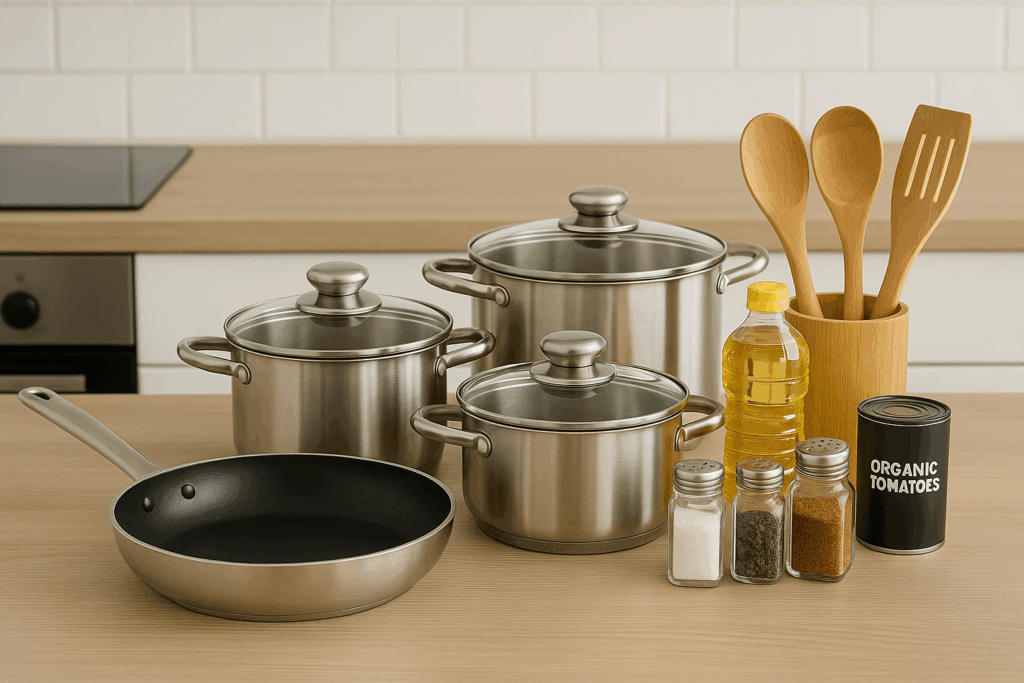
A basic set of pots, a frying pan, and a knife is essential, since nearly every dish requires them. Choosing a Teflon-coated frying pan makes cleanup easy and helps even beginner cooks feel comfortable. As for knives, while a traditional Japanese knife might feel exotic to overseas guests, it’s often safer and more practical to provide a standard Western-style kitchen knife instead.
3-2. Rice Cookers, Microwaves, and Other Appliances
Many overseas guests are genuinely fascinated by Japanese rice cookers. Japan is often seen as a leader when it comes to cooking perfectly fluffy rice, so guests will likely appreciate a quick explanation of how to use one. Having a microwave and toaster on hand also makes it easy for guests to reheat food or whip up a simple breakfast.
Without these appliances, self-catering quickly becomes inconvenient, and long-term guests may pass over your listing altogether when browsing for a place to stay. Even if it means a bit of extra cost upfront, fully equipping your kitchen with these appliances is well worth the investment.
3-3. Distinctly “Japanese” Items Like Okonomiyaki Spatulas and Sushi Rolling Mats
This is where you can really set your property apart from the rest. Uniquely Japanese cooking tools that catch the interest of overseas guests—like an okonomiyaki spatula or a sushi rolling mat (makisu)—hold real value as items that let guests feel that “Japanese touch,” whether they actually end up using them or not. Simply having them displayed on the kitchen counter can make for a great photo opportunity, potentially generating some free promotion through guests’ social media posts.
Leave Your Minpaku Management to Us
Free Online Consultation4. A List of Japanese Seasonings Guests Will Appreciate
4-1. Essential Japanese Seasonings
- Soy sauce: The flavor that symbolizes Japan. Whether you go with the low-sodium or regular version is up to your preference
- Miso: Not just for miso soup—it can also be used in sauces and dressings
- Mirin: Adds sweetness and a glossy finish, an essential seasoning in Japanese cooking
- Sake (cooking sake): Used in simmered dishes and to remove the gamey smell from meat
4-2. Dashi Packs and Bonito Flakes
To make it easy for guests to draw out the deep umami flavor that defines Japanese cooking, providing dashi packs (tea-bag style) or bonito flakes lets them enjoy an authentic taste with minimal effort. Since this way of building flavor doesn’t exist in most other culinary traditions, many guests are pleasantly surprised at how a small amount can completely transform a dish.
4-3. Sauces (Okonomiyaki Sauce, Mentsuyu, and More)
Okonomiyaki sauce and tonkatsu sauce may be unfamiliar to overseas guests, but they’re beloved staples for Japanese people, making them a great way to spark curiosity. Mentsuyu is another versatile option—used not only for soba and udon, but also in simmered dishes and rice bowls—working much like an all-purpose dashi-and-soy-sauce blend that can be adapted to many recipes.
Of course, since these are meant to be stocked over the long term, be sure to provide individually portioned packets or unopened large bottles, and make it a habit to check expiration dates regularly so you can restock or replace items as needed.
5. Key Points for Operations and Management
5-1. Restocking and Hygiene Management
Even if you’ve stocked your kitchen with plenty of cookware and seasonings, neglecting restocking and hygiene management will still hurt guest satisfaction. Seasonings in particular are prone to mold and pests, and quality can deteriorate if they’re left sitting for too long, so it’s important to regularly check expiration dates and keep everything up to date.
Work with your cleaning staff to establish a routine of checking the remaining quantity and expiration dates of salt, sugar, soy sauce, oil, miso, dashi packs, and other items—restocking anything that’s running low or expired—so the kitchen always feels fresh and ready to use.
5-2. Multilingual Instructions
To help overseas guests actually use everything you provide, it’s a great idea to include multilingual instructions for your cookware and seasonings. Putting together simple explanations in English, Chinese, and other languages—covering things like how to operate the rice cooker, how to use an okonomiyaki spatula, or what miso and mirin are for—reduces the risk of items going unused simply because guests aren’t sure how they work.
This is especially true for distinctly Japanese tools (like a sushi rolling mat, a suribachi grinding bowl, or an electric kettle), since many guests won’t be able to tell just by looking what they’re for. A manual with photos is a small touch that guests will really appreciate.
6. Standing Out from Other Rental Options
6-1. Comparison with Standard Rental Properties
With a standard rental property, tenants are expected to source their own seasonings and cookware, and it’s rare for owners to provide any amenities at all. As a result, tenant satisfaction largely comes down to rent and the condition of the unit, making it difficult to add extra value that would justify charging higher rent.
With a minpaku (especially one catering to long-term guests), the cookware and seasonings you provide become a major point of differentiation, giving you real room to reflect that value in your nightly rate. This, in turn, can become a key driver of increased revenue.
6-2. How This Differs from Hotel-Style Accommodations
Hotels typically have so many rooms that “kitchen included” is a rare offering, and even when it is available, it’s usually limited to a specific category like serviced apartments. A minpaku, by contrast, offers the same kind of freedom you’d find in an ordinary home, giving it a real advantage for guests who want to settle in long-term and enjoy cooking for themselves.
Choosing a Special Zone Minpaku format also removes the 180-day cap, allowing you to flexibly accommodate long-term guests. This makes it easier to lean into a homey feel that hotels simply can’t match, while still pursuing a strategy geared toward higher profitability.
7. Conclusion: A Cooking Environment Built for Long-Term Guests Boosts Your Listing’s Ratings
If you’re targeting long-term guests for your minpaku, investing in quality cookware and seasonings is an incredibly effective way to make your listing stand out. Offering tools that let guests experience Japan’s unique food culture, along with distinctly Japanese seasonings, tends to earn high praise from overseas guests, which in turn makes it easier to generate buzz through review sites and social media.
Long-term guests, in particular, tend to place a lot of value on the comfort of cooking their own meals, and for those mindful of food costs and nutrition, how well-equipped the kitchen is can make a huge difference. Try stocking items that guests would think of as genuinely convenient—easy-to-use pots, pans, and knives, along with distinctly Japanese touches like a traditional knife or a sushi rolling mat.
Of course, maintenance and hygiene management require careful attention, but by working closely with your cleaning staff on regular restocking, checks, and inventory management of consumables, you can keep the kitchen ready to use comfortably no matter when guests arrive. With just a bit of effort and investment, you have a real chance to significantly boost your listing’s ratings and attract more long-term bookings.
Long-term guests may bring in a lower rate per guest, but the stable occupancy and word-of-mouth benefits they generate can ultimately have a positive impact on your property’s overall revenue. Why not take this opportunity to reevaluate how well-equipped your kitchen really is?
Leave Improving Your Minpaku’s Guest Satisfaction to Stay Buddy Inc.
If you’re looking to stock cookware and seasonings for long-term guests at your minpaku, or you’d like to improve your operations and inventory management, we’d love to hear from you at Stay Buddy Inc.
Drawing on our experience guiding numerous minpaku properties to success, we offer support across every aspect of your business—from kitchen setup and cleaning operations to pricing strategy. If your goal is to run a minpaku that keeps long-term guests genuinely satisfied, let our expertise help you boost your listing’s ratings and grow your base of repeat guests and referral bookings.