
Leave Your Vacation Rental Management to Us
Free Online ConsultationUnderstanding Why Airbnb Bookings Decline During Off-Peak Seasons
To stabilize your Airbnb bookings during the off-season, the first step is to accurately understand why bookings decrease in the first place. Many hosts simply resign themselves to it, thinking “it’s just the season,” but in reality, quite a few listings maintain occupancy rates of 70% or higher even during slow periods. What separates those listings from the rest comes down to understanding the underlying causes and taking concrete countermeasures.
The main reasons bookings decline during off-peak seasons go beyond a simple drop in overall demand. Several factors compound together: fiercer price competition among competing listings as demand shrinks, reduced visibility as your search ranking drops, and shifts in guests’ travel purposes. For example, a property in a sightseeing destination might see plenty of tourists in summer and around the New Year holidays, but leisure demand typically falls sharply from mid-January through March. Meanwhile, demand from business travelers and long-stay guests remains fairly steady, so whether you can capture that demand becomes the deciding factor for your occupancy rate.
Reviewing Your Pricing to Stay Competitive
Adjusting your pricing is the most immediately effective measure during the off-season. Airbnb’s search algorithm places heavy weight on the relationship between price and booking rate, and listings priced significantly out of line with market rates tend to sink toward the bottom of search results. If you keep your peak-season rates unchanged going into the off-season, you’ll end up with long stretches of no bookings, which in turn drags your search ranking down further—creating a vicious cycle.
In practical terms, a discount of roughly 20%–40% off your peak-season rate is generally considered the going rate for the off-season. For example, if your property normally rents for ¥15,000 per night during peak season, setting the off-season rate somewhere between ¥9,000 and ¥12,000 will make it much easier to secure bookings. Airbnb offers an automatic price adjustment feature called “Smart Pricing,” but if you don’t set an appropriate price floor, this feature carries the risk of discounting your rate further than you intended. For a more reliable approach, manually research the rates of nearby competing listings and set a price that reflects your listing’s amenities and review score. Third-party dynamic pricing tools like PriceLabs or Beyond Pricing can also automatically set optimal daily rates based on historical booking data and local demand forecasts. These tools typically cost around ¥2,000–¥5,000 per month, and they can cut down both the effort of manual adjustments and the lost revenue from mispricing.
Flexibly Adjusting Minimum Stay Requirements and Discount Settings
Travelers’ stay patterns differ during the off-season compared to peak season. While peak season is dominated by short stays of two to three nights, the off-season sees a higher proportion of mid-to-long-term stays of five nights or more, driven by workations, temporary returns home, and business trips. Adjusting your minimum stay requirements and discount settings to match this shift can help you avoid missing out on bookings.
Airbnb lets you set weekly discounts (for stays of 7+ nights) and monthly discounts (for stays of 28+ nights) independently. During the off-season, it’s effective to set weekly discounts at 15%–20% and monthly discounts at 30%–40%. For example, on a property priced at ¥10,000 per night, applying a 35% monthly discount brings the total for 28 nights to ¥182,000—about ¥6,500 per night. At first glance this looks like a steep discount, but since it locks in revenue for 28 nights all at once, it eliminates vacancy risk and dramatically reduces cleaning costs as well. Simply lowering your minimum stay requirement from two nights (peak season) to one night during the off-season can also help you capture sudden weekday business-trip demand. Airbnb’s “seasonal rules” feature lets you automatically switch minimum stay requirements and rates for specific date ranges, keeping the burden of manual management to a minimum.
Optimizing Your Listing Page for the Off-Season
Guests who book during the off-season tend to have different needs than those who book during peak season. Updating your listing’s title and description to match your off-season target audience can improve both your search hit rate and conversion rate.
Updating Your Title and Description
In winter, incorporate season-appropriate keywords into your title, such as “fully heated,” “kotatsu included,” or “a short walk to the hot spring district.” If you’re targeting business demand, phrases like “high-speed Wi-Fi, ideal for remote work” or “3-minute walk from the station—perfect for business trips” work well. Since Airbnb’s search results are influenced by the keywords in your title, the effort of updating your title seasonally is well worth the return. The first three lines of your description are visible even before a guest opens your listing page, so concentrate the information most relevant to your off-season target audience right there.
Swapping and Adding Photos
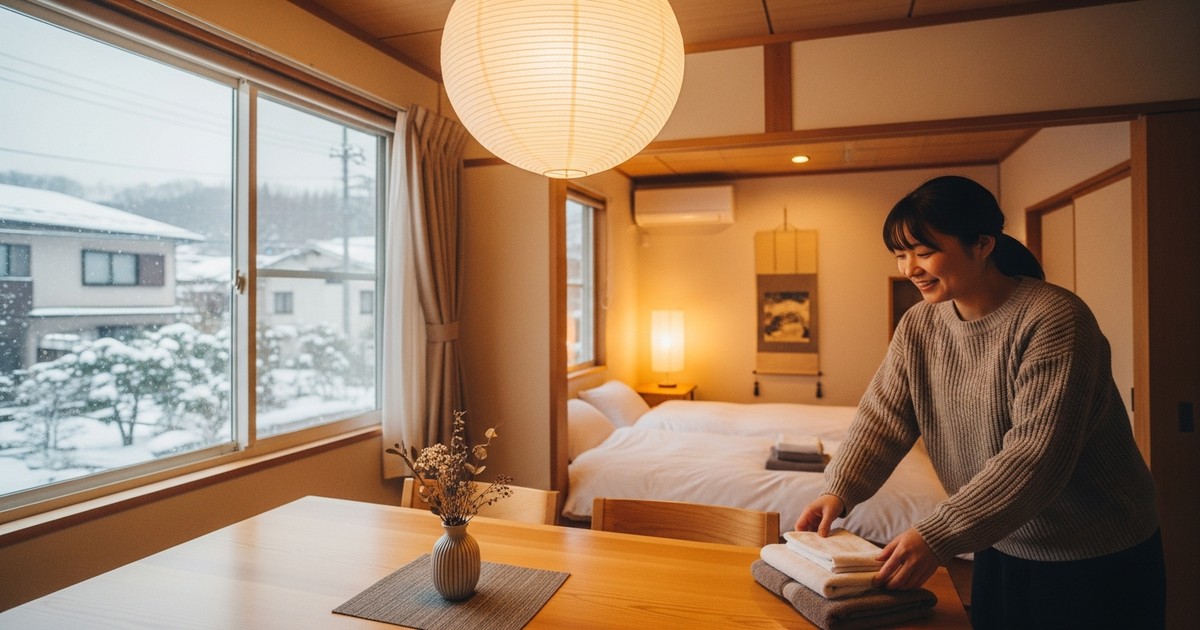
Photos are the single most influential factor in a guest’s booking decision. In areas where the off-season falls in winter, it’s effective to set warm, cozy interior lighting shots or photos showing your heating equipment as the first image. If a “bright blue summer sky” photo is displayed at the top when a guest is searching in winter, the seasonal mismatch will hurt your click-through rate. In fact, one host who swapped their cover photo to match the season saw a 25% increase in click-through rate compared to before the change. At minimum, we recommend reviewing your cover photo and top five images each season.
Improving Your Search Ranking on Airbnb
Airbnb’s search ranking is determined by multiple factors, but there are a few points worth paying special attention to during the off-season. A listing that drops from page one to page two of search results can see its view count fall by more than 50%, making maintaining visibility the lifeline of booking acquisition.
Enabling Instant Book
Airbnb tends to favor listings with Instant Book enabled in its search results, since it improves convenience for guests, making it a feature the platform actively promotes. Data shows that listings with Instant Book enabled rank, on average, 15%–20% higher in search results than those without it. If you’re concerned about guest quality, you can combine Instant Book with filters such as “guests with positive past reviews only” or “verified guests only” to enjoy the search ranking benefits while keeping risk in check.
Improving Response Rate and Response Time
Airbnb treats your response rate and response time to inquiries as key indicators for search ranking. Maintaining a response rate of 90% or higher and a response time under one hour is also a requirement for Superhost status, and listings that meet these standards are given priority placement. It’s easy for motivation to dip during the off-season, but this is exactly the time to be especially diligent about responding quickly. Using the auto-message feature lets you send an instant first reply to inquiries, shortening your response time.
Updating Your Calendar Regularly
Airbnb’s algorithm treats hosts who update their calendar frequently as “active hosts” and rewards them with better search rankings. Make a habit of opening your calendar and checking or updating rates and availability at least twice a week. It’s especially tempting to neglect your calendar during the off-season when bookings are scarce, but doing so causes your search ranking to drop, which in turn makes it even harder to get bookings—a negative spiral you want to avoid.
Shifting Your Target Guest Profile to Match the Off-Season
The profile of guests who use short-term rentals differs significantly between peak and off-peak seasons. Whether you can adapt to this shift is the single biggest factor determining your off-season occupancy rate.
While peak season is dominated by families and sightseeing groups, the off-season’s main guest segments shift toward business travelers, workation users, long-stay foreign visitors, and people looking for temporary housing while relocating. These guests tend to prioritize a comfortable workspace, reliable internet, and everyday living amenities like a kitchen and washing machine, over proximity to tourist attractions. In fact, one host who set up a desk and monitor during the off-season to appeal to workation travelers saw a 30% improvement in occupancy rate compared to the same month the previous year. Since the equipment investment—one monitor (¥15,000–¥20,000) and a desk chair (¥10,000–¥15,000)—is relatively low, this measure offers a strong return on investment.
Considering Expanded Exposure Across Multiple Platforms
If you feel you’ve hit a ceiling with Airbnb alone, listing your property simultaneously on other OTAs (online travel agencies) such as Booking.com or Expedia can boost your exposure. Booking.com in particular has a higher proportion of business travelers than Airbnb, making it well suited for capturing off-season business demand.
When listing on multiple platforms, adopting a channel manager (such as Beds24, Hospitable, or Guesty) is essential to prevent double bookings. For a monthly cost of around ¥3,000–¥10,000, these tools automatically sync your calendar across platforms and centralize your booking management. There are cases where a host who had previously operated on Airbnb alone saw off-season bookings increase by 40% after adding Booking.com, with properties in urban areas typically seeing the strongest results. That said, since fee structures differ between platforms (Airbnb charges hosts around 3%, while Booking.com charges roughly 15%), you’ll need to adjust your pricing on each platform accordingly to account for these fees.
Building Up Reviews and Maintaining Superhost Status
When it comes to securing off-season bookings, a strong review score can be an even more important differentiator than price. Data shows that around 85% of Airbnb guests check reviews before booking, and since guests tend to have more options to choose from during the off-season, bookings tend to concentrate on listings with a review score of 4.8 or higher.
Listings with Superhost status gain access to a priority placement reserved for guests who filter their search specifically for “Superhost.” The requirements for Superhost status are an overall rating of 4.8 or higher, a response rate of 90% or higher, a cancellation rate below 1%, and at least 10 completed stays over the past year. Since a drop in bookings during the off-season puts you at risk of losing this status, it’s often a smart strategy to lower your rates somewhat in order to secure enough bookings and maintain your Superhost qualification. The cost of missing out on a single booking isn’t limited to that booking’s revenue—it can also ripple into long-term losses from losing your Superhost status.
Have Questions About Running Your Vacation Rental? Talk to Stay Buddy Inc.
Maintaining bookings during the off-season requires simultaneously executing a wide range of measures—pricing adjustments, listing optimization, target audience shifts, and multi-platform expansion, among others. However, keeping up with all of this consistently is a heavy burden for an individual host to bear alone.
Stay Buddy Inc. offers a comprehensive vacation rental management service that provides one-stop support for everything from off-season pricing strategy and listing optimization to guest communication and cleaning coordination. Our specialized staff handle data-driven dynamic pricing implementation and seasonal listing improvements, allowing hosts to achieve stable, year-round occupancy while minimizing their own workload.
If you’re struggling with declining revenue due to persistent off-season vacancies, or you want to boost your occupancy rate while reducing the effort of day-to-day management, please don’t hesitate to reach out to Stay Buddy Inc. We’ll propose the optimal management plan tailored to your property’s specific situation and regional characteristics.