The Seasonal Occupancy Gap Challenge Facing Asahikawa Vacation Rentals
For owners running vacation rentals in Asahikawa, the gap in occupancy between tourist high season and the off-season is the single biggest management challenge. By leveraging a management service, Asahikawa vacation rental owners can strategically close this seasonal gap and achieve stable revenue throughout the year. It’s not uncommon for occupancy to reach 80–90% during the summer Asahiyama Zoo season and the winter ski/snow festival season, only to plummet to the 30–40% range during the shoulder seasons of spring and fall.
This occupancy gap translates into monthly revenue swings of ¥100,000–¥200,000 or more. Since fixed costs like rent, utilities, and loan repayments continue regardless of season, off-season losses often eat into the profits earned during peak periods. This article presents concrete figures showing the reality of seasonal fluctuation in Asahikawa’s vacation rental market, then explains specific ways to use property management services to boost off-season occupancy.
This content is useful not only for owners struggling to manage everything themselves, but also for those already using a management service who aren’t satisfied with the results. We’ll walk through practical, actionable steps.
Understanding Seasonal Occupancy Fluctuations in Asahikawa in Numbers
Before implementing any countermeasures, it’s essential to accurately understand how Asahikawa’s vacation rental market fluctuates seasonally. Asahikawa City sees roughly 5 million tourist visitors annually, with about 35% concentrated in the July–August summer months and about 25% in the December–February winter months. In other words, roughly 60% of all visitor traffic is concentrated into just these two seasons.
Combining publicly available platform data with performance figures from management companies, typical occupancy rates in the Asahikawa area run 75–90% during peak season and just 25–40% during the off-season (April–May and October–November). Assuming an average nightly rate of ¥8,000 for a single unit, peak months generate roughly ¥180,000–¥210,000 in revenue, while off-season months bring in only about ¥60,000–¥100,000. With rent and management fees running ¥80,000–¥100,000 per month, the off-season essentially means operating at a real loss or barely breaking even.
Whether you treat this gap as an unavoidable fact of life or actively work to close it makes a huge difference to your annual profit. Simply raising off-season occupancy from 40% to 60% can improve annual revenue by roughly ¥300,000–¥500,000. From here, let’s look at specific methods for achieving that.
Redefining Your Off-Season Target Guest Segments
Uncovering Demand Beyond Tourism
While peak-season guests are overwhelmingly sightseers, continuing to chase the same tourist segment during the off-season won’t move the occupancy needle. Asahikawa has demand for accommodation beyond tourism. Examples include people traveling from afar to accompany patients or attend appointments at Asahikawa Medical University Hospital or Asahikawa City Hospital, buyers visiting to inspect Asahikawa furniture and woodworking production sites, short-term visitors connected to the JGSDF Asahikawa Camp, and people needing temporary housing before a job transfer or move. These segments exist year-round regardless of season, making them a crucial foundation for supporting off-season occupancy.
Management companies accumulate data on this kind of non-tourist demand across multiple properties, allowing them to propose optimal listing copy and pricing tailored to each target segment. Identifying data-driven segments like “medical tourism demand” or “workation demand”—things that are easy to overlook when self-managing—and reflecting them in your marketing is one of the first benefits of using a management service.
Designing Mid- to Long-Term Stay Plans
Waiting for one-night bookings during the off-season is inefficient. Setting up discount plans for stays of seven nights or longer can improve both occupancy and cleaning cost efficiency. For example, for a property priced at ¥8,000/night, an effective tiered pricing structure might offer a 7-night package at ¥5,500/night (¥38,500 total) and a 30-night package at ¥4,000/night (¥120,000 total).
At ¥120,000 for 30 nights, the price is fully competitive with a monthly stay at an Asahikawa business hotel (¥150,000–¥180,000) or a monthly-rental apartment (¥80,000–¥120,000 plus initial fees). Management companies also optimize listings across multiple OTAs as well as monthly-rental specialty sites and Booking.com’s long-stay filters, dramatically expanding the acquisition channels for mid- to long-term bookings compared to self-management.
Executing a Pricing Strategy Tailored to the Off-Season
Introducing Dynamic Pricing
When it comes to off-season pricing, the two extremes to avoid are: keeping peak-season rates and getting no bookings, and pricing too low and leaving no profit margin. Dynamic pricing tools used by management companies (such as PriceLabs, Wheelhouse, and Beyond Pricing) analyze competitor vacancy rates in the Asahikawa area, local event calendars, and historical booking patterns to automatically calculate optimal daily rates.
For example, on an October weekday when competitor vacancy is high, the rate might drop to ¥5,500/night to capture early bookings, while it’s held at ¥7,500 on weekends when a local event (such as the Tabemarche food festival) is taking place—with these fine-grained adjustments made daily. Adjusting prices every single day is simply not realistic for a self-managing owner, making this one of the major practical benefits of outsourcing to a management company. Some management companies report that properties using this approach have seen off-season occupancy improve by an average of 15–20 percentage points.
A Two-Pronged Approach: Early-Bird and Last-Minute Discounts
In addition to dynamic pricing, manually configured discount strategies are also effective. Setting a 15% early-bird discount for bookings made 30+ days in advance during the off-season helps secure a baseline of reservations. Meanwhile, setting up a rule to automatically apply a 25–30% last-minute discount when a unit remains vacant within three days of the date minimizes the loss of unbooked nights slipping by.
Management companies are well versed in the promotional features of Airbnb and Booking.com and understand which discount configurations work favorably with each platform’s search algorithm. On Airbnb, for instance, properties offering “weekly” and “monthly” discounts tend to rank higher in search results—this kind of platform-specific know-how has a direct impact on occupancy.
Optimizing Listings to Boost Off-Season Search Visibility
Rewriting Listing Copy by Season
One thing many owners overlook is updating their listing content to match the season. If your listing still reads “15 minutes by car to Asahiyama Zoo” heading into fall and winter, it won’t catch the eye of guests searching for a fall foliage drive or the Sounkyo Ice Fall Festival in winter.
Management companies update listing titles, descriptions, and photos on a quarterly or even monthly basis, naturally weaving in the keywords that guests visiting Asahikawa during that particular season are likely to search for. In practice, this means switching messaging to phrases like “your base for Daisetsuzan fall foliage” or “perfect for an Asahikawa ramen-hopping trip” in autumn, and “20 minutes to Kamui Ski Links” or “fully heated with parking” in winter. This kind of update alone has been shown to increase off-season impressions by 1.5 to 2 times in some cases.
Seasonal Photo Rotation and Thumbnail Strategy
The thumbnail photo is the first thing guests see in OTA search results. Using a summer exterior shot straight through winter reduces authenticity for guests hoping for a snowy scene, which lowers click-through rates. Management companies photograph the property’s exterior and surroundings each season and swap out the thumbnails accordingly.
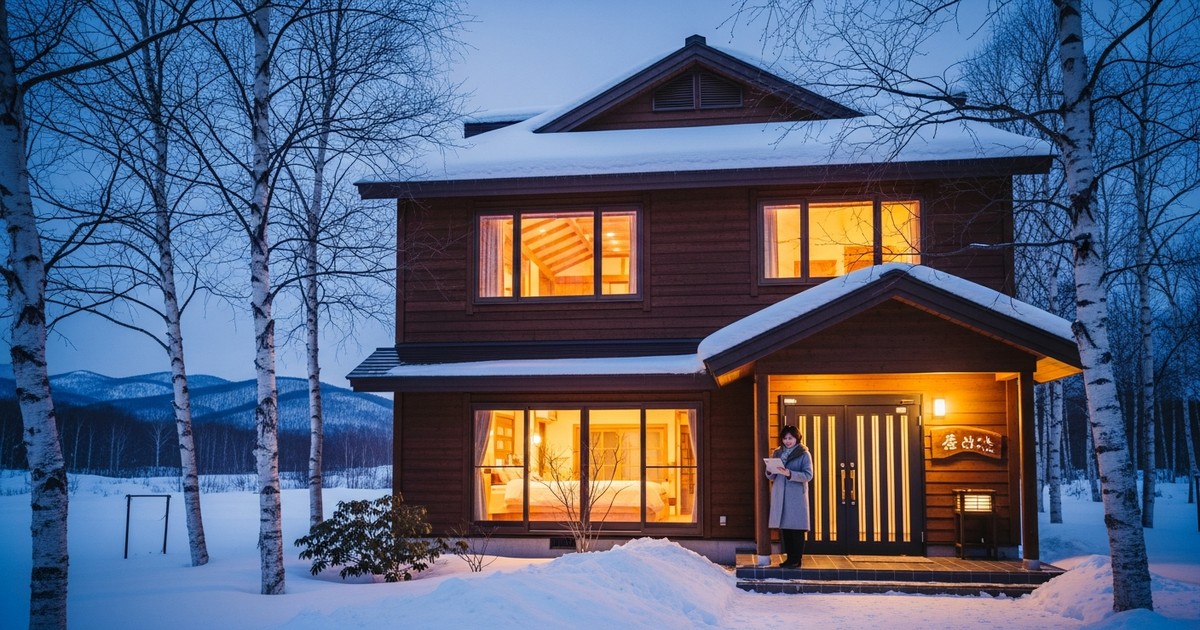
In winter, the featured images might showcase a snow-covered exterior, a snowy view from inside the unit, or cozy interior shots of a kotatsu or stove that convey warmth. According to Airbnb data, there’s a strong correlation between photo quality and click-through rate, with listings using professional photography seeing booking rates that are, on average, 24% higher. The off-season is precisely when the power of good photography is worth investing in for differentiation.
Running Multiple Channels Simultaneously to Avoid Missed Bookings
Most self-managing owners operate solely on Airbnb, or at most across two channels—Airbnb and Booking.com. But boosting off-season occupancy requires exposing your property across as many booking channels as possible. This can include Airbnb, Booking.com, Vrbo, Rakuten Travel (for properties eligible under minpaku regulations), Agoda, and monthly-rental specialty sites (such as Monthly Mansion.com).
That said, running multiple channels simultaneously dramatically increases the risk of double bookings. Management companies use a channel manager (such as Beds24 or similar channel-management tools) to centrally manage inventory across all channels, automatically blocking the corresponding date on all other channels the moment a booking comes in on one of them. Building and running this kind of infrastructure independently requires tool subscription fees (¥5,000–¥15,000 per month) as well as setup effort, making it, in many cases, more cost-effective to receive this as part of a bundled management service.
Building Up Review Scores by Improving the Guest Experience
The Off-Season Is a Prime Opportunity to Earn Reviews
With fewer bookings during the off-season, you have more bandwidth to give each individual guest attentive, high-quality service. Building up strong reviews during this period pays dividends in the next peak season, benefiting both your search ranking and your conversion rate. On Airbnb, properties with an overall rating of 4.8 or higher can earn a “Guest Favorite” badge, which substantially increases visibility in search results.
Management companies execute a standardized workflow covering pre-check-in guidance messages, in-stay follow-up, and post-checkout review requests. A management company with round-the-clock, multilingual messaging support can respond instantly to inquiries from international guests, which also improves platform-tracked metrics like response rate and response time.
Adding Value Through Local Experience Recommendations
Guests who visit Asahikawa during the off-season tend to be looking for experiences beyond the standard tourist spots. When a management company partners with local businesses to offer guests information on activities—such as tours of Asahikawa furniture workshops, sake tastings at breweries like Otokoyama Sake Brewery, or farm experiences in the areas surrounding Asahikawa—it leads to reviews saying things like “I’m so glad I chose this place.”
In fact, properties that provide local experience information through guestbooks or digital guidebooks tend to see an increase in glowing review comments like “the host’s recommendations were amazing,” creating a positive cycle that drives future bookings. This kind of community engagement is a heavy lift for individual owners, but a locally rooted management company can leverage its existing network to make it happen.
The Cost and ROI of Using a Management Service for Vacation Rentals in Asahikawa
Management service fee structures generally fall into two categories: revenue-share models (10%–30% of revenue, varying by company and scope of services) and flat-fee models (¥30,000–¥80,000 per month). Assuming a single-unit property in Asahikawa generates monthly revenue of ¥120,000 (off-season) to ¥210,000 (peak season), a 20% revenue-share fee would come out to ¥24,000–¥42,000 per month, or roughly ¥400,000–¥450,000 annually.
On the other hand, if bringing in a management service improves off-season occupancy from 40% to 60% and generates an additional ¥300,000–¥500,000 in annual revenue, the math still works out in your favor even after subtracting management fees. On top of that, freeing up the time owners would otherwise spend on self-management—arranging cleaning, handling guest communication, adjusting pricing, managing listings, and so on (roughly 20–30 hours per month)—is a major benefit that’s hard to put a dollar figure on. For owners running their rental as a side business alongside a full-time job, reclaiming that time can be worth even more than the revenue itself.
Contact Stay Buddy Inc. for Vacation Rental Management Consultation
The occupancy gap between tourist high season and the off-season is an unavoidable challenge for vacation rental operators in Asahikawa, but it can be substantially improved with the right strategy and execution. Consistently implementing the target redefinition, pricing strategy, listing optimization, multi-channel management, and review-building tactics covered in this article really does require the support of an experienced management partner.
Drawing on extensive experience in vacation rental management, Stay Buddy Inc. analyzes the specific challenges of each property and proposes and executes concrete measures aimed at maximizing occupancy and revenue. Beyond off-season strategy, we offer one-stop support covering everything from pre-launch permit assistance and revenue simulations to interior coordination.
We’re also happy to answer questions like “How much can off-season occupancy realistically improve for my property?” or “What kind of ROI can I expect from using a management service?” with personalized answers based on your property details. Please feel free to reach out to Stay Buddy Inc. anytime.