Introduction: The Appeal and Potential of Special Zone Minpaku in Higashiyodogawa Ward
Current State and Future Potential of the Minpaku Market in Osaka City
The minpaku (private lodging) market in Osaka City has shown remarkable recovery and growth in recent years. The number of foreign tourists visiting Osaka Prefecture has been rapidly increasing, reaching an estimated 14.64 million in 2024, an all-time high 1. While occupancy rates temporarily dropped to 20–30% during the COVID-19 pandemic, they have since rebounded sharply to 70–80%, with room rates now roughly 30% higher than pre-pandemic levels 2. This clearly demonstrates that current accommodation demand is outpacing supply, creating an extremely favorable market environment for newcomers entering the minpaku business.
This state of excess demand is expected to continue and even accelerate going forward. In particular, the 2025 Osaka-Kansai Expo is projected to attract approximately 28.2 million visitors (including around 3.5 million from overseas) 2, which works out to an average of over 150,000 visitors to Osaka per day during the event period 2. As a result, accommodation demand within Osaka City is expected to reach unprecedented levels 2. Some forecasts suggest that existing hotel supply alone will be unable to fully absorb demand during the Expo period 2, meaning minpaku will play a crucial role in filling this accommodation gap. Special Zone Minpaku, in particular—with no restrictions on the number of operating days per year—is well positioned to make the most of this surge in demand, creating an extremely favorable market environment where high occupancy rates and profitability can be expected.
Beyond this short-term surge in demand, the minpaku market also has a solid foundation for medium- to long-term growth. Osaka Prefecture has set a target of 20 million foreign visitors by 2030, with per-visitor spending also on an upward trend 5. Furthermore, the opening of Osaka’s Integrated Resort (IR) is scheduled for 2029, with visitor numbers projected to reach approximately 19.87 million annually (13.58 million domestic and 6.29 million international) by its third year of operation 2.
These large-scale developments and targets indicate that Osaka is not simply experiencing a temporary tourism boom, but is on a sustained upward trajectory in tourism demand. As such, the minpaku business is an attractive option not only as a short-term speculative venture, but also as a long-term investment capable of generating stable cash flow. By incorporating these macro trends into their business plans, investors can look forward to more reliable returns.
Geographic Characteristics, Transportation Access, and Analysis of Minpaku Demand in Higashiyodogawa Ward
Higashiyodogawa Ward is located in the northeastern part of Osaka City, bordering Suita City, Settsu City, and Moriguchi City. Within Osaka City, it also borders Yodogawa Ward, Kita Ward, Miyakojima Ward, and Asahi Ward. Geographically, the ward is bounded by the large Yodo River to the south and the Kanzaki River (and partially the Ai River) to the north 6. The rich natural surroundings along these rivers provide a relaxing environment well-suited for cycling and jogging, giving the area a calm atmosphere despite its proximity to the city center 7.
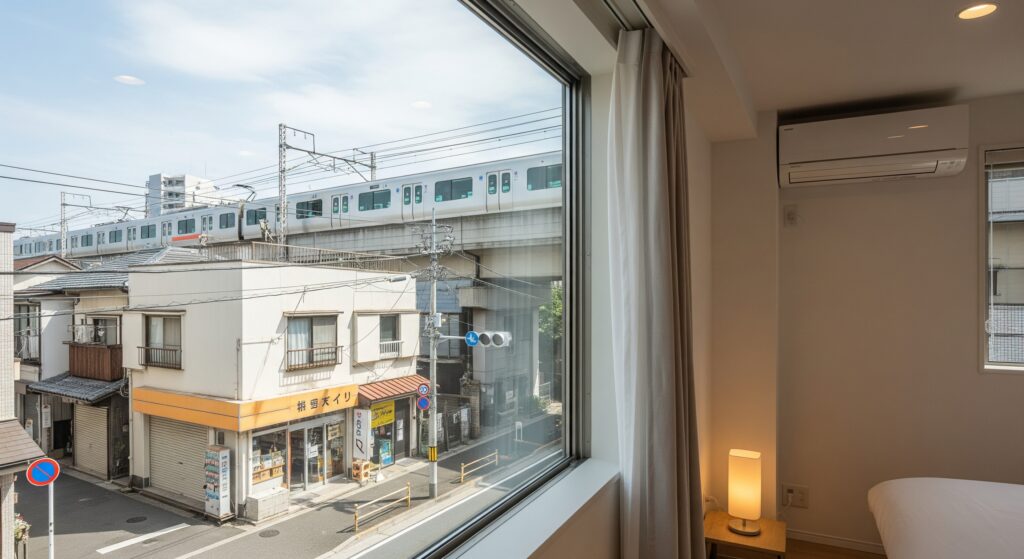
In terms of transportation, Higashiyodogawa Ward is exceptionally well connected. The ward is served by the Hankyu Railway Kyoto Line and Senri Line, the Osaka Metro Imazatosuji Line, and the JR West Kyoto Line 6, with Hankyu Awaji Station, JR Awaji Station, and Kamishinjo Station serving as major transit hubs within the ward 7. Access to Osaka’s major terminal stations—Umeda, Namba, and Shin-Osaka—is particularly excellent. JR Shin-Osaka Station is just a few minutes away (0.7 km) 7, and the Higashiyodogawa Ward Office can be reached in about 30 minutes by bus from the east exit of Shin-Osaka Station 9.
The ward also offers one-train access to major hub stations across the wider region, such as Kyoto, Tengachaya, and Senri, allowing it to function as a convenient base for exploring the entire Kansai area 7. On the other hand, there are some challenges, including underdeveloped east-west road networks within the ward and inconvenient east-west movement in areas where the elevation of the Hankyu Railway line has not yet been completed 6. It should also be noted that many of the local streets connecting to main roads are relatively narrow 6. These road network issues may pose some inconvenience for tourists relying on private cars, so promotional efforts that emphasize the convenience of rail access are likely to be more effective.
Given these geographic characteristics and transportation access, the primary demand for minpaku in Higashiyodogawa Ward is expected to come from business travelers and foreign tourists 10. The excellent access to central Osaka meets the needs of business travelers, while the balanced environment—combining nature with urban convenience—makes the area attractive to tourists seeking a relaxed stay away from the hustle and bustle of the city center, as well as to travelers looking for extended stays or repeat visits 10. In particular, since many foreign tourists use Shin-Osaka Station as a base for traveling throughout the Kansai region, accommodation demand in this area—including neighboring Yodogawa Ward—continues to grow steadily 10.
In terms of competition, reference rates for minpaku properties in Higashiyodogawa Ward range from approximately 15,000 to 38,000 yen per night 11. Nearby hotels tend to fall within a price range of about 6,000 to 20,000-plus yen per night 12. This diversity in pricing suggests there is room for differentiation through property types and pricing tailored to specific target groups (e.g., large groups, families, or mid-to-long-term guests). In particular, spacious properties or those accommodating larger groups can meet needs that hotels typically cannot, making it easier to establish a competitive advantage in the market. Rather than falling into simple price competition, it is important to clearly define the unique characteristics of a property—such as size, amenities, and atmosphere—and align them with the needs of the target demographic.
Why Is Special Zone Minpaku Attracting Attention in Higashiyodogawa Ward Now? (Benefits and Profitability)
Special Zone Minpaku is attracting attention in Higashiyodogawa Ward because of the numerous advantages offered by the system, and the high profitability these advantages make possible.
Key Benefits of Special Zone Minpaku:
- No Limit on Annual Operating Days: The biggest advantage of Special Zone Minpaku is that there is no restriction on the number of days it can operate per year 14. This is a major difference compared to the Private Lodging Business Act (the “Minpaku Law”), which limits operations to 180 days per year 14. Being able to operate year-round allows operators to pursue maximum revenue. This means stable, year-round income—not just from short-term surges like the Expo, but also through the off-season—leading to shorter investment payback periods and higher expected returns.
- Minimum Stay Requirement: Special Zone Minpaku requires a minimum stay of 2 nights and 3 days 14. While this condition may mean missing out on single-night guests, it also reduces the frequency of cleaning and check-in/check-out tasks, improving operational efficiency. This aligns well with Higashiyodogawa Ward’s characteristics, which tend to attract mid-to-long-term stays, and contributes to more stable operations.
- Flexibility in Management Outsourcing: For owner-absent operations, Special Zone Minpaku has no special rules governing the outsourcing of management duties 15. This differs from the Private Lodging Business Act, which requires owners to outsource management to a licensed management company when the owner is absent—meaning that under Special Zone Minpaku, owners can handle emergency response and cleaning themselves if they choose.
- Flexibility in Zoning: Special Zone Minpaku can, in some cases, operate in exclusively residential zones where hotel/ryokan-style operations would normally be difficult 16. In Osaka City, Special Zone Minpaku can be conducted in Category 2 Residential Zones, Quasi-Residential Zones, Neighborhood Commercial Zones, Commercial Zones, Quasi-Industrial Zones, and Category 1 Residential Zones (subject to floor area requirements) 17. This zoning flexibility broadens the range of options when searching for properties, making it possible to operate in areas with a more pleasant living environment. This can help reduce the risk of disputes with neighbors while increasing the likelihood of providing guests with a comfortable stay. Confirming the zoning classification is one of the most critical steps in the early stages of business planning, and it’s essential to make active use of public tools such as “Map Navi Osaka” to obtain accurate information.
- Government Support: Within National Strategic Special Zones, government support is extensive, including subsidy programs for fire safety equipment installation, among other things 18. Taking advantage of these subsidies can help reduce initial investment costs and enable more efficient business development.
- Profitability: The lack of operating day restrictions, combined with operating in an area with high tourism demand, offers a major advantage in attracting guests and ensures strong profitability 14. The approximately 30% increase in room rates since the pandemic and the current situation of demand outpacing supply both indicate an environment where high profitability can be expected 2.
Taken together, these benefits make Special Zone Minpaku a powerful option for maximizing revenue and achieving stable operations in the minpaku business within Osaka City, and Higashiyodogawa Ward in particular.
Comparison Table: Special Zone Minpaku vs. Other Minpaku Systems
When considering starting a minpaku business, multiple legal frameworks exist, each with different regulations, making it essential to understand their differences accurately. The comparison table below concisely outlines the key features of Special Zone Minpaku, the Private Lodging Business Act (Minpaku Law), and the Hotel Business Act, providing operators with the information needed to choose the system best suited to their business strategy.
| Item | Special Zone Minpaku (National Strategic Special Zone Foreign Visitor Accommodation Business) | Private Lodging Business Act (Minpaku Law) | Hotel Business Act (e.g., Simple Lodging License) |
| Governing Law | National Strategic Special Zones Act | Private Lodging Business Act | Hotel Business Act |
| Max Annual Operating Days | No limit 14 | Up to 180 days per year 14 | No limit |
| Minimum Stay | 2 nights, 3 days or more 14 | 1 night, 2 days or more 15 | No limit |
| Management Outsourcing Requirement | No special rules for owner-absent operations 15 | Must outsource to a licensed management company for owner-absent operations 15 | Generally requires an on-site manager |
| Zoning Restrictions | Permitted in Category 2 Residential, Quasi-Residential, Neighborhood Commercial, Commercial, Quasi-Industrial, and Category 1 Residential Zones (subject to floor area requirements). Not permitted in exclusively residential or exclusively industrial zones, etc. 16 | Can operate nationwide outside of industrial zones (may vary by municipality). Properties in exclusively residential zones must front a road at least 4m wide 14 | Subject to zoning restrictions (generally not permitted in exclusively residential zones) 16 |
| Neighbor Notification Requirement | Required 23 | Also required for schools, childcare facilities, etc. within 100m 17 | Depends on the municipality 23 |
| Key Facility Requirements | Rooms of 25㎡ or more, kitchen, bathroom, toilet, washing facilities, bedding, cooking equipment, cleaning equipment, etc. 16 | At least 3.3㎡ per guest 28 | Minimum room floor area (7㎡ for Japanese-style, 9㎡ for Western-style), ventilation, natural light, lighting, moisture control, drainage, bathing facilities, guest registry, etc. 29 |
This comparison table simplifies the complex regulatory landscape of the minpaku business, allowing operators to grasp the key differences between systems at a glance and providing essential information for making strategic decisions. In particular, it clarifies items that directly affect business profitability and operational structure—such as the number of operating days, zoning, and management outsourcing requirements—allowing operators to efficiently determine which system best suits their property’s characteristics and business strategy (for example, aiming for year-round full operation, wanting to run an owner-occupied operation, or wishing to open in a specific area). This reduces the risk of building a business plan based on mistaken assumptions and supports more reliable business development.
Osaka City Special Zone Minpaku: List of Room Structure and Facility Requirements
To operate Special Zone Minpaku in Osaka City, specific requirements regarding the structure and facilities of guest rooms must be met. These requirements are set out under the Enforcement Order of the National Strategic Special Zones Act and Osaka City’s own regulations, and require detailed verification when selecting a property and planning renovations.
| Item | Requirement | Osaka City’s Additional Regulation |
| Room Floor Area | Must be at least 25 square meters. If applying with multiple rooms, each room must be at least 25㎡ 16 | – |
| Entrances and Windows | Must be lockable 16 | – |
| Boundary Between Room and Other Rooms/Hallways | Must be constructed of solid walls, excluding entrances and windows 16 | – |
| Facilities (Basic) | Must have adequate ventilation, natural light, lighting, moisture control, drainage, heating, and cooling facilities 16 | – |
| Water Facilities | Must have a kitchen, bathroom, toilet, and washing facilities 16 | Kitchen and washing facilities must be separately provided, with running water facilities that can supply tap water or other water suitable for drinking 16 |
| Cooking Equipment | Must have equipment or facilities necessary for cooking 16 | Must include heating equipment such as a microwave or stovetop 16 |
| Cleaning Equipment | Must have equipment necessary for cleaning 16 | Must include a vacuum cleaner, cleaning cloths, and a trash bin 16 |
| Bedding and Furniture | Must have bedding, a table, chairs, and storage furniture 16 | It is desirable that covers for futons, pillows, etc. be of a structure that allows for easy removal 26 |
This detailed list clearly presents the specific facility requirements that are otherwise difficult to visualize from the text of laws and ordinances alone, making it extremely practical for operators planning property selection and renovations. By clarifying exactly what equipment is needed, operators can more accurately estimate the scope and cost of renovation work, improving the precision of their business plans.
This checklist also serves as a concrete guide when preparing the “drawings clarifying the structure and facilities of the property” required at the time of application, as well as when preparing for on-site inspections, helping streamline preparations. In particular, by including Osaka City’s own additional regulations, it helps reduce the risk of overlooking region-specific requirements and helps prevent legal non-compliance before it occurs.
The Specific Process and Required Documents for Special Zone Minpaku Applications
Key Step Before Applying: Prior Consultation with the Public Health Center, Fire Department, and Building Division
When beginning the Special Zone Minpaku certification application process, the most important and essential first step is prior consultation with the relevant public health center, fire department, and, if necessary, the building division 23. This step functions as an extremely important risk-mitigation measure, helping to prevent major rework and unexpected additional investment later on. In particular, requirements related to fire safety equipment and building codes are closely tied to a property’s structure, and making changes after the fact can require significant time and cost 32.
During the prior consultation, operators should explain their business plan in concrete terms, including an overview of the business, the selected property, safety measures, and the operational structure to be established 34. Bringing drawings such as elevation and floor plans to the consultation 23 allows operators to accurately convey the specific details of the property to government staff and receive appropriate advice. This is essential for making early, fundamental business decisions—such as whether the property can meet Special Zone Minpaku requirements, what renovations may be needed, and how much they might cost.
Since consultation windows at public health centers are often busy, it is strongly recommended to make a phone appointment in advance before visiting 27. Consultations without an appointment may not be accepted, so caution is advised 27. Professionals such as administrative scriveners (gyoseishoshi) can handle these prior consultations on the operator’s behalf, helping to ensure smooth negotiations with the authorities 35. This can be a major advantage for operators with limited time or specialized knowledge, helping streamline the application process. Thorough prior consultation reduces the risk of non-compliance, improves the accuracy of renovation cost estimates, and ultimately leads to a smoother application process.
Process for Obtaining a Fire Code Compliance Certificate and Key Fire Safety Equipment Requirements
While Special Zone Minpaku relaxes some requirements of the Hotel Business Act, fire safety regulations are not relaxed, and their standards remain strict 30. A copy of the Fire Code Compliance Certificate is a mandatory attachment for the Special Zone Minpaku certification application 27, and without it, the application will not be accepted.
To obtain the Fire Code Compliance Certificate, operators must first submit an application for the certificate to the relevant fire department 31. The fire department will then conduct an on-site inspection of the property 23 to confirm that the installed fire safety equipment meets the required standards. The business owner is required to be present for this inspection 23.
Key fire safety equipment requirements include the following:
- Automatic Fire Alarm System: Fire alarm systems and emergency exit lighting are generally required 23. In particular, automatic fire alarm systems designed for small-scale facilities can be installed in minpaku properties with a total floor area of 300㎡ or less 36. Heat detectors are required in kitchens and washrooms, while smoke detectors are required elsewhere 36.
- Fire Extinguishers: For standalone house-type minpaku properties with a total floor area of 50㎡ or more, fire extinguishers are required on every floor 36. If the property is classified as having “windows for evacuation purposes” (yusomado-kai), this threshold may be relaxed to 150㎡ or more, but installation is generally recommended given the relatively low burden involved 36.
- Flame-Resistant Items: In minpaku properties, carpets (2㎡ or larger) and curtains are required to be made of flame-resistant materials 35. During fire inspections, the use of flame-resistant items is checked rigorously alongside fire safety equipment 36.
- Evacuation Route Maps: To ensure guest safety, evacuation route maps must be displayed in minpaku bedrooms 33.
- Fire Safety Manager: If the total occupancy of the building is 30 people or more, a designated fire safety manager is required 15. Outsourcing this role to a specialized company is recommended, as it ensures fire safety management duties—such as fire drills and equipment maintenance—are properly carried out 36.
- Earth Leakage Fire Alarm: Buildings constructed with lath and mortar and with a contracted electrical current of 50A or more, or with a total floor area of 150㎡ or more, are required to install an earth leakage fire alarm 36.
- Emergency Exit Lighting: In some cases, emergency exit lighting may not be required if certain conditions are met—such as clear visibility of the main evacuation exit from all parts of the room, the ability to reach a safe location without passing within 3m of windows or doors, the display of evacuation route maps, and the installation of emergency lighting devices 33. For apartment-style buildings, if the floor area of the minpaku unit is 100㎡ or less, installing emergency lighting devices or portable lighting equipment may be sufficient 33.
Fire safety regulations represent one of the biggest hurdles in the minpaku application process, and installing the required equipment can be costly 32. Particularly for row houses (nagaya) and multi-unit residential buildings, the impact may extend to the entire building, creating a risk of sharply increased costs 37. However, taking advantage of certain exceptions—such as the exemption from fire safety equipment requirements when the minpaku portion is under 50㎡ 39, or the exemption criteria for emergency exit lighting 33—can help keep costs down.
For this reason, prior consultation with the fire department 33 and the use of professionals such as administrative scriveners and fire safety equipment specialists 35 are important factors in avoiding unnecessary investment and achieving compliance efficiently. Professionals are familiar with specific conditions and equipment—such as installing “automatic fire alarm systems for small-scale facilities” 36 or leveraging the “window-equipped floor classification” to relax fire extinguisher installation requirements 36—that can help avoid large-scale equipment investments, and this knowledge contributes to a more efficient application process.
Conditions for Fire Code Exceptions in Row Houses (Nagaya)
A nagaya (row house) is a building with two or more units that share walls with adjacent units and have no shared common areas such as hallways or staircases, with each unit’s main entrance facing directly onto a road or similar space 40. Unlike apartment buildings, nagaya do not fall under the category of “special-use buildings” under the Building Standards Act, and are instead treated as ordinary residences, which tends to mean fewer building code restrictions apply 41. However, when used for minpaku purposes, new obligations arise under fire safety law, making it important to understand the applicable exceptions.
| Item | Condition | Notes |
| Total Floor Area of the Entire Nagaya | Must be less than 1,000㎡ 32 | If this is exceeded, applying the exception may become difficult. |
| Entrance of Each Unit | All entrances must face a road that allows evacuation 32 | For on-site pathways, an effective width of at least 3m is required 40. |
| Presence of Shared Areas | Units must not share common areas such as stairs or hallways 32 | The structure must conform to the definition of a nagaya. |
| Ownership or Management Rights | Each unit must be separately owned or leased (i.e., all owners or tenants must be different individuals) 32 | – |
| If the Minpaku Portion Is Less Than 50㎡ | In addition to the above conditions, the total floor area used for minpaku purposes must be less than 50㎡ 39 | This is treated the same as converting part of an ordinary residence into minpaku use, and exempts the property from requirements such as automatic fire alarm systems (though residential fire alarms and self-installed fire extinguishers are still required) 39. |
This table helps operators considering minpaku in a nagaya property understand the particularly important fire code exception conditions and avoid confusion. While nagaya properties benefit from more relaxed building code and fire safety regulations compared to apartment buildings 41, new fire safety equipment obligations arise once the property is used for minpaku 37. In particular, the fire resistance performance of the “partition wall” (kaikabe) shared with adjacent units 35 and the risk of fire safety equipment requirements applying to the entire building 35 are complex issues unique to nagaya properties. Proceeding without detailed prior confirmation and consultation with professionals can result in unexpectedly high renovation costs.
In particular, the exception for cases where “the minpaku portion is less than 50㎡ in floor area” 39 and the “nagaya exception” described above 32 have the potential to significantly reduce initial investment costs for nagaya properties, so these possibilities should be verified as a top priority when considering a nagaya property. However, caution is needed, as the obligation to install an automatic fire alarm system across the entire nagaya may arise if another resident begins operating minpaku in a different unit within the same building 39.
When converting a partition wall to quasi-fire-resistant construction, prior consultation with the fire department is essential; proceeding with construction without consultation risks the need for rework 33. Understanding the applicable exceptions and consulting in advance are essential for avoiding risk and optimizing costs.
Neighbor Briefings: Scope, Content, and the Importance of Preventing Disputes
In Osaka City, holding an explanatory briefing for neighboring residents is a mandatory step before submitting a Special Zone Minpaku certification application 16. This briefing is not merely a procedural formality—it is one of the most critical factors determining the long-term sustainability of the minpaku business, since noise and garbage-related issues can lead to complaints or reports to the authorities, potentially resulting in administrative guidance or a suspension of operations in the worst case 42.
The scope of neighboring residents requiring explanation is as follows:
- If the minpaku property is a “multi-unit residential building” or a “nagaya,” all residents of that building are included 43.
- All residents of buildings located on land adjacent to the property’s site are included 43.
- If the minpaku property faces a park, road, or vacant land, all residents of buildings on land within 10 meters of the property’s site are included 15.
The content of the briefing should cover a wide range of information, including:
- The name and location of the facility 25
- The type of minpaku (i.e., that it is Special Zone Minpaku) and the management structure 25
- Waste disposal methods (noting that minpaku waste is classified as commercial waste, and explaining proper sorting and disposal procedures) 17
- Noise prevention measures (preventing nighttime noise, posting notices inside the property, and enforcing house rules) 35
- Emergency response procedures (for fires, accidents, etc.) and emergency contact information 24
- A point of contact for complaints 25
- Warnings regarding smoking and fire safety 24
To prevent trouble after operations begin, it is strongly encouraged to conduct the briefing sincerely and make every effort to gain the understanding of neighboring residents 23. While the application process can proceed even without residents’ consent, it is also effective to draft a written agreement documenting any conditions or promises made, in order to avoid future disputes 25. For residents who did not attend the briefing, it’s also worth considering distributing meeting minutes afterward or conducting individual visits 25.
This kind of prior explanation and ongoing consideration for neighboring residents reduces the risk of disputes and helps secure understanding and cooperation from the local community, thereby improving the stability and sustainability of the business. Enforcing house rules 42, establishing a clear emergency contact system 25, and maintaining regular communication with the community 18 are all essential to maintaining good relationships—this should be viewed not as a one-time event, but as an ongoing effort toward “coexistence with the community.”
Establishing a Waste Disposal System and Notifying the Environmental Bureau
Waste generated by minpaku operations is treated as “commercial waste,” distinct from ordinary household waste 17. As such, it is not collected through the city’s standard waste collection service, and certified operators are responsible for ensuring it is disposed of properly.
Specifically, operators must contract with a licensed waste disposal company to handle the collection, transport, and disposal of waste 27. For this reason, it’s necessary to clearly define waste disposal methods and storage locations in advance and to sign a contract with the chosen waste disposal company 31. After the contract is finalized, operators must submit a notification to Osaka City’s Environmental Bureau, Business Division, General Waste Guidance Section 27.
Waste disposal is not simply a routine task—it is a legal obligation and one of the leading causes of disputes with neighbors 24. Improper handling can lead to administrative guidance or penalties and can seriously damage a minpaku operator’s brand image. Contracting with a proper waste disposal company and clearly communicating disposal procedures is essential not only for legal compliance but also for earning the trust of the local community. Making sure guests understand and follow the correct waste disposal rules is also extremely important 28, and multilingual guidance is necessary when hosting many international guests 27.
Certification Application and On-Site Inspection with the Public Health Center
Once preparations for minpaku operations are complete, the next step is the certification application process. Operators must submit the full set of required documents to the relevant public health center (Osaka City Public Health Center, Environmental Hygiene Inspection Division, Hotel Business Guidance Group) 23.
The application fee is 10,500 yen if an on-site inspection is conducted, or 2,500 yen if no on-site inspection is required 27. However, some sources list the fee as 21,200 yen 44, so it’s important to confirm the exact amount in advance.
After the certification application documents are submitted, an on-site inspection of the facility will be conducted by both the public health center and the fire department to verify the equipment 23. The business owner’s presence is mandatory during this inspection 23, and the inspection covers not only the facility’s equipment but also its operational structure. If no issues are found during the inspection, a notice of certification will be issued at a later date, at which point the operator can officially begin the minpaku business 23.
Preparing the application documents requires attention to detail across a wide range of materials 27. Any deficiencies can delay the review process and postpone the opening of the business. In particular, in addition to basic documents such as articles of incorporation and certificates of registration for corporate applicants, or a copy of the resident registry for individual applicants, a wide range of specialized documents—such as structural facility drawings, records of neighbor briefings, and the Fire Code Compliance Certificate—require broad knowledge and careful preparation.
The difference in application fees depending on whether an on-site inspection is required reflects differences in the administrative burden involved, and thorough preparation combined with close coordination with the authorities is essential to ensuring the on-site inspection proceeds smoothly. This, in turn, leads to faster certification. Careful preparation of application documents and thorough prior consultation both contribute to a smoother review process and quicker certification.
Special Zone Minpaku Application: Required Documents Checklist
The Special Zone Minpaku certification application requires the submission of a wide range of documents. The checklist below serves as a comprehensive guide to help ensure all necessary documents are prepared without omission. Missing even a single document may result in the application not being accepted, or may cause significant delays in the review process, so careful preparation is essential 27.
| Category | Document Name | Notes |
| Application Form | National Strategic Special Zone Foreign Visitor Accommodation Business Certification Application Form | Use the designated format 27 |
| Applicant Information | Articles of incorporation or founding documents and certificate of registered matters (for corporations) | Also attach a list of officers 27 |
| Copy of resident registry (for individuals) | 27 | |
| Property Information | Drawings clarifying the structure and facilities of the property | Floor plans for each room, floor area, location of plumbing fixtures, etc. 27 |
| Vicinity map | A map showing the surrounding area of the facility 25 | |
| Legal Rights | Lease agreement and any associated terms and conditions | 27 |
| For rental properties: copies of all lease agreements related to the property, plus a copy of a document confirming that the owner and lessor have consented to the property’s use for business purposes | 25 | |
| For condominium units: a document confirming that operations do not violate the building’s management regulations | 27 | |
| Neighbor Relations | Method and record of explanation provided to residents in the surrounding area (including materials used in the explanation) | 24 |
| System for appropriately responding to complaints and inquiries from residents in the surrounding area, along with how this system is communicated | Including an overview of the facility’s structure, equipment, and services provided during a stay 27 | |
| Safety and Hygiene | Copy of the Fire Code Compliance Certificate | Issued by the relevant fire department 27 |
| Copy of water quality test results (if the water source is not municipal tap water) | 27 | |
| Operational Documents | Instructions on how to use the facility, to be placed in the guest room | Prepared in Japanese and the relevant foreign language(s) 27 |
| Guest registry format | Must include stay dates, name, address, occupation, nationality, passport number, contact information, and verification records 26 |
This checklist serves as a compass to ensure comprehensive preparation, helping operators avoid missing any required documents. By tracking the status of each document, operators can move through the entire application process more efficiently, minimizing the need for rework. Even when outsourcing the application to a professional such as an administrative scrivener, sharing this checklist can streamline the exchange of information and materials, improving the quality of collaboration. It can also serve as a reference point for confirming that each document meets the legally required standards, improving the overall quality of the application and increasing the likelihood of successful certification.
Confirming Zoning and Using “Map Navi Osaka”
When operating a minpaku business within Osaka City, it’s essential to understand the zoning regulations established under the City Planning Act and the Building Standards Act, and to confirm whether your property is located in an area where operations are permitted 17. Verifying the zoning classification is the single most important step at the early stage of business planning, and it can be the deciding factor in whether the business succeeds or fails. If a property is acquired in an unsuitable zone, minpaku operations may simply not be possible at all, resulting in wasted investment—making it essential to obtain accurate information from the outset 16.
The zoning classifications in which Special Zone Minpaku is permitted are as follows:
- Category 2 Residential Zone
- Quasi-Residential Zone
- Neighborhood Commercial Zone
- Commercial Zone
- Quasi-Industrial Zone
- Category 1 Residential Zone (subject to floor area requirements)
On the other hand, Special Zone Minpaku cannot be operated in exclusively residential zones or exclusively industrial zones, among others 16.
To check the zoning classification of a specific property, Osaka City’s map information site, “Map Navi Osaka,” is a convenient tool 17. While this tool is useful as a reference, it is recommended that final confirmation of the official city planning designation be made using the “public inspection documents” (jūran tosho) available at the City Planning Information Corner of the Planning Coordination Bureau, City Planning Division, on the 7th floor of Osaka City Hall 45. Since zoning also affects the surrounding environment (commercial facilities, residences, factories, etc.) and future development plans, it plays an important role in long-term business planning as well.
Confirming Management Regulations for Condominiums and Multi-Unit Residential Buildings
When planning to operate minpaku in a condominium or other multi-unit residential building, confirming the building’s management regulations is an even more critical step than verifying zoning compliance 35. Because management regulations are legally binding, operating a minpaku business in violation of them constitutes an unlawful act and could lead to forced eviction or claims for damages 27. Even if the zoning classification permits minpaku, there are cases where the building’s management regulations prohibit it, making prior confirmation essential 35.
Even if the management regulations state that the property is to be used “exclusively as a residence,” it may still be possible to apply for Special Zone Minpaku certification if the management association grants written consent for minpaku use 16. However, if such consent cannot be obtained, or if the management regulations explicitly state that minpaku is prohibited, the application will not be approved, and a different property will need to be considered 16.
This step suggests that simply reading the regulations is not enough—proactive dialogue with the management association is essential. Through transparent communication, it’s important to address any concerns about minpaku operations and make every effort to gain understanding and approval. Confirming and obtaining approval regarding management regulations is directly tied to legal compliance and avoiding community disputes, ultimately contributing to stable business operations.
Thorough Neighbor Dispute Prevention Measures and Emergency Response Systems
One of the biggest concerns in minpaku operations is disputes with neighboring residents caused by issues such as noise, garbage disposal, improper handling of cigarettes or fire, and unauthorized occupants 29. These issues can lead to complaints or reports to the authorities and, in the worst case, result in administrative guidance or a suspension of operations, directly threatening the sustainability of the business 42.
Concrete measures for preventing disputes before they occur include the following:
- Enforcing House Rules: Post notices inside the property, such as reminders to “please be quiet,” and make sure guests are thoroughly briefed on house rules in advance 35. Deterrent measures such as printed notices or direct messages to guests are also effective and can dramatically reduce the occurrence of disputes 42.
- Noise Countermeasures: Consider conducting nighttime noise measurements and, if necessary, strengthening soundproofing measures 35.
- Clarifying Waste Disposal Procedures: Clearly define waste disposal methods and storage locations, and explain to guests how to properly sort and dispose of waste 17. Since minpaku waste is treated as commercial waste, guests should be informed of this and instructed to dispose of it using the designated method 17.
- Establishing an Emergency Response System: It is extremely important to explain emergency response procedures—for fires, accidents, and similar situations—along with emergency contact information, to neighboring residents in advance 24. This helps establish a system capable of responding quickly in the event of an emergency and eases residents’ concerns.
- Setting Up a Complaint Response Point of Contact: A clear point of contact must be established for responding quickly and appropriately to complaints and inquiries from neighboring residents, along with a defined method for communicating this contact information 25.
These measures are not merely about fulfilling obligations—they are among the most critical factors determining the long-term sustainability of the minpaku business. By providing thorough explanations in advance, presenting concrete solutions to address concerns, and building trust with the community, operators can prevent future disputes and ensure stable business operations. Enforcing house rules, establishing clear emergency contact procedures, and maintaining regular communication with the community are all essential to preserving good relationships—this should be viewed not as a one-time event, but as an ongoing commitment to “coexistence with the community.”
Operational Strategies for Maximizing Revenue
To succeed in the Special Zone Minpaku business in Higashiyodogawa Ward and maximize revenue, it’s essential not only to operate the property legally, but also to adopt a strategic approach to management.
- Target Setting and Property Differentiation: Taking into account Higashiyodogawa Ward’s geographic characteristics and transportation access, it’s important to differentiate properties to match specific demand segments. For example, considering its proximity to Shin-Osaka Station for business travelers, its natural surroundings for long-term stays and families, and group travelers during the Expo period, operators should clearly define their target audience and tailor the room size, facilities, and amenities accordingly 10. By offering accommodations for larger groups—something hotels often struggle to provide—along with a comfortable, home-like atmosphere, operators can establish a competitive edge 11.
- Optimizing Pricing Strategy: Implementing dynamic pricing that adjusts based on seasonality, events, and fluctuations in demand can help maximize revenue 2. In particular, during high-demand periods such as the Expo, setting room rates appropriately can lead to substantial revenue gains 2.
- Leveraging Multiple Booking Channels: In addition to major online travel agencies (OTAs), combining multiple booking channels—such as promoting direct bookings through your own website and social media, and partnering with local tourism information sites—can help improve occupancy rates 18.
- Improving Guest Experience and Managing Reviews: Maintaining high cleanliness standards, providing prompt and courteous guest communication, and offering thorough multilingual support all contribute to higher guest satisfaction and positive reviews 27. Since reviews have a major impact on attracting new guests, it’s important to actively manage them and use feedback for continuous improvement. In particular, cleaning issues and unsatisfactory guest service are major contributors to negative reviews, making it essential to strengthen operational systems 42.
- Actively Utilizing Subsidy Programs: Osaka Prefecture offers subsidies of up to 400,000 yen through its environmental improvement promotion program for Special Zone Minpaku facilities, covering things like fire safety equipment installation, multilingual support, and Wi-Fi setup 18. Taking advantage of these public support programs and subsidies can help reduce initial investment and operating costs, enabling more efficient business development 18. However, note that businesses must wait until they receive an official grant approval notice before beginning the subsidized work 20.
These strategic approaches are essential not only for legal compliance, but also for strengthening the competitiveness of a minpaku business in Higashiyodogawa Ward and ensuring long-term financial health.
Conclusion and Recommendations
Given the current market environment and future tourism trends, Special Zone Minpaku in Osaka City’s Higashiyodogawa Ward presents a highly promising investment opportunity. The rapid recovery in foreign tourist numbers across Osaka City, together with major upcoming events such as the 2025 Osaka-Kansai Expo and the 2029 Osaka IR, will likely further accelerate the current imbalance between accommodation supply and demand—bringing high occupancy rates and strong profitability to the minpaku business.
Higashiyodogawa Ward offers a unique combination of excellent access to Shin-Osaka Station and a naturally rich environment surrounded by major rivers, making it an ideal destination for specific demand segments—including business travelers, long-term guests, and families—who want convenience while avoiding the hustle and bustle of the city center.
The Special Zone Minpaku system offers the major advantage of having no limit on annual operating days, enabling maximum revenue potential. The ability to operate in certain residential zones, along with the availability of government subsidy programs, further enhances the appeal of entering this business.
However, to make the most of this opportunity, it’s essential to pay close attention to the following points and pursue the business strategically.
- Thorough Preparation and Legal Compliance:
- Close Coordination with Government Authorities: Prior consultation with the public health center, fire department, and building division is essential for confirming a property’s suitability, identifying the scope of necessary renovations, and avoiding unexpected costs. Fire safety regulations, in particular, are strict, and understanding the exceptions specific to nagaya properties while working closely with professionals can help avoid unnecessary equipment investment.
- Confirming Zoning and Management Regulations: At the earliest stage of property selection, always confirm that the zoning classification permits Special Zone Minpaku operations, and, in the case of condominiums or multi-unit residential buildings, that the management regulations do not prohibit minpaku. These are among the most important factors in establishing the legal foundation of the business.
- Accurate Preparation of Required Documents: The wide range of documents required for certification means that even a single deficiency can delay the review process. Using a checklist to prepare accurately and comprehensively will help ensure faster certification.
- Building Good Relationships with Neighboring Residents:
- Thorough Prior Briefings: The neighbor briefing required by Osaka City is not merely a formality—it is a crucial process that determines the long-term sustainability of the business. Presenting concrete solutions to address concerns about noise and waste disposal, and sincerely seeking residents’ understanding, is essential for preventing future disputes and earning the trust of the local community.
- Ongoing Communication: Maintaining good relationships is recommended through consistent efforts such as enforcing house rules, establishing clear emergency contact procedures, and participating in local community events when appropriate.
- Strategic Operations to Maximize Revenue:
- Differentiation Based on Target Audience: Leverage the unique characteristics of Higashiyodogawa Ward to establish a property concept tailored to specific needs—whether that’s guests seeking a balance between city access and natural surroundings, or large groups and long-term guests—to achieve differentiation.
- Optimizing Pricing Strategy and Booking Channels: Combine flexible pricing that responds to demand fluctuations with a diverse mix of online and offline booking channels to maximize occupancy and profitability.
- Delivering a High-Quality Guest Experience: Cleanliness, prompt guest service, and multilingual support all contribute to positive reviews, helping attract repeat guests and new customers alike.
With proper preparation and strategic management, the Special Zone Minpaku business in Higashiyodogawa Ward has significant potential for success, backed by Osaka’s growing tourism demand.