Leave Your Vacation Rental Management to the Experts
Free Online ConsultationWhy Management Company Insolvency Is a Real Risk for Overseas Rental Owners in Japan
Owning short-term rental property in Japan from abroad is an attractive proposition. Strong inbound tourism, a culture of hospitality, and the unique appeal of traditional ryokan accommodation have drawn foreign investors into the market in meaningful numbers over the past decade. But running a Japanese rental property from overseas means placing an extraordinary level of trust in whoever is managing it on the ground.
That trust becomes painfully exposed when a management company runs into serious financial trouble. Insolvency among property management firms is not a hypothetical edge case. Japan’s short-term rental sector has experienced significant turbulence — regulatory tightening under the Minpaku Law, the near-complete collapse of inbound tourism during the pandemic years, and ongoing pressure on margins from OTA commission structures have all squeezed smaller operators. For an overseas owner, the practical consequences of a management company going bust can range from the inconvenient to the genuinely catastrophic.
This article walks through exactly what can happen to your Japanese rental property if your management company becomes insolvent, what protections exist (and where the gaps are), and the practical questions you should be asking any operator before you hand them the keys — or the licence.
Understanding What a Management Company Actually Holds on Your Behalf
Before examining what insolvency means for you, it helps to be precise about what a management company typically controls when you are managing a property remotely from Europe, North America or Australia.
Licences and Registrations
This is the single most consequential area. Japan operates two primary legal pathways for short-term residential rental.
The first is the minpaku licence under the Housing Accommodation Business Act (2018), commonly referred to as the Minpaku Law. This permits a property to operate as a short-stay rental for a maximum of 180 nights per calendar year. The licence is tied to a specific property address, but the operator — the entity responsible for running the accommodation — must also be registered. Many overseas owners appoint a management company as the registered operator on their behalf. If that company’s registration is revoked or lapses because of insolvency proceedings, your property is no longer legally permitted to accept guests — even if you find a replacement operator immediately.
The second pathway is a ryokan business licence (旅館業法に基づく許可), which removes the 180-day cap and allows year-round operation. This licence is issued to the operator of the specific premises by the local public health authority. Again, if the licensed operator ceases to exist in a meaningful legal sense, the licence does not automatically transfer. The new operator must re-apply, and approval timelines can run to several months depending on the municipal authority and the completeness of the application.
There is a third pathway worth mentioning: special zones (tokku minpaku), such as those operating in certain areas of Osaka and other designated regions, where the 180-day cap can be lifted under different conditions. These zones carry their own operator registration requirements, and the same fundamental risk applies.
OTA Accounts and Booking Pipelines
Most management companies operate their properties under their own accounts on platforms such as Airbnb, Booking.com, Vrbo and domestic Japanese platforms. Guest reviews, property rankings and booking history accumulate under the operator’s account, not the owner’s. If the company collapses mid-season, active bookings may be orphaned — guests are confirmed to arrive but there is no one to manage check-in, cleaning or any aspect of the stay. Cancellations issued at short notice typically incur full refunds and can result in the property being de-ranked or temporarily removed from listings.
Guest Deposits, Cleaning Fees and Rental Income
Depending on the contractual structure, a management company may hold rental income earned on your behalf for weeks or months before remitting it. Some operators batch remittances monthly; others quarterly. In insolvency, that pooled income becomes an unsecured creditor claim — meaning you join a queue alongside suppliers, landlords, tax authorities and employees. Recovering it in full is rarely straightforward.
Physical Keys, Smartlock Codes and Inventory
An insolvent company’s staff may leave without completing proper handover. Physical keys, smartlock access codes, linen, guest supplies and maintenance equipment can all disappear into the confusion of a company wind-down. For an owner in a different time zone who cannot visit, establishing operational control again can take weeks.
The Japanese Legal Framework Around Insolvency — What It Means for You
Japan has well-developed insolvency legislation, including civil rehabilitation procedures and corporate reorganisation pathways, but these are primarily designed to protect the insolvent company’s creditors as a class. As an overseas property owner, your position depends heavily on how your management agreement was structured.
Are You a Creditor or a Principal?
If the management company is your agent — receiving income on your behalf and remitting it — the money it holds arguably belongs to you, not to the company. In theory, segregated client money should not form part of the insolvent estate. In practice, proving segregation requires the company to have maintained genuinely separate accounts and clean records. Many smaller operators in the minpaku sector do not do this rigorously.
If instead the structure is one where the operator sub-leases your property and pays you a fixed monthly rent regardless of occupancy, you are simply an unsecured creditor for any unpaid rent. You would need to file a creditor claim and may recover only a fraction, if anything, after secured creditors are satisfied.
Licence Continuity: The Critical Gap
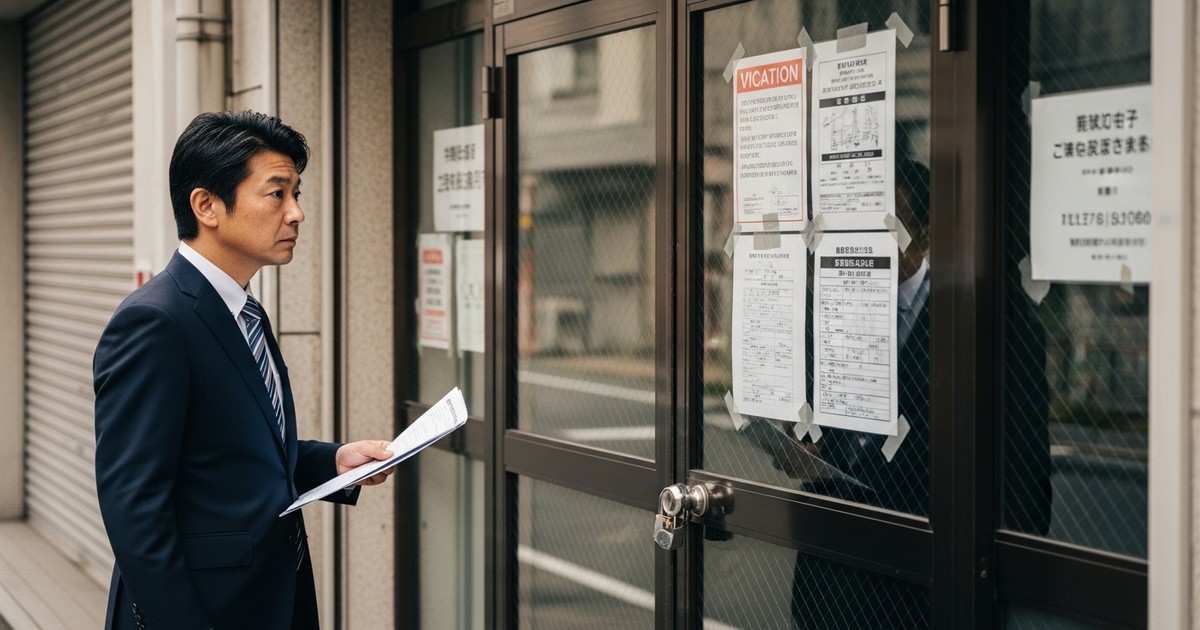
Japanese licensing authorities — whether the local ward office for minpaku registrations or the prefectural public health centre for ryokan licences — do not automatically extend grace periods to allow business continuity when an operator becomes insolvent. The property goes dark from a compliance perspective. Accepting paying guests without a valid licence or registration is a criminal offence under both the Minpaku Law and the Ryokan Business Law, carrying potential fines and, in serious cases, criminal liability. This is not a theoretical risk that regulators overlook; enforcement has become materially stricter since 2018.
The time needed to transfer or re-apply for a licence varies considerably. Below is a realistic comparison of what an overseas owner might face across different operational pathways.
| Licence Type | Annual Operating Limit | Who Holds the Licence | Approximate Re-application Time After Operator Change | Key Risk in Insolvency Scenario |
|---|---|---|---|---|
| Minpaku (standard) | 180 nights per year | Operator registered with ward/city office | 4–12 weeks (varies by municipality) | Lost operating days count against the annual cap even during gap period |
| Ryokan Business Licence | Unlimited (year-round) | Operator licensed by prefectural health authority | 8–20+ weeks; structural inspection may be required | Year-round properties have highest revenue exposure during gap |
| Tokku Minpaku (special zone) | Unlimited within zone rules | Zone-specific registration | Varies; zone authority must approve new operator | Zone availability is geographically limited; fewer replacement operators |
Municipal Variation: Tokyo Is Not Osaka Is Not Kyoto
One of the most important things for overseas owners to understand is that Japan’s short-term rental regulations are not uniform. The Minpaku Law sets a national framework, but prefectures, cities and individual wards have significant latitude to impose additional restrictions — and many have used it aggressively.
Certain central Tokyo wards, for example, restrict standard minpaku operation to weekends and public holidays only, effectively reducing the functional operating window well below the theoretical 180-day national cap. Some residential zones in Kyoto have introduced near-complete prohibitions on minpaku in certain property types. Osaka’s special zone designation means that properties in eligible districts can operate under different rules entirely.
When a management company becomes insolvent, a replacement operator must not only hold the right type of licence — they must be willing and able to operate within the specific local rules that apply to your property’s exact address. This sounds obvious, but it significantly narrows the pool of viable replacement operators, particularly in areas with complex local restrictions. An overseas owner who assumed their property had wide-open commercial potential may discover that finding a compliant replacement is harder than anticipated.
Financial Exposure: Income, Tax and the Cost of a Gap Period
Lost Revenue During the Gap
If your property sits empty and unlicensed for two to four months while you establish a new operator and obtain fresh regulatory approvals, the revenue loss can be significant. Prime properties in popular tourist areas can generate meaningful monthly income during peak seasons. A gap coinciding with cherry blossom season or Golden Week represents a particularly painful loss that cannot be recovered.
Withholding Tax for Non-Resident Owners
Overseas owners receiving rental income from Japanese property are subject to Japanese income tax as non-residents. Under the standard framework, a Japanese management company remitting income to a non-resident owner is required to withhold a percentage at source and remit it to the tax authorities on the owner’s behalf. If the insolvent company failed to remit withheld tax correctly, the Japanese tax authority (NTA) may look to recover amounts owed — and in some scenarios this can create complications even for the property owner if the management arrangements were not properly documented.
Non-resident owners who register as having a permanent establishment in Japan, or who appoint a tax representative, face different obligations again. If the management company was also acting as your de facto tax agent and that relationship breaks down suddenly, ensuring compliance continuity with the NTA is a matter of some urgency.
Consumption Tax Considerations
Accommodation services in Japan are subject to consumption tax (currently ten per cent, with a reduced rate applicable in some contexts). Whether your management company collected and remitted consumption tax on your behalf, and whether their insolvency created any gap in those obligations, is something that needs to be reviewed with a Japan-qualified tax adviser promptly in any insolvency situation.
OTA Fees and Cleaning Costs
Under standard minpaku and ryokan operations, OTA commissions typically run in a range that varies between platforms and property types, and cleaning fees — often charged directly to guests — are used to fund the actual cleaning service. In an insolvency, cleaning staff and suppliers are among the creditors least likely to be paid first. For an overseas owner, this means the property may have been left in a condition that requires paid-for deep cleaning before it can be relisted, adding further cost at the worst possible time.
What Good Operators Do Differently: Transparency and Reporting Standards
The difference between a management company and a genuine operator comes down substantially to accountability structures — what they report, how often, and what you can verify independently.
Financial Reporting
A robust operator should provide monthly income statements broken down by booking channel, showing gross booking value, OTA commission, cleaning fees, maintenance deductions and net remittance to owner. This is not unusual to ask for — it should be the default. If a company is resistant to providing channel-level breakdowns, treat that as a meaningful warning sign.
Critically, ask whether client funds are held in segregated accounts. This is the single most important financial protection for an overseas owner and it costs the operator nothing to implement properly. Ask for confirmation in writing and, if possible, have your lawyer review the contract language around fund segregation.
Licence and Registration Documentation
You should hold copies of every licence and registration associated with your property. These are documents issued to the operator, but as the property owner you have a legitimate interest in holding copies and being notified immediately of any change in status, including renewals, variations and any regulatory correspondence.
Booking and Occupancy Transparency
OTA platforms provide some owner-facing visibility, but only if the property is listed under your ownership credentials rather than entirely under the operator’s account. Discuss with any prospective operator how OTA accounts are structured and what access you will retain independently of the operator relationship. Properties listed solely under an operator’s master account give the owner no independent visibility and no leverage if the relationship breaks down.
Contingency Planning
Ask prospective operators directly: what happens to my property if your company ceases operations? A serious operator will have a documented answer. This might include arrangements with a partner operator, insurance cover for business interruption, or a contractual obligation to notify you with sufficient notice for an orderly transition. Vague reassurances are not sufficient.
Practical Steps to Protect Yourself Before a Problem Arises
- Read the management contract carefully before signing, ideally with input from a Japanese-qualified lawyer. Pay particular attention to termination clauses, fund segregation provisions, liability limitations and what happens to active bookings if the contract ends.
- Ensure you understand the licence structure — specifically whether you, as the property owner, have any independent legal standing with respect to the licence, or whether it sits entirely with the operator.
- Appoint a Japanese tax representative independently of your management company so that tax compliance does not depend on the management company’s continued existence.
- Request monthly financial reports and review them. Unexplained deductions, irregular remittance timing or sudden reductions in occupancy rate without explanation are all early warning signs worth investigating.
- Maintain a relationship with a local trusted contact — a lawyer, accountant or trusted agent — who can physically check on your property and act quickly if your management company becomes unresponsive.
- Understand your property’s specific municipal restrictions. Know whether you are in a minpaku zone, what the local operating hour or night restrictions are, and which regulatory body holds authority over your property. This knowledge is essential for evaluating any replacement operator quickly.
- Keep copies of all property-related documents including the property deed, building registration, licence copies, OTA listing URLs and guest communication histories in a location you control, not solely within the management company’s systems.
Questions to Ask Any Management Company Before You Commit
- Are client rental proceeds held in a segregated account separate from your operating funds? Can you provide written confirmation of this?
- Under what name and registration number is my property currently listed with the relevant licensing authority?
- What is your process for notifying me if there is any change in my property’s licence or registration status?
- How frequently do you remit rental income, and what is the maximum float you hold at any one time?
- Do you carry professional indemnity or business interruption insurance? What does it cover?
- If you were to cease operations, what is your contractual obligation to me regarding notice period, active booking handover and return of funds?
- Who handles Japanese tax withholding on your behalf, and can I appoint an independent tax representative alongside your services?
- Can you provide references from other non-resident overseas owners whose properties you currently manage?
Choosing Stability Over Promises
The short-term rental market in Japan remains a compelling opportunity for overseas investors. The regulatory environment, while demanding, is navigable by operators who take compliance seriously. The hospitality culture, the depth of tourist demand across diverse property types from modern urban apartments to centuries-old machiya townhouses, and the relative stability of the yen against a basket of foreign currencies all make the market worth engaging with carefully.
But the distance between an overseas owner and their Japanese property is not just geographical. It is informational, legal and practical. The management company you choose is not simply a service provider — it is the entity standing between your investment and regulatory, financial and operational risk. Understanding exactly what happens to your property if that company fails is not pessimism. It is the foundation of sensible ownership.
The right operator will welcome these questions, answer them in detail and put the answers in writing. That willingness to be accountable — not just in good times, but in structuring for the possibility of difficulty — is the most reliable signal that you are dealing with an operator who takes their responsibilities seriously.