Leave Your Minpaku Management to the Experts
100% Free Online ConsultationWhen running a minpaku (private lodging) business, properly understanding depreciation and using it to your tax advantage is a key strategy for maximizing profitability. While you can’t deduct the full cost of a building or its fixtures all at once, “depreciation” lets you spread that cost out as an expense each year based on the asset’s useful life—legally shrinking your taxable income in the process. This article walks you through the mechanics of minpaku depreciation and tax savings, complete with useful life figures by building structure and concrete calculation examples.
Many people starting out in minpaku find themselves puzzled: “I bought this property, and my cash is going down, yet I’m still being taxed on top of that?” By handling depreciation correctly, you can record a set amount as an expense every year—even without any actual cash outlay—protecting your cash on hand while easing your tax burden at the same time.
The Basic Mechanics of Depreciation and Tax Savings in Minpaku
Depreciation is an accounting method that spreads the acquisition cost of a fixed asset—such as a building or equipment—as an expense over that asset’s useful life. For minpaku operations, this applies to the building itself, along with interior fixtures, appliances, and furniture used for guest accommodation. Land, however, is excluded from depreciation, since its value doesn’t diminish over time.
The tax-saving power of depreciation comes from the fact that it’s “an expense that doesn’t involve any actual cash outflow.” For example, if your annual depreciation expense is 1,000,000 yen, that amount gets deducted from your taxable income for the year. At a 20% income tax rate, that translates to 200,000 yen in tax savings; at 30%, it’s 300,000 yen. The biggest advantage here is that you can shrink your taxable income without any cash actually leaving your pocket, easing your tax burden while preserving your cash flow.
Statutory Useful Life by Building Structure
When calculating depreciation, the building’s “statutory useful life” is the single most important factor. This figure is set by Japan’s National Tax Agency and varies depending on the building’s structure. The longer the useful life, the smaller the annual depreciation amount—and vice versa. Below is a breakdown of the statutory useful life for the main building structures.
Reinforced Concrete (RC)
The statutory useful life for RC residential buildings is 47 years. This structure is common in condominiums and high-rise buildings, and since it has the longest useful life of any structure, its annual depreciation amount is relatively small. On the flip side, RC buildings are highly durable and allow you to record stable depreciation expenses over a long period, making them well-suited for minpaku investments built around long-term ownership.
Heavy-Gauge Steel Frame (S)
For residential buildings with heavy-gauge steel frames (steel thickness exceeding 4mm), the statutory useful life is 34 years. Since this is shorter than RC, the annual depreciation amount is somewhat larger. This structure is common in apartment buildings and mid-sized properties, and in the minpaku world, it frequently shows up in detached-house rentals and whole-building apartment operations.
Light-Gauge Steel Frame (Light S)
For residential buildings with light-gauge steel frames (steel thickness of 3mm or less), the statutory useful life is 19 years. This structure is common in prefabricated buildings, and because of its shorter useful life, the annual depreciation amount is larger—meaning you can often achieve strong tax savings right from the moment you acquire the property. That said, keep in mind that the building’s actual physical lifespan also tends to be shorter than other structures.
Wood and Synthetic Resin Construction
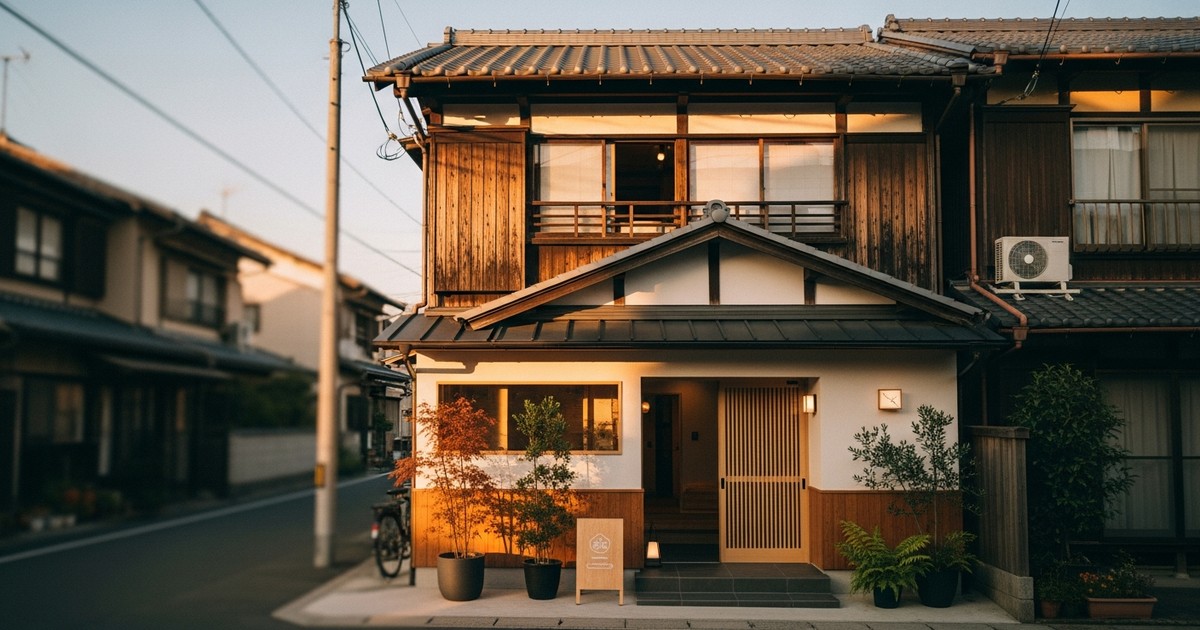
The statutory useful life for wooden houses is 22 years. Since most of Japan’s detached-house minpaku properties and traditional kominka-style rentals are wood construction, this is likely the useful life figure most familiar to minpaku owners. Compared to RC’s 47 years, this is less than half—meaning annual depreciation expenses tend to be substantially larger, and the resulting tax savings correspondingly greater.
Useful Life for Pre-Owned Properties
When acquiring a pre-owned property, you don’t simply use the statutory useful life as-is—instead, you calculate the useful life using a “simplified method.” The formula is: (Statutory useful life − years elapsed) + (years elapsed × 0.2). However, if the building has already exceeded its statutory useful life, you instead use “statutory useful life × 0.2” (rounding down any fraction, with a minimum of 2 years). For example, for a 30-year-old wooden building (statutory useful life of 22 years), the calculation would be 22 years already exceeded, so 22 × 0.2 = 4.4, rounded down to 4 years.
How to Calculate Depreciation: Straight-Line vs. Declining-Balance Methods
There are two methods for calculating depreciation: the “straight-line method” and the “declining-balance method.” Since 2007, buildings themselves can only use the straight-line method. Building fixtures, furniture, and appliances, on the other hand, allow sole proprietors to use the straight-line method, while corporations can also opt for the declining-balance method. Understanding the characteristics of each method—and choosing the one that fits your minpaku operating style—is the first step toward effective tax savings.
Straight-Line Method
The straight-line method records the same depreciation expense every year. The formula is: Acquisition cost × straight-line depreciation rate. This rate is determined by the useful life—for example, 0.046 for a 22-year wooden structure, or 0.022 for a 47-year RC structure. Since you record a fixed amount as an expense each year, this method makes it easy to forecast your earnings and is well-suited for long-term tax planning.
Declining-Balance Method
The declining-balance method calculates depreciation by applying a fixed rate to the remaining undepreciated balance of the acquisition cost. This means you record a larger expense right after acquisition, with the depreciation amount shrinking in later years. While this method can’t be applied to buildings, it can be used for equipment and furniture—such as air conditioners or refrigerators (for corporations)—allowing you to capture substantial tax savings from your very first year of operation.
Depreciation Calculation Examples by Building Structure
Let’s now run through some concrete numbers for depreciation expenses when acquiring an actual minpaku property. Note that the acquisition cost here refers strictly to the building portion—land is not included. The split between land and building value is typically calculated based on the sales contract or the fixed asset tax valuation.
Calculation Example: New Wooden Property
For a building acquisition cost of 20,000,000 yen, wood construction (useful life of 22 years, depreciation rate of 0.046), the annual depreciation expense is: 20,000,000 yen × 0.046 = 920,000 yen. At a 20% income tax rate, that’s roughly 184,000 yen in annual tax savings; at 30%, roughly 276,000 yen. Since you can record this amount as an expense every year for 22 years, the cumulative long-term tax savings are substantial.
Calculation Example: New RC Property
For a building acquisition cost of 50,000,000 yen, RC construction (useful life of 47 years, depreciation rate of 0.022), the annual depreciation expense is: 50,000,000 yen × 0.022 = 1,100,000 yen. While the annual depreciation amount is smaller than wood construction due to the longer useful life, the fact that you can keep recording this expense for a full 47 years is a major advantage. Since RC condominiums acquired for minpaku use tend to come with a higher price tag, the absolute tax savings can end up being quite substantial.
Calculation Example: Pre-Owned Wooden Property
For a building acquisition cost of 8,000,000 yen, an 18-year-old wooden building (statutory useful life of 22 years), the useful life under the simplified method is calculated as: (22 − 18) + (18 × 0.2) = 4 + 3.6 = 7 years (rounding down). The depreciation rate for a 7-year useful life is 0.143. The annual depreciation expense is: 8,000,000 yen × 0.143 = 1,144,000 yen—and because the useful life is so short, the annual tax savings are correspondingly high. With their low acquisition costs combined with short depreciation periods, pre-owned wooden properties often draw attention as a tax-saving minpaku investment strategy.
Other Minpaku Assets Eligible for Depreciation Beyond the Building
Depreciation in minpaku isn’t limited to the building alone. By properly capitalizing interior fixtures and equipment as assets, you can further boost your tax savings. That said, assets under 100,000 yen can be expensed in full immediately (lump-sum deduction), while “small depreciable assets” valued between 100,000 and 300,000 yen can be expensed in full in a single year under a special provision available to blue-form tax filers (up to a combined total of 3,000,000 yen).
Building Fixtures
Air conditioning (electrical equipment) has a useful life of 15 years, as do water supply and sanitation facilities. These are recorded separately from the main building as “building fixtures” and depreciated according to their own respective useful lives. For example, if a corporation acquires a 300,000-yen air conditioning unit, it can also use the declining-balance method, allowing a large portion of the cost to be expensed right from the first year.
Furniture and Appliances
Appliances such as refrigerators, washing machines, and TVs generally have a useful life of 5 years, while furniture like sofa sets is typically pegged at 8 years. Since opening a minpaku property usually involves a substantial upfront purchase of furniture and appliances, properly capitalizing and depreciating these items lets you spread out your initial investment cost as an expense over several years. And by taking advantage of the 300,000-yen special provision for blue-form filers, any individual appliance or furniture item priced under 300,000 yen can be expensed in full during the year of purchase—maximizing your tax savings right in your opening year.
Practical Tips for Turning Minpaku Depreciation Into Real Tax Savings
Beyond simply handling depreciation correctly, keeping a few key points in mind can help you squeeze out even more tax savings. It goes without saying that any tax-saving strategy for minpaku operations should stay strictly within legal bounds—but whether or not you know these tricks can make a substantial difference in your tax burden.
Take Advantage of Blue-Form Tax Filing
If you’re running your minpaku as an individual, choosing blue-form tax filing entitles you to a special deduction of up to 650,000 yen. It also opens the door to the small depreciable asset special provision mentioned earlier (full expensing for items under 300,000 yen)—a benefit reserved exclusively for blue-form filers. While this does involve more bookkeeping work compared to white-form filing, the difference in tax savings is significant enough that minpaku owners should, as a general rule, opt for blue-form filing.
Accurately Allocate Value Between Land and Building
Since only the building portion can be depreciated, accurately splitting the price between land and building is crucial for effective tax savings. Common allocation methods include: (1) using the figures explicitly listed separately for land and building in the sales contract, if available; (2) allocating based on the ratio of fixed asset tax valuations; or (3) if consumption tax is itemized on the contract (since consumption tax only applies to the building), working backward from that tax amount to calculate the building’s value. Simply verifying the building’s proportion correctly can shift your annual depreciation expense by hundreds of thousands of yen.
Expanding Tax Savings Through Incorporation
Once your minpaku earnings reach a certain scale, transitioning from sole proprietorship to a corporation can lower your effective tax rate. The corporate tax rate generally sits at 23.2% (or a reduced 15% for small and medium-sized corporations), a stark contrast to the top individual income tax rate (which can reach as high as 55% including resident tax). Incorporating also lets you set an executive salary, allowing you to take advantage of the employment income deduction and optimize your overall tax and social insurance costs. Since the ideal choice depends heavily on your revenue scale and profit level, we strongly recommend consulting with a tax accountant.
Want to Balance Tax Savings and Profitability by Leaving Your Minpaku Operations to the Pros?
Properly leveraging minpaku depreciation and tax savings requires ongoing management—from calculating the land-building split at the time of purchase all the way through to filing your tax return each year. But juggling all the accounting, tax, and operational work yourself, on top of your main job and everyday life, is no small feat. To truly capture the full tax-saving potential outlined in this article, having support from experienced professionals can make all the difference.
At Stay Buddy Inc., our minpaku management service handles the day-to-day operations for you—cleaning, guest communication, reservation management, and more, all under one roof. Our goal is to free up owners to focus on what truly matters: asset management and tax strategy. Through more efficient operations, we help boost occupancy rates while helping you maximize both your depreciation-driven tax savings and your overall profitability.
Have questions like “Which property would give me the best tax savings?”, “How do I calculate the useful life for a pre-owned property?”, or “What’s the cost-to-revenue balance if I outsource operations?” We’re happy to answer them all in detail through a free consultation. Whether you’re still considering opening a minpaku or already up and running, we welcome your inquiry at any stage.
Feel free to reach out through Stay Buddy Inc.’s official website to get started. Our team of specialists is ready to sincerely support you with any questions about minpaku depreciation, tax savings, or operations.