Leave your vacation rental management to us
Free Online ConsultationIn vacation rental operations, generating consistent revenue from accommodation alone is becoming harder every year. With more competing properties and intensifying price competition, it’s difficult to differentiate yourself by simply offering “a place to sleep.” This is why combining vacation rentals with experiences and activities to add value—boosting both nightly rates and occupancy—has become such an attractive strategy.
In fact, vacation rental properties that offer experience-based content tend to command nightly rates 20-40% higher than those that don’t. What’s more, higher guest satisfaction leads to better reviews, which in turn improves search rankings on booking platforms. This article explains concrete ways of thinking about—and practical methods for—adding value to your rental by incorporating experiences.
What follows is a step-by-step approach, ranging from ideas you can start with no special investment to more ambitious initiatives developed in partnership with local businesses. We’ve aimed to make this useful both for beginner hosts and those who are already up and running.
Why Adding Experiences to Your Vacation Rental Increases Its Value
Raising Nightly Rates and Escaping Price Wars
In the vacation rental market, as similar properties multiply in the same area, it becomes easy to get dragged into price competition. If there are ten properties nearby all charging ¥5,000 a night, sooner or later one will drop to ¥4,500, triggering a vicious cycle that squeezes everyone’s margins. However, when you add an experience—like a “stay plan with kimono dressing included” or a “stay package with a local cooking class”—the basis for comparison changes entirely. Guests judge value based on the total of “accommodation cost + experience cost,” making it much easier to sell rooms even at ¥8,000–¥12,000 per night.
According to Airbnb data, hosts who feature or provide experience content tend to have average review scores of 4.8 or higher, along with higher repeat booking rates than typical properties. In other words, offering experiences isn’t just a short-term revenue boost—it’s a strategy that builds long-term brand value.
A Shift in What Guests Are Looking For
Travelers today are increasingly shifting their focus from “buying things” to “buying experiences.” According to a Japan Tourism Agency survey, roughly 70% of inbound visitors cite “uniquely Japanese experiences” as a purpose of their trip. This trend has spread to domestic travelers as well, with demand particularly strong among people in their 20s to 40s for “unique, Instagram-worthy experiences.”
Vacation rentals have a distinctive quality compared to hotels and ryokan: they let guests “live like a local” during their stay. Pairing this quality with experience-based content allows you to offer “the kind of charm only locals know about”—a strength that’s genuinely hard for hotel chains to replicate.
Types of Experience Content and Their Revenue Models
Cultural Experiences
Tea ceremony, calligraphy, flower arranging, kimono dressing, and Japanese sweet-making are all experiences related to Japanese culture that are especially popular with international guests. For example, you might partner with a nearby tea ceremony school to offer a 90-minute session priced at ¥3,000–¥5,000 per person. If the rental host takes a referral commission of 15–20% of the experience fee, they earn income with zero additional labor costs.
If you have skills of your own, offering the experience directly can boost your margin even further. One host who personally teaches calligraphy earns an average of ¥4,000 per group in experience revenue on top of accommodation fees—generating an extra ¥80,000–¥120,000 per month.
Food-Related Experiences
Cooking classes, breakfasts featuring local ingredients, and guided food tours are all in high demand regardless of a guest’s nationality. Experiences with a strong storytelling element—such as “browse a local market together, then cook a meal with what you buy”—achieve high satisfaction even at price points of ¥5,000–¥8,000 per person.
That said, if you’re offering food, you need to be mindful of Japan’s Food Sanitation Act and required business licenses. In some cases, a “cooking experience” format—where guests cook and eat what they make themselves—may not require a food service license, but rules vary by municipality, so confirming in advance is essential. Partnering with a local restaurant or cooking school lets you avoid licensing headaches while still delivering a high-quality experience.
Outdoor and Nature Experiences
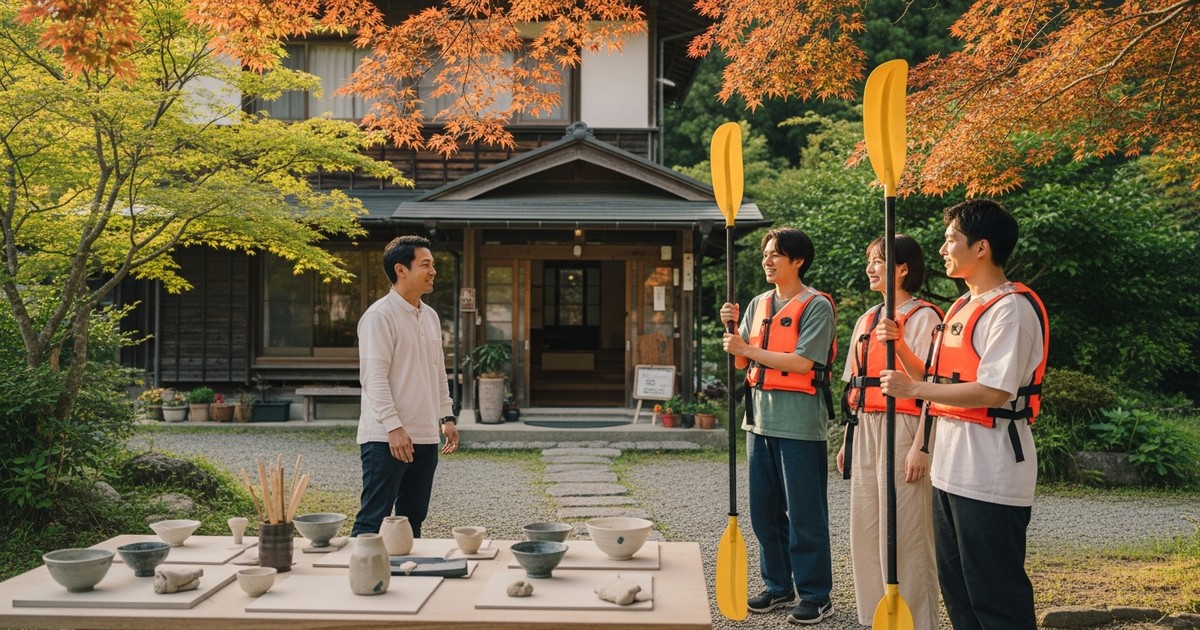
Cycling tours, hiking guides, fishing experiences, and farming activities—activities that make the most of the local natural environment—can be developed in both urban and rural settings. Setting up three to five bicycles and offering a stay-plus-rental package can differentiate your listing for an initial investment of roughly ¥50,000–¥150,000. Bike rental alone can bring in an additional ¥1,500–¥2,000 per bike per day.
In rural areas, farm experiences are particularly effective. There are cases of rentals partnering with nearby farmers to package seasonal harvest experiences—strawberry picking, rice planting, grape harvesting, and the like—successfully attracting families and couples from urban areas. Experience fees typically run ¥3,000–¥6,000 per group, and since farmers also benefit from the extra foot traffic, this kind of win-win relationship is relatively easy to build.
Workshop and Creative Experiences
Pottery, indigo dyeing, woodworking, and accessory-making are the kinds of hands-on experiences guests love because they leave with a physical memento of their trip. An effective approach is partnering with a local workshop or artist to organize a special workshop exclusively for your guests. A typical 2-hour workshop is priced at ¥4,000–¥7,000 per person.
This type of experience can be held indoors, so it carries low weather risk and can be offered reliably. Plus, since many guests post photos of their finished creations on social media, you can expect a natural word-of-mouth effect.
Concrete Steps for Introducing Experience Content
Step 1: Analyze Your Guest Profile and Local Resources
Start by understanding what kind of guests typically stay at your property. Check the guest nationality, age range, and trip purpose (business, tourism, family travel, etc.) in your Airbnb or booking site dashboard. If you get a lot of international guests, cultural experiences will likely resonate; if it’s mostly domestic couples, food or creative experiences tend to work better.
Next, list out what local resources exist within roughly a 5km radius of your property. Look for shrines and temples, natural attractions, traditional craft workshops, farms, and popular restaurants—anything that could become the basis for an experience offering. A simple Google Maps search for terms like “experience,” “class,” or “workshop” often turns up promising partnership candidates.
Step 2: Decide on Partners and Revenue Sharing
When approaching local businesses about a partnership, it’s best to start with a simple model: “We’ll send you rental guests in exchange for a referral commission.” Typical commission rates run 10–20% of the experience fee. Even at ¥1,000 per referral, sending five groups a month adds up to ¥5,000 in extra income. That may sound small, but partnering with multiple experience providers can add up to ¥20,000–¥50,000 a month.
You can start with a verbal or simple email agreement with your partners, but once referral volume grows, it’s worth putting things in writing. Clarifying cancellation policies, payment cycles, and quality standards up front—points that often lead to disputes—helps build a good long-term relationship.
Step 3: Design Your Package and Set Up the Booking Flow
Once you’ve settled on your experience content, package it into a stay plan. For example: “3 days, 2 nights + pottery experience, ¥25,000 per person” or “2 days, 1 night + morning Tsukiji guided tour, ¥12,000 per person”—present a clear combined price for accommodation and the experience. A package price feels like better value than listing the two separately, which increases booking rates.
As for the booking flow, it helps to mention the experience plan in your Airbnb listing description as well as in your welcome message at check-in. Placing a card with a QR code in the room that links directly to the experience booking page minimizes friction for guests. In fact, one property that implemented this reported that experience sign-ups increased roughly 2.5x after adding the card.
Things to Watch Out for and Risk Management When Adding Experiences
Confirming Legal Requirements and Licenses
Depending on the nature of the experience, you may need to consider regulations such as the Travel Agency Act, the Food Sanitation Act, or various instructor certifications. For instance, running a paid guided tour may, depending on the content, require registration as a travel agency. The required permits differ significantly depending on whether you’re providing the experience yourself or simply referring guests to an existing business, so be sure to consult with a local government office or a specialist beforehand.
The lowest-risk approach is referring guests to a business that already holds the necessary licenses. In this case, the rental owner generally doesn’t need any additional permits and can monetize simply by earning a referral commission.
Quality Control and Managing Reviews
Low-quality experience content can drag down your overall property reviews. Try the experience yourself before offering it to guests, and make sure you can confidently recommend it. It’s also important to set up a system for regularly relaying guest feedback to your partners so they can make improvements.
One effective approach is to send a short survey after checkout asking, “How was your experience?” and collect a 5-point rating along with open comments. If a particular experience keeps scoring 3 or below, it may be time to consider switching partners. Posting photos of the experience and past guest reviews in your listing also helps manage guest expectations effectively.
Success Stories: Patterns for Rolling Out Experience-Based Rentals
Traditional Japanese House × Local Culture Experience Model
There’s an example of a renovated traditional Japanese house (kominka) offering a package that combines a hearth-cooked regional meal experience, a pottery-making session at a nearby kiln, and an early-morning zazen meditation session. Accommodation alone runs ¥8,000 per person per night, but with the experience package it sells for ¥15,000 per person per night—nearly doubling the nightly rate (about 1.9x) without any drop in occupancy.
The key to this property’s success is that it treats the experience not as an “optional add-on” but as the central purpose of the stay. The listing title puts the experience front and center, and the photos feature guests enjoying the activities more prominently than the property itself. As a result, the property now attracts “people who want to experience local culture” rather than simply “people who want to stay in a traditional house,” which has significantly boosted guest satisfaction and review scores.
Urban Apartment × Local Food Tour Partnership Model
Experience content can work well for urban apartment-style rentals, too. One city-based property partnered with a local food tour operator to offer guests a ¥2,000 discount coupon. The tour operator covers the cost of the coupon, while the rental property earns a ¥500 commission per referral.
This approach carries zero financial risk for the rental owner, gives guests a sense of added value, and provides the tour operator with a stable customer acquisition channel—a win-win-win for all three parties. With an average of 20 referrals per month, the property earns ¥10,000 a month in commissions alone, and the resulting positive reviews further boost its booking rate.
Contact Stay Buddy Inc. for Vacation Rental Management Support
Introducing experience content is an effective strategy for boosting both profitability and guest satisfaction simultaneously—but putting it into practice involves plenty of considerations, from confirming permits to finding partners, designing packages, and setting up your booking flow. Especially if you’re managing multiple properties or running a rental alongside a full-time job, handling all of this yourself simply isn’t realistic.
Stay Buddy Inc. supports property owners in maximizing revenue through our vacation rental management services. Beyond core operational tasks, we’re also happy to advise on value-adding initiatives such as planning experience content, connecting you with partners, and designing packages.
If you’re thinking, “I want to add experiences but don’t know where to start,” or “I’m already operating but can’t seem to raise my rates,” please don’t hesitate to reach out. We’ll propose the optimal strategy tailored to your property’s location and target guest profile.
For any questions or consultations about vacation rental management, feel free to contact Stay Buddy Inc. through our website.