Leave Your Vacation Rental Management to Us
100% Free Online ConsultationWhen running a vacation rental, preparing a guest guide is an essential step for both boosting guest satisfaction and preventing trouble. If you’re creating one for the first time, you might be wondering exactly what content to include. In fact, survey data shows that properties with a well-prepared guest guide see average review scores that are 0.3 to 0.5 points higher—the effect really does show up in the numbers.
In this article, we’ll walk through the concrete benefits of preparing a guest guide for your vacation rental, then dive into the essential items you should include, category by category. We’ll also cover practical implementation methods ranging from printed guidebooks to digital PDF formats, so whether you’re just starting out or already running a property and looking to revamp your guide, you’ll find plenty to work with here.
What Is a Guest Guide for Vacation Rentals?
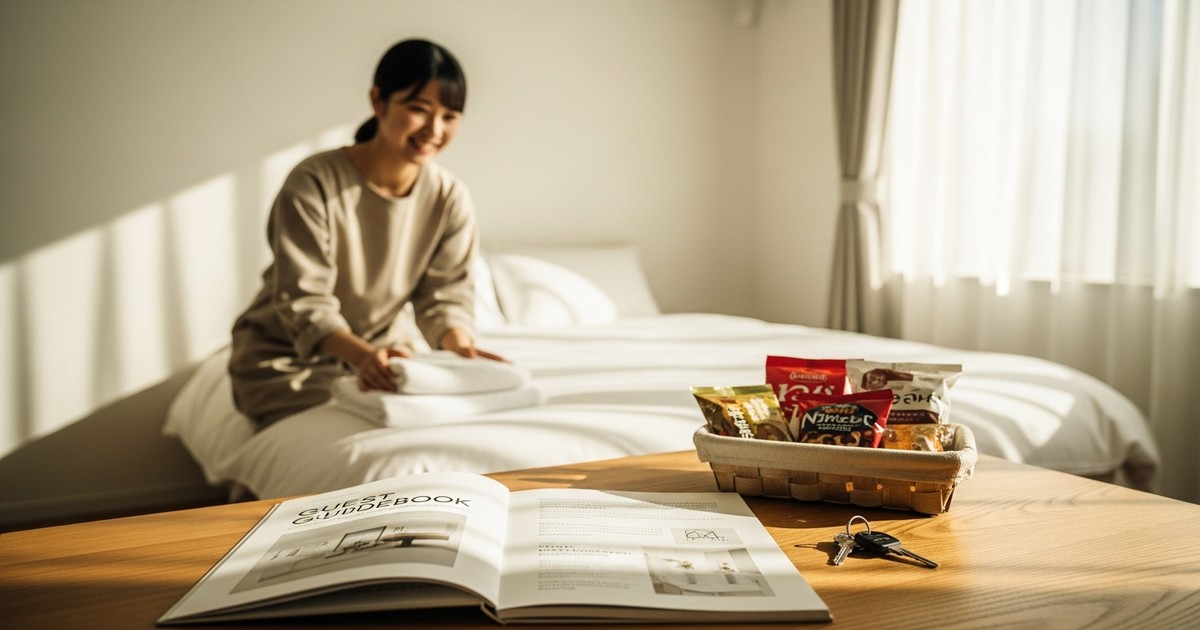
A guest guide is a reference document that covers how to use the property, house rules, and information about the surrounding area. It’s the vacation rental equivalent of the “in-room directory” or “information booklet” you’d find at a hotel or ryokan. Since hosts often can’t meet guests in person, the guide plays a crucial role in communicating information on the host’s behalf. Most guides run 10 to 20 pages on A4 paper, and many properties create bilingual versions in Japanese and English.
Under Japan’s Private Lodging Business Act (the “Minpaku Law”), hosts are required to provide guests with appropriate information. This includes an obligation to explain matters related to consideration for neighbors, such as noise precautions and garbage disposal rules. Because a guest guide helps fulfill these legal requirements, it’s not merely a nice-to-have service—it’s an essential operational tool.
5 Benefits of Preparing a Guest Guide
A Significant Drop in Guest Inquiries
Hosts who provide a guest guide report that post-check-in message inquiries drop by an average of 60–70%. By compiling information guests want to know—Wi-Fi passwords, how to operate the air conditioner, garbage sorting rules, and more—in advance, you eliminate the hassle of answering the same questions over and over. If each inquiry takes 5–10 minutes to handle, reducing inquiries by 20 per month can save you roughly 2–3 hours of work.
Higher Review Scores
On booking platforms like Airbnb, guest reviews directly influence future bookings. Properties with a thorough guest guide tend to receive comments like “the host’s communication was thoughtful” or “everything I needed for my stay was covered,” making it easier to maintain a rating of 4.8 or higher out of 5. For international guests in particular, whether or not you explain Japan-specific fixtures (such as washlet toilets and water heater controls) can significantly affect their overall satisfaction.
Preventing Trouble with Neighbors
One of the biggest risks in running a vacation rental is trouble with neighbors. Violating garbage disposal rules or making noise late at night can, in the worst case, lead to a suspension of your business license. Simply stating clearly in your guest guide, “Please avoid loud conversation, even indoors, after 10 PM” or “Please put out garbage on the designated day at the designated location,” can noticeably reduce rule violations. One host reported that after adding photo-illustrated instructions for garbage sorting to their guest guide, complaints from neighbors about garbage disposal dropped to zero.
More Repeat Guests and Word-of-Mouth Referrals
By including host-curated local information—like recommended restaurants and sightseeing spots—that you won’t find in a standard guidebook, you can offer guests an experience that goes beyond the basics. This kind of personal touch tends to stick in guests’ memories, leading to referrals among friends and shares on social media. In fact, properties whose guest guide includes three or more pages of local area information tend to see repeat booking rates that are about 10–15% higher.
Reducing Legal Risk for the Host
If a guest is injured due to improper use of an appliance, or unknowingly breaks a rule, whether you provided written notice of the relevant precautions beforehand can determine where responsibility lies. Clearly stating safety precautions and prohibited actions in your guest guide serves as evidence that you, as the host, fulfilled your duty of care. In particular, documenting safety information such as the location of smoke detectors, fire extinguishers, and emergency evacuation routes can also work in your favor when filing an insurance claim.
Essential Content to Include in Your Vacation Rental Guest Guide
Check-In and Check-Out Procedures
Provide specific details on how guests receive the key (key box PIN code, smart lock operation, etc.), available check-in hours, and what guests need to do at check-out (where to return the key, turning off the AC and lights, locking windows, and so on). If you use a smart lock, including screenshots that walk through the app step by step can prevent issues upon arrival. State the check-out time clearly, e.g., “10:00 AM,” and it’s helpful to also note whether late check-out is available and any associated fees (e.g., ¥1,000 per 30 minutes).
How to Use In-Room Appliances and Facilities
Explain how to operate major appliances and fixtures—air conditioner, washing machine, microwave, IH stovetop, TV, water heater, etc.—with accompanying photos or illustrations. This is especially important for international guests, since Japanese remote controls often only have labels in Japanese, which can be confusing. Numbering the main buttons on each remote and creating a corresponding key (e.g., “① turns the power ON, ② adjusts the temperature, ③ switches the mode”) helps communicate clearly across the language barrier.
Instructions for the washlet (heated bidet toilet seat) are one item that international guests especially appreciate. Simply translating the “rear wash,” “bidet,” and “stop” buttons into English can prevent confusion and accidental misuse.
Wi-Fi Connection Details
The network name (SSID) and password are among the first things guests want to know. We recommend placing this information somewhere prominent in the guide—ideally on the first or second page. It’s also worth including the router’s location and troubleshooting steps for connection issues (e.g., “unplug the router, wait 30 seconds, then reconnect”), which can help cut down on late-night inquiries. Noting the approximate connection speed (e.g., “about 50 Mbps download”) can also reassure guests planning to work remotely during their stay.
Garbage Sorting and Collection Rules
Japan’s garbage sorting rules vary by municipality and can be quite complex for international guests. Cover the basics—”burnable trash,” “non-burnable trash,” and “recyclables (cans, bottles, PET bottles)”—with photo-illustrated explanations of how to sort each type. If collection days are fixed by day of the week, presenting this in a calendar format (e.g., “Monday and Thursday: burnable trash, Wednesday: recyclables”) makes it easy to follow. Including a photo and map of the garbage collection point also helps first-time guests avoid confusion.
Noise and Etiquette Rules
For properties located in residential neighborhoods, clearly stating noise rules is especially important. Specify exact time frames and locations, such as “10 PM to 8 AM is a quiet hour—please keep conversation and TV volume down indoors” or “Please refrain from talking on the balcony at any time of day.” Clearly stating that parties are prohibited and restricting visitors (e.g., no entry for non-registered guests) also eliminates ambiguity and helps prevent trouble.
Nearby Facilities and Transportation Access
Include travel time from the nearest station or bus stop, the location and hours of convenience stores and supermarkets, and information on nearby hospitals and drugstores. Covering all essential daily-life facilities within a roughly 500-meter radius of the property greatly improves convenience for guests. A numbered screenshot of Google Maps paired with a corresponding list format is highly effective for readability.
Narrow down sightseeing spots and restaurant recommendations to 3–5 options, and add context on distance and budget—for example, “○○ Shopping Street, a 10-minute walk away, has many local diners popular with residents, with lunch typically costing ¥800–1,200.” This kind of detail makes it easier for guests to actually go and try them out.
Emergency Contacts and Response Procedures
In addition to the numbers for police (110) and fire/ambulance (119), include emergency contact information for the host or management company. For international guests, it’s reassuring to also list English-language emergency reporting procedures and multilingual medical consultation hotlines. Include the location of fire extinguishers, evacuation routes, and the nearest designated shelter, along with brief guidance on basic responses to disasters unique to Japan, such as earthquakes and typhoons (e.g., “If you feel shaking, take cover under a table”).
Guest Guide Formats and Tips for Creating One
Choosing Between a Printed Guidebook and a Digital Version
A printed guidebook placed inside the unit has the advantage of being immediately accessible right when guests arrive. It’s standard to compile 10–15 pages in an A4-size clear file folder. On the other hand, a digital version sent as a PDF or link after booking confirmation lets guests review the information before check-in. Ideally, you’d offer both—sharing information in advance via the digital version, while providing a printed copy guests can reference anytime during their stay.
Free tools like Canva or Google Slides are handy for creating the digital version. Using a template, you can put together an attractive guide in about 1–2 hours, even without any design experience. Using plenty of photos and keeping text to a minimum are key to making a guide that’s easy to understand for guests regardless of their native language.
Tips for Multilingual Support
Bilingual support in Japanese and English is the minimum standard. Depending on your guest demographics, adding Chinese (Simplified) or Korean can further improve accessibility. You can use tools like DeepL or Google Translate for translation, but we recommend having a native speaker review critical safety information (such as fire evacuation procedures and gas handling instructions). Translation typically costs around ¥2,000–4,000 per A4 page. If translating the entire guide isn’t feasible within your budget, at minimum, translating the safety information and check-in procedures into multiple languages is highly effective.
Don’t Forget Regular Updates
A guest guide isn’t something you create once and forget—it should be reviewed at least once every six months. Outdated information, such as a nearby restaurant that’s closed down or opened, a change in garbage collection days, or an old Wi-Fi password, can undermine guest trust. Use guest feedback and reviews that mention confusing sections as a basis for improvement in your next update. Noting the update date on the guide’s final page (e.g., “Last updated: Month/Year”) makes it easier to keep track of revisions.
For Vacation Rental Management Concerns, Consult Stay Buddy Inc.
Creating a guest guide is a critical task that directly improves both the efficiency of guest communication and your review scores. That said, when you factor in multilingual translation, photography, and ongoing updates, it can become a substantial burden for an individual host to manage alone.
Stay Buddy Inc. offers full property management services for vacation rentals, providing one-stop support that covers everything from creating and translating guest guides to guest communication, cleaning arrangements, and revenue management. Drawing on our experience managing numerous properties, we propose the ideal guide tailored to your property’s unique characteristics and guest demographics.
If you’re thinking, “I want to create a guest guide but don’t know where to start,” or “I’d like to hand off the entire operation,” please feel free to reach out to Stay Buddy Inc. Your first consultation is completely free.