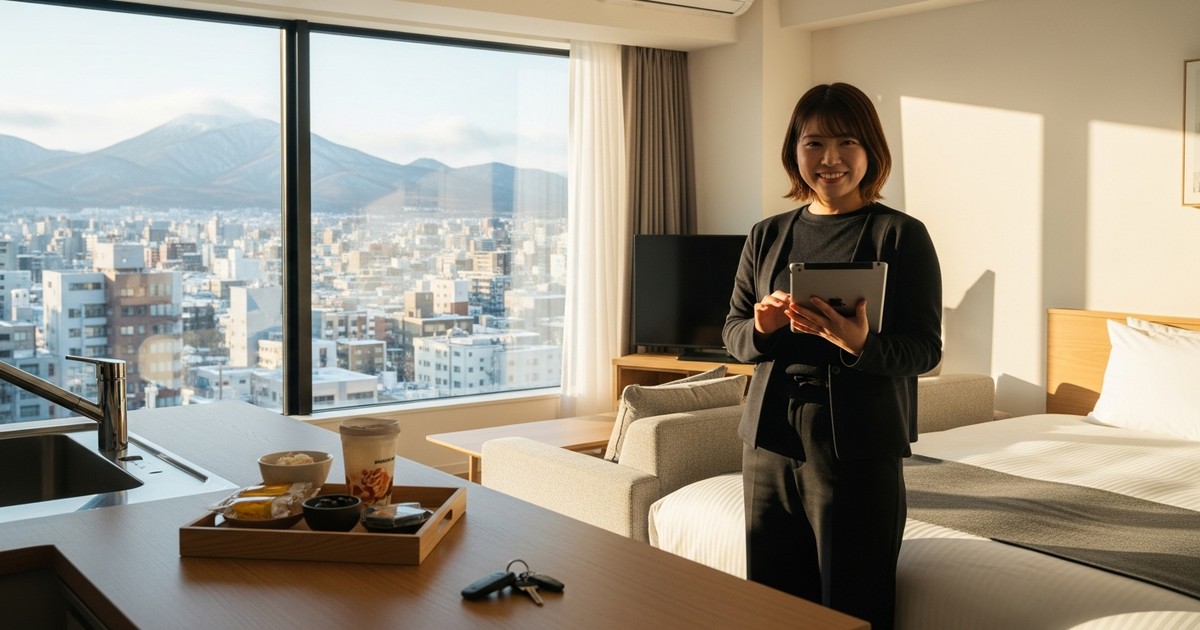
Essential Knowledge Before Hiring a Vacation Rental Management Company in Sapporo
For owners in Sapporo considering vacation rental management services, the first thing to understand is exactly what “management outsourcing” covers and how far it extends. Vacation rental property management refers to the arrangement where you delegate some or all of the tasks required to run a short-term rental—listing creation, guest communication, cleaning arrangements, pricing adjustments, review management, and more—to a specialized company. Sapporo sees demand not only from tourism but also from business trips and event-related travel, so with the right management structure in place, you can expect stable occupancy year-round.
That said, the scope of services and fee structures vary widely between management companies. Options range from fully comprehensive support—where everything is handled for you—to partial services covering only cleaning or guest communication. Sapporo also has region-specific challenges not found elsewhere, such as snow removal and heating system management in winter, so choosing a company well-versed in local conditions has a direct impact on your bottom line.
5 Key Points to Consider When Comparing Management Companies
Fee Structure and Commission Rates
Management company fee structures generally fall into two categories: “revenue-based” and “fixed-fee.” Revenue-based models typically charge 10%–30% of your booking revenue as a commission (the exact rate varies by company and scope of service). This keeps costs lower during slow months but increases expenses during peak season. Fixed-fee models charge a flat monthly rate of roughly ¥30,000–¥80,000 regardless of revenue.
In Sapporo, winter (December–March) tends to see higher occupancy due to ski resort traffic and the Sapporo Snow Festival, meaning revenue-based fees can add up during this period. Conversely, revenue-based pricing is more advantageous during the slower months from spring through autumn. The key is to simulate your property’s location and expected occupancy rate, then compare total annual costs between the two models before deciding.
Scope of Services
Even companies advertising “full-service” or “hands-off” management can vary significantly in what they actually deliver. Some companies handle everything—listing creation, guest messaging, check-in/check-out management, cleaning arrangements, restocking supplies, trouble resolution, and even support with regulatory filings—while others cover only cleaning and guest communication.
Three points in particular are worth confirming: whether 24-hour guest support is included, whether multilingual support is available, and whether the company can manage listings across multiple OTA platforms (such as Airbnb and Booking.com). Since Sapporo attracts a high proportion of inbound tourists, the ability to support English, Chinese, and Korean directly affects occupancy rates. Before signing a contract, get a written list of included services and check carefully for any items that incur additional fees.
Cleaning Quality and Structure
Cleanliness is one of the most frequently mentioned factors in vacation rental reviews. On Airbnb, “cleanliness” is its own rating category—failing to maintain a score of 4.5 or above can not only jeopardize Superhost status but also hurt your search ranking. It’s important to find out whether the management company employs its own cleaning staff or outsources to a third-party cleaning service.
Companies with in-house cleaning staff generally offer better quality control and can accommodate last-minute schedule changes more easily. If cleaning is outsourced, expect to pay roughly ¥4,000–¥8,000 per cleaning, with the price varying depending on whether the unit is a studio or a 2LDK or larger. In Sapporo’s winter months, entryways tend to accumulate more snow and mud, requiring more thorough cleaning than in other seasons—so be sure to confirm the company’s setup can handle this.
Pricing Strategy for Maximizing Revenue
Top-tier management companies don’t just list your property—they use dynamic pricing to maximize revenue. Dynamic pricing analyzes factors like competing listings in the area, demand forecasts, and local events to automatically adjust nightly rates day by day. Many management companies use tools such as PriceLabs, Wheelhouse, or Beyond Pricing, and there are documented cases of revenue increasing by 10%–30% compared to manually set pricing.
In Sapporo, bookings can still come in during the Sapporo Snow Festival even at rates two to three times the usual price. On the other hand, demand tends to drop in mid-May through June, right after Golden Week, so shortening the minimum stay requirement or lowering rates becomes necessary during that period. Choosing a company that deeply understands these region-specific demand fluctuations can make a difference of several hundred thousand yen in annual revenue.
Track Record and Reviews
When comparing management companies, their track record and reputation among existing owners are essential factors to consider. Companies managing a large number of properties tend to have well-established, systematized processes for cleaning and guest communication, reducing the risk of errors caused by individual staff inconsistency. As a general benchmark, a company with a track record of managing 10 or more properties in Sapporo can be considered reasonably reliable.
For reviews, checking Google Business Profile ratings and feedback within vacation rental communities and on social media is effective. If you see multiple negative comments such as “slow to respond” or “cleaning complaints went ignored,” proceed with caution. Whenever possible, ask to be connected with an existing owner client so you can hear directly about their experience—this can help you avoid mismatches after signing a contract.
The Step-by-Step Process for Hiring a Management Company
Step 1: Organize Property Information and Consult
Start by organizing the basic details of your property: location, floor plan, distance from the nearest station, condition of facilities, and whether your building’s management regulations permit short-term rental use. Gathering this information in advance helps management companies provide accurate quotes. At this stage, it’s a good idea to contact two or three companies and set up initial meetings or online consultations.
During the initial consultation, ask for a projected monthly revenue simulation, net take-home income after fees, and an estimate of initial setup costs. Confirm whether furniture, appliances, and interior styling costs are billed separately, and whether photography costs are included. For a studio apartment in Sapporo, initial setup costs—including furniture and appliances—typically run from ¥300,000 to ¥800,000.
Step 2: Confirm and File the Required Permits
A filing under the Private Lodging Business Act (Japan’s “Minpaku law”) is required. This filing requires property floor plans, a fire code compliance certificate, and documentation showing that neighboring residents were notified in advance. Many management companies will handle this filing process on your behalf, though administrative scrivener fees of roughly ¥50,000–¥150,000 may apply separately.
Under Sapporo City ordinances, operating days can be restricted depending on the zoning of your property—for example, short-term rentals in residential-only zones may be limited to weekends only. In commercial zones within Chuo Ward or Kita Ward, full-year operation of up to 180 days is possible, while residential-only zones will significantly reduce profitability. It’s therefore essential to check the zoning designation before selecting a property. A good management company can provide specific advice on this point as well.
Step 3: Prepare the Property and Publish the Listing
Once your filing is approved, it’s time to prepare the property. This includes bringing in furniture, appliances, and bedding, setting up amenities, installing a Wi-Fi router and smart lock, and posting evacuation routes and house rules. If the management company handles interior styling as part of their service, they’ll typically also arrange professional photography.
For your listing, photo quality and the appeal of your title and description directly affect your booking rate. In Sapporo, features like “5-minute walk to the station,” “close to Susukino,” “convenient access to ski resorts,” and “free parking available” are strong selling points. Since Airbnb’s search algorithm gives new listings a temporary visibility boost, it’s standard practice to price your listing 10%–15% below market rate for the first two weeks to secure positive early reviews.
Step 4: Begin Operations and Review Monthly Reports
Once operations begin, your management company will send monthly reports covering occupancy rate, revenue, expenses, and guest reviews. Use these reports to guide decisions about pricing adjustments, amenity improvements, and equipment investments. A trustworthy management company will include improvement suggestions along with the raw data.
Treat the first three months as a trial-and-error period, and it’s wise to check in with your management company at least once a month. If occupancy falls below 50%, take concrete action—update your photos, reset your pricing, adjust the minimum stay requirement, or add listings on additional platforms. Once operations stabilize after six months to a year, you can reduce the frequency of check-ins and move toward a truly hands-off arrangement.
Common Mistakes When Choosing a Vacation Rental Manager in Sapporo—and How to Avoid Them
Overlooking Contract Term Restrictions
Management contracts often include a minimum contract term. Terms of six months to a year are common, and canceling early may incur a penalty fee. Always confirm the cancellation terms before signing, and try to negotiate the ability to cancel within three months if possible. This helps you avoid being locked into an arrangement that significantly underperforms your expectations.
The Risk of Companies Managing Too Many Properties
A strong track record is a good sign of reliability, but if a company manages too many properties, there’s a risk that individual properties won’t receive the attention they need. Ask how many properties each staff member is responsible for—if one person is handling 20 or more properties alone, service quality may suffer. Confirm in advance whether you’ll have a dedicated point of contact or whether you’ll be supported by a team.
Overly Optimistic Revenue Projections
It’s not uncommon for management companies to present overly optimistic revenue projections. You might be shown a simulation based on 80% occupancy, but in reality, the average occupancy rate for a vacation rental’s first year in Sapporo is more realistically in the range of 50%–65%. Do your own calculations to determine what your actual take-home profit would look like after fixed costs (rent, utilities, Wi-Fi, insurance, etc.), and confirm that the numbers still work under a conservative scenario.
For Vacation Rental Management Consultations, Contact Stay Buddy Inc.
If you’re considering starting a vacation rental business in Sapporo, or if you’re unsatisfied with your current management company, reach out to Stay Buddy Inc. We provide one-stop support covering every aspect of vacation rental management—from property selection advice and permit application assistance, to furniture and appliance sourcing, listing creation, day-to-day guest communication, and cleaning management.
At Stay Buddy Inc., we prepare free, customized revenue simulations tailored to each owner’s property characteristics and investment goals. Rather than presenting overly optimistic figures, we base our proposals on realistic scenarios to minimize any gap between expectations and reality after signing.
Whether you’re “interested but don’t yet own a property,” “already own a property but haven’t started operating it,” or “feel like you’ve hit a wall managing it yourself,” we’re ready to support you at any stage. Please don’t hesitate to reach out via our contact form or by phone—our dedicated staff will be happy to assist you.